By Elsie Driggs
Located in Miami, FL
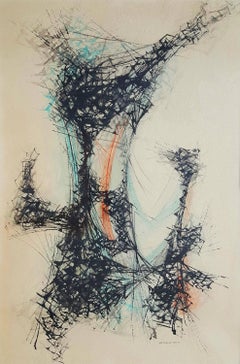
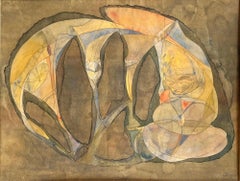
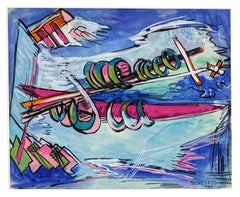
Pioneering female abstract artist Elsie Driggs paints stylized abstract organic forms in a warm palette of orange browns and tope. She merges abstraction with some figuration. A structured face composed of lines and tone emerges from an orange background. It's 1939, and even though Driggs is not well known, she is preceding many of the marquee names of abstraction by a decade. Although under the radar, this is a major work and is titled on the back stretcher is " Egyptian Gothic." It features the artist's inventiveness with her fine pencil lines incorporated in flat washes of color and collage elements. Signed lower right and inscribed on frame verso with title, artist and the date of 1939. Provenance, Christie's, Freemans. Framed under glass..
Elsie Driggs (1898 – July 12, 1992 in New York City) was an American painter known for her contributions to Precisionism, America's one indigenous modern-art movement before Abstract Expressionism, and for her later floral and figurative watercolors, pastels, and oils. She was the only female participant in the Precisionist movement, which in the 1920s and 1930s took a Cubist-inspired approach to painting the skyscrapers and factories that had come to define the new American landscape. Her works are in the collection of the Whitney Museum of American Art, the Houston Museum of the Fine Arts, the Fine Arts Museums of San Francisco, the James A. Michener Art Museum in Pennsylvania, and the Columbus Museum of Art, among others. She was married to the American abstract artist Lee Gatch.
Career
Born in Hartford, Connecticut, Driggs grew up in New Rochelle, a suburb of New York City, in a family that was supportive of her artistic interests. After a summer spent painting with her sister in New Mexico in her late teens, she felt she had found her life's calling. At twenty, she enrolled in classes at the Art Students League of New York, where she studied under George Luks and Maurice Sterne, both of whom were charismatic, inspirational figures in her early life. She also attended the evening criticism classes held at the home of painter John Sloan. Driggs spent fourteen months in Europe from late 1922 to early 1924, drawing and studying Italian art. There she met Leo Stein, first in Paris and later in Florence, who became an important intellectual influence, and who urged her to study Cézanne. He also introduced her to the works of Piero della Francesca, the Renaissance artist for whom she felt throughout her life the greatest admiration.[1]
Driggs eventually settled in New York City, where she found representation with the progressive Charles Daniel Gallery.[2] (Advised that the old-fashioned and misogynistic Daniel would be unlikely to take on a woman artist, she signed the works she left for his consideration simply "Driggs" and waited to meet him in person until he had expressed his eagerness to include her in his gallery.)[3] In sympathy with those artists Daniel represented who were part of the burgeoning Precisionist movement, such as Charles Demuth, Charles Sheeler, George Ault, Niles Spencer, and Preston Dickinson, she too painted "the modern landscape of factories, bridges, and skyscrapers with geometric precision and almost abstract spareness."Impressionism and academic or Ashcan realism represented the past, in Driggs' view, and she intended to be resolutely modern. She was an attractive and engaging woman, but her demeanor belied a strong ambition and a clear sense of what it would take to make her mark in the New York art world. Driggs was part of the pre-eminent first group of Precisionist painters, including Demuth and Sheeler, who exhibited at the Daniel Gallery in the 1920s. Although a later group of Precisionist painters, including Louis Lozowick, Ralston Crawford and others, came on the American Art scene during the 1930s, Driggs felt that the style came to an end with the 1929 stock market crash.[5]
In 1926 she painted her most famous work, Pittsburgh, a dark and brooding picture now in the permanent collection of the Whitney Museum of American Art, which depicts the gargantuan smokestacks of the Jones & Laughlin steel mills in Pittsburgh. Its focus is an overpowering mass of black and gray smokestacks, thick piping, and crisscrossing wires with only clouds of smoke to relieve the severity of the image, yet it was an image in which she found an ironic beauty. She called the picture "my El Greco" and expressed surprise that viewers in later years interpreted the painting as a work of social criticism. Like the other Precisionists (e.g., Demuth, Charles Sheeler, Louis Lozowick, Stefan Hirsch), she was concerned with applying modernist techniques to renderings of the new industrial and urban landscape, not in commenting on potential dangers the overly mechanized modern world of 1920s America might present. If anything, Precisionism, like Futurism, was a celebration of man-made energy and technology. One year later, she painted Blast Furnaces, in a similar vein. As noted above, Piero della Francesca's mural depicting "The Story of the True Cross" in Arezzo, with its tubular, static and frozen forms was the major influence on Driggs' "Pittsburgh" (it may have been the major influence for "Blast Furnaces" as well).[7]
After Pittsburgh, Driggs' most acclaimed work was probably Queensborough Bridge...
Category
1930s Mixed Media
MaterialsPaper, Watercolor, Pencil