Want more images or videos?
Request additional images or videos from the seller
1 of 10

Georges Lemmen
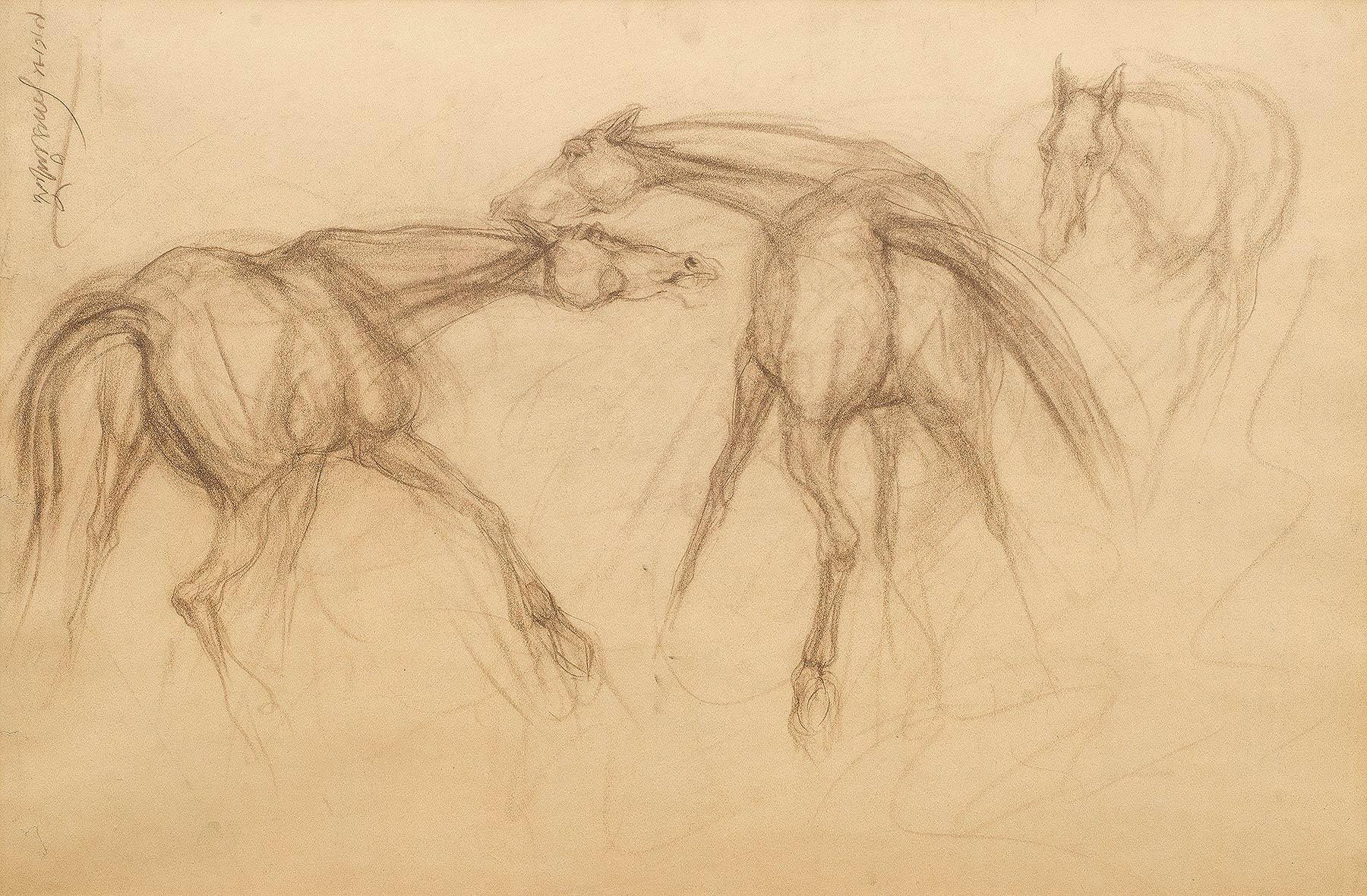
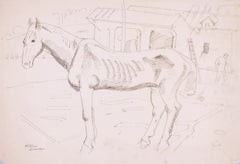
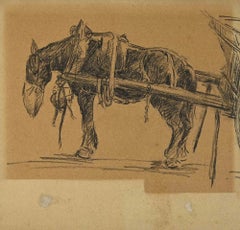
Horses in Stable

1896

$2,750
£2,071.04
€2,419.86
CA$3,896.29
A$3,913.59
CHF 2,269.21
MX$47,749.87
NOK 26,261.24
SEK 26,945.40
DKK 18,089.43

About the Item

Horses in a Stable Black chalk on tan wove paper, 1896 Signed with the estate stamp lower right corner (see photo) Note: The image has been sqaured off in red chalk grid lines for use in a large painting Dated in charcoal lower right: "23 Nov '96" Condition: Tack holes in the corners small tears and creases along margins Sheet size: 14 11/16 x 16 13/16 inches Provenance: Dr. Ernst Hauswedell Brenner Fine Arts, Inc., New York Alan Stone Gallery, New York "Georges Lemmen was the son of an architect and studied under Amédée Bourson at the academy in St Joost-ten-Node. He was invited in 1889 to join the Group of Twenty ( Cercle des XX) which had been launched in 1884 by Oscar Maus and had in the interim emerged as an influential force in Belgian artistic circles, not least by bringing to public and critical attention the work of such artists as Georges Seurat and Paul Signac. The Cercle des XX would be reborn in 1894 as La Libre Esthétique. In the early days of the Cercle des XX, Lemmen espoused a pointilliste technique. His earlier painting was clearly influenced by the Neo-Impressionists; over time, however, his style became more subtle and nuanced – recalling, perhaps, that of his compatriot Van Rysselberghe, another Cercle des XX member. With the group’s rebirth as the Libre Esthétique, Lemmen’s work became more intimiste in character, most notably in his portraits, nudes and still-lifes, where the influence of Bonnard and Vuillard is unmistakable, as is that of Renoir, particularly after Lemmen’s travels in the Midi in 1911. From this point onwards, he would go on to make a major contribution to the renewal of the graphic and decorative arts in terms of his input to the new ‘free’ aesthetic and to Art Nouveau. Although his draughtsmanship retained its essential purity and elegance of line, his painting became more fleshy, imprecise and sensual, his compositions governed less by technical considerations than by the urgent need to express his emotions. Between 1889 and 1893, Lemmen exhibited at the Salon des Indépendants in Paris, aligning himself with the Neo-Impressionists. In 1893, Henry van de Velde invited him to participate in the Pour l’Art association that had been created in Antwerp. He travelled to the south of France in 1911. By this juncture, he had already exhibited solo on two occasions (in 1906 and 1908) at the Galerie Druet in Paris. A further solo exhibition in 1913, his first in Brussels, cemented Lemmen’s reputation. Museum and Gallery Holdings Bremen (Kunsthalle): Standing Nude Combing her Hair Brussels (Mus. royaux des Beaux-Arts de Belgique): Children’s Room (watercolour); Reading; Couture; Young Girl by the Sea (1913) Ixelles: posters Ostend (Mus. voor Schone Kunsten) Paris (Mus. d’Orsay): River Thames; Portrait of Madame Lemmen (drawing)" Courtesy Leighton Fine Art
  • Creator:
    Georges Lemmen (1865 - 1916, Belgian)
  • Creation Year:
    1896
  • Dimensions:
    Height: 14.59 in (37.06 cm)Width: 16.82 in (42.73 cm)
  • Medium:
  • Movement & Style:
  • Period:
  • Condition:
    Tack holes in the corners, small tears and creases along margins.
  • Gallery Location:
    Fairlawn, OH
  • Reference Number:
    Seller: FA109801stDibs: LU14015089822

More From This Seller

View All
American Ashcan drawing by George Bellows, horse, related to a Bellows painting

American Ashcan drawing by George Bellows, horse, related to a Bellows painting

By George Wesley Bellows

Located in Fairlawn, OH

George Bellows (1882-1925) Study of a Horse Grazing Study for the painting "The After Glow" Lithographic crayon on paper, 1919 Signed by the artist's daughter (J.B.B.) Provenance: Es...

Category

1910s Ashcan School Animal Drawings and Watercolors

Materials

Crayon

Horses Leaving the Barn, American Realist Watercolor, Signed, 1940

Horses Leaving the Barn, American Realist Watercolor, Signed, 1940

By Adolf Dehn

Located in Fairlawn, OH

Horses Leaving the Barn Watercolor on paper, 1940 Signed and dated lower left corner (see photo) Condition: Excellent Image: 14 1/2 x 21” Frame: 25” x 31” Provenance; Associated American Artists, New York (see photo of label) Mamdouha and Elmer Holmes Bobst Displayed in an original wormy chestnut frame with OP3 Acrylic. Most probably from the AAA Dehn watercolor exhibition of 1940. Vintage original framing chosen by the artist. Note: Elmer Holmes Bobst (1884–1978) was an American businessman and philanthropist who worked in the pharmaceutical industry. His wife, Mamdouha, was also well known philanthropist. Bobst was born in Lititz, Pennsylvania. He aspired to become a doctor, but instead, he taught himself pharmacology. After his wife Ethel composed his interview letter, he became manager and treasurer of the Hoffman-LaRoche Chemical Works by 1920. When Bobst retired from the company in 1944, he was one of the nation's highest paid corporate executives. In 1945 he took charge of the ailing William Warner Company (later Warner–Lambert) and he remained board chairman until his retirement. Bobst had close connections to President Dwight Eisenhower, but was also a close friend of President Richard Nixon. Note: In 1940, the year of this watercolor, Dehn and Elizabeth Timmerman visited Waterville, MN on their way to Colorado Sprint, Colorado where Dehn was to teach lithography and watercolor. This watercolor is obviously a view of the area around Waterville. Adolf Dehn, American Watercolorist and Printmaker, 1895-1968 Adolf Dehn was an artist who achieved extraordinary artistic heights, but in a very particular artistic sphere—not so much in oil painting as in watercolor and lithography. Long recognized as a master by serious print collectors, he is gradually gaining recognition as a notable and influential figure in the overall history of American art. In the 19th century, with the invention of the rotary press, which made possible enormous print runs, and the development of the popular, mass-market magazines, newspaper and magazine illustration developed into an artistic realm of its own, often surprisingly divorced from the world of museums and art exhibitions, and today remains surprisingly overlooked by most art historians. Dehn in many regards was an outgrowth of this world, although in an unusual way, since as a young man he produced most of his illustrative work not for popular magazines, such as The Saturday Evening Post, but rather for radical journals, such as The Masses or The Liberator, or artistic “little magazines” such as The Dial. This background established the foundation of his outlook, and led later to his unique and distinctive contribution to American graphic art. If there’s a distinctive quality to his work, it was his skill in introducing unusual tonal and textural effects into his work, particularly in printmaking but also in watercolor. Jackson Pollock seems to have been one of many notable artists who were influenced by his techniques. Early Years, 1895-1922 For an artist largely remembered for scenes of Vienna and Paris, Adolf Dehn’s background was a surprising one. Born in Waterville, Minnesota, on November 22, 1895, Dehn was the descendent of farmers who had emigrated from Germany and homesteaded in the region, initially in a one-room log cabin with a dirt floor. Adolf’s father, Arthur Clark Dehn, was a hunter and trapper who took pride that he had no boss but himself, and who had little use for art. Indeed, during Adolf’s boyhood the walls of his bedroom and the space under his bed were filled with the pelts of mink, muskrats and skunks that his father had killed, skinned and stretched on drying boards. It was Adolf’s mother, Emilie Haas Dehn, a faithful member of the German Lutheran Evangelical Church, who encouraged his interest in art, which became apparent early in childhood. Both parents were ardent socialists, and supporters of Eugene Debs...

Category

1940s American Realist Landscape Drawings and Watercolors
Materials

Watercolor

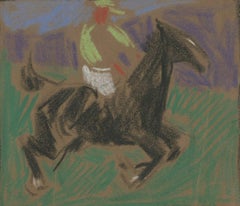
untitled (polo player on horseback)

untitled (polo player on horseback)

By Henry George Keller

Located in Fairlawn, OH

untitled (polo player on horseback) Chalk on tan paper, c. 1920 Unsigned Provenance: Gift of the artist William McGill (Keller's student) Image size: 4 3/8 x 5 ...

Category

1920s American Impressionist Animal Drawings and Watercolors

Materials

Chalk

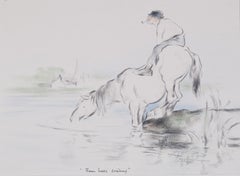
Farm Horse Drinking

Farm Horse Drinking

By Edmund Blampied

Located in Fairlawn, OH

Farm Horse Drunking Charcoal and pastel on artist's board, c. 1920 Signed lower right in pencil (see photo) Titled in ink lower center, as are all the illustration for At the Farm (s...

Category

1920s English School Animal Drawings and Watercolors

Materials

Chalk

You May Also Like

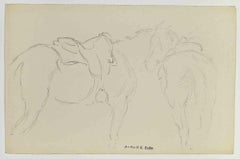
Horses - Drawing by Paul Emile Colin - Early-20th century

Horses - Drawing by Paul Emile Colin - Early-20th century

By Paul Emile Colin

Located in Roma, IT

Horses is a drawing realized by Paul Emile Colin in the Early 20th Century. Carbon Pencil on ivory-colored paper Stamped on the lower. Good conditions with slight foxing. The art...

Category

Early 20th Century Modern Landscape Drawings and Watercolors

Materials

Pencil

Vintage French Stable Scene Impressionist Oil Painting of Horses in Their Stalls

Vintage French Stable Scene Impressionist Oil Painting of Horses in Their Stalls

Located in Cirencester, Gloucestershire

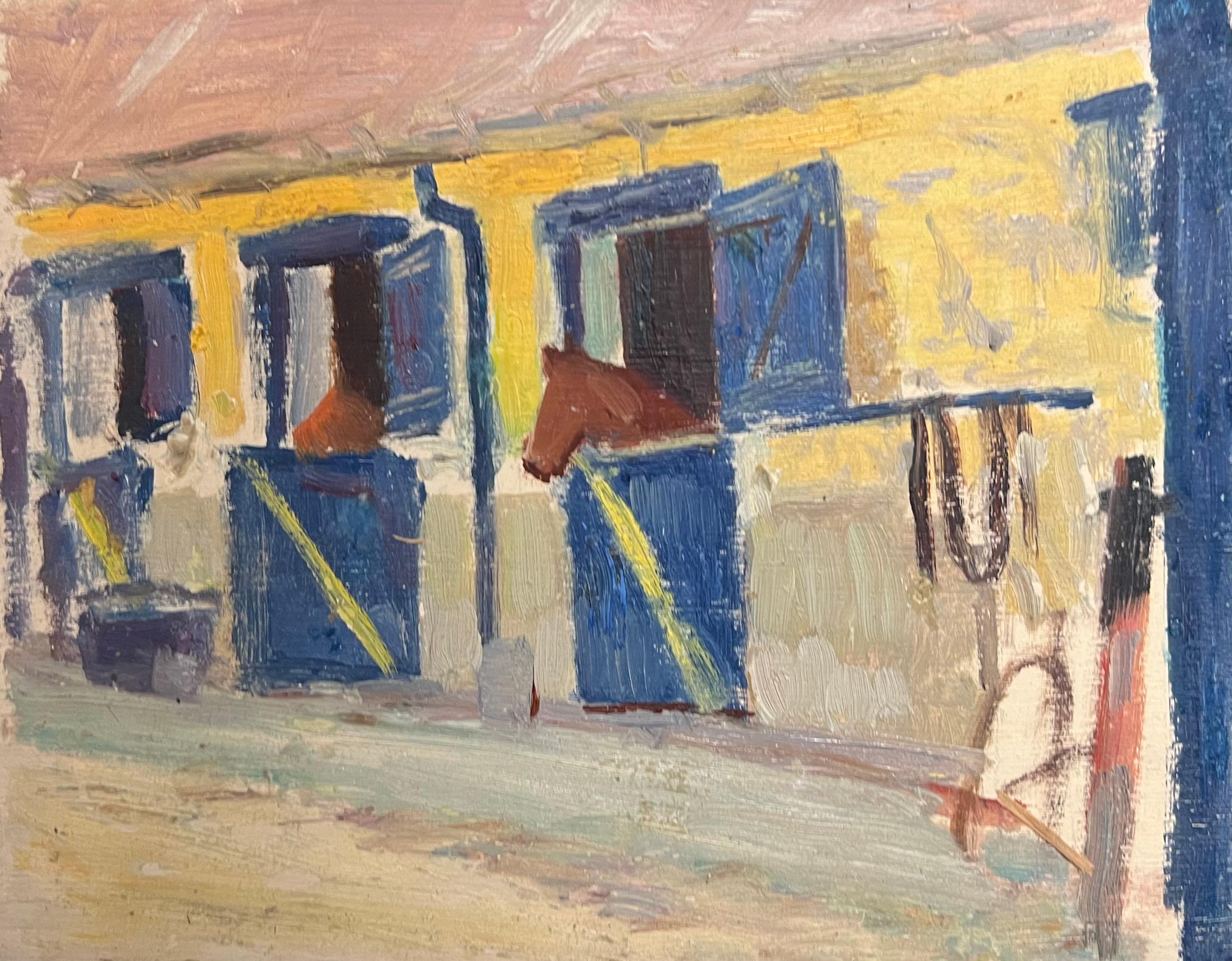
Charming Stable Scene by Jean Dreyfus-stern (1890-1969) signed verso oil on board, unframed Board : 7.5 x 9.5 inches Provenance: private collection, Paris Condition: very good condit...

Category

Mid-20th Century Post-Impressionist Animal Paintings

Materials

Oil

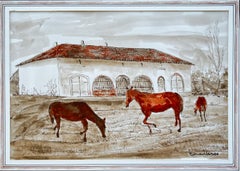
French Equestrian Horse Stable Farmyard Ink Watercolour Painting

French Equestrian Horse Stable Farmyard Ink Watercolour Painting

By Bernard Labbe

Located in Cirencester, Gloucestershire

Title: French Equestrian Horse Stable Farmyard Ink Watercolour Painting Artist: Bernard Labbe, French mid 20th century Medium: Watercolour and ink on paper, laid to mount card, unfra...

Category

Mid-20th Century Impressionist Landscape Drawings and Watercolors
Materials

Watercolor

Horse - Drawing by Karl Hanny - 1935 ca.

Horse - Drawing by Karl Hanny - 1935 ca.

By Karl Hanny

Located in Roma, IT

Pencil and watercolor drawing realized by Karl Hanny (1879-1972) in 1935 ca. Not signed. Very good condition.

Category

1930s Modern Figurative Drawings and Watercolors
Materials

Watercolor, Pencil