Navagunjara, a Composite Manifestation of Krishna-Vishnu
Pigment on cloth, c. 1940
Diameter 10"
Condition: Cracking to pigment in upper left (see photos)
Provenance: Cleveland Museum of Art (57.517)
De-Accessed 2013
India, Odisha (formerly Orissa), probably the Puri region
Mid-20th century
Odisha, probably Puri district and possibly the Puri–Raghurajpur chitrakara tradition.
This circular painting represents Navagunjara—calle
India, mid 2oth century
Navagunjara, a Composite Manifestation of Krishna-Vishnu
India, Odisha (formerly Orissa), probably the Puri region
Mid-20th century
Opaque pigments, probably on prepared cloth or layered paper
Description and identification
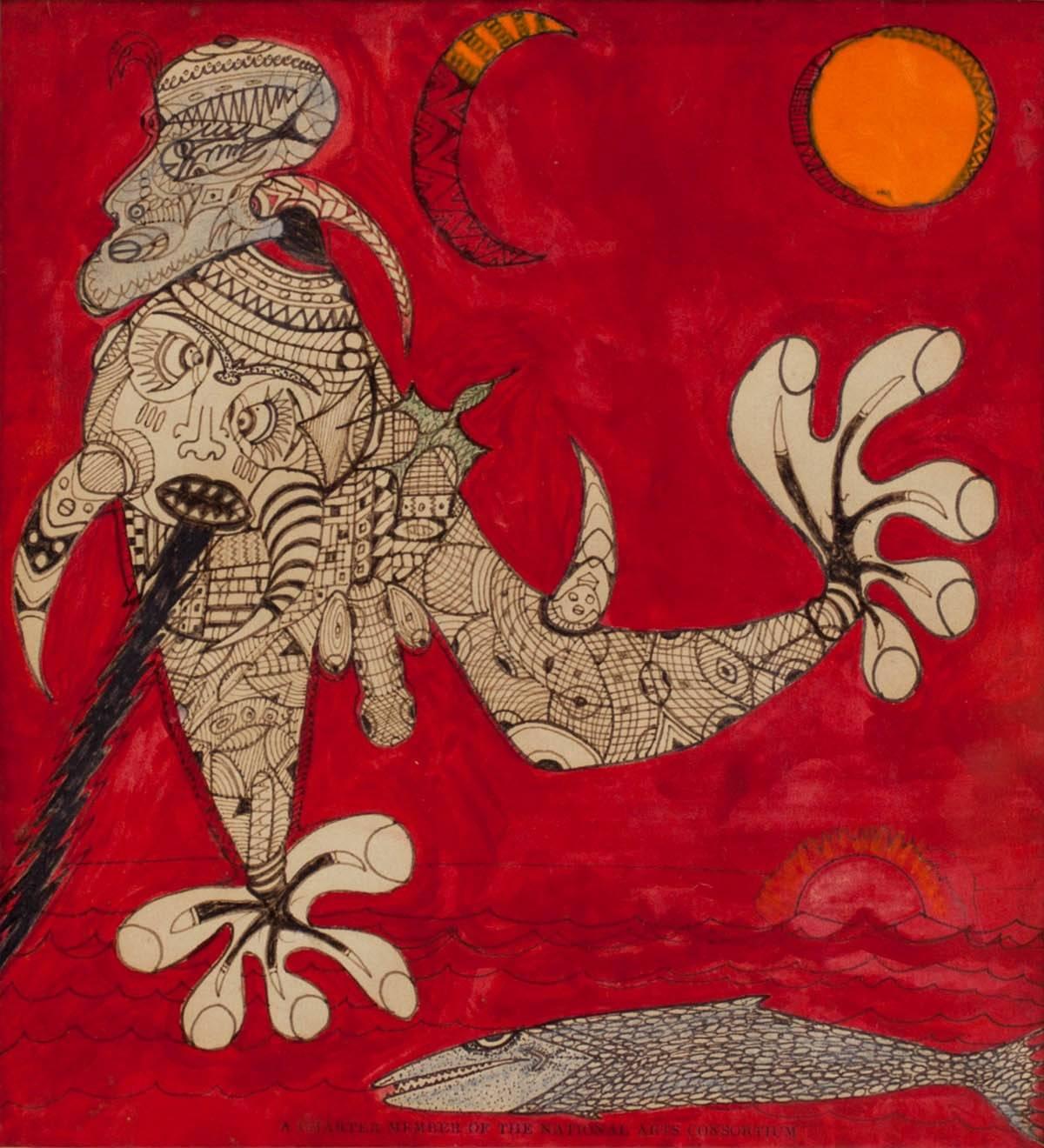
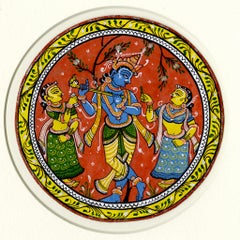
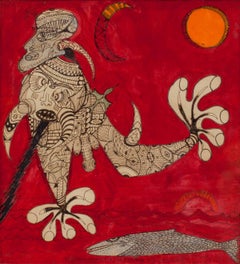
This circular painting represents Navagunjara—called Nabagunjara in Odia—a wondrous being composed of parts belonging to nine different creatures. The unusual subject provides compelling evidence for an attribution to Odisha in eastern India, probably the traditional painting communities associated with Puri and Raghurajpur.
The creature combines:
the head and blue, patterned neck of a peacock or rooster;
the hump and pale back of a bull;
the spotted hindquarters of a leopard or tiger;
a white leg terminating in a horse- or deer-like hoof;
another leg resembling that of an elephant;
a serpent forming the tail;
and a human arm raised at the left, holding what appears to be a sacred emblem—probably a stylized lotus.
Some elements vary among Navagunjara representations: the head may be described as that of a rooster or peacock, while the legs may be identified as those of an elephant, tiger, deer, or horse. Such variation belongs to the living transmission of the image rather than indicating a different subject.
The artist has fitted this complicated body vigorously into the circular field. The sinuous serpent tail curves back across the animal, enclosing a blue plantlike or featherlike form. Small white floral devices enliven the brilliant red ground, while concentric black, white, and yellow borders give the design the appearance of a self-contained emblem. Its restricted palette—vermilion red, yellow, indigo blue, black, and white—together with the emphatic contour and decorative patterning, is characteristic of Odisha’s pattachitra tradition.
Literary and religious context
Navagunjara enters Odia literature through the Sarala Mahabharata, composed in the 15th century by the poet Sarala Dasa. This important Odia retelling incorporates regional stories not found in the Sanskrit Mahabharata traditionally attributed to Vyasa.
According to the episode, Arjuna is performing penance when Krishna-Vishnu appears before him in an inexplicable composite form. Arjuna initially raises his weapon, believing the creature threatening. On observing the human arm carrying the lotus or divine emblem, however, he recognizes the being as a manifestation of Krishna and lowers his bow in reverence.
Navagunjara is therefore not simply a fabulous animal. It is a regional conception of Krishna-Vishnu’s Vishvarupa or Virat-svarupa—the universal form in which apparently incompatible aspects of creation are revealed as components of a single divine reality. The image teaches that the divine cannot necessarily be understood through ordinary categories. What initially appears unnatural or monstrous becomes, to the enlightened observer, evidence of the unity underlying creation.
The subject occupies a particularly important position in Odisha. Representations occur in pattachitra paintings, temple decoration, architectural sculpture, palm-leaf manuscripts, murals, and the region’s traditional circular playing cards. A Navagunjara relief is also associated with the great Jagannath Temple at Puri, strengthening the motif’s connection with the local worship of Jagannath as a manifestation of Krishna-Vishnu. An accessible scholarly discussion by Srinivas Sistla emphasizes both the subject’s origin in the Sarala Mahabharata and its continuing importance in Puri’s visual culture. “The Navagunjara Motif of Odisha,” The New Indian Express
.Several features support this conclusion:
The subject itself: Navagunjara is particularly identified with Odia literature and religi