Want more images or videos?
Request additional images or videos from the seller
1 of 6

Anthony Baus
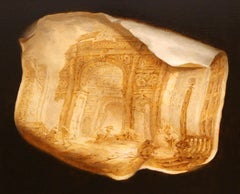
Manhattan Arch

2020

$3,500
£2,646.21
€3,087.95
CA$4,980.33
A$5,052.36
CHF 2,884.63
MX$61,176.23
NOK 33,959.16
SEK 33,846.46
DKK 23,090.76

About the Item

Anthony Baus is an alumnus and instructor of the Grand Central Atelier in Long Island City, New York. His unique artistic vision, which mines the world of the Old Masters and antiquity as source material for contemporary issues, is expressed through an astonishing graphic facility derived from intense study of Italian Baroque drawing and painting. His references from to historical art are never literal; rather they are meditative and original. His impressive technique does not reflect the mind of a copyist. The Old Master-style that style Baus has embraced is his preferred language of expression, but his content is entirely personal. Baus has described it as “romantically inspired narratives created on scaffolding of ancient architecture, richly imbued with symbolism and mystery.” This pair of works began with a drawing that belonged to a series of works that reimagine view of American cities. Baus uses the historicizing architecture of these cities as setting for narrative scenes that play out in the foreground with a cast of characters dressed in a mix of contemporary and historical styles. The arch depicted here, prominently inscribed “Manhattan,” situates us with New York City, but without any specific architectural references. Baus’s drawing serves as the basis for the painting, which masterfully depicts the drawing in perspective. He presents us with a view of the drawing envisioned as a rumpled piece of paper, with the corners curling way and curling over. Anthony Baus has written of these works: “The curl paper painting series was created out of a need to re-evaluate my work and to see it from a different perspective. I first make the drawing, and then the painting as a way to distance myself from the original work and look at it as an object. It also, upon later inspection, makes the original drawing an immediate antique. The painting is an homage to the work, which at the same time celebrates the tradition of drawing. The paintings make the drawings “old” by giving them a patina that can only be achieved over time, and also by displaying them in a way similar to the paper we might find scattered on a table or displayed in a letter-rack, or rack still-life, in Dutch or Italian painting. The black background of the painting is intended to give the work a contemporary feel, as if presenting the drawing in a void.” Baus’s drawings can be savored as intricate compositions of great beauty and finesse. They are also complex and sophisticated amalgams of the modern world and ages past. However appreciated or approached, they provide an introduction to a visionary artist of earnest intent and expansive imagination.
  • Creator:
    Anthony Baus (1981)
  • Creation Year:
    2020
  • Dimensions:
    Height: 12 in (30.48 cm)Width: 16 in (40.64 cm)
  • Medium:
  • Movement & Style:
  • Period:
  • Condition:
  • Gallery Location:
    New York, NY
  • Reference Number:
    1stDibs: LU10215883202

More From This Seller

View All
Manhattan Arch – Curled Paper

Manhattan Arch – Curled Paper

Located in New York, NY

Anthony Baus is an alumnus and instructor of the Grand Central Atelier in Long Island City, New York. His unique artistic vision, which mines the world of the Old Masters and antiqui...

Category

21st Century and Contemporary American Realist Figurative Paintings

Materials

Oil, Acrylic

The Flight into Egypt

The Flight into Egypt

Located in New York, NY

Inscribed: 3. una Madonna che va in Egitto, verso, and Madonna che va in Egitto, recto Provenance: Private Collection, UK, since 1999 This expressive and boldly executed drawing is the work of Luca...

Category

16th Century Old Masters Figurative Drawings and Watercolors

Materials

Chalk, Ink, Pen, Paper

Woman in Fantasy Costume (pair)

Woman in Fantasy Costume (pair)

By Jean Baptist Le Prince

Located in New York, NY

The pair consists of the present work and an engraving after it by the hand of Giles DeMarteau (Liège 1722 – 1776 Paris) titled Woman in Fantasy Costume, after Jean Baptiste Le Prince, and measuring, 10 ⅜ x 8 ⅝ inches (26.5 x 22 cm). DeMarteau's engraving is inscribed at the bottom: Le Prince inv. del. / Demarteau sc. / A Paris ches Demarteau Graveur du Roi, rue de la Pelterie à la Cloche...

Category

18th Century Drawings and Watercolor Paintings

Materials

Paper, Chalk, Engraving

Seven Scenes from the Life of Apollo

Seven Scenes from the Life of Apollo

By Jacopo Guarana

Located in New York, NY

Attributed to Jacopo Guarana (Verona 1720 – 1808 Venice) Canvas, unsigned The Deeds of Apollo Provenance: Suida-Manning Collection These seven scenes are brilliant evocations o...

Category

18th Century and Earlier Baroque Figurative Paintings

Materials

Oil

View of St. John’s Cathedral, Antigua

View of St. John’s Cathedral, Antigua

Located in New York, NY

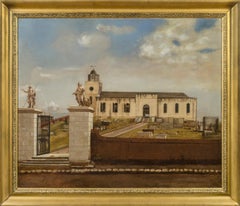
Provenance: Robert Hollberton, Antigua, ca. 1841 Private Collection, New York The present painting depicts Old St. John’s Cathedral on the island of Antigua. The church was erected in the 1720s on the designs of the architect Robert Cullen. It measured 130 feet by 50 feet with north and south porches 23 x 20 ½ feet. The tower, 50 feet high with its cupola, was added in 1789. The church was elevated to the status of a cathedral, but disaster struck in the form of an earthquake that destroyed the building on 8 February 1843. A memorandum of that date relates the event: “On Wednesday, 8th February, 1843, this island was visited by a most terrific and destructive earthquake. At twenty minutes before eleven o’clock in the forenoon, while the bell was ringing for prayers, and the venerable Robert Holberton was in the vestry-room, awaiting the arrival of persons to have their marriage solemnized, before the commencement of the morning service, the whole edifice, from one end to the other, was suddenly and violently agitated. Every one within the church, after the first shock, was compelled to escape for his life. The tower was rent from the top to the bottom; the north dial of the clock precipitated to the ground with a dreadful crash; the east parapet wall of the tower thrown upon the roof of the church; almost the whole of the north-west wall by the north gallery fell out in a mass; the north-east wall was protruded beyond the perpendicular; the altar-piece, the public monument erected to the memory of lord Lavington, and the private monuments, hearing the names of Kelsick, Warner, Otley, and Atkinson, fell down piecemeal inside; a large portion of the top of the east wall fell, and the whole of the south-east wall was precipitated into the churchyard, carrying along with it two of the cast-iron windows, while the other six remained projecting from the walls in which they had been originally inserted; a large pile of heavy cut stones and masses of brick fell down at the south and at the north doors; seven of the large frontpipes of the organ were thrown out by the violence of the shock, and many of the metal and wooden pipes within displaced; the massive basin of the font was tossed from the pedestal on which it rested, and pitched upon the pavement beneath uninjured. Thus, within the space of three minutes, this church was reduced to a pile of crumbling ruins; the walls that were left standing being rent in every part, the main roof only remaining sound, being supported by the hard wood pillars.” The entrance from the southern side into the cathedral, which was erected in 1789, included two imposing statues, one of Saint John the Divine and the other of Saint John the Baptist in flowing robes. It is said that these statues were confiscated by the British Navy from the French ship HMS Temple in Martinique waters in 1756 during the Seven Years’ War and moved to the church. The statues are still in situ and can be seen today, much as they appeared in Bisbee’s painting, but with the new cathedral in the background (Fig. 1). Little is known of the career of Ezra Bisbee. He was born in Sag Harbor, New York in 1808 and appears to have had a career as a political cartoonist and a printmaker. His handsome Portrait of President Andrew Jackson is dated 1833, and several political lithographs...

Category

19th Century Old Masters Landscape Paintings
Materials

Canvas, Oil

Allegory of Abundance

Allegory of Abundance

Located in New York, NY

Painted in collaboration with Hendrick van Balen (Antwerp, 1575 – 1632). Provenance: Private Collection, Uruguay, since the 1930s. The eldest son of Jan Br...

Category

17th Century Old Masters Paintings

Materials

Copper

You May Also Like

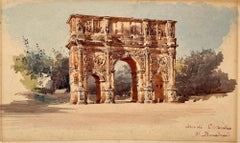
Arco di Constantino

Arco di Constantino

Located in Middletown, NY

Pen and ink in sepia and watercolor on board, 7 x 11 1/2 (178 x 293 mm), the full sheet. Signed in ochre gouache in the lower right corner on the recto. Moderate toning and light att...

Category

Late 19th Century Italian School Figurative Drawings and Watercolors

Materials

Watercolor, Ink

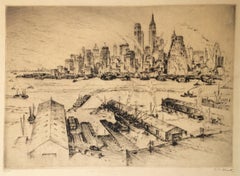
MANHATTAN

MANHATTAN

By Anton Schutz

Located in Santa Monica, CA

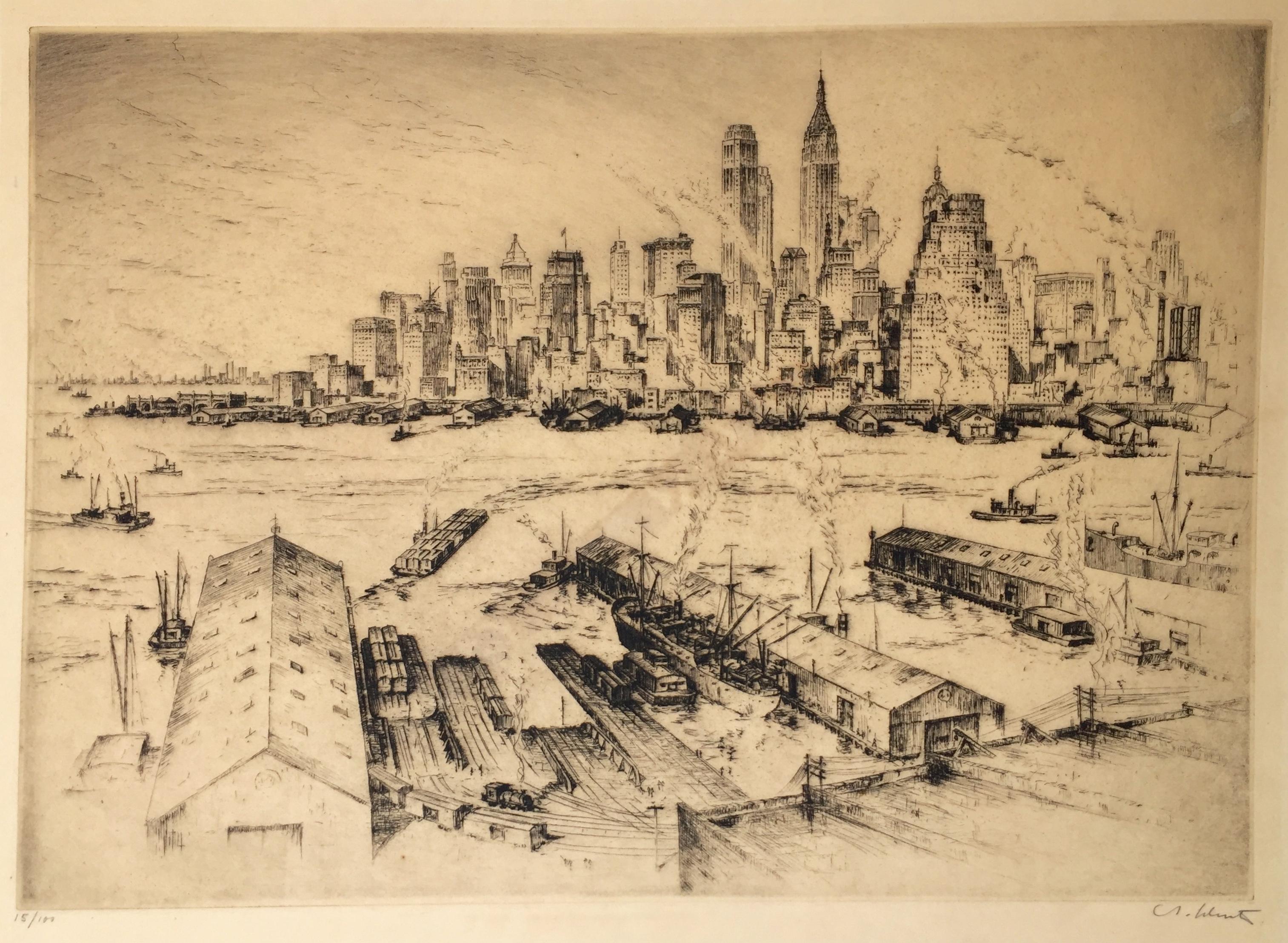
ANTON SCHUTZ MANHATTAN c 1940 Etching, signed in pencil, edition 100, no. 15/100. On thin simili-japan paper. Very slight toning around plate mark. Remnants of old tape on verso, s...

Category

1940s American Realist Landscape Prints

Materials

Etching

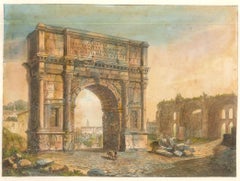
Arch of Septimus Severus

Arch of Septimus Severus

By Matthew Dubourg

Located in Middletown, NY

London: J. Taylor, 1820. Etching with aquatint and engraving with hand coloring in watercolor on cream wove paper with a gilded edge, 11 1/2 x 14 3/4 inches (290 x 374 mm), the full...

Category

Mid-19th Century English School Landscape Prints

Materials

Watercolor, Handmade Paper, Engraving, Etching, Aquatint

Roman Ruins -  Painting attr. to Francis Harding - 17th Century

Roman Ruins - Painting attr. to Francis Harding - 17th Century

Located in Roma, IT

Roman ruins is an original old master artwork realized realized by a follower of the artist Giovanni Paolo Panini and attributed to Francis Harding (1730-1766). Mixed colored oil on canvas. Includes frame. The work is a replica of Panini's canvas made around 1740, made known by Ferdinando Arisi in his 1986 monograph (Cat.456) as belonging to the Galleria Taccani in Milan and recently reappeared on the London market...

Category

17th Century Modern Figurative Paintings

Materials

Paint, Oil