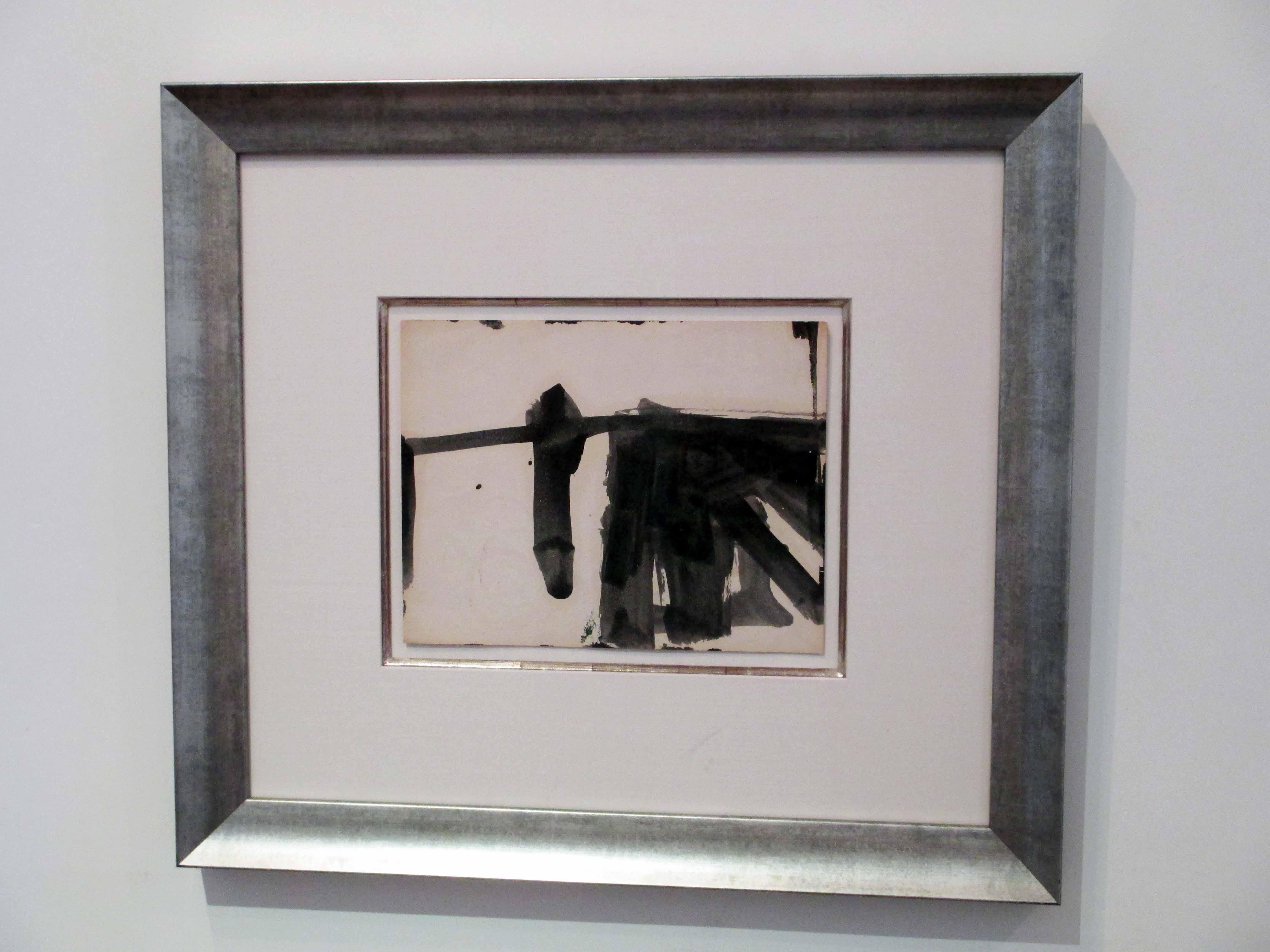
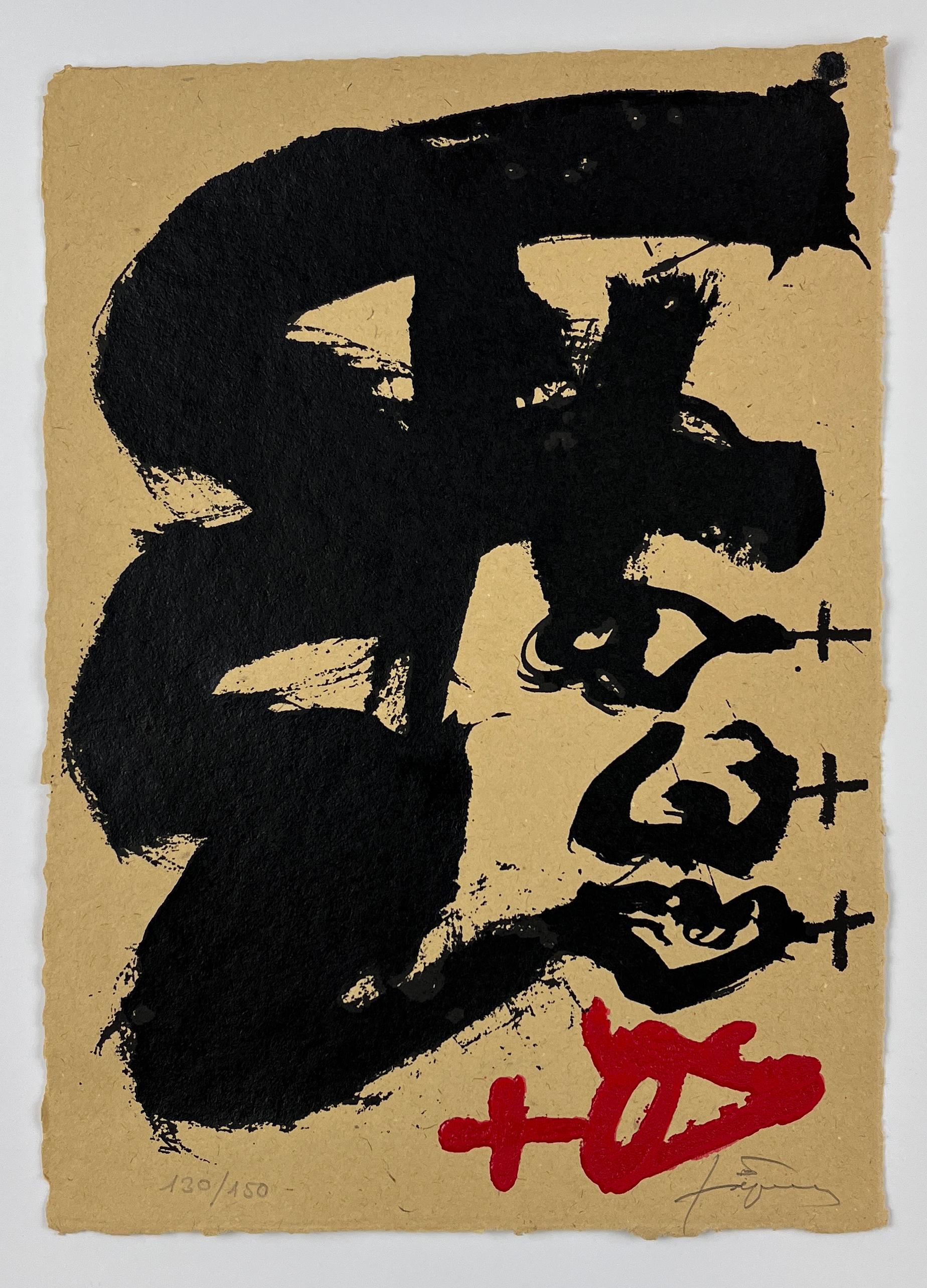
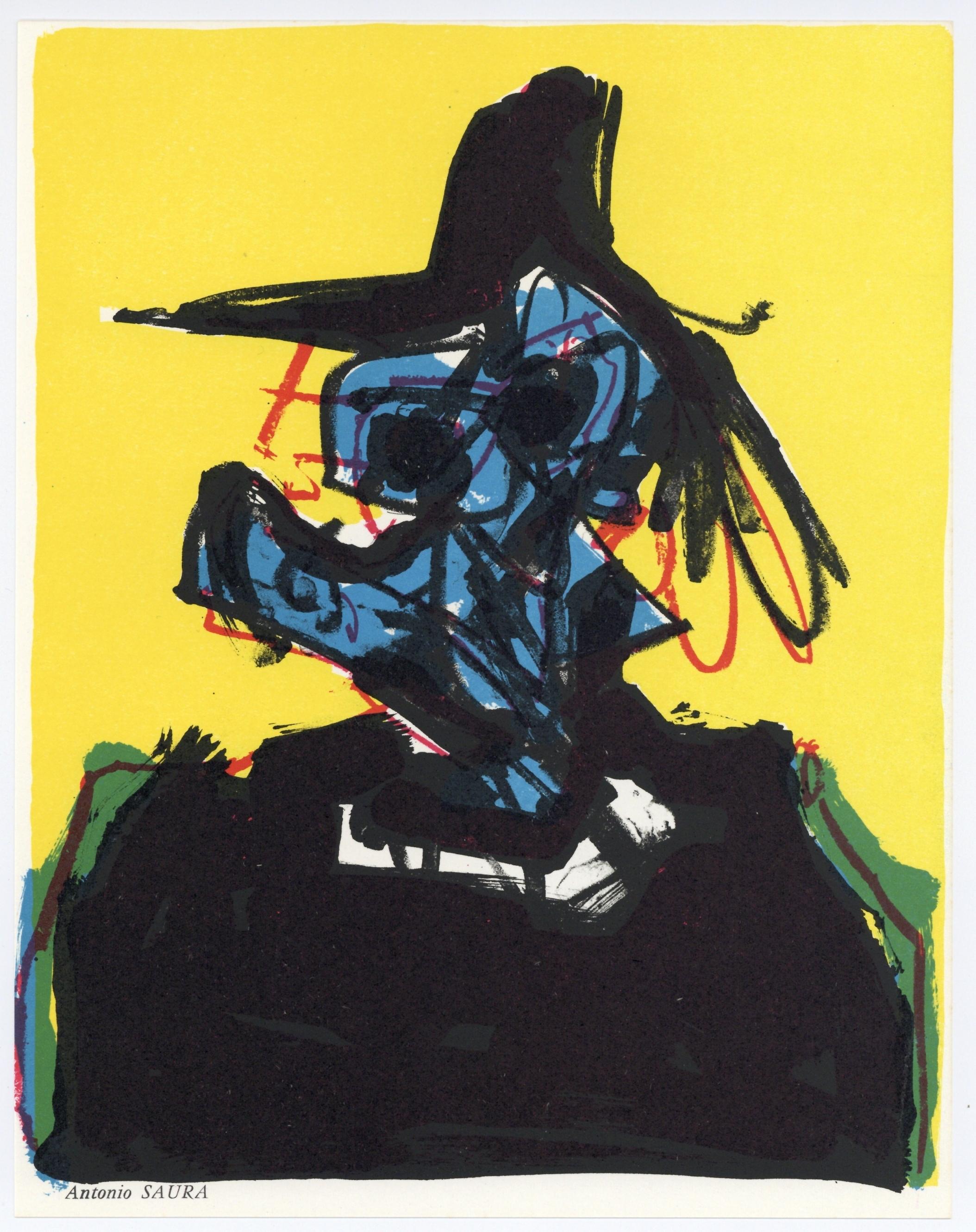
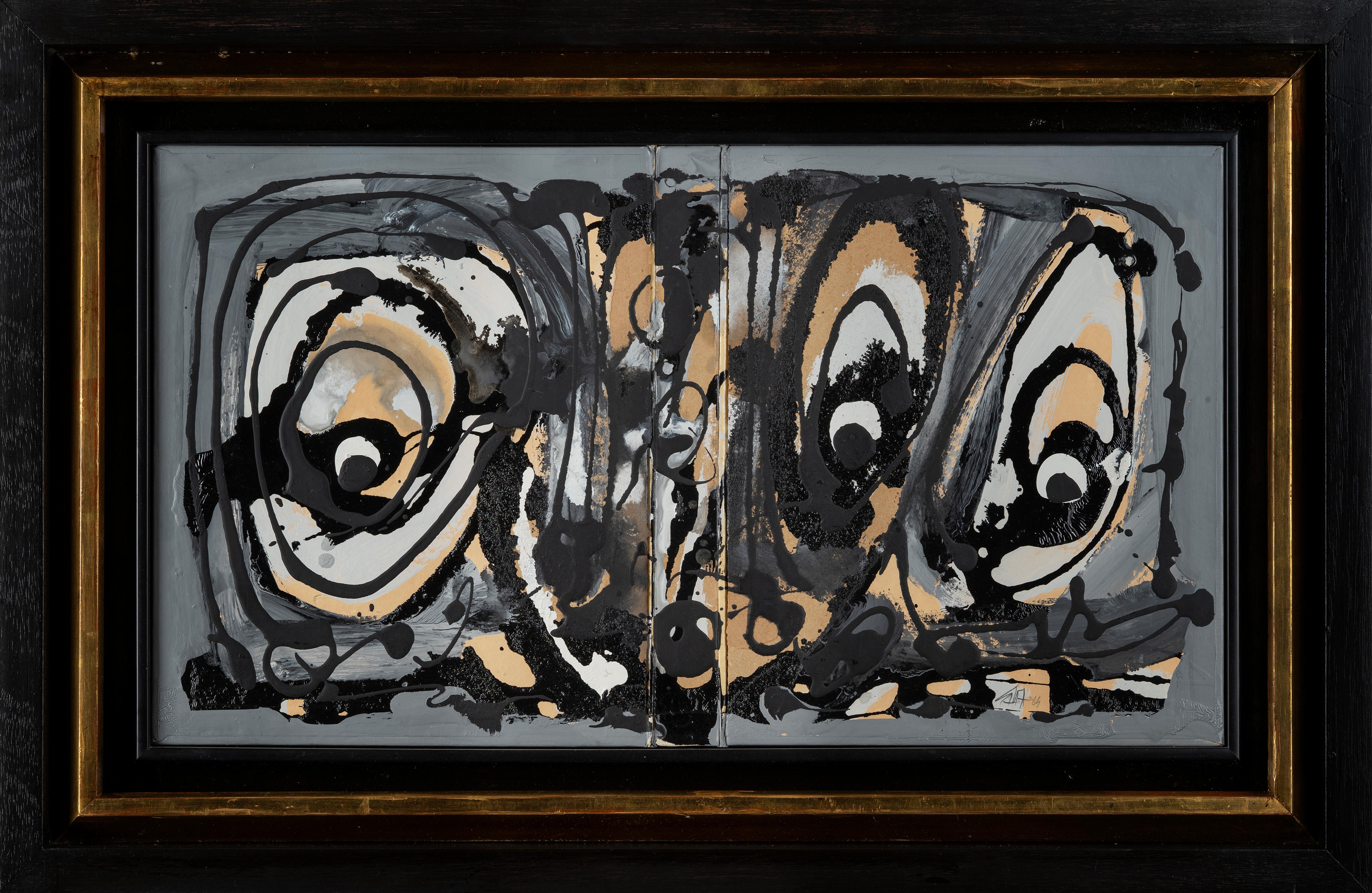
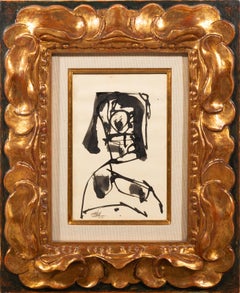
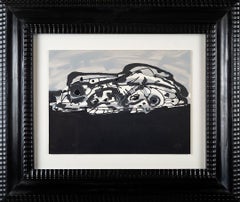
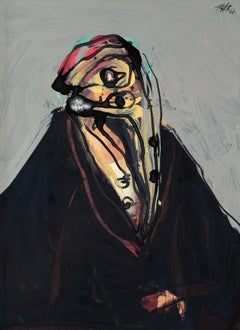
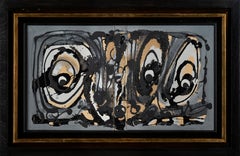
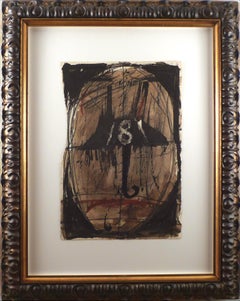
Antonio Saura Atarés (Huesca, 1930 - Cuenca, 1998)
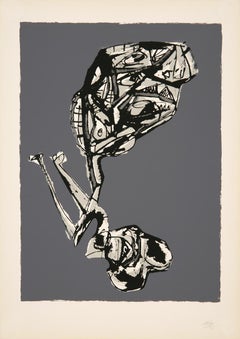
"Crucifixion".
1960.
Ink on paper.
70 x 100 cm.
Signed, dated and titled in the central right area.
Bibliography:
- GUIGON, E. et al. “Antonio Saura, Crucifixions”. Musée d’Art Moderne et Contemporain de Strasbourg, Ministry of Foreign Affairs, 2002.
- SAURA, A. “Notebook (Memory of Time)”. Official College of Quantity Surveyors and Technical Architects of Murcia, 1992.
- SAURA, A. “Fijeza. Ensayos”. Galaxia Gutenberg, 1999.
Description:
From the intense black background, though full of strokes and gestures, emerges an asymmetrical cross, the same white as the paper, enclosing a grotesque Christ with an enormous head crowned with thorns, unequal arms with hands that are those of the painter, and a strange androgynous anatomy, with a woman's breasts and a heavy phallus. As is often the case in Saura's Crucifixions, the cross, mutilated in this instance, is more horizontal than vertical, thus determining a twisted position of the figure's legs, which are bent and in profile, with short, animalistic thighs. It is a vigorous and intense figure, and at the same time, one of absolute pathos, represented through a brutal expressionism that links Saura to both the Baroque and American Action Painting. In Saura's own words: “In abstract expressionism, whether figurative or not, forms, or pre-existing structural schemes, are shattered only to be reorganized into a complex rhythm, obeying an organic, unconscious geometry that aims to unify the entire flow of the painting (in its ebb and flow) into a single biological pulse” (A. Saura, 1999).
This pulse, however, is subject to rigorous compositional construction: the black does not completely cover the paper, but rather allows slivers of light to enter on the left side, at the bottom and top, creating diagonals that introduce tension and imbalance. Furthermore, on the reserved space of the cross, the ink is applied with different gestures, speeds, and intensities of the painter's physical movement, combining the pen, the brush, the paintbrush, and the imprint of his own hands. Thus are revealed the distinct rhythms of the different moments of the creative flow—the pause, the fury, and the slow brushstroke—from which emerges a rich variety of black ink tones, more opaque or translucent, more subdued or more violent, depending on the moment.
Saura based the origin of his Crucifixions, a recurring theme in his work between 1956 and 1996, on his obsessive fascination with the “Crucified Christ” that Velázquez painted for the San Plácido convent (fig. 1), which he was able to contemplate in the Prado Museum as a child. He was particularly impressed by the deep black of the background which, in his own words, “encourages the appearance of the tortured body” (A. Saura, 1992). For him, this work was always an emblem of concentrated expressive intensity, determined by the tension between light and darkness, by the presence of flesh against emptiness. Saura's crucifixions are not copies, however, but rather function as quotations: through the formal and expressive structure of Velázquez's Christ on the Cross, a framework is established that allows the painter to explore all aspects of the suffering inherent in the human condition (fig. 2). In the words of art historian Nicolas Surlapierre, "For Saura, the cross is a structural element that allows the body to be received" (N. Surlapierre, "Crucifixions at work," in Guigon 2002).
In Saura's work, the Crucified Christ becomes a timeless image of human suffering, completely discarding any religious undertones. Guided by his interest in religious painting and the Spanish Middle Ages, the artist makes this theme one of the cornerstones of his career, despite his openly anticlerical stance. In his work, the crucifixion ceases to be a religious or cultural emblem and becomes an icon of the tragedy of the human condition. Saura's "Man of Sorrows" is a secular figure, a representation of man alone in a sinister world: the artist translates the baroque pathos of the Sevillian genius into the language of the human and cultural drama of post-World War II Europe, with radical plasticity and powerful expressiveness. One of the best works in the series, an oil painting executed between 1959 and 1963 and currently housed in Bilbao (fig. 3), exemplifies the radical nature of Saura's work in Spain at that time, in its combination of traditional Spanish themes, which the regime sought to identify with order, tradition, and itself, with a violent expressionism that arises from the gestural style of Informalism and American Abstract Expressionism.
On a formal level, Saura's Crucifixions are based on a single structure that is maintained in ever-changing images, emphasizing the metamorphic nature of form and the plastic interplay of the body's manipulation, the appearance and disappearance of the figure (fig. 4). In these works, whether on paper or canvas, it is always the paint itself that expresses the body's suffering, while the gesture elaborates the tensions and forces contained by the matrix structure of the cross. In this way, the expressive violence is controlled, and the image acquires the character of a plastic sign, a key element in Saura's pictorial work, which is intimately linked to writing.
Comparative artworks:
Fig. 1 Diego Velázquez. “Christ Crucified”, c. 1632. Oil on canvas, 248 x 169 cm. Prado Museum, Madrid.
Fig. 2 Antonio Saura. “Crucifixion”, 1959-60. Oil on canvas, 130 x 162 cm. Private collection.
Fig. 3 Antonio Saura. “Crucifixion”, 1959-63. Oil on canvas, 133 x 164.6 cm. Guggenheim Museum, Bilbao.
Fig. 4 Antonio Saura. “Crucifixion”, 1959. Oil on canvas, 200 x 250.5 cm. Centre Pompidou, Paris, inv. AM 1991-186.
Biography:
Antonio Saura (Huesca, 1930 – Cuenca, 1998) was a painter and essayist, and one of the great Spanish artists of the second half of the 20th century. The first stage of his artistic production was deeply marked by the five years he spent bedridden as a result of bone tuberculosis. At that time he dedicated himself to reading and training as a self-taught artist. In 1947 he began writing and painting, experimenting with a language that seemed to advance surrealism that he would not know until later. These first works formed his first individual exhibition, when he was only twenty years old, in the Libros room in Zaragoza (1950). In this key stage of training, Saura became interested not only in painting but also in poetry and music, and immersed himself in the dreamlike and the fantastic. These concerns took him to Paris, where he met the surrealist group; However, he soon became disenchanted with a language already belonging to the past, while he looked to the future through formal and technical experimentation. The artist explained it like this: “In difficult moments of experimental search, before and after my break with the surrealist group, I made a series of very diverse paintings that were polarized in three certain aspects: fluidity, texture, grattage.” Finally, the young painter will leave behind his interest in the representation of the subconscious to investigate along the lines of automatism.
In 1957 Saura was one of the founding members of the El Paso group, in Madrid, a space of artistic freedom that managed to put contemporary Spanish art on the international map. A year later he was invited to participate in the Venice Biennale, along with Chillida and Tàpies, and in 1959 he took part in Documenta II in Kassel. Before the end of the decade, he made large paintings in which he addressed themes that would be constants in his work, series titled Shrouds, Portraits, Nudes, Nude-landscapes, Priests and Multitudes. In 1960 his international success was recognized for the first time with the Guggenheim Prize in New York.
Starting in the sixties, Saura exhibited his work in the main capitals of Europe, the United States and South America, and made paintings, sculptures, graphic works and even stained glass and stage designs. In 1965 he destroyed a hundred of his canvases; A year later he held a retrospective of works on paper in Havana. In 1967 he made a new auto-da-fé with the burning of another hundred canvases, and between 1968 and 1979 he completely renounced oil painting, working since then exclusively on paper. In 1977 he began publishing his writings, mainly essays on art and artists, including Goya, Miró, Picasso, Francis Bacon and himself. His anthological and retrospective exhibitions take place all over the world, and since 1980 he regularly participates in seminars and colloquiums on art and painting at the Center Georges Pompidou in Paris. In 1981 he was named Chevalier de l’Ordre des Arts et des Lettres in France, and in 1982 he was awarded the Gold Medal of Fine Arts in Spain. Currently, Saura's work can be seen in prominent contemporary art collections around the world, as well as in the museum of the foundation that bears his name in Cuenca.