Want more images or videos?
Request additional images or videos from the seller
1 of 11

Emily Cole
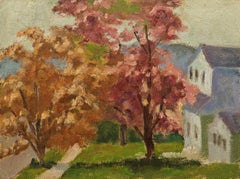
"Cherry Blossom" Emily Cole, Early American Female Artist, Botanical Painting

1890

$18,000List Price

You May Also Like

More From This Seller

View All
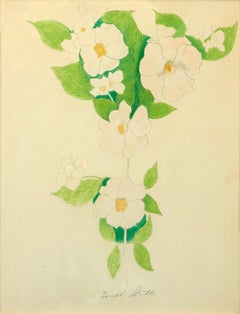
"Flowers" Joseph Stella, Vibrant Modernist Flower Composition on Paper

"Flowers" Joseph Stella, Vibrant Modernist Flower Composition on Paper

By Joseph Stella

Located in New York, NY

Joseph Stella Flowers Signed lower center Crayon and pencil on paper 13 1/4 x 10 1/4 inches Stella was born June 13, 1877 at Muro Lucano, Italy, a mountain village not far from Nap...

Category

Early 20th Century Modern Figurative Drawings and Watercolors

Materials

Paper, Crayon, Pencil

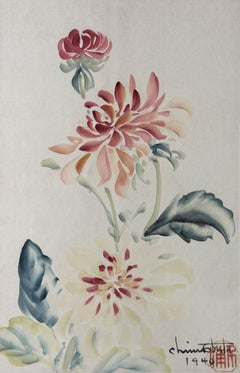
"Dahlias" Chiura Obata, Japanese American, Red and Blue Delicate Floral Work

"Dahlias" Chiura Obata, Japanese American, Red and Blue Delicate Floral Work

By Chiura Obata

Located in New York, NY

Chiura Obata Dahlias, 1940 Signed, dated and stamped lower right Watercolor on paper 15 x 9 5/8 inches Born in the Okayama prefecture of Japan, Chiura Obata was adopted by his uncle, an artist. As a child he was trained in ink painting, and at 14 he was apprenticed to the painter Murata Tanryo in Tokyo. He also studied with Kogyo Terasaki and Goho Hasimoto. In 1903, Obata moved to San Francisco and began working as an illustrator for The New World and The Japanese American, two of the city's Japanese newspapers. He also did work as a commercial designer. Obata helped establish the East West Art Society in San Francisco in 1921, which sought to promote cross-cultural understanding through art. This goal was reflected in his embrace of the Nihonga style, which fused traditional Japanese sumi-e ink painting with the conventions of western naturalism. He spent much of the 1920s painting landscapes throughout California, and among his favorite subjects were mountain landscapes. In 1927, he visited Yosemite and the Sierra Nevada, creating over a hundred paintings and sketches of the high country. Obata stayed in the USA until the death of his father in 1928. Between 1928 and 1932, he worked in Tokyo as a painter and transformed his California landscape watercolors...

Category

1940s Modern Still-life Drawings and Watercolors

Materials

Paper, Watercolor

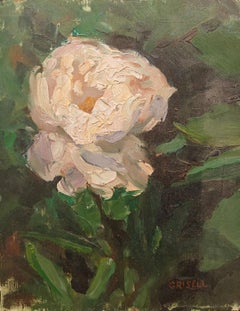
"At Bloom" Susan Grisell, White Flowers, American Impressionist Floral Sketch

"At Bloom" Susan Grisell, White Flowers, American Impressionist Floral Sketch

By Susan Grisell

Located in New York, NY

Susan Grisell At Bloom, circa 1990 Signed lower right Oil on board 9 7/8 x 7 7/8 inches Following the guidance of her long-time teacher and mentor, the respected New England impressionist painter, Bernard Lennon, Susan Grisell developed a style marked adherence to nature. Her paintings are recognizable for their effortless rendering, with line and color that express the impressions of what she observes, and dense brushwork that conveys her response following the sensitive observation of atmosphere. In May 2023, one of Susan's paintings "Blue Crock...

Category

1990s American Impressionist Figurative Paintings

Materials

Oil, Board

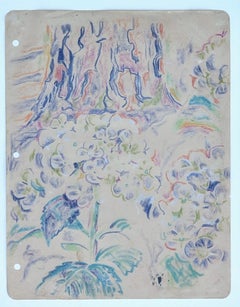
"Hydrangeas, " Walter Inglis Anderson, Mississippi Southern Illustrator, Flowers

"Hydrangeas, " Walter Inglis Anderson, Mississippi Southern Illustrator, Flowers

Located in New York, NY

Walter Anderson ( American, 1903 - 1965) Hydrangeas, circa 1950 Mixed media on paper 11 x 8 1/2 inches Provenance: Luise Ross Gallery, New York Private Collection, New Jersey Acquired from the estate of the above, 2021 Walter Anderson firmly believed that quality art was an important part of life and should be made available to everyone. As he said, "There should be simple, good decorations, to be sold at prices to rival the five-and-ten." Noticing that only poor quality art was available in stores and little was available for children, he resolved to make art which could be reproduced easily and sell inexpensively — linoleum block prints. This technique enabled him to provide affordable, quality art. The technique of linoleum block printing is a simple concept; however, it requires much skill and talent to actually produce memorable art. Anderson purchased surplus "battleship linoleum," thicker than ordinary linoleum with a burlap backing for better support, to create his blocks. During the mid-1940s, he created almost 300 linocuts working in the attic of the sea-side plantation house, Oldfields, his wife's family home in Gautier. Masses of linoleum chips accumulated at the foot of the attic stairs as he often worked night and day. He began with sketching out a design directly on the linoleum. Once he had carved the image into the surface, he used the back of faded, surplus stock wallpaper that a friend sent him, laying long strips on top of the inked linoleum. A roller made of sewer pipe filled with sand served as his press. When the print was completed, he often colored it by hand with bold strokes and vivid colors. The prints were sold at Shearwater Pottery, the family business, for a mere dollar a foot. But "what about a well-designed fairy tale for a child's room?" he asked himself. Since there was a lack of affordable art for children, much of his work with linoleum blocks focused on subjects for children. He depicted fables and fairy tales ranging from Arabian Nights, to Germany and the Grimm Brothers' Rapunzel, to the French story of The White Cat, to the Greek tales such as Europa and the Bull, and to tales from China, India, and other cultures. Anderson also created "mini" books featuring the alphabet and Robinson Cat. The blocks are not only alive with the story being depicted, but they are also filled with designs taken from Best-Maugard's Method for Creative Design. Swirls, half-circles and zig-zag lines fill every available space on the linoleum block making them come alive and capture their audience. But fairy tales, children's verses and the "mini" books, consisting of about 90 blocks, were not the sole subject of Anderson's linoleum block prints. In total, he created approximately 300 linoleum blocks with subjects ranging from coastal flora and fauna, coastal animals, and sports and other coastal activities. Anderson even created linoleum blocks to be used to print tablecloths and clothing, some worn by his own children. Color and subjects of the linoleum block prints were not the only things that got them noticed. In 1945 when Anderson was creating these prints, the standard size of linoleum block prints was only 12 by 18 inches. These small dimensions were due to the common size of the paper available and the restrictions made by national competitions. Since Anderson used wallpaper...

Category

Mid-20th Century American Modern Landscape Paintings
Materials

Paper, Crayon

"In the Neighborhood" Richard Stalter, Trees in Bloom, American Neighborhood

"In the Neighborhood" Richard Stalter, Trees in Bloom, American Neighborhood

By Richard Stalter

Located in New York, NY

Richard Stalter In the Neighborhood Oil on canvas laid on board 8 7/8 x 12 inches Richard Stalter was born in Dayton, Ohio, on April 27, 1934. He developed an interest in art at a ...

Category

1970s American Impressionist Figurative Paintings

Materials

Canvas, Oil, Board