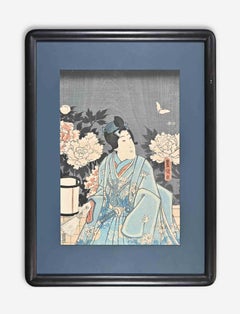
SNOW, MOON AND FLOWERS OF THE ÔGIYA TEA HOUSE
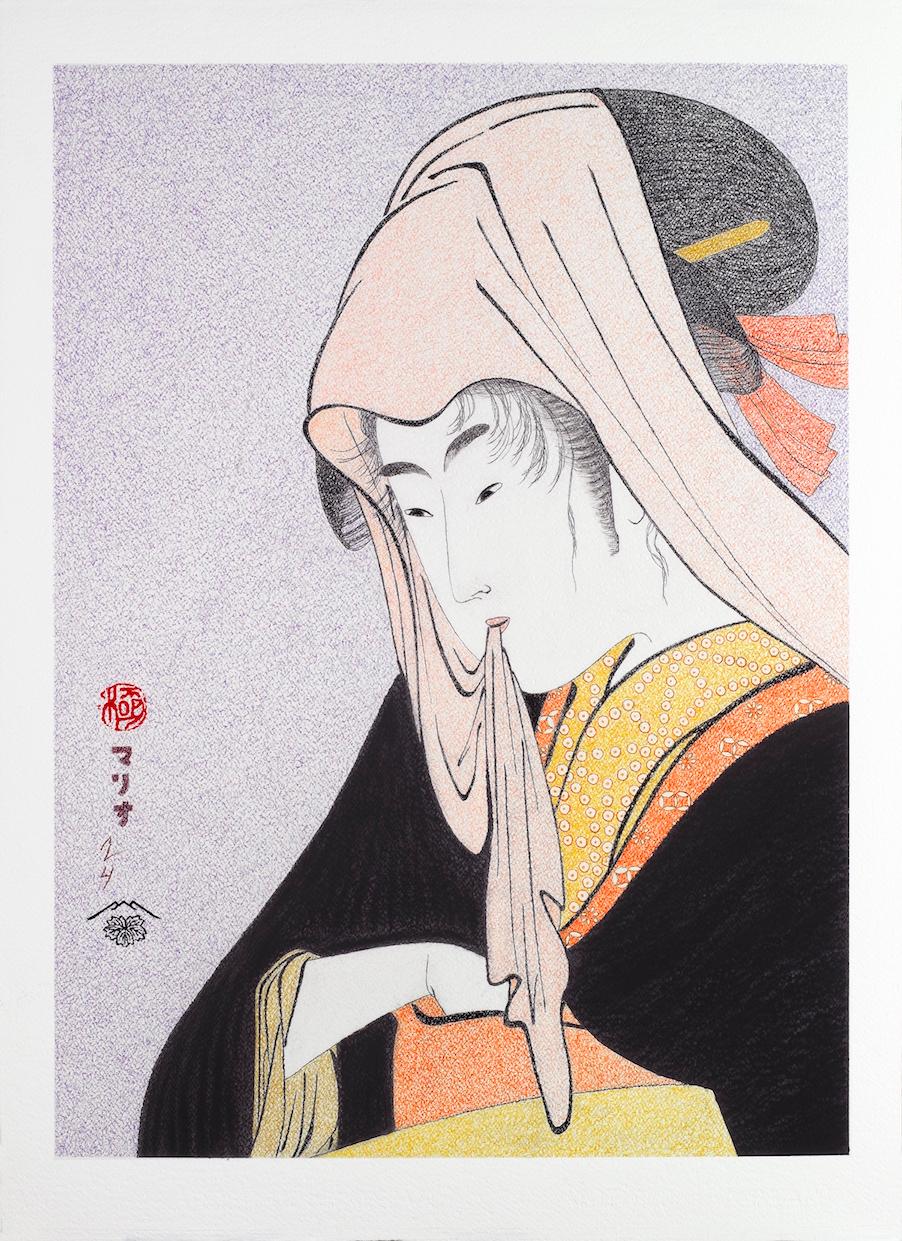
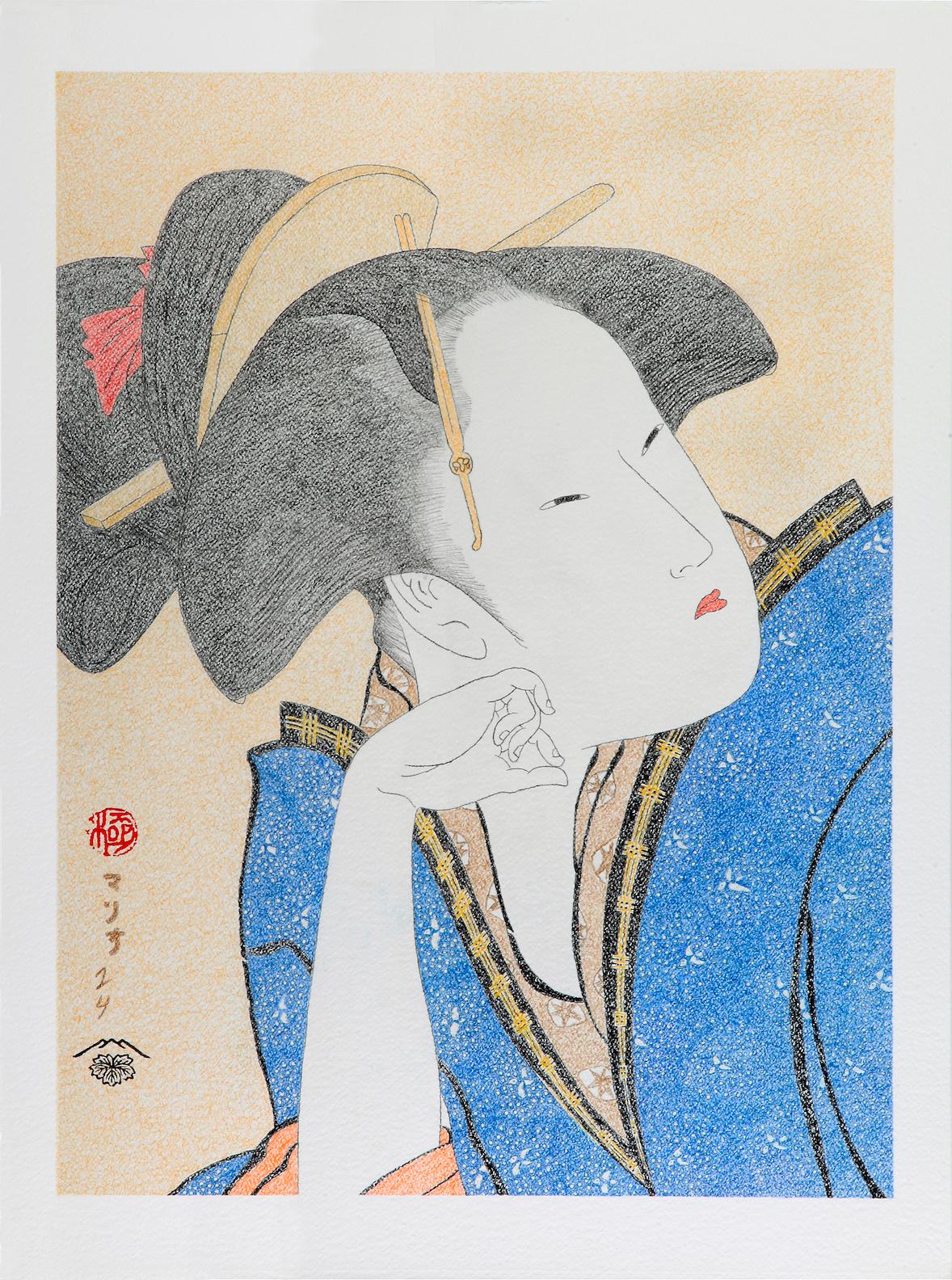
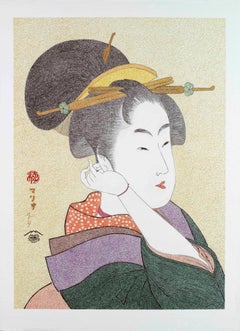
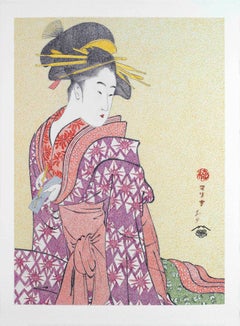
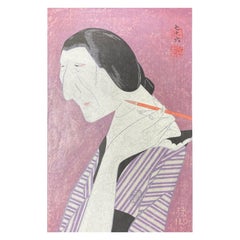
Head and shoulders portrait of a beautiful courtesan of the Ôgiya Tea House. With an attentive gesture, she brings her left hand behind her ear with delicate wrist and finger motion.
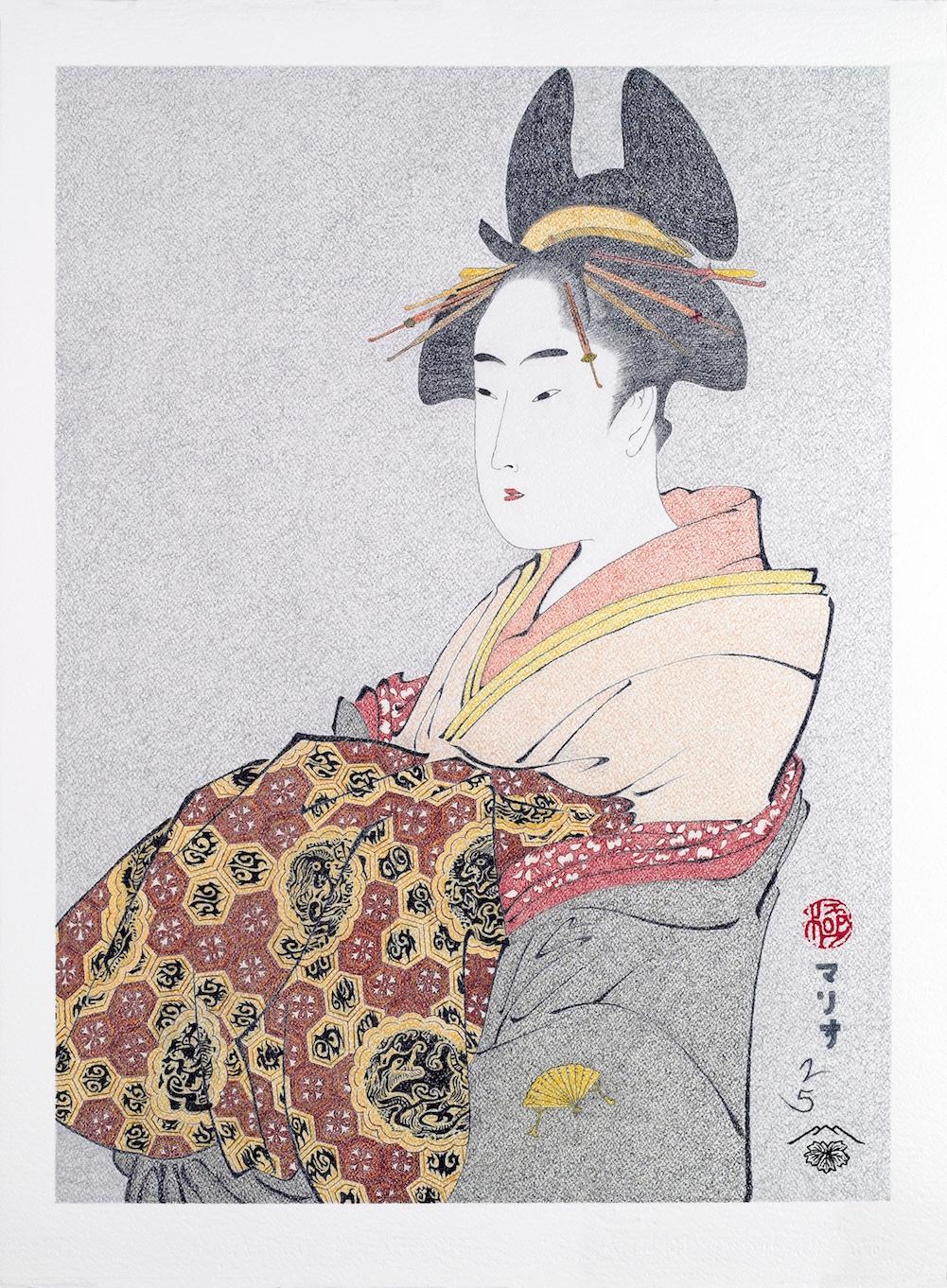
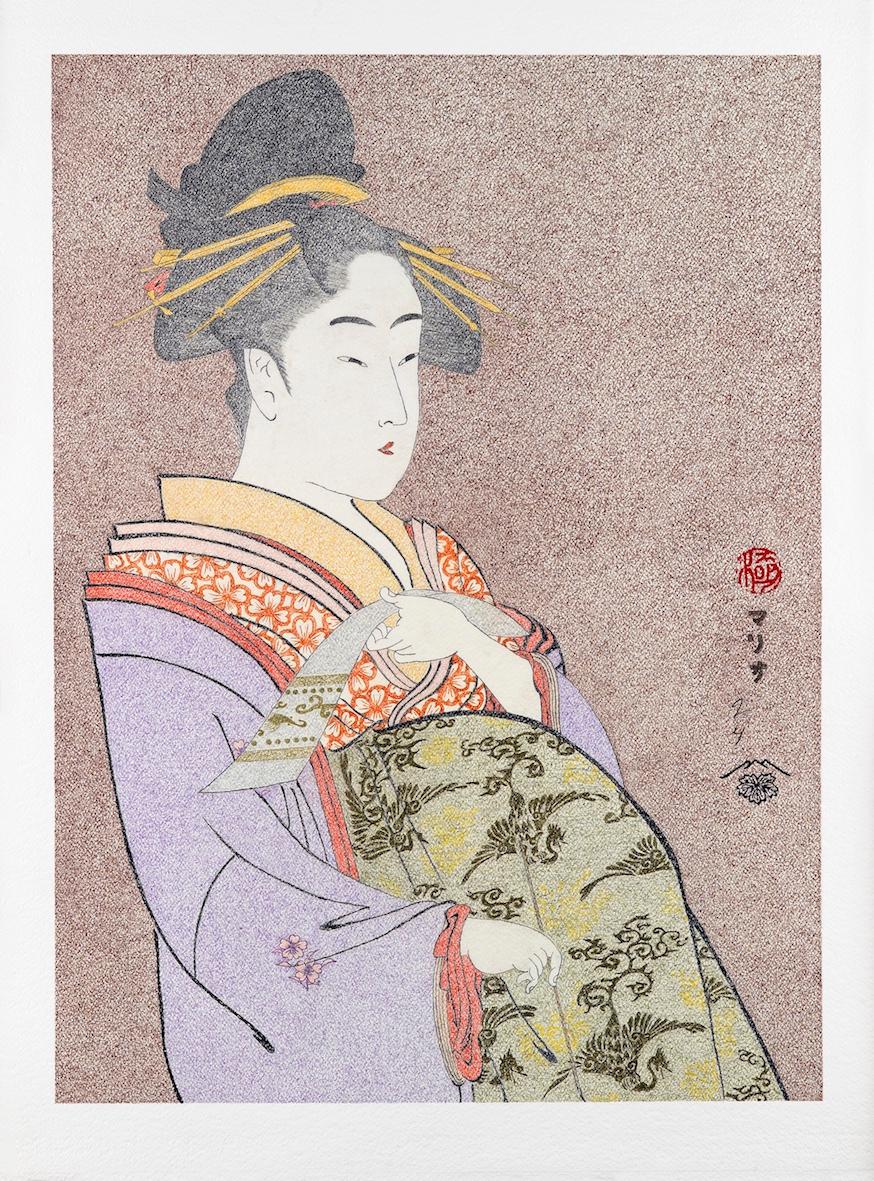
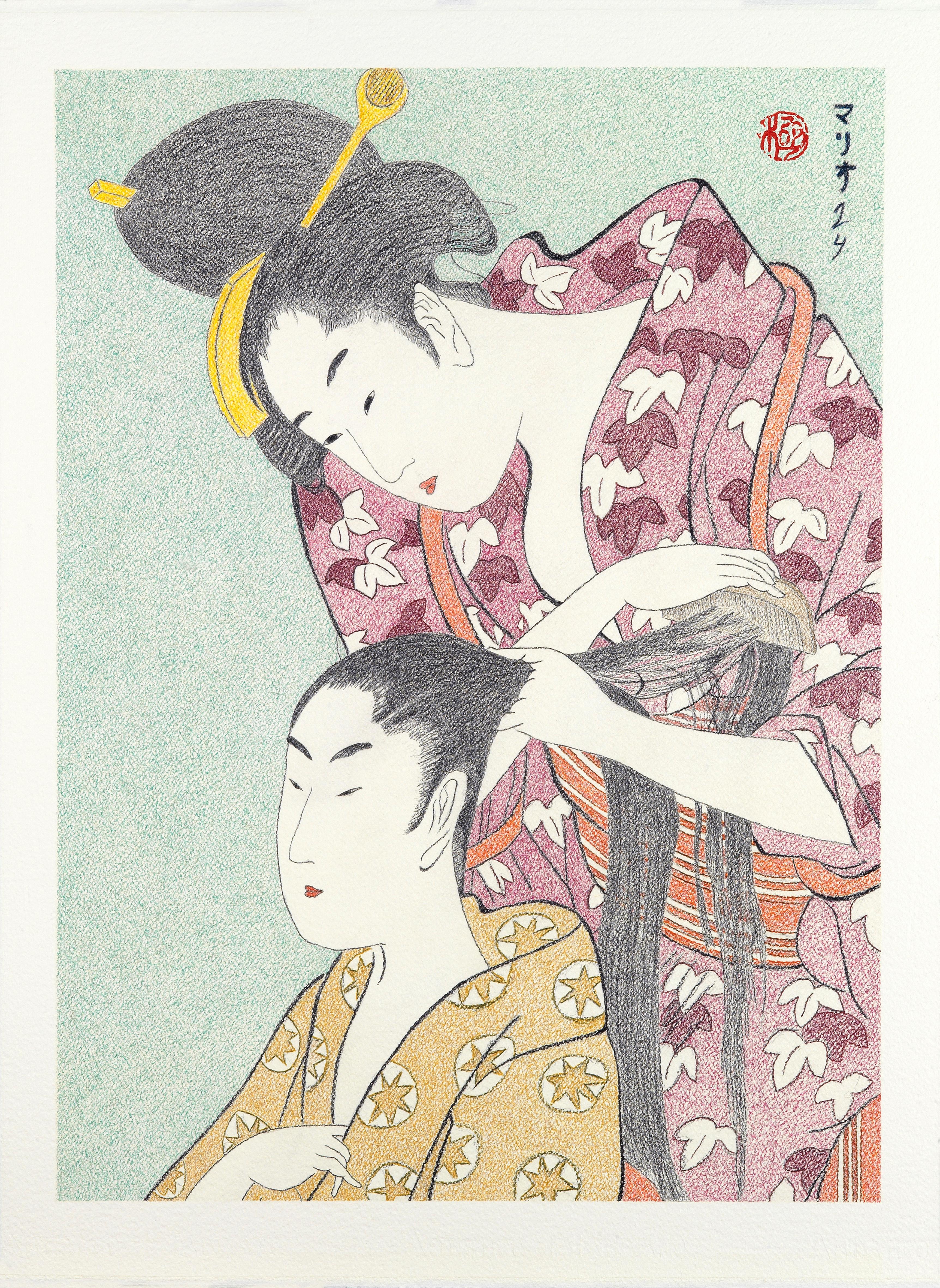
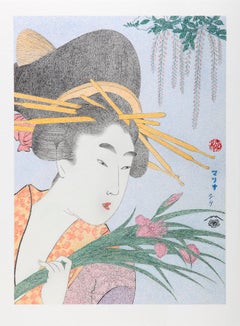
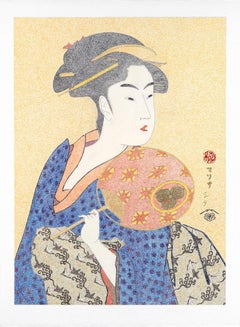
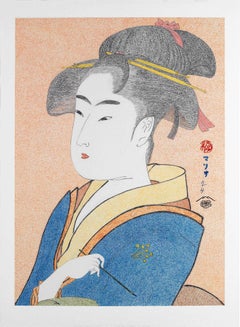
This image is part of the bijin-ga series, “Pretty women”, drawn by Mario BGil, based in the Kitigawa Utamaro woodblock print “Snow, moon and flowers from the Ôgiya Tea House” (1793-1795). The tittle is a Japanese topic in art and design originating from a poem by Tang dynasty poet Bai Juyi. It became popular in the late Edo used to describe serene beauty.
The artist reproduces the seal of the censor (Kiwame) and from the original publisher (Tsutaya, climbing leaf)), as it appears in the woodblock print used as a model; between the two, the signature of Mario BGil written in Japanese, with the date 14 (2014).
The mesaurements of the drawing are 76 x 56 cm., with a painted surface of 67 x 49,5 cm. (the woodblock print is 36,2 x 25,9 cm.).
With his work on the bijing-ga series, Mario BGil wanted to embellish, give brilliance and volume to the images presented by japanese artist Kitigawa Utamaro in those beautiful engravings, ennobled with the patina of time, which have served as inspiration. The result obtained is almost life-size portraits, endowed with strong chromaticism and valuable contrasts, all enhanced, in turn, with the volume provided by the weight and rigidity of the paper, and its thick texture (Fabriano Artistico “grana grosso”, 640g/m2; the thickness and hardness of the paper makes it necessary to transport it without rolling).
In this way, Mario BGil pays tribute to his admired artist and offers us a new and enriched vision of this popular facet of oriental art from the 18th and 19th centuries.
ABOUT THE ARTIST
Mario BGil is a self-taught artist who for years has combined his creative activity with his work in the family business, away from commercial art galleries. In 2012, a deep interest in oriental art was awakened in him and he began to study the great masters of Japanese Ukiyo-e prints, who had such an influence on the European avant-garde of the late XIX century.
The discovery of Kitagawa Utamaro (1753-1806), a key figure in the metropolitan culture of Edo (now Tokyo), and a point of reference in the history of Japanese engraving, meant for Mario a change of course caused by the imperative need to study his images, recreate them and recreate himself in them, incorporating certain changes in both the format and the technique used.
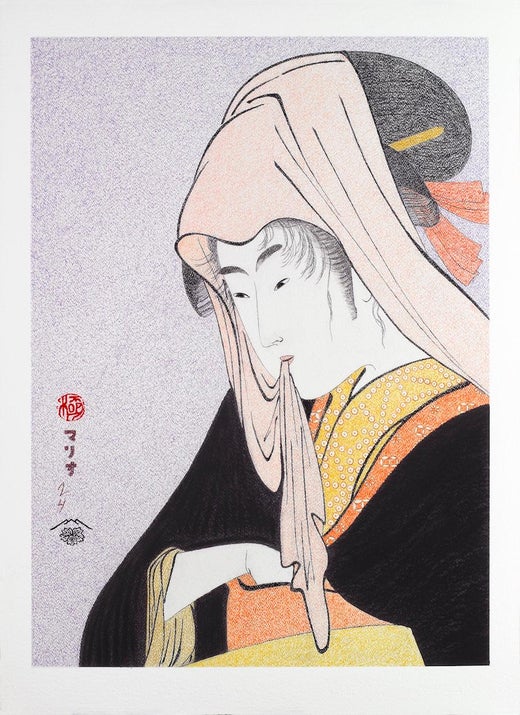
The technique used by Mario BGil is very different from that used in engravings with wooden blocks impregnated in inks of intense colors that serve as a model. On a paper of heavy weight and thick texture, Mario BGil outlines with a black pencil, and colors the spaces with pencils and watercolors. Faced with the intensity of color of the prints (already very lost in some of them due to their age and exposure to the sun), their drawings are sifted by the streaky white, due to the thick texture of the paper, showing more lines, soft and warmer tones, giving color to the backgrounds but leaving all the volumes corresponding to the skin blank, thus giving the figures a classic serenity that transcends their oriental character.
Between 2014 and 2015, Mario BGil made more than 35 drawings based on the prints selected from the huge amount of work produced by the master Utamaro that shows images of courtesans in different attitudes and poses that highlight the subtle delicacy of oriental feminine beauty.
Kitagawa Utamaro was a faithful representative of the tastes of the Japanese bourgeoisie of its time, which had transformed the life of the cities giving birth to a culture parallel to the official and aristocratic.
The activity of the new rising group took place in special neighborhoods of Edo (Tokyo) and Osaka and its banality, inconsistency and frivolity earned it the name of Ukiyo: "floating world"; a world that will give priority to a series of cultural manifestations much more popular and less intellectualized than those preferred by the nobility. The new neighborhoods are filled with brothels and shows that the upper classes will consider vain, and a new breed of heroes: sumo wrestlers, singers, actors and courtesans will come to reign in this "floating world."
In front of the traditional painting the stamp arises with images of this new world. The courtesans of the pleasure districts of Edo that Utamaro portrays, do not always appear perfectly dressed to receive the client, but are surprised while getting ready, or during the day. He observes them without being seen, spy on them in their daily and intimate work. All of them are women drawn in a similar style, with elongated faces, straight delicate noses (almost a single line) and other features reduced to a mere suggestion (the mouth, a tiny butterfly of red).
The importance that it has had in later European artists (Degas, Toulouse-Lautrec, Bonnard, Gauguin, Van Gogh ...) has been great and Mario BGil has not been able to escape the recreation of those images so classic and, at the same time, so current, paying clear tribute to its original creator.