Want more images or videos?
Request additional images or videos from the seller
1 of 3

Murat Bernard 'Chic' Young
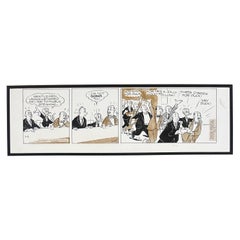
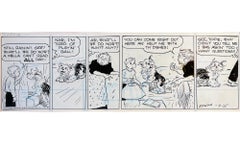
Blondie 3, Original Blondie Comic Strip by Murat Bernard 'Chic' Young

1962

$1,500
£1,130.21
€1,321.08
CA$2,124.15
A$2,163.22
CHF 1,241.78
MX$26,103.12
NOK 14,391.58
SEK 14,589.27
DKK 9,876.96

About the Item

Murat Bernard Young (January 9, 1901 – March 14, 1973), better known as Chic Young, was an American cartoonist who created the popular, long-running comic strip Blondie. His 1919 William McKinley High School Yearbook cites his nickname as Chicken, source of his familiar pen name and signature. According to King Features Syndicate, Young had a daily readership of 52 million. Stan Drake, who drew Blondie in the 1980s and 1990s, stated that Young "has to go down in history as one of the geniuses of the industry." Born in Chicago, Illinois, Young began drawing with the encouragement of his mother, who was an artist. Although his father, James, was a shoe salesman who didn't think much of artists, all of the children in the family were creative: Walter was a painter, daughter Jamar entered the commercial art field and Lyman, Chic's older brother, drew the Tim Tyler's Luck comic strip for King Features. It was Lyman who spurred Chic to constantly draw. Chic Young grew up in a German-Lutheran neighborhood on the south side of St. Louis. After graduating from high school in St. Louis, he returned to Chicago where he worked as a stenographer while taking night classes at the Art Institute of Chicago. In 1921, he learned that the Newspaper Enterprise Association was seeking an artist to do a comic strip about an attractive young woman. He headed for Cleveland and earned a salary of $22 a week while drawing The Affairs of Jane about a struggling film actress who dreamed of graduating from low-budget pictures to stardom. The short-lived strip, which began in 1921 on Halloween, came to a conclusion five months later on March 18, 1922. In the NEA art department, Young worked near cartoonist Gene Ahern, and the two often played pranks on each other. When a call came from King Features' J. Gortatowski offering an annual salary of $10,000, Young thought it was a prank and turned down the job. Looking for work later, he applied to Gortatowski and learned the call was legitimate. After six months in Cleveland, Young left for New York where he created another female flapper strip, Beautiful Bab, which the Bell Syndicate began distributing on July 15, 1922. It ran for only four months but landed him a job in the art department of King Features Syndicate. In 1924, he began Dumb Dora, about brunette Dora who "wasn't as dumb as she looked." In 1927, Young married professional harpist Athel Lindorff. In the spring of 1930, after six years of Dumb Dora's increasing popularity, Young requested more money and strip ownership. This action led to changes, and Paul Fung took over Dumb Dora in April 1930 when Young dropped it in order to create a new strip. In the summer of 1930, working in his studio in Great Neck, Long Island, Young created Blondie. When it debuted September 8, 1930, it quickly became the most popular comic strip in America, gaining even more readers when Blondie and Dagwood married in 1933, followed by the 1934 birth of Baby Dumpling (later known as Alexander). When his first son, Wayne, died of diptheria in 1937, Young took a year's hiatus; the experience made it difficult for him to draw Baby Dumpling. After Young and his wife spent a year traveling in Europe, he began Blondie once again, quelling rumors that he might not return to the strip. With films, radio, television and products, the strip became a licensing and media bonanza that made Young a wealthy man. During his lifetime, he produced more than 15,000 Blondie strips. Described by former King Features president Joseph Connelly as "the greatest story teller of his kind since the immortal Charles Dickens," Young at his peak received more fan mail than any other cartoonist. His other works include the strip Colonel Potterby and the Duchess, which ran as a topper strip on the Blondie page from 1935 through 1963. Young worked with several assistants, including Alex Raymond and Ray McGill. Alex Raymond's younger brother, Jim Raymond, who began as Young's assistant in 1935, took over all the art in 1950 when Young's eyesight began to fail. Living in suburban New Rochelle, New York, Chic and Athel had two children, Dean and Jeanne. In 1939, Young relocated his family to California to be more closely involved with Columbia's Blondie film series. In the early 1950s, the entire family vacationed in Paris, and a few years later, they moved to Florida, prompting his comment, "We reside on a little island off the west coast of Florida, where the porpoises and pelicans entertain me while I work on the strip. Hobbies? Oh, fishing, golf, very amateurish Oriental cooking and such nonsense." Young died in St. Petersburg, Florida in 1973 at age 72. Blondie is currently written by Chic Young's son, Dean Young, and illustrated by John Marshall with his assistant Frank Cummings. Blondie 3 by Murat Bernard 'Chic' Young, American (1901–1973) Date: 1962 Ink on Paper, signed Size: 5 in. x 18 in. (12.7 cm x 45.72 cm) Frame Size: 9.5 x 21.5 inches
  • Creator:
    Murat Bernard 'Chic' Young (1901 - 1973, American)
  • Creation Year:
    1962
  • Dimensions:
    Height: 9.5 in (24.13 cm)Width: 21.5 in (54.61 cm)
  • Medium:
  • Period:
  • Condition:
  • Gallery Location:
    Long Island City, NY
  • Reference Number:
    Seller: 481951stDibs: LU46618319562

More From This Seller

View All
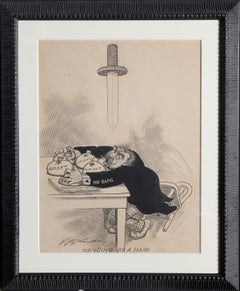
Hanging by a Hair, Original 1900's Political Cartoon Drawing

Hanging by a Hair, Original 1900's Political Cartoon Drawing

Located in Long Island City, NY

A political satire illustration "Hanging by a Hair" originally published in the The Philadelphia North American newspaper circa 1902, edited by Edwin A Van Valkenburg and pubilshed b...

Category

Early 1900s Figurative Drawings and Watercolors

Materials

India Ink

You May Also Like

Tippie Comic Strip Original Art  - Female Cartoonist

Tippie Comic Strip Original Art - Female Cartoonist

Located in Miami, FL

An early example from pioneering Female Cartoonist/ Illustrator Edwina Dumm, who draws a comic strip from her long-running cartoon series Tippie which lasted for almost five decades. Signed and dated Edwina, 9-25, matted but unframed. Frances Edwina Dumm (1893 – April 28, 1990) was a writer-artist who drew the comic strip Cap Stubbs and Tippie for nearly five decades; she is also notable as America's first full-time female editorial cartoonist. She used her middle name for the signature on her comic strip, signed simply Edwina. Biography One of the earliest female syndicated cartoonists, Dumm was born in Upper Sandusky, Ohio, and lived in Marion and Washington Courthouse, Ohio throughout her youth before the family settled down in Columbus.[1] Her mother was Anna Gilmore Dennis, and her father, Frank Edwin Dumm, was an actor-playwright turned newspaperman. Dumm's paternal grandfather, Robert D. Dumm, owned a newspaper in Upper Sandusky which Frank Dumm later inherited. Her brother, Robert Dennis Dumm, was a reporter for the Columbus Dispatch, and art editor for Cole Publishing Company's Farm & Fireside magazine. In 1911, she graduated from Central High School in Columbus, Ohio, and then took the Cleveland-based Landon School of Illustration and Cartooning correspondence course. Her name was later featured in Landon's advertisements. While enrolled in the correspondence course, she also took a business course and worked as a stenographer at the Columbus Board of Education. In 1915, Dumm was hired by the short-lived Republican newspaper, the Columbus Monitor, to be a full-time cartoonist.[2] Her first cartoon was published on August 7, 1915, in the debut issue of the paper. During her years at the Monitor she provided a variety of features including a comic strip called The Meanderings of Minnie about a young tomboy girl and her dog, Lillie Jane, and a full-page editorial cartoon feature, Spot-Light Sketches[3]. She drew editorial cartoons for the Monitor from its first edition (August 7, 1915) until the paper folded (July 1917). In the Monitor, her Spot-Light Sketches was a full-page feature of editorial cartoons, and some of these promoted women's issues. Elisabeth Israels Perry, in the introduction to Alice Sheppard's Cartooning for Suffrage (1994), wrote that artists such as Blanche Ames Ames, Lou Rogers and Edwina Dumm produced: ...a visual rhetoric that helped create a climate more favorable to change in America's gender relations... By the close of the suffrage campaign, women's art reflected the new values of feminism, broadened its targets, and attempted to restate the significance of the movement.[4] After the Monitor folded, Dumm moved to New York City, where she continued her art studies at the Art Students League. She was hired by the George Matthew Adams Service[5] to create Cap Stubbs and Tippie, a family strip following the lives of a boy Cap, his dog Tippie, their family, and neighbors. Cap's grandmother, Sara Bailey, is prominently featured, and may have been based on Dumm's own grandmother, Sarah Jane Henderson, who lived with their family. The strip was strongly influenced by Mark Twain’s Adventures of Huckleberry Finn, as well as Dumm’s favorite comic, Buster Brown by Richard F. Outcault. Dumm worked very fast; according to comics historian Martin Sheridan, she could pencil a daily strip in an hour.[6] Her love of dogs is evident in her strips as well as her illustrations for books and magazines, such as Sinbad, her weekly dog page which ran in both Life and the London Tatler. She illustrated Alexander Woollcott's Two Gentlemen and a Lady. For Sonnets from the Pekinese and Other Doggerel (Macmillan, 1936) by Burges Johnson (1877–1963), she illustrated "Losted" and other poems. From the 1931 through the 1960s, she drew another dog for the newspaper feature Alec the Great, in which she illustrated verses written by her brother, Robert Dennis Dumm. Their collaboration was published as a book in 1946. In the late 1940s, she drew the covers for sheet music by her friend and neighbor, Helen Thomas, who did both music and lyrics. During the 1940s, she also contributed Tippie features to various comic books including All-American Comics and Dell Comics. In 1950, Dumm, Hilda Terry, and Barbara Shermund...

Category

1920s Conceptual Figurative Drawings and Watercolors

Materials

Ink, Color Pencil, Graphite
Humorous Gentleman's Magazine cartoon

Humorous Gentleman's Magazine cartoon

Located in Wilton Manors, FL

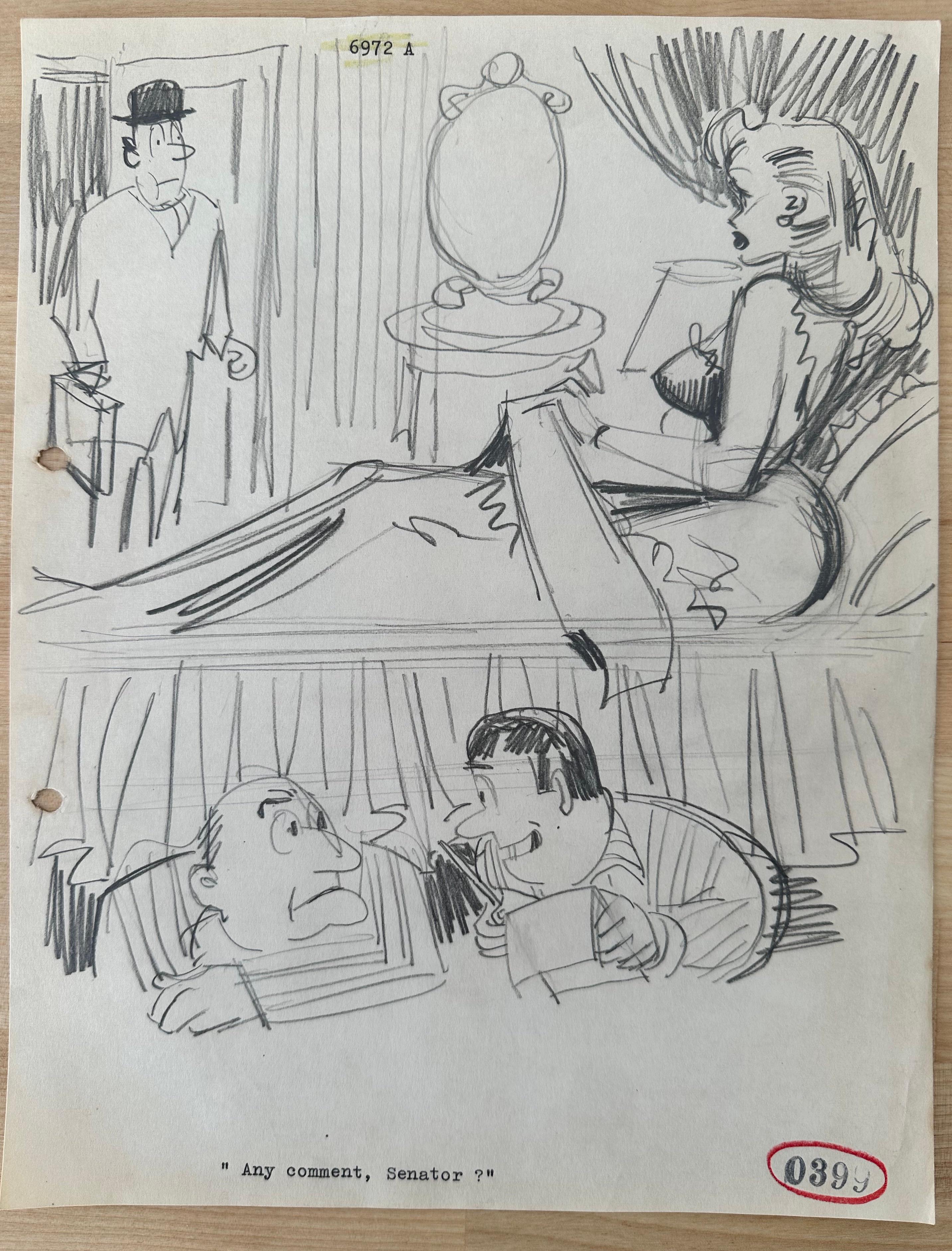
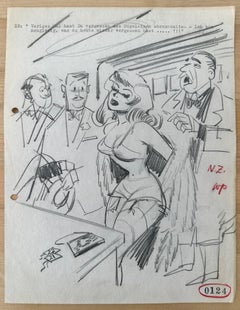
Cartoon sketch, ca. 1955. Pencil on paper, sheet measures 8.5 x 11 inches. Unsigned with editor's notations. From a group of sketches meant to be preliminary drafts for editor appro...

Category

Mid-20th Century Figurative Drawings and Watercolors

Materials

Pencil

Original Walt Disney "Donald Duck" Comic Strip Art 1967

Original Walt Disney "Donald Duck" Comic Strip Art 1967

By Walt Disney Productions

Located in San Diego, CA

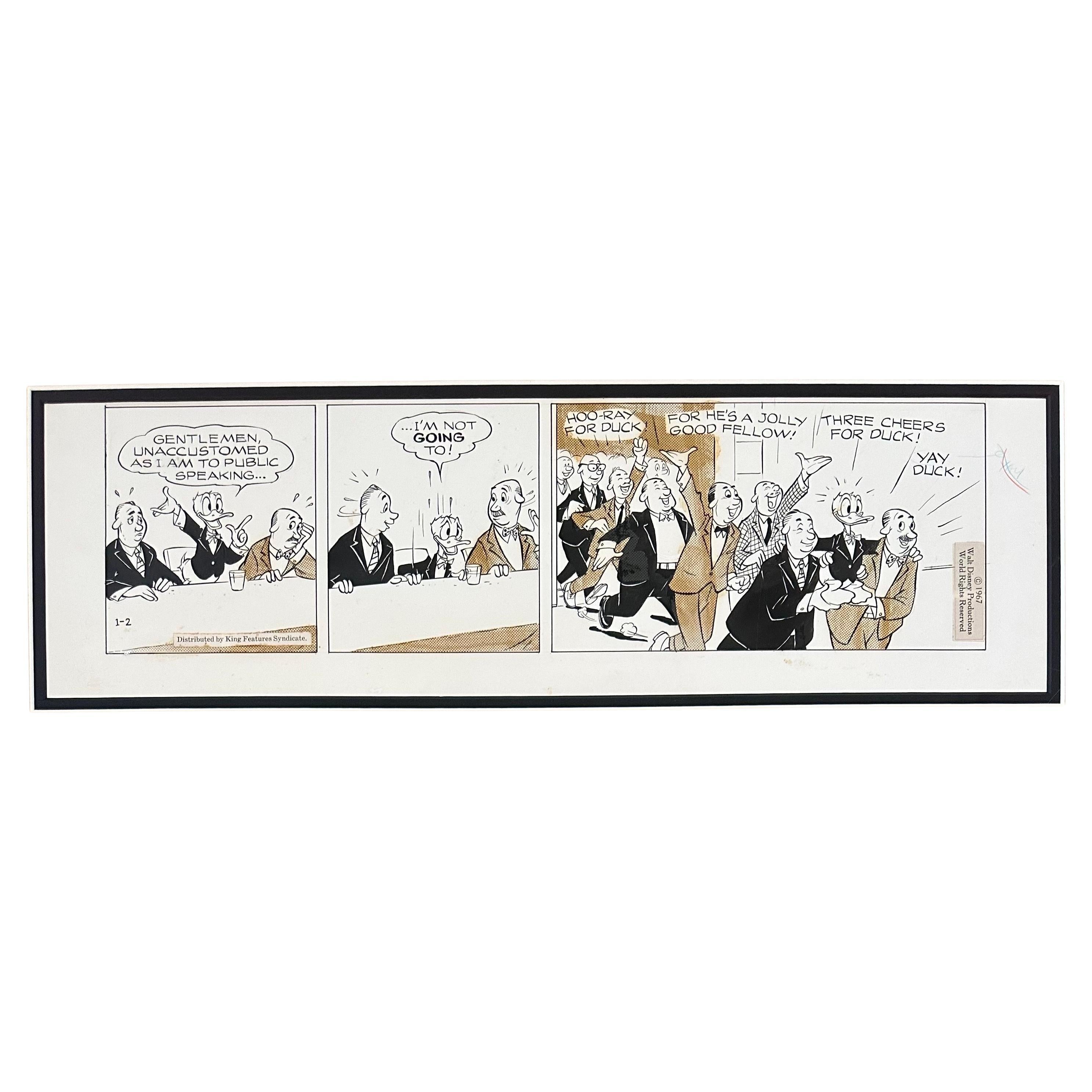
Hard to find original Walt Disney "Donald Duck" comic strip art (King Features Syndicate), circa 1967. The piece is presented in a black wood frame with black mat. Created by com...

Category

Mid-20th Century American Mid-Century Modern Books

Materials

Paper

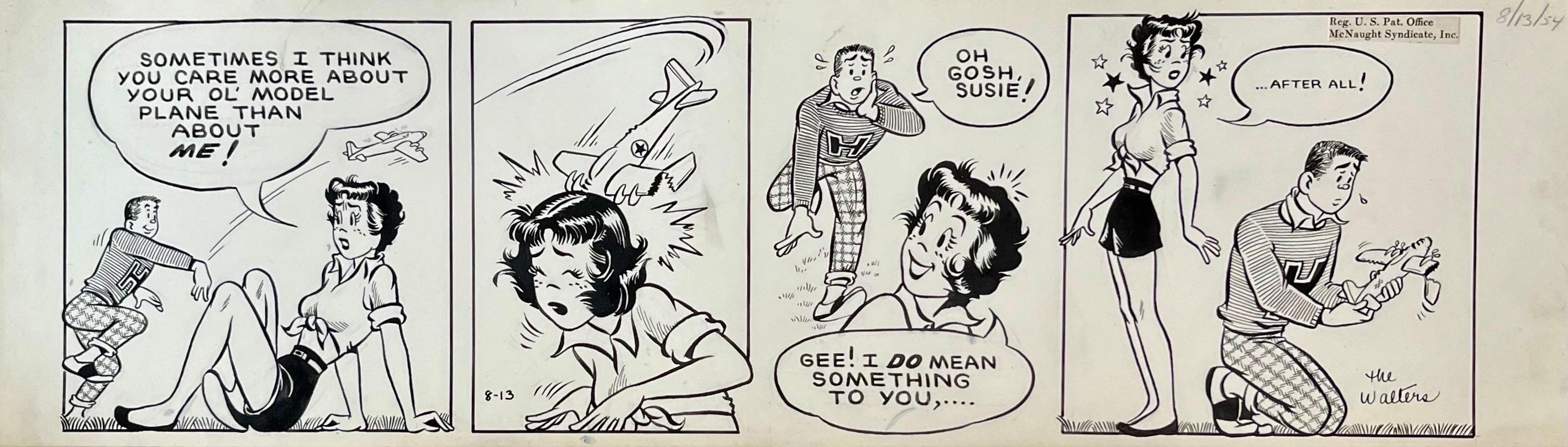
Original Vintage Syndicated Ink Drawing Cartoon Strip Susie Q Smith Comic Art

Original Vintage Syndicated Ink Drawing Cartoon Strip Susie Q Smith Comic Art

By Jerry Walter & Linda Walter

Located in Surfside, FL

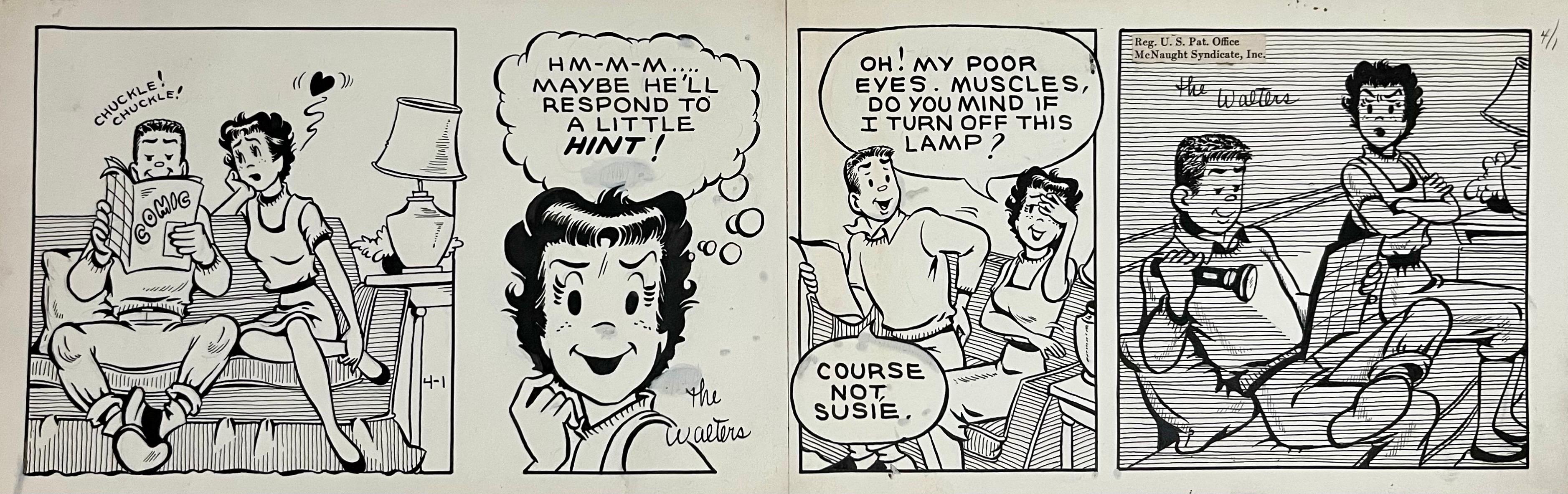
SUSIE Q. SMITH Medium: Newspaper comics Distributed by: King Features Syndicate First Appeared: 1945 Creators: Linda and Jerry Walter 6.5 X 18 Like her contemporaries, Aggie Mack, Candy and Patsy Walker (before her conversion to a superhero), Susie Q. Smith was a female Archie-type — not exactly an imitator, because Archie, who had started only four years earlier, hadn't yet become popular enough to spawn imitators, but part of his genre. She attended high school, where her teachers often seemed unreasonable to her, interacted with the opposite gender in a typically adolescent way, and her parents didn't completely understand her. And she was cute and perky as only a teenage girl can be. Susie was the star of a comic strip distributed by King Features, the biggest of the comic strip syndicates, whose other offerings have ranged from Jackys Diary to Prince Valiant...

Category

1950s American Modern More Art

Materials

Paper, Ink

Rare 1950s Original Syndicated Ink Drawing Cartoon Strip Susie Q Smith Comic Art

Rare 1950s Original Syndicated Ink Drawing Cartoon Strip Susie Q Smith Comic Art

By Jerry Walter & Linda Walter

Located in Surfside, FL

SUSIE Q. SMITH Medium: Newspaper comics Distributed by: King Features Syndicate First Appeared: 1945 Creators: Linda and Jerry Walter 5.5 X 17.75 Like her contemporaries, Aggie Mac...

Category

1950s American Modern More Art

Materials

Paper, Ink

Humorous Gentleman's Magazine cartoon

Humorous Gentleman's Magazine cartoon

Located in Wilton Manors, FL

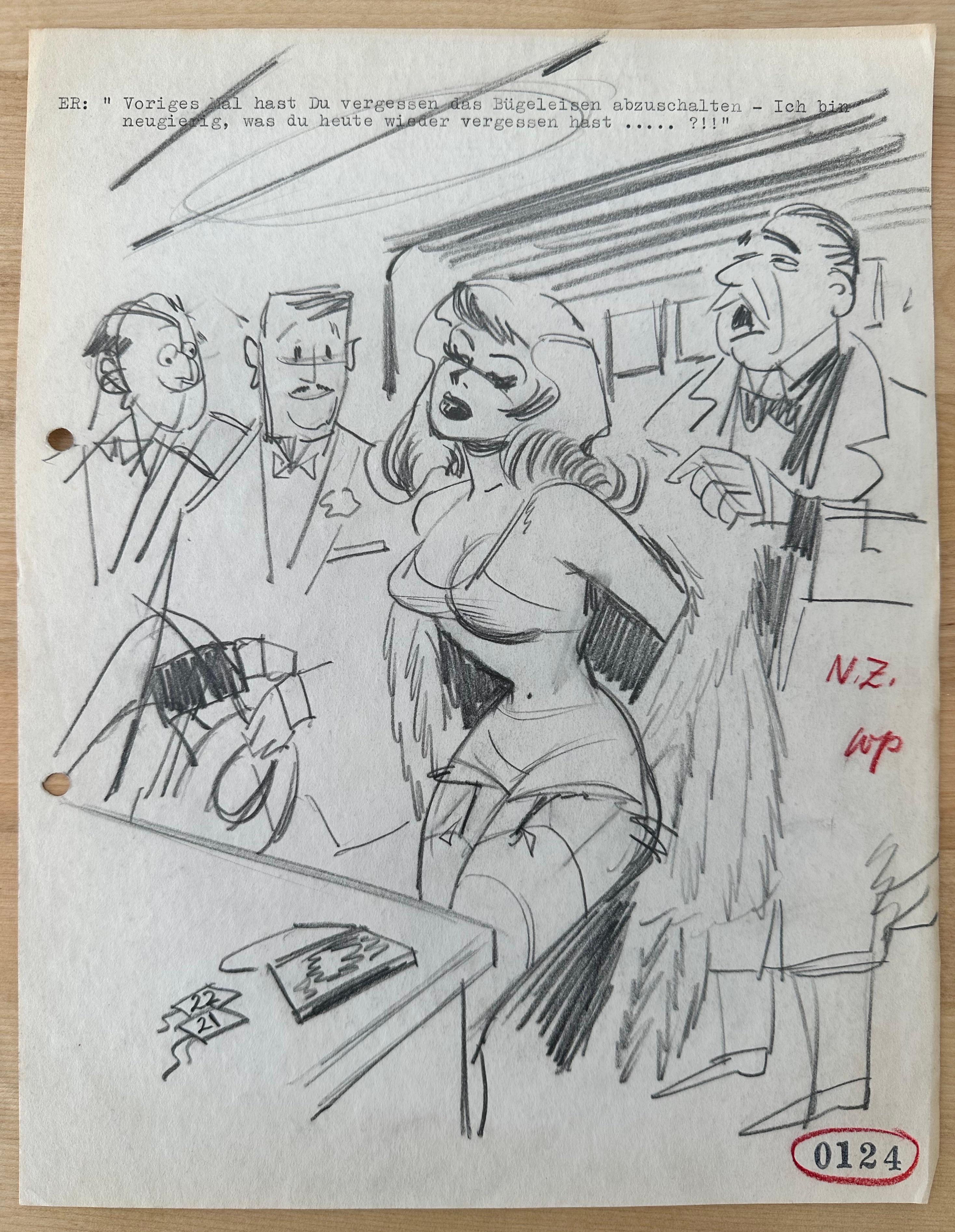
Cartoon sketch, ca. 1955. Pencil on paper, sheet measures 8.5 x 11 inches. Unsigned with editor's notations. From a group of sketches meant to be preliminary drafts for editor appro...

Category

Mid-20th Century Figurative Drawings and Watercolors

Materials

Pencil