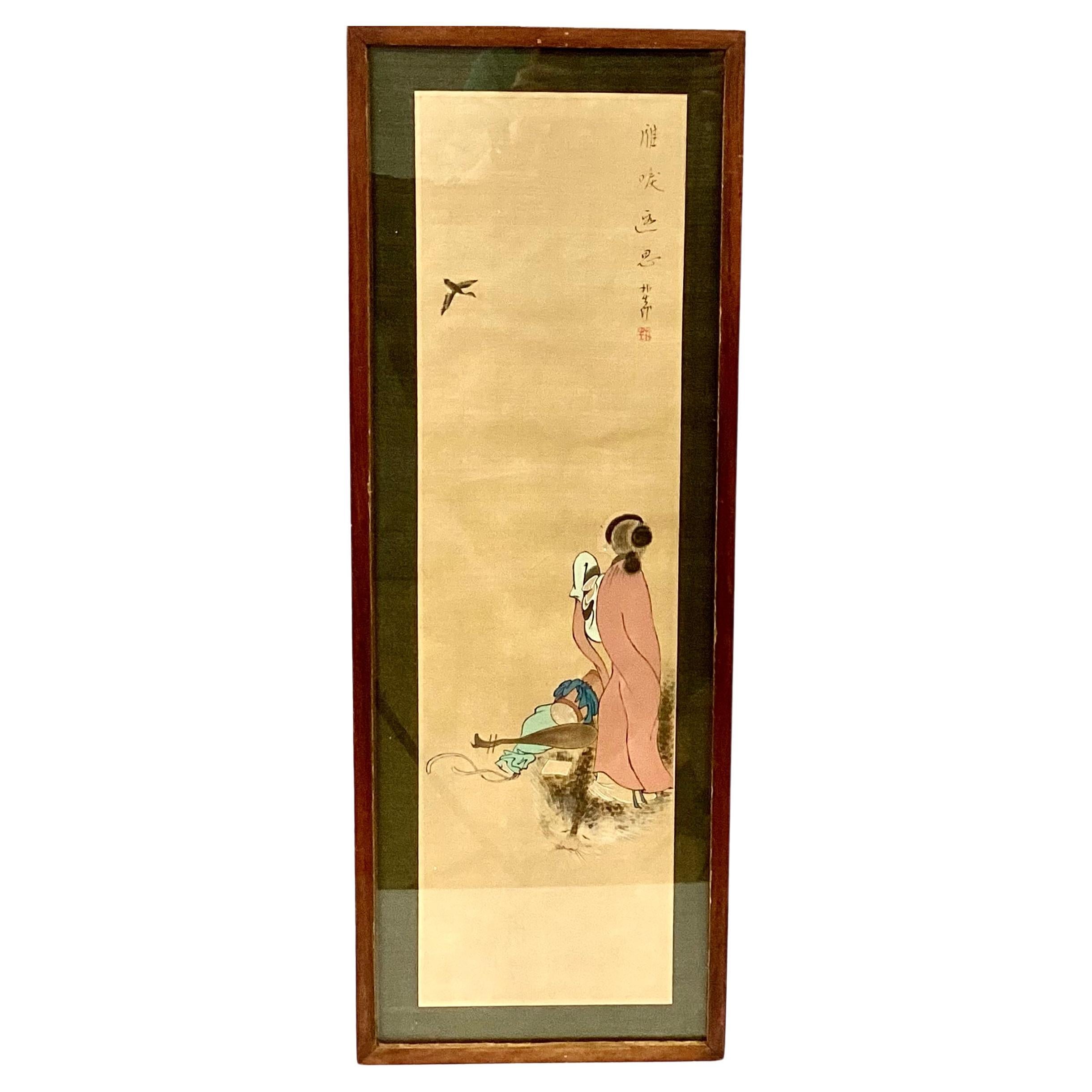
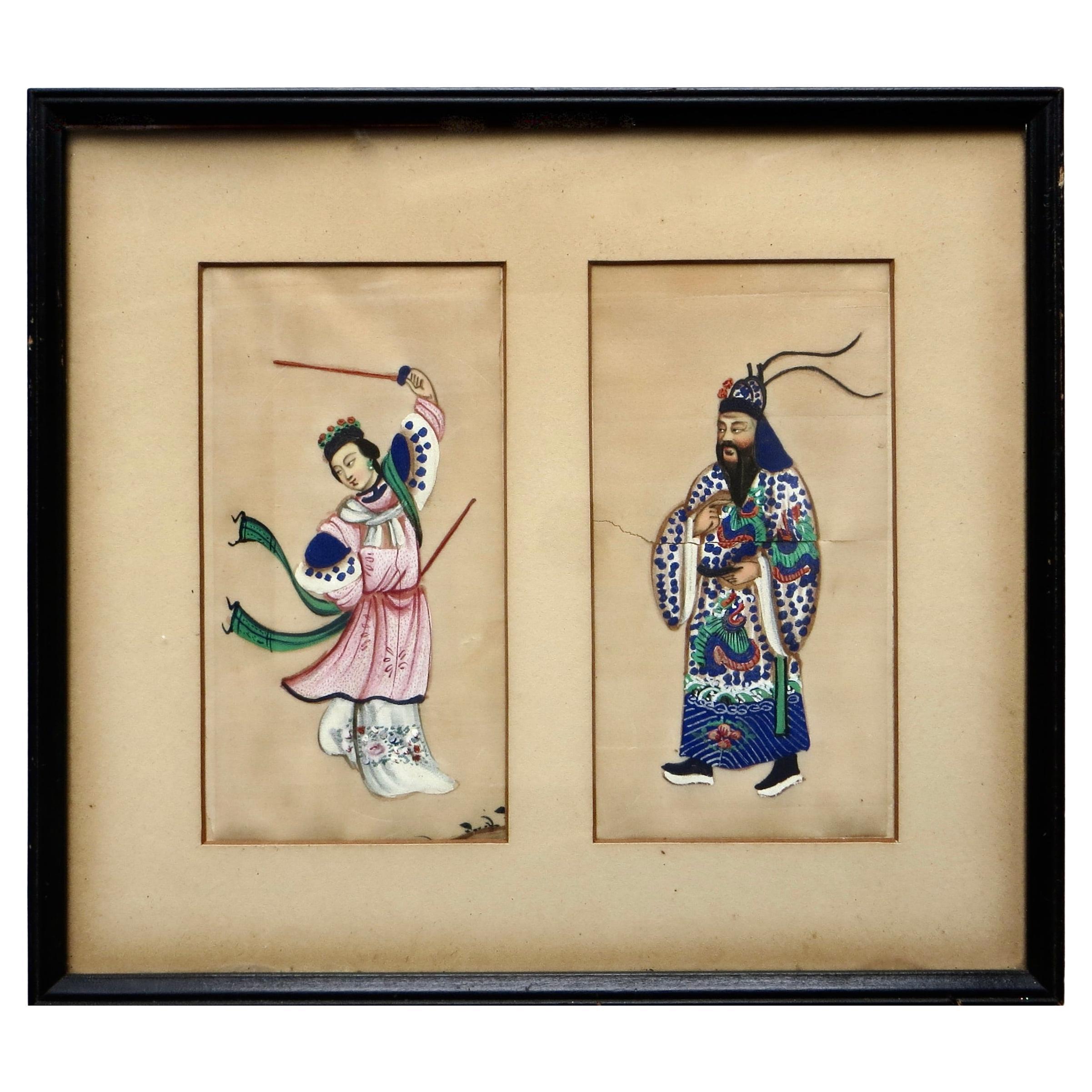
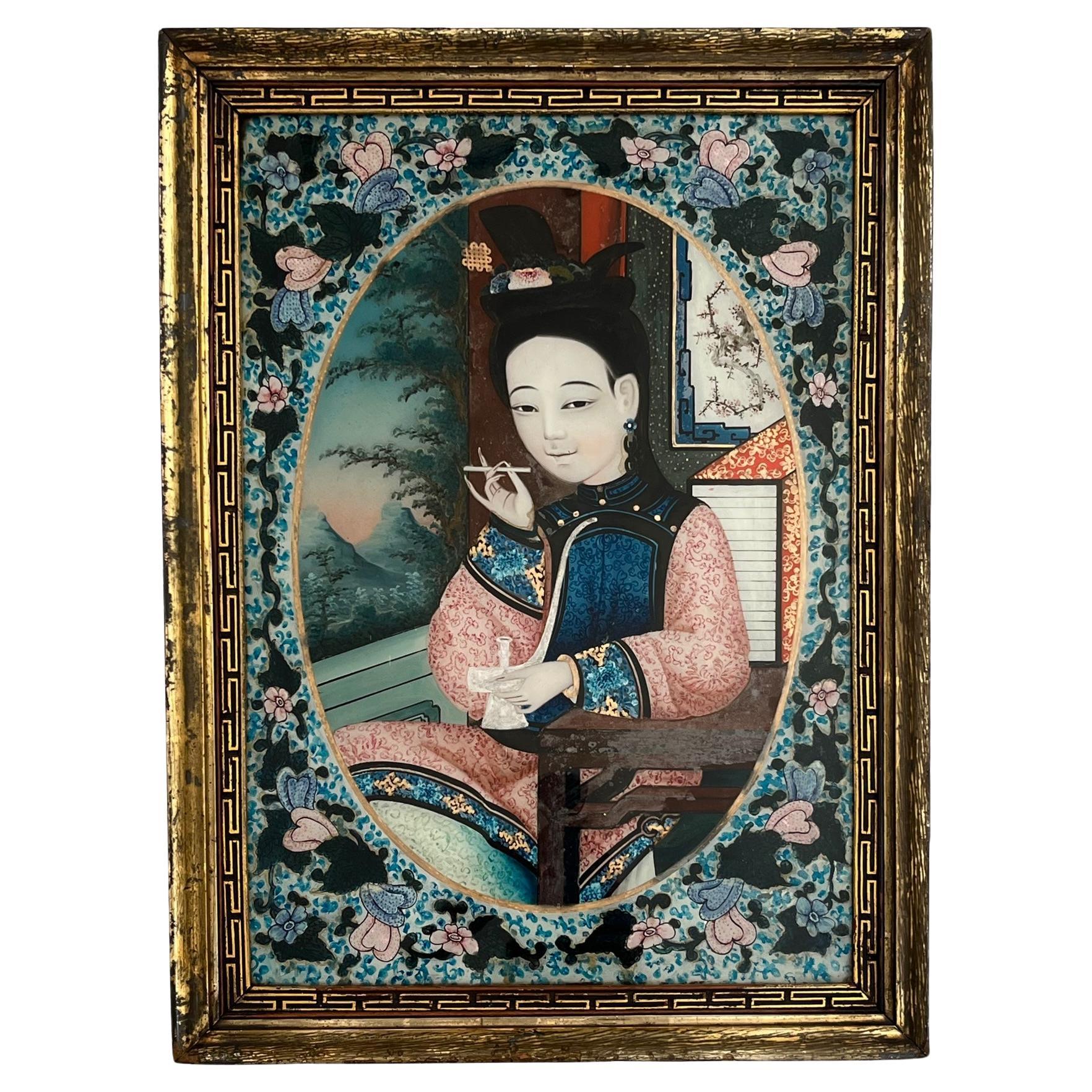
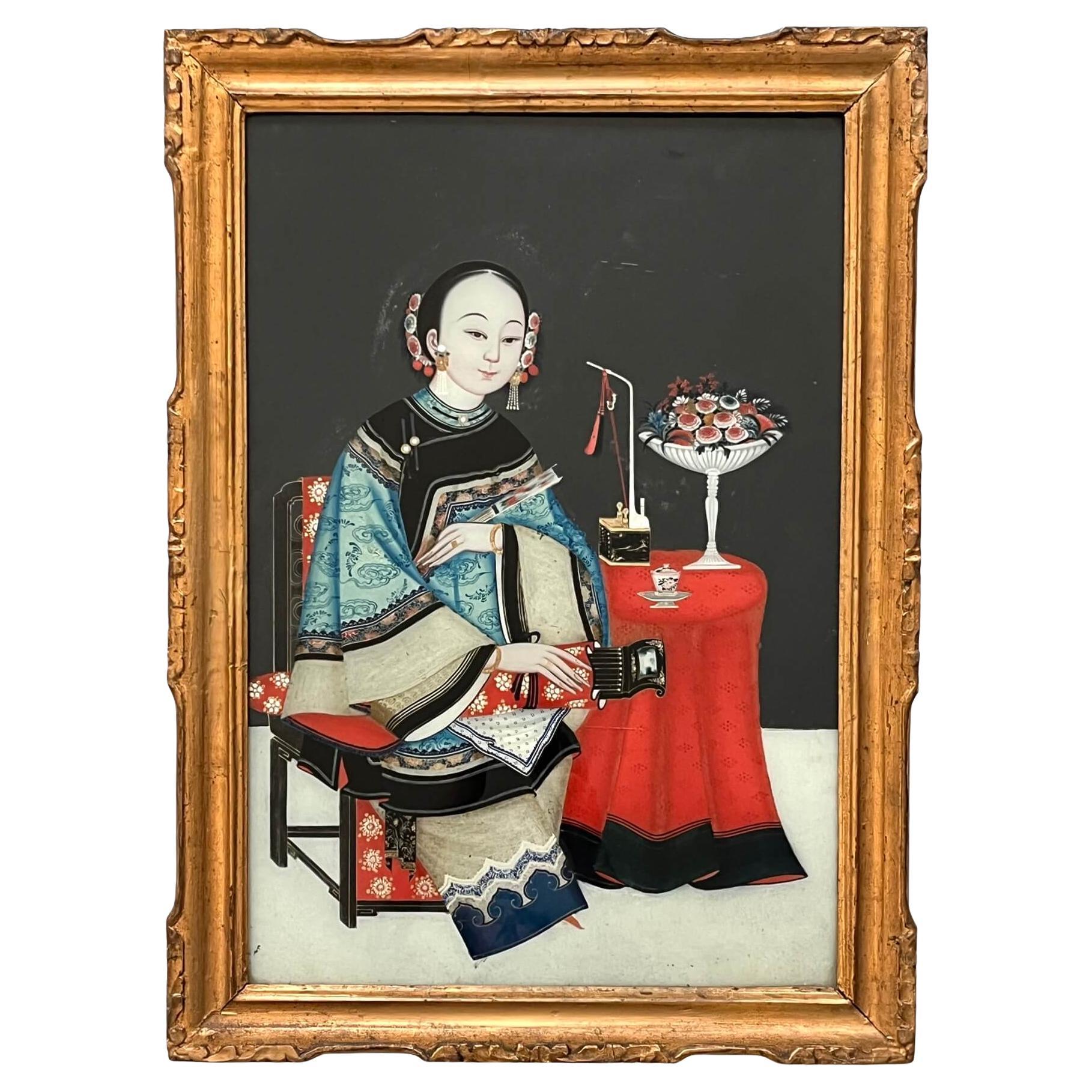
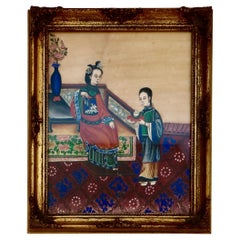
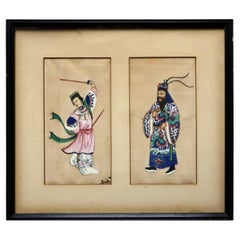
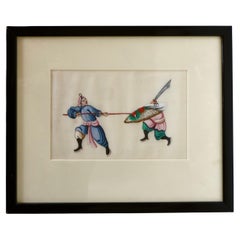
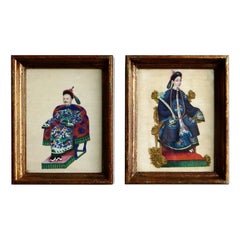
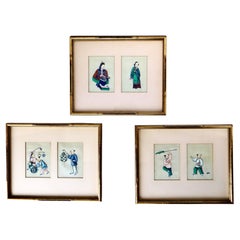
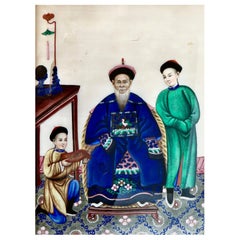
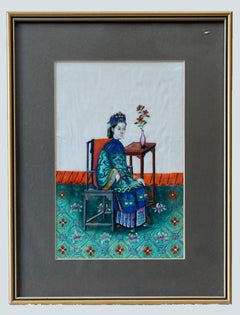
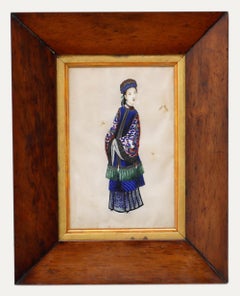
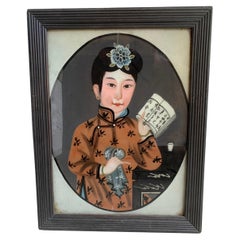
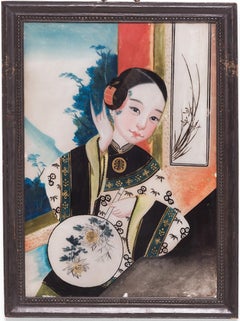
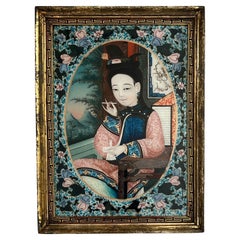
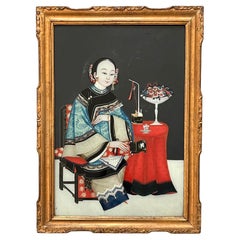
A female flautist is proudly on display in this circa 1850 Chinese watercolor pith painting; as the subject portrays an element of Chinese culture wanting to be expressed and shown to the outside world during that time period. She is obviously a woman of means as per her attire and, just by virtue of the fact that she can fund music lessons and afford an instrument; in addition; she is elegantly dressed in a lovely pink robe, with light blue pants, and a sweeping hanging green scarf, while seated on a green fancy ottoman. Note the detail to the flute. A plain background of the original cream colored pith paper above the brown diamond patterned floor completes the painting, which is very nicely mounted in a gold and black wooden frame. In addition, a beautiful and tastefully done oval matte inside and under glass highlights the subject; probably mounted in the 1920's based on the early style telephone number (see image of the rear), address research, and estate acquisition.
The picture is in very good and completely all original condition with no repaint, restoration, or repaint of any kind and would make a lovely addition to those who collect pith paintings, or others who are simply interested in 19th century Chinese culture.
Dimensions: 10 1.2" high x 10 3/4" wide x 3/4" deep (frame)
Actual painting;l oval matte= 7" high x 4 3/4" wide
Note: Please see my other 19th century Chinese Pith Paintings that I have listed for sale.
Background:
19th century Chinese "Pith Paintings" were produced by local Chinese artists; painted predominately in watercolor on sheets of "pith paper" hand cut and trimmed from the stem of a papyrus type plant (indigenous to China), often mistakenly referenced as rice paper. Actual pith paper is porous and spongy, which results in the paint sitting on the surface, and producing a crisp and velvety look, with strong and vibrant sharp colors, often appearing as three dimensional.
During the 1800's in cities like Canton, China, and other tourist attractions, Chinese artisans painted and sold these gems to travelers as souvenirs to give them a glimpse of life in the "Orient" at the time. Whether it be their dress, customs, mores, or dining habits, Chinese tradition was featured on these small paintings and often they were placed in an inexpensive frame for the long journey home by land and sea. They were very rarely signed. The "heyday" of pith paintings was from the 1830's to 1870's (albeit, some earlier examples, circa 1820's, have been noted). The advent of photography in the late 1800's resulted in their demise. These mementoes turn up mainly in England, Western Europe, and to some extent, the United States; wealthy Americans having ventured to China in the mid to late 19th century.
Today, Chinese Pith Paintings have universally become quite collectible by antique aficionados and also, for those who like historical 19th century contemporaneous Asian artifacts. Collections can be found and viewed in the British Museum, The Hermitage, and The Peabody/ Essex Museum in Massachusetts.
Note: I am a second generation antiques dealer and have been in business, buying, selling, and collecting, fine art and antiques for 50 years; I am also a member of several prestigious antique associations. Thus, I am well qualified to inspect and evaluate the products I offer for sale and I guarantee this to be authentic and as I have described.