Want more images or videos?
Request additional images or videos from the seller
1 of 8

William Henry Hunt
19th century watercolour of a Girl at her Dressing Table

Circa 1833

$27,723.31
£20,000
€23,804.17
CA$38,399.52
A$38,498.41
CHF 22,309.55
MX$470,420.32
NOK 258,535.98
SEK 264,008.56
DKK 177,929.48

About the Item

Collections: Muir Hetherington; Sir John and Lady Witt, acquired 1974; By descent to 2015. Literature: Tom Jones (ed.), William Henry Hunt 1790-1864, exh. cat., 1981, no. 145 (Girl in a bedroom); John Witt, William Henry Hunt (1790-1864) Life and Work, London, 1982, no. 553, p. 194, colour pl. 16. Exhibited: Wolverhampton, Central Art Gallery, Preston, Harris Museum and Art Gallery and Hastings, Hastings Museum and Art Gallery, William Henry Hunt 1790-1864, 1981, no. 145 as Girl in a bedroom (Lent by Sir John & Lady Witt) Framed dimensions: 20 x 20.75 inches This unusually charming and well-preserved watercolour was painted by William Henry Hunt in around 1833. Almost certainly depicting his young wife, Sarah, possibly in the interior of her family home at Bramley in Hampshire. This work shows Hunt’s remarkable virtuosity as a watercolourist, Hunt, for example, articulates the profile of his young wife, by leaving a reserve of white paper to suggest the light modelling her features. Throughout the 1830s Hunt made a sequence of richly painted interior views of both domestic and agricultural spaces which pay scrupulous attention to detail. Hunt was born in London, the son of a tin-plate worker and japanner. J. L. Roget recorded the observation of Hunt’s uncle: ‘nervy, little Billy Hunt… was always a poor cripple, and as he was fit for nothing, they made an artist of him.’ At the age of sixteen he was apprenticed to the landscape painter John Varley for seven years, moving to live with Varley at 18 Broad Street, Golden Square, London. There he made close friends with both John Linnell and William Mulready. Hunt worked at the ‘Monro Academy’, at 8 Adelphi Terrace, London, the house of Dr Thomas Monro, an enthusiastic patron of landscape watercolourists. Through Monro, Hunt was introduced to the 5th Earl of Essex and 6th Duke of Devonshire, working extensively at Cassiobury, Chatsworth, Hardwick Hall, Devonshire House and Chiswick House. At the beginning of the 1820s Hunt’s work moved away from topographical scenes to ones of human interest, including rural or domestic characters, as well as still lives and figure studies. Throughout the decade he spent the winter months at Hastings in Sussex, where he made many drawings of boats, the seashore, and fishermen. Three brothers he met in Hastings, who became known as ‘Hunt’s boys’, posed as models for many of his drawings. On 13 September 1830 Hunt married his eighteen-year-old cousin Sarah Holloway, whose father was a miller and farmer at Bramley in Hampshire. A daughter, Emma Effie, was born in 1832. Hunt’s work for the 6th Duke of Devonshire in particular established him as the greatest interior watercolourist of his generation. Hunt’s views of Chatsworth, Hardwick, Devonshire House and Chiswick are still revered for their verisimilitude, charting the precise position of furniture and state of upholstery with such accuracy that they are still referred to by historians. This forensic approach to the recording and rendering of interiors is apparent in this watercolour. Hunt has meticulously depicted the patchwork quilt on the bed, its simple canopy and hangings as well as the patterned hat box under the bed. Hunt has similarly captured the early eighteenth-century inlaid table and high-backed chair. But what transforms this watercolour from a careful portrait of an interior is Hunt’s tender and intimate depiction of his wife at her dressing table, carefully plaiting (or unplaiting) her hair. Hunt. Hunt’s silent observation adds a curious tension to the image. Preserved in outstanding condition, this particular watercolour belonged to the greatest collector of Hunt’s works, Sir John Witt, who was responsible for writing the standard account of Hunt’s career. The Witt family retained the watercolour and it was not included in the Sotheby’s auction of Witt’s collection in 1987.
  • Creator:
    William Henry Hunt (1790 - 1864, British)
  • Creation Year:
    Circa 1833
  • Dimensions:
    Height: 20.25 in (51.44 cm)Width: 16.5 in (41.91 cm)
  • Medium:
  • Movement & Style:
  • Period:
  • Condition:
    Preserved in excellent condition, the watercolour remains very fresh.
  • Gallery Location:
    London, GB
  • Reference Number:
    1stDibs: LU150727722902

More From This Seller

View All
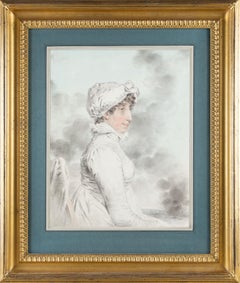
Regency portrait drawing of Arabella Graham-Clarke

Regency portrait drawing of Arabella Graham-Clarke

By John Downman

Located in London, GB

Collections: The sitter, and by descent; Christie's, 19th March 1928, lot 6; Private collection to 2019 Literature: G.C. Williamson, John Downman, A.R.A., his Life and Works, Lon...

Category

Early 19th Century Old Masters Portrait Drawings and Watercolors

Materials

Pencil, Watercolor

Portrait drawing of Harriot Mellon, Mrs Thomas Coutts

Portrait drawing of Harriot Mellon, Mrs Thomas Coutts

By Henry Fuseli

Located in London, GB

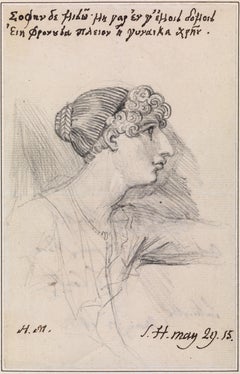
Inscribed by the artist in pen and brown ink, upper margin: 'σοφὴν δὲ μισῶ: μὴ γὰρ ἔν γ' ἐμοῖς δόμοις / εἴη φρονοῦσα πλείον' ἢ γυναῖκα χρή [Euripides, Hippolytus, 11, 640-41: “But a ...

Category

19th Century Old Masters Portrait Drawings and Watercolors

Materials

Pencil

Drawing of a captive woman

Drawing of a captive woman

By Henry Fuseli

Located in London, GB

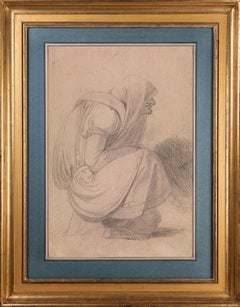
Collections: Sir Thomas Lawrence, who acquired the contents of Fuseli’s studio; Susan, Countess of Guilford, née Coutts (1771-1837), acquired from the Lawrence estate; Susan, Baroness North (1797-1884), daughter of the above; Mrs A. M. Jaffé, acquired in France, c. 1950 to 2016. Black chalks, on buff-coloured paper Stamped verso: ‘Baroness Norths Collection / of Drawings by H Fuseli Esq.’ Framed dimensions: 26.38 x 20.63 inches This boldly drawn sheet depicting a seated figure was made by Fuseli at an important and highly productive moment in his career. The monumental drawing is closely related to another sheet by Fuseli in the British Museum which Schiff published as subject unknown. Both drawings were made when Fuseli was designing his most important sequence of historical works, including scenes from Shakespeare and Milton, The Nightmare and The Death of Dido which was exhibited at the Royal Academy to great critical acclaim in 1781. The present drawing does not relate directly to any of Fuseli’s finished historical paintings of the period, but evidently the image of a slightly menacing, seated and covered old woman was precisely the sort of motif he was playing with. It is notable that the same figure reappears later in Fuseli’s work as the witch from Ben Jonson’s Witch’s Song which Fuseli produced as both a painting and engraving in 1812. Fuseli returned to London in 1779 from a highly creative and productive period in Rome and established himself as one of the leading history painters of the period. Fuseli re-established contact with his old mentor Sir Joshua Reynolds, becoming a regular guest at his dinner table and visitor to his studio. The earliest and most striking manifestation of this strategy was Fuseli's Death of Dido, exhibited in 1781 at the Royal Academy. Executed on the same scale as Reynolds's version (Royal Collection), Fuseli's vertically oriented picture was hung directly opposite Reynolds's with its horizontal orientation, inevitably inviting comparison between the two works and garnering Fuseli much publicity and favourable reviews in the newspapers. The present, previously unpublished sheet, relates closely to a drawing now in the British Museum. That sheet shows the same seated old woman, drawn on a smaller scale and more schematic in design, seated next to an anatomical drawing of a man. The pose of this figure is related to the pose of Dido in his Death of Dido; the foreshortened torso, arrangement of head, oblique view of Dido’s features and arms all suggest that the study can be viewed as an initial thought for the composition. Fuseli may have initially thought of including the figure of the hunched and covered old woman. Drawn on identical paper to the British Museum sheet, our study is an enlarged depiction of the same figure, more elaborately delineated and developed. The presence of a chain to the right of the figure, suggests that the iconography was related in some way to a scene of imprisonment. Fuseli had first explored the motif of the hooded old woman in an early Roman drawing, 'The Venus Seller'. The idea of a grotesque old woman, hooded and with angular nose and projecting chin seen in profile was most spectacularly used by Fuseli in his sequence of paintings depicting The Three Witches from Macbeth. Fuseli seems to have kept the present sheet and may have returned to it when preparing a painting of The Witch and the Mandrake from Ben Jonson’s Witch’s Song from his Masque of Queens in 1812. Here the same seated figure looks out from under her hood and picks a mandrake by moonlight. Jonson’s drama had been performed at the court of James I in 1609, inspired the subject. To throw the nobility of the queens into relief, the poet added a coven of witches, one of whom declares: ‘I last night lay all alone, On the ground, to hear the mandrake groan; And plucked him up, though he grew full low, And, as I had done, the cock did crow.’ The figure was reversed in the associated etching which was published in 1812. It seems likely that the present drawing remained as part of Fuseli’s working archive of figure studies. The present drawing was presumably purchased with the bulk of Fuseli’s drawings after the artist’s death by Sir Thomas Lawrence. Lawrence’s large group of Fuseli drawings were then acquired by Susan, Countess of Guildford (1771-1837). Lady Guildford was the eldest daughter of the banker Thomas Coutts (1735-1822), who himself had supported Fuseli’s journey to Rome in the 1770s and had remained one of the artist’s key...

Category

18th Century Old Masters Figurative Drawings and Watercolors
Materials

Chalk

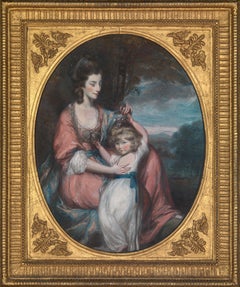
18th century pastel portrait of Lady Augusta Corbett and her son, Stuart

18th century pastel portrait of Lady Augusta Corbett and her son, Stuart

By Daniel Gardner

Located in London, GB

Collections: Commissioned by Andrew Corbett, husband of the sitter; The Venerable Stuart Corbett; Sir Stuart Corbett; By descent to 2002; Sotheby’s, London 21 March 2002, lot.104; Lowell Libson...

Category

18th Century Old Masters Portrait Drawings and Watercolors
Materials

Pastel, Gouache

Self-Portrait

Self-Portrait

By John Hamilton Mortimer

Located in London, GB

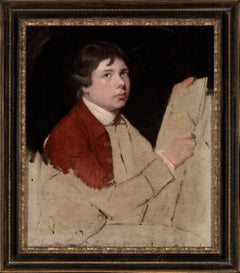
Oil on canvas 30 x 25 ⅛ inches; 762 x 638 mm Verso: after Sir Joshua Reynolds, a self-portrait Not signed Painted c. 1758 Collections: Philip Gell (1775–1842), Hopton Hall, Derbyshire; By inheritance at Hopton Hall to his daughter, Isabella, who married William Pole Thornhill, who renounced Hopton and its contents in favour of his kinsman, Henry Chandos-Pole-Gell (1829–1902); By descent to his son, Brigadier General Harry Chandos-Pole-Gell (1872–1934), who sold Hopton Hall in 1918 and moved the family to Newnham Hall, Northamptonshire; By descent to his son, Lt Colonel John Chandos-Pole (1909–1993), Newnham Hall; Thence by descent until 2015, when acquired By descent to 2015; Lowell Libson & Jonny Yarker Ltd. Literature: Algernon Graves and Walter V. Cronin, A History of the works of Sir Joshua Reynolds P.R.A., London, 1901, IV, p. 1394. David Manning...

Category

18th Century Old Masters Portrait Paintings

Materials

Canvas, Oil

You May Also Like

Young woman with a mirror - 19th century watercolor drawing

Young woman with a mirror - 19th century watercolor drawing

Located in Beuzevillette, FR

A beautiful pencil drawing enhanced with watercolor, executed with remarkable finesse. The artist demonstrates here a great mastery of line and lighting, elegantly conveying volumes,...

Category

Antique Mid-19th Century Paintings

Materials

Paper

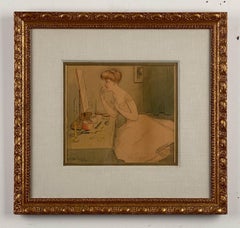
Lady at her Vanity

Lady at her Vanity

By Henry Mayo Bateman

Located in Sheffield, MA

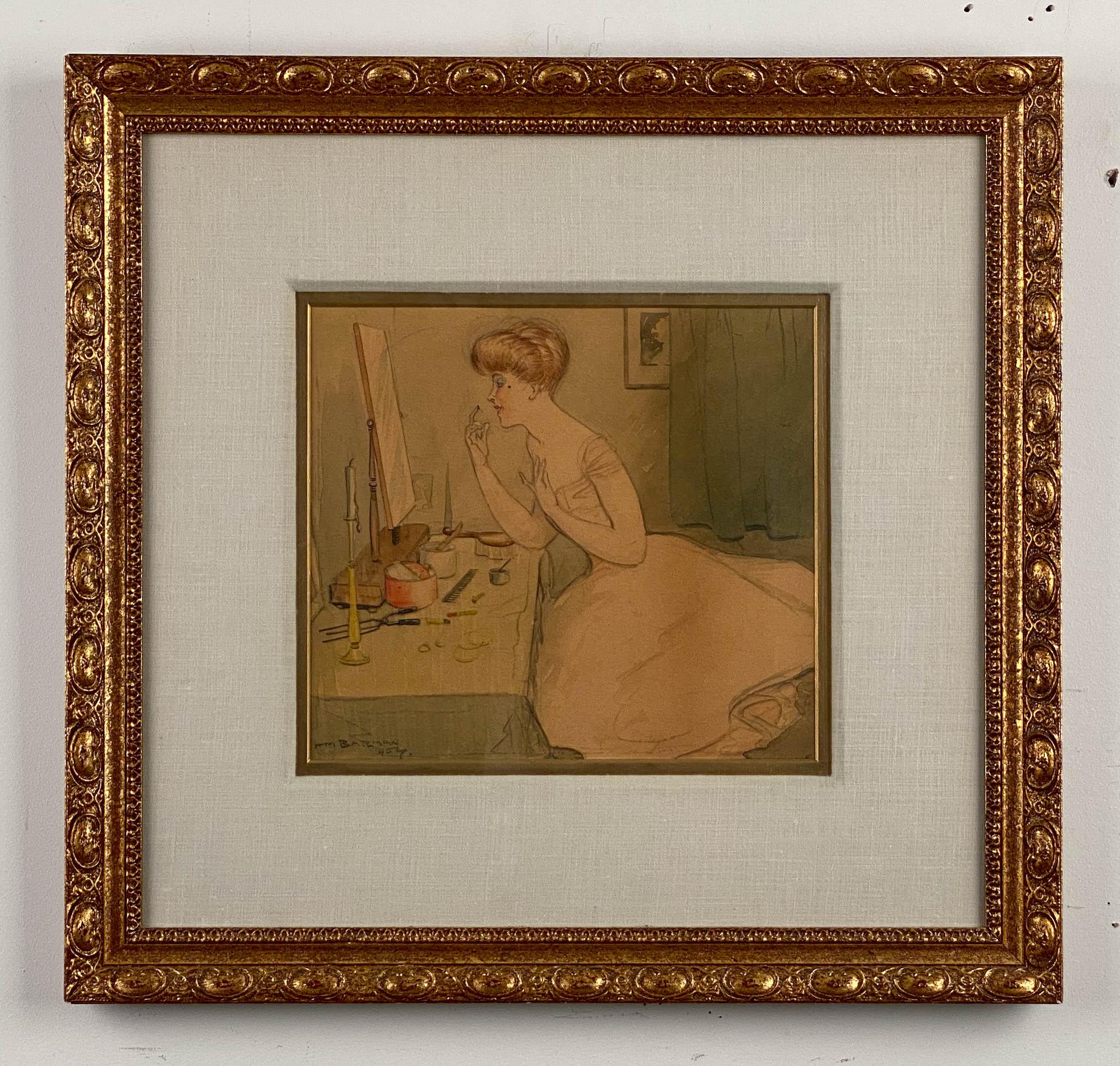
Henry Mayo Bateman English, 1887–1970 Lady at her Vanity Watercolor on paper 9 ½ by 10 ½ in. W/frame 18 ½ by 19 ½ in. Signed & dated 1904 lower on left H. M. Bateman was noted for his "The Man Who..." series of cartoons, featuring comically exaggerated reactions to minor and usually upper-class social gaffes, such as "The Man Who Lit His Cigar Before the Loyal Toast", "The Man Who Threw a Snowball at St. Moritz" and "The Boy Who Breathed on the Glass at the British Museum." He was born in the small village of Sutton Forest in New South Wales, Australia. His parents were Henry Charles Bateman and Rose Mayo. His father had left England for Australia in 1878 at the age of 21 to seek his fortune, then returned to England briefly in 1885 before going back with an English wife. Soon after Henry was born, his strong-willed mother insisted that they return to London 'and civilisation'. He had one sister, Phyllis, three years younger. Henry remained in England for the remainder of his life except for one disappointing visit to his birthplace.[citation needed] Henry was always drawing from an early age, consistently producing funny drawings...

Category

Early 1900s Art Nouveau Interior Drawings and Watercolors
Materials

Watercolor