William Sommer (1867-1949)
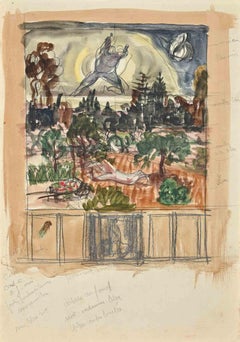
untitled (Sunrise with Figures)
Pen and ink on watermarked Otis Litho, Cleveland, paper, c. 1925
Signed with the Estate Stamp B
Related Works
Several works provide useful points of comparison:
Adam and Eve, c. 1915, in which Sommer placed archetypal nude figures within a modernist landscape.
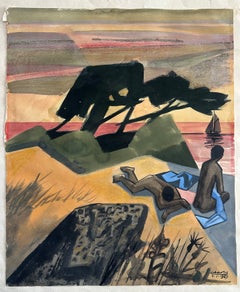
Adam and Eve at Sunset, which similarly joins the human pair to a large celestial event. The sunset in that work and sunrise in the present drawing may be viewed as complementary images of ending and beginning.
Bathers in Moonlight, c. 1916, where figures and cosmic illumination create a dreamlike, ritualized pastoral world.
Incantation, c. 1915, whose title and expressive landscape suggest Sommer’s interest in the ceremonial, spiritual, and psychologically charged dimensions of nature.
Fire Worshippers, 1921, an especially relevant precedent for the treatment of figures responding to a cosmic or elemental force.
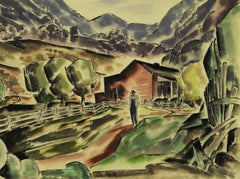
Brandywine Falls, 1923, and Sommer’s numerous Brandywine landscapes of the 1920s, which provide the rural vocabulary—rolling ground, trees, rocks, and rhythmic contours—out of which the imaginary setting of Sunrise with Figures appears to have developed.
Pa’s Brainstorm, 1937, in the Cleveland Museum of Art, offers a later comparison for Sommer’s use of an enormous circular sun radiating over a vigorously drawn landscape. Cleveland Museum of Art
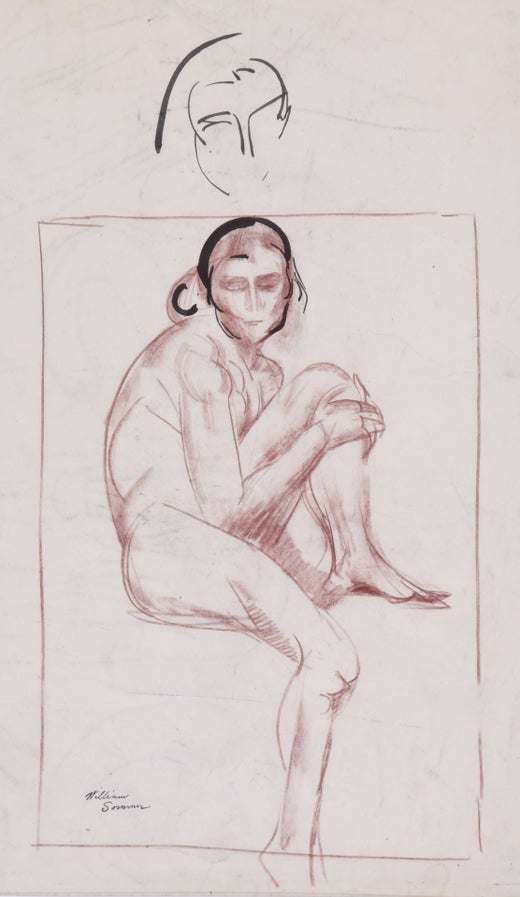
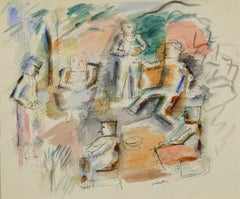
Sommer also produced numerous ink and watercolor figure studies connected with the experimental Cleveland Play House. The Cleveland Museum of Art preserves a large group of these drawings, several of which combine distorted scale, emphatic outlines, theatrical gestures, and freely invented settings. Cleveland Museum of Art
Provenance: William Sommer, Brandywine, Ohio; by descent to Ray Sommer, the artist’s son; acquired from Ray Sommer by Joseph M. Erdelac, Cleveland, Ohio; thence by descent
An Arcadian Vision of Death and Renewal
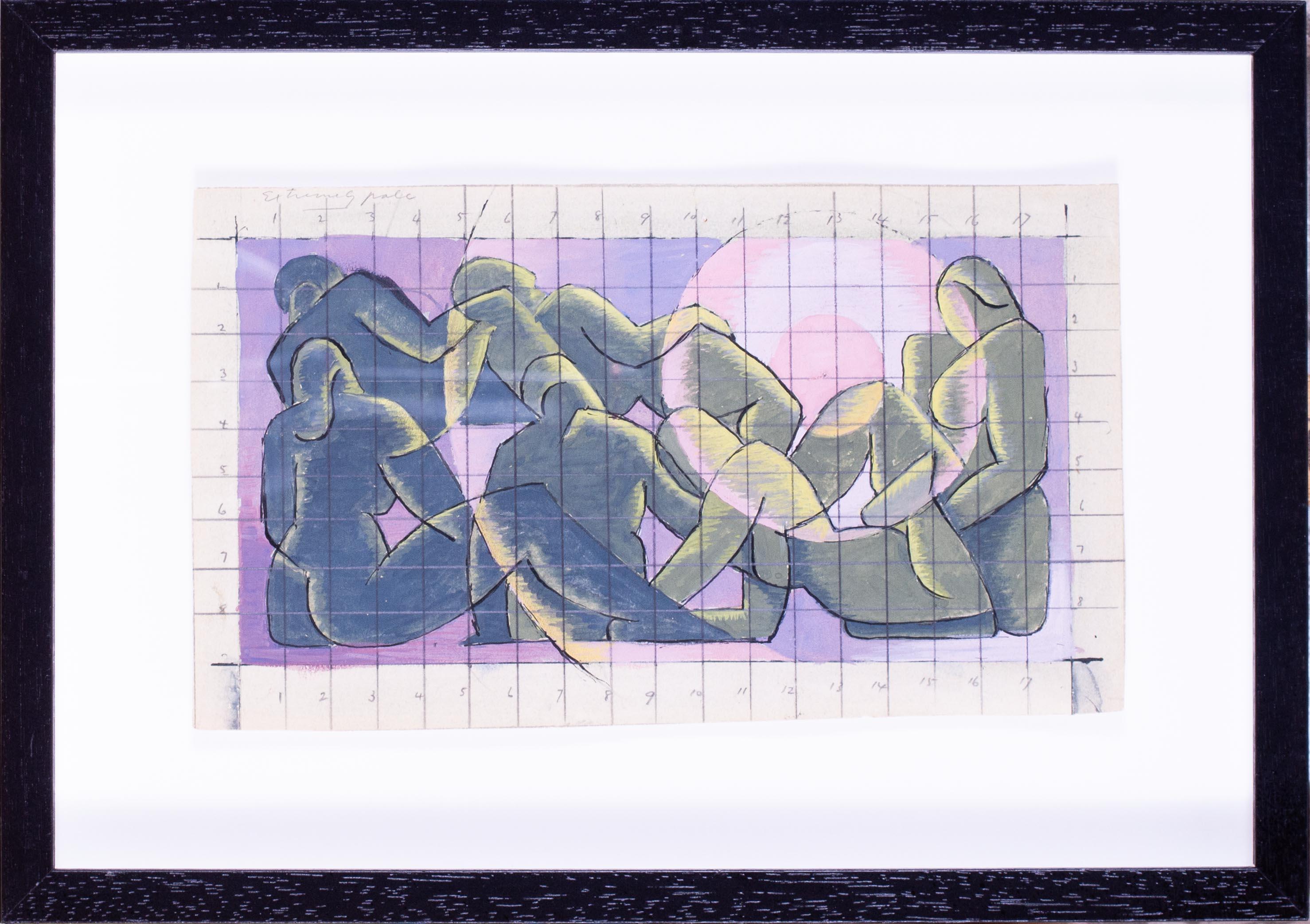
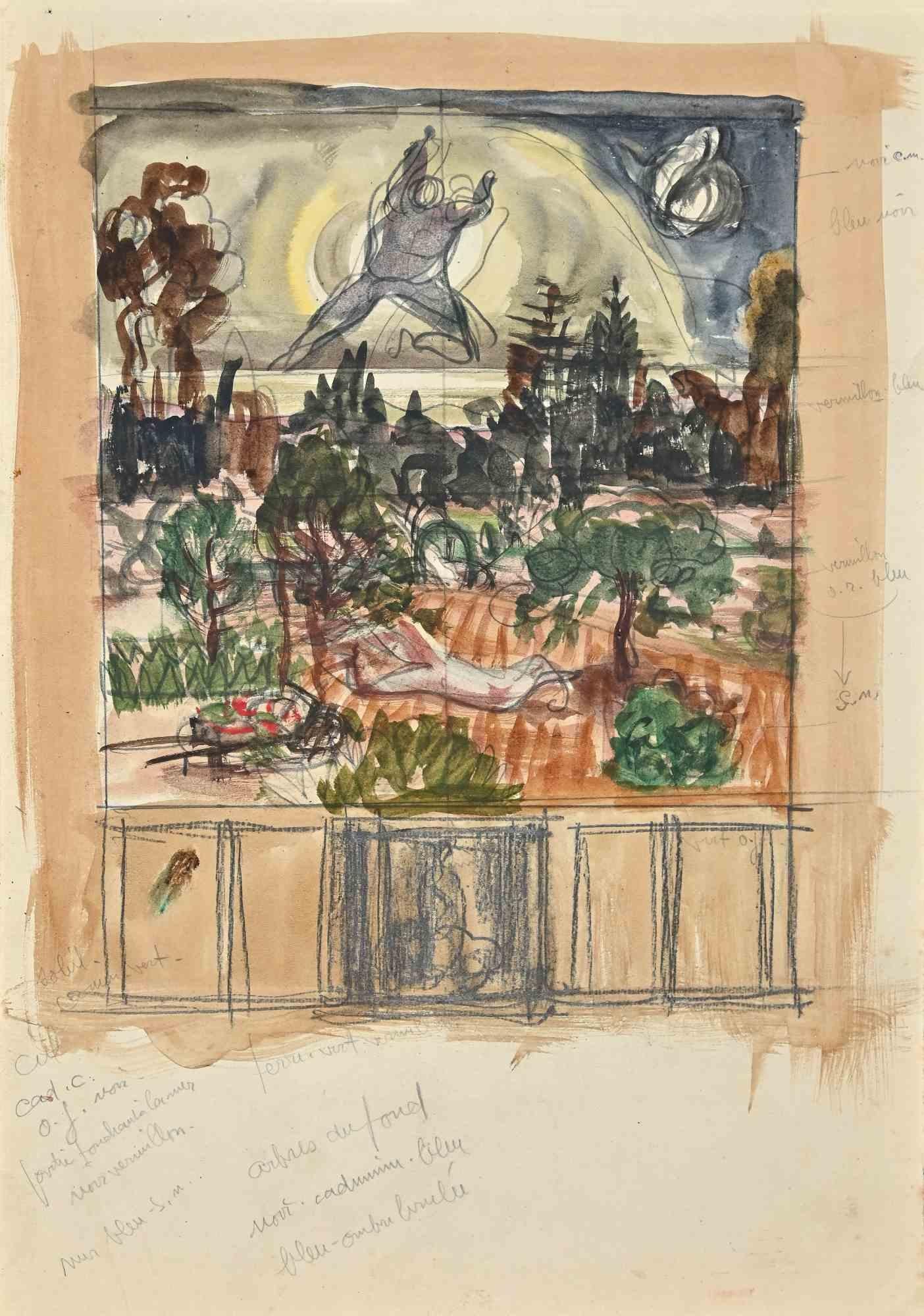
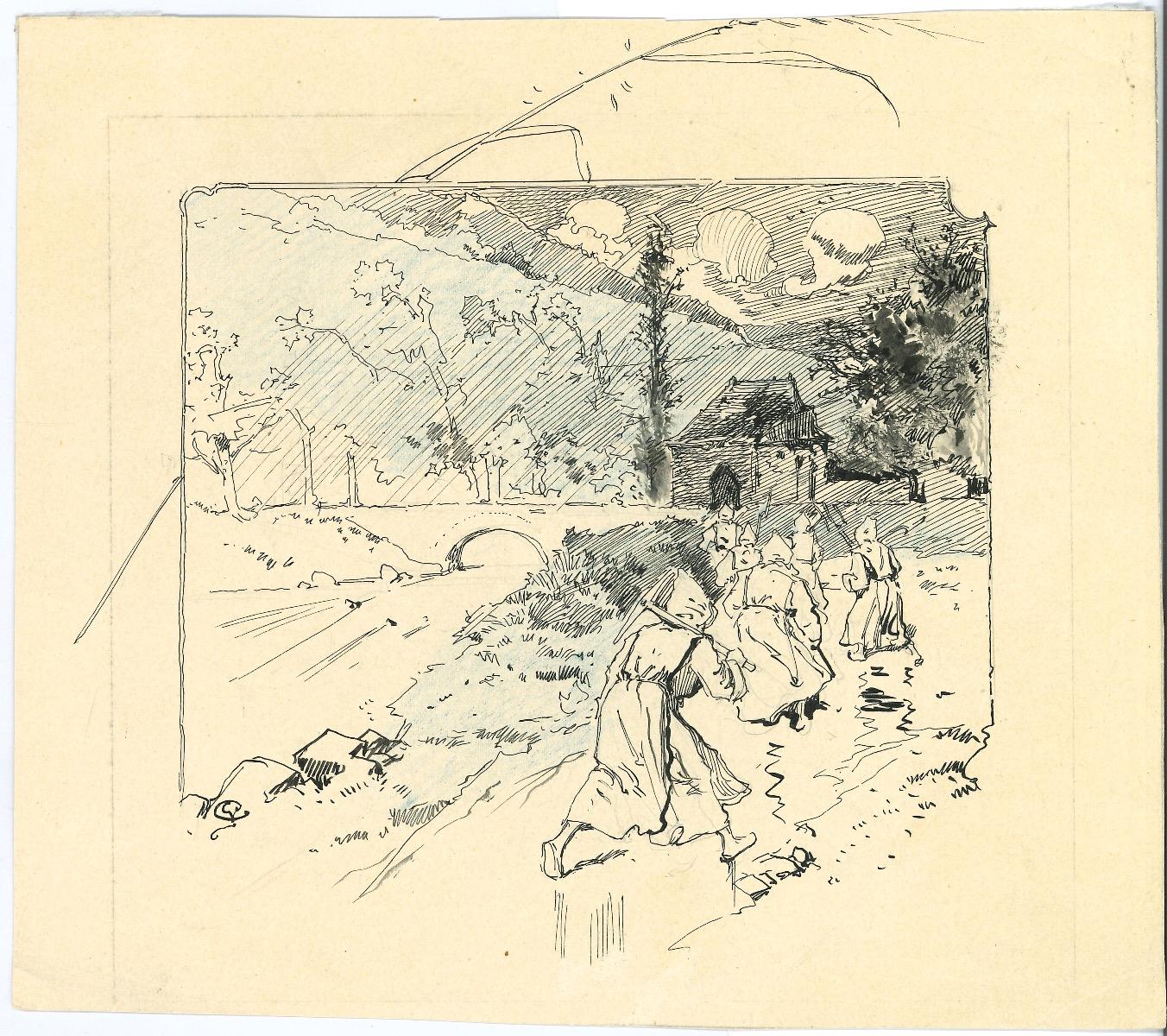
In Sunrise with Figures, William Sommer transforms a rural landscape into a mysterious allegory of human existence. Three small children occupy the foreground beside two monumental reclining adults, while an enormous sun rises—or possibly sets—behind a hill. Trees bend and twist across the horizon, their branches animated like flames or ceremonial gestures. Although the drawing is executed with the economy and spontaneity of a pen sketch, its imagery is unusually charged. The scene lies somewhere between observed nature, dream, biblical parable, and modernist pastoral.
The composition is organized around a striking disparity of scale. The two central figures are enormously enlarged in relation to the children and surrounding landscape. One lies face downward with an arm extended across the ground; the other is curled on his or her side, legs drawn inward. They could be sleeping, exhausted, grieving, or dead. Sommer deliberately avoids supplying enough detail to settle the question. Their arrangement resembles bodies deposited upon the earth rather than figures actively inhabiting it.
Around them, however, life continues. One child stands at the left, another crouches beside the outstretched adult, and a third sits in the foreground examining a flower or small plant. The contrast between the prostrate adults and the alert children gives the drawing its emotional and symbolic force. The older generation has become motionless, while the children remain upright, curious, and absorbed in the natural world.
The Rising Sun
The great circular sun is the drawing’s most direct emblem. It appears low on the horizon, intersected by radiating bands of line. If the traditional title Sunrise with Figures is correct, it identifies the moment not as an ending but as a beginning. Dawn brings light after darkness and has long signified awakening, resurrection, spiritual illumination, and the renewal of nature.
Conditiono: Excellent
Image/Sheet size: 8 1/8 x 11 1/2 inches
Privenance: Estate of the Artist
Ray Sommer, the artist's son
Acquired by Joseph M. Erdelac (1914-2005)
William Sommer: Biography
Born in Detroit in 1867, Sommer received his earliest training in drawing and commercial lithography. He apprenticed at the Calvert Lithograph Company and studied briefly in Munich before working as a professional lithographer in New York. In 1907 he moved to Cleveland to join the Otis Lithograph Company.
Sommer’s encounter with William Zorach and his exposure to Post-Impressionism, Fauvism, Cubism, and German Expressionism transformed his private art. He helped establish Cleveland’s Kokoon Arts Club in 1911 and became a central figure in the city’s early modernist community. Around 1914 he settled with his family in a converted schoolhouse near Brandywine Falls, south of Cleveland. The surrounding farms, hills, children, animals, and rural inhabitants became the foundation of his imagery. The Akron Art Museum characterizes Sommer as an artist who absorbed European modernism while adapting it to distinctly Midwestern subjects. Akron Art Museum
During the 1920s Sommer achieved increasing recognition. He exhibited in the Cleveland Museum of Art’s May Shows and received first prize for drawing there in 1924. His friendship with poet Hart Crane further connected his work to Cleveland’s avant-garde literary circles. Sommer later participated in federal art projects and exhibited nationally, while continuing to develop his intensely personal vision of Ohio life. Encyclopedia of Cleveland History
Provenance and Significance
The provenance from Ray Sommer to Joseph M. Erdelac is important. Ray was William and Martha Sommer’s youngest son and a frequent subject of his father’s art. Ownership by Ray therefore places the drawing within the immediate Sommer family and suggests that it may have remained in the artist’s household after its creation.
Joseph M. Erdelac became one of Sommer’s foremost collectors and advocates. His acquisition of works from the artist’s family helped preserve an important body of Sommer material. Erdelac was also instrumental in placing Sommer works in institutional collections; Princeton University records that an important Sommer landscape entered its collection through arrangements involving Erdelac. Princeton University Graphic Arts Collection
Conclusion
Sunrise with Figures is a compact but unusually ambitious example of William Sommer’s visionary draftsmanship. Its subject is not merely a family resting in the countryside. Through radical differences of scale, the uncertain condition of the reclining adults, the attentive children, animated trees, and monumental rising sun, Sommer constructs an allegory of mortality and renewal.
The drawing’s ultimate meaning remains intentionally unresolved. The figures may sleep or lie dead; the children may play innocently or represent a new generation emerging beside its ancestors. Dawn may promise personal awakening, spiritual resurrection, or simply the indifferent continuation of nature. That ambiguity is precisely the work’s strength. Sommer transforms the familiar Ohio landscape into a timeless stage upon which human vulnerability, childhood, death, and regeneration coexist. The direct family provenance from Ray Sommer, followed by ownership by the distinguished collector Joseph M. Erdelac, further enhances the drawing’s historical importance within the artist’s oeuvre.