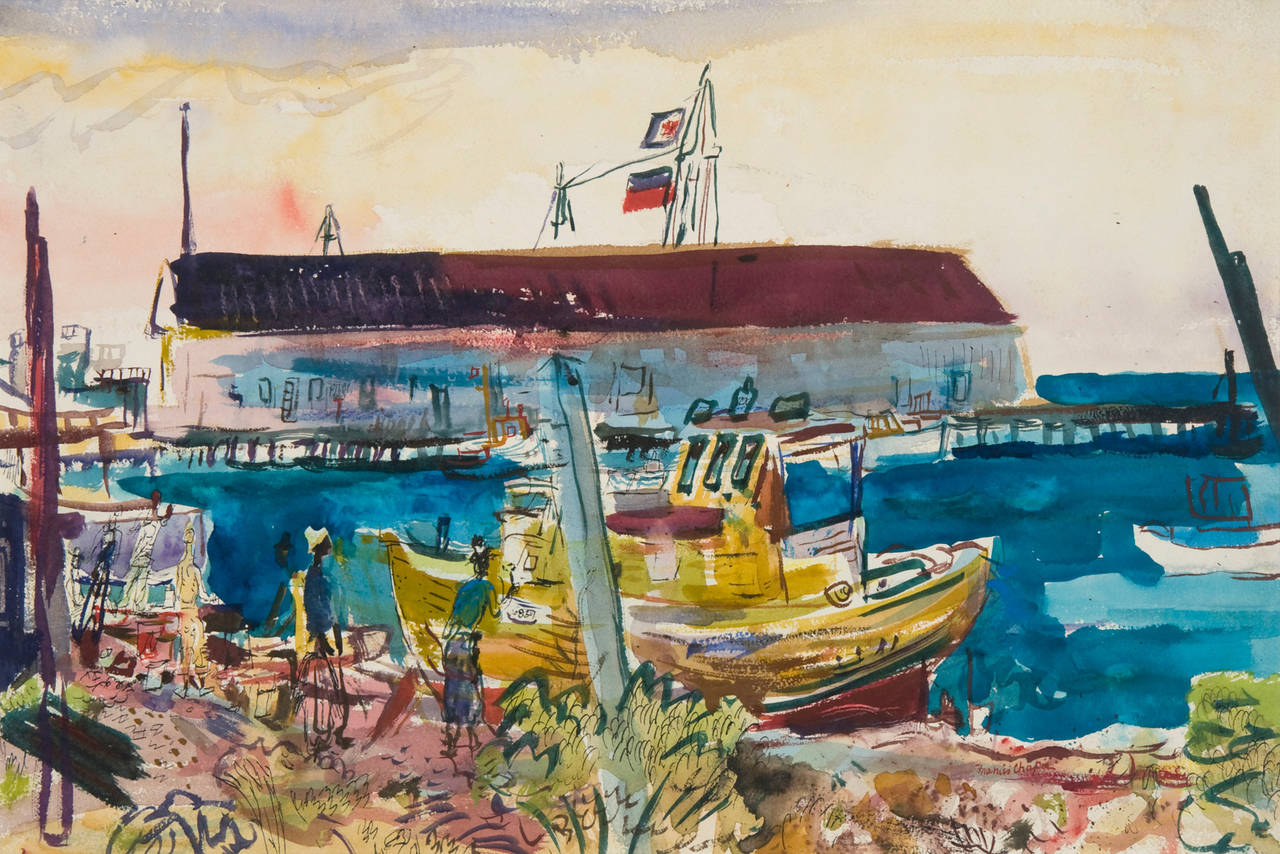
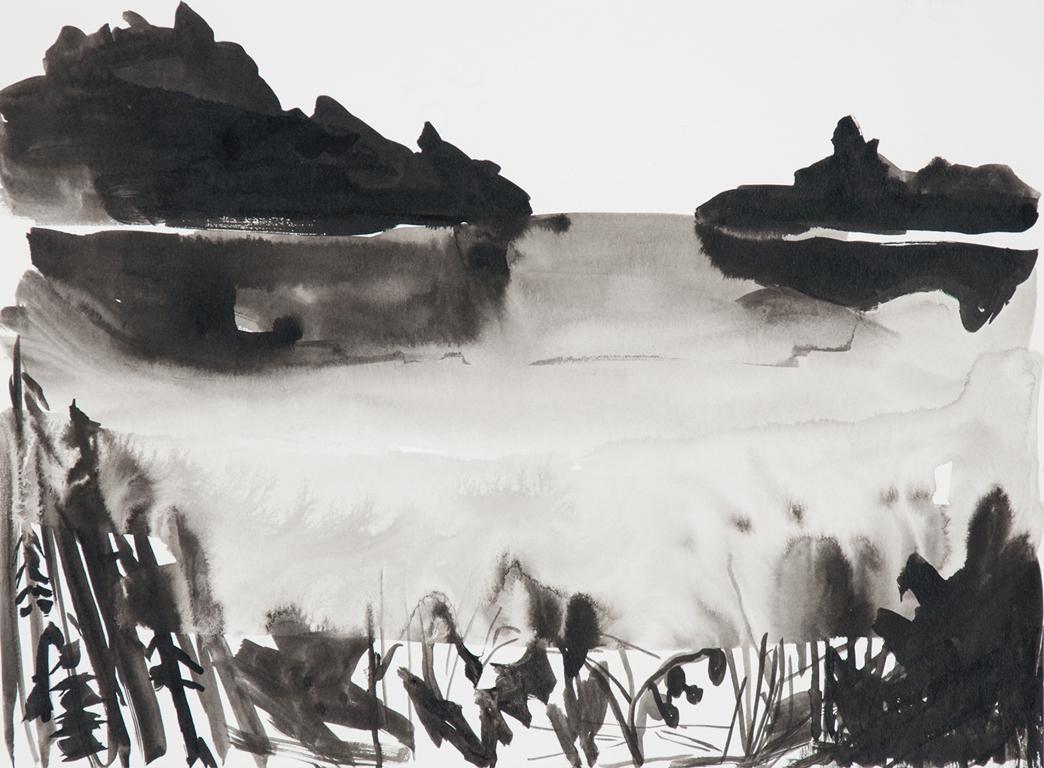
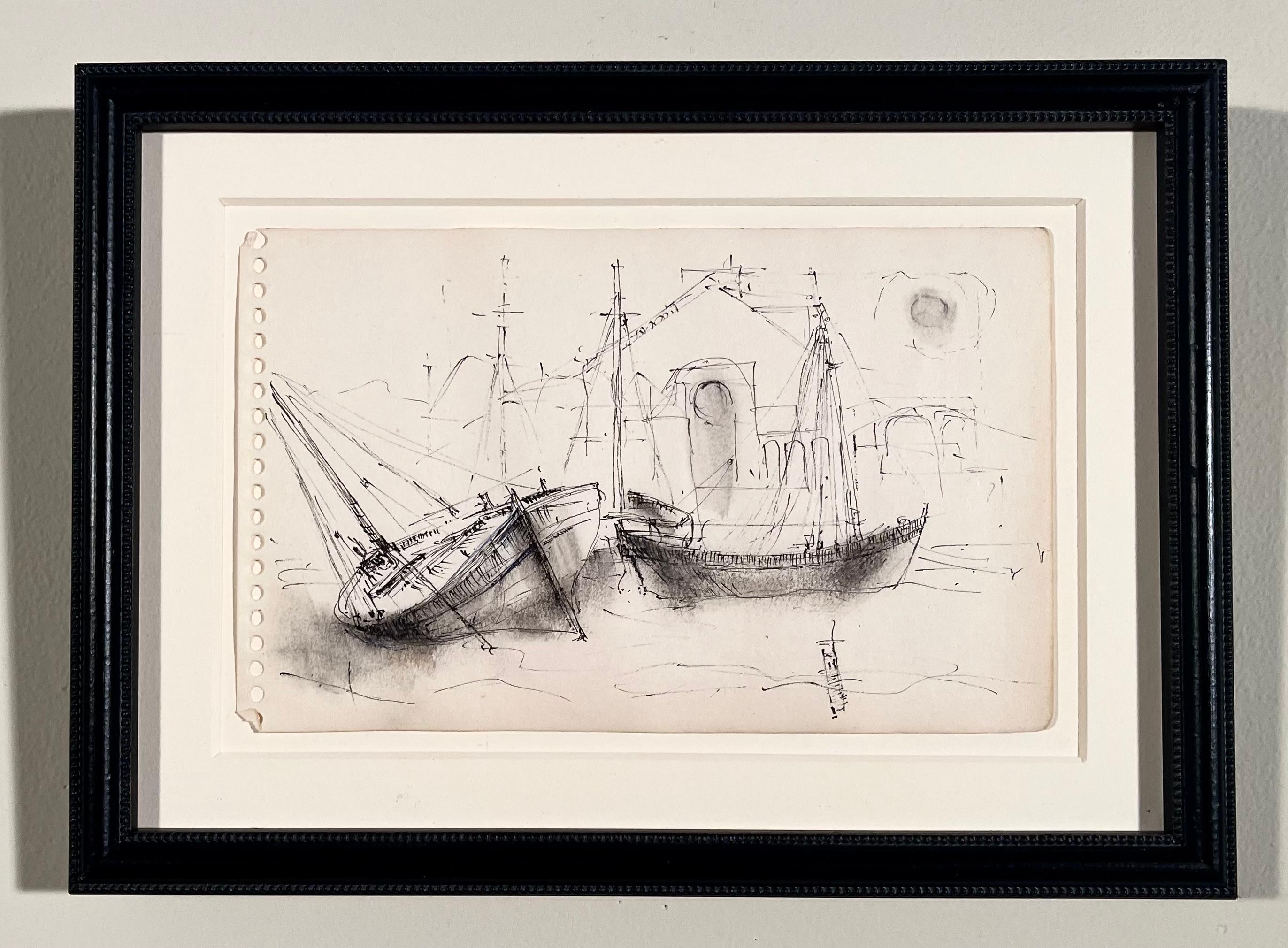
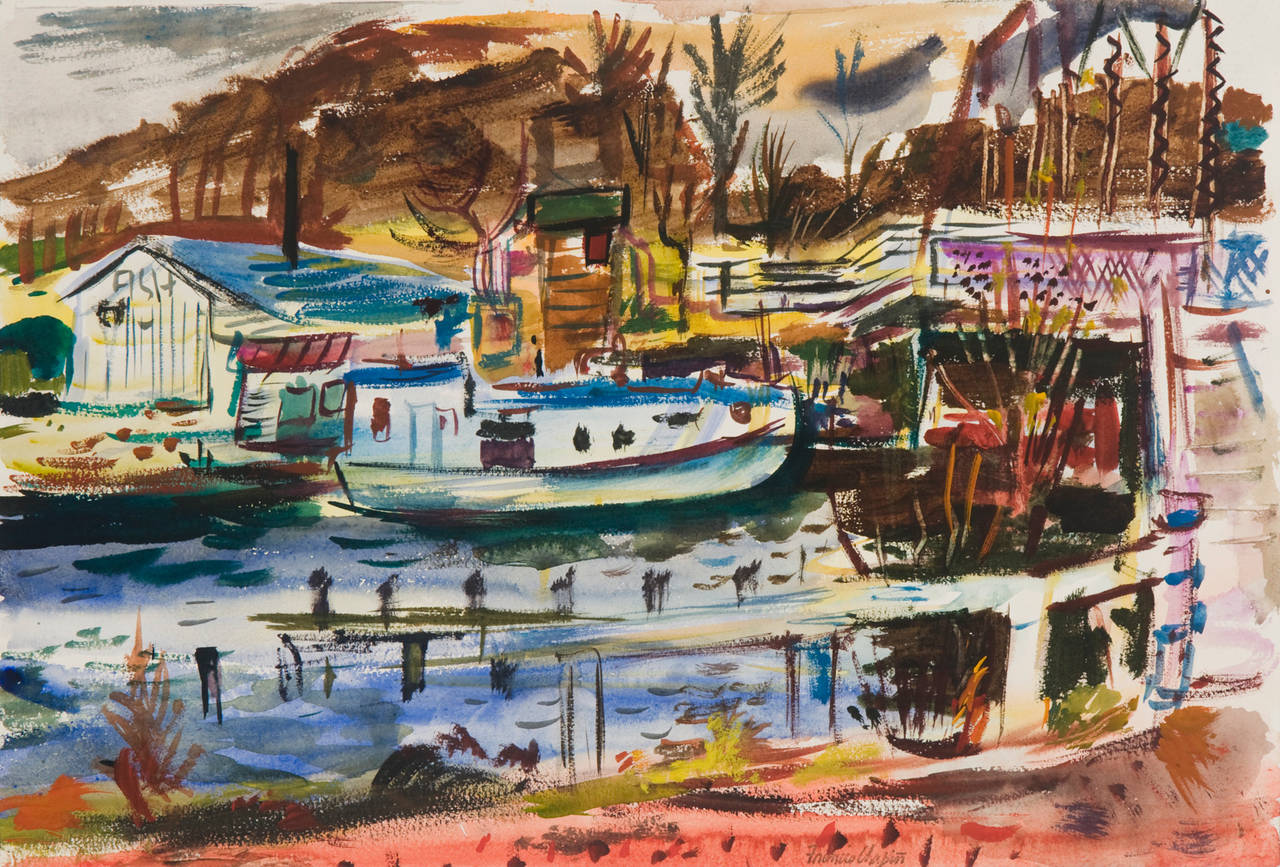
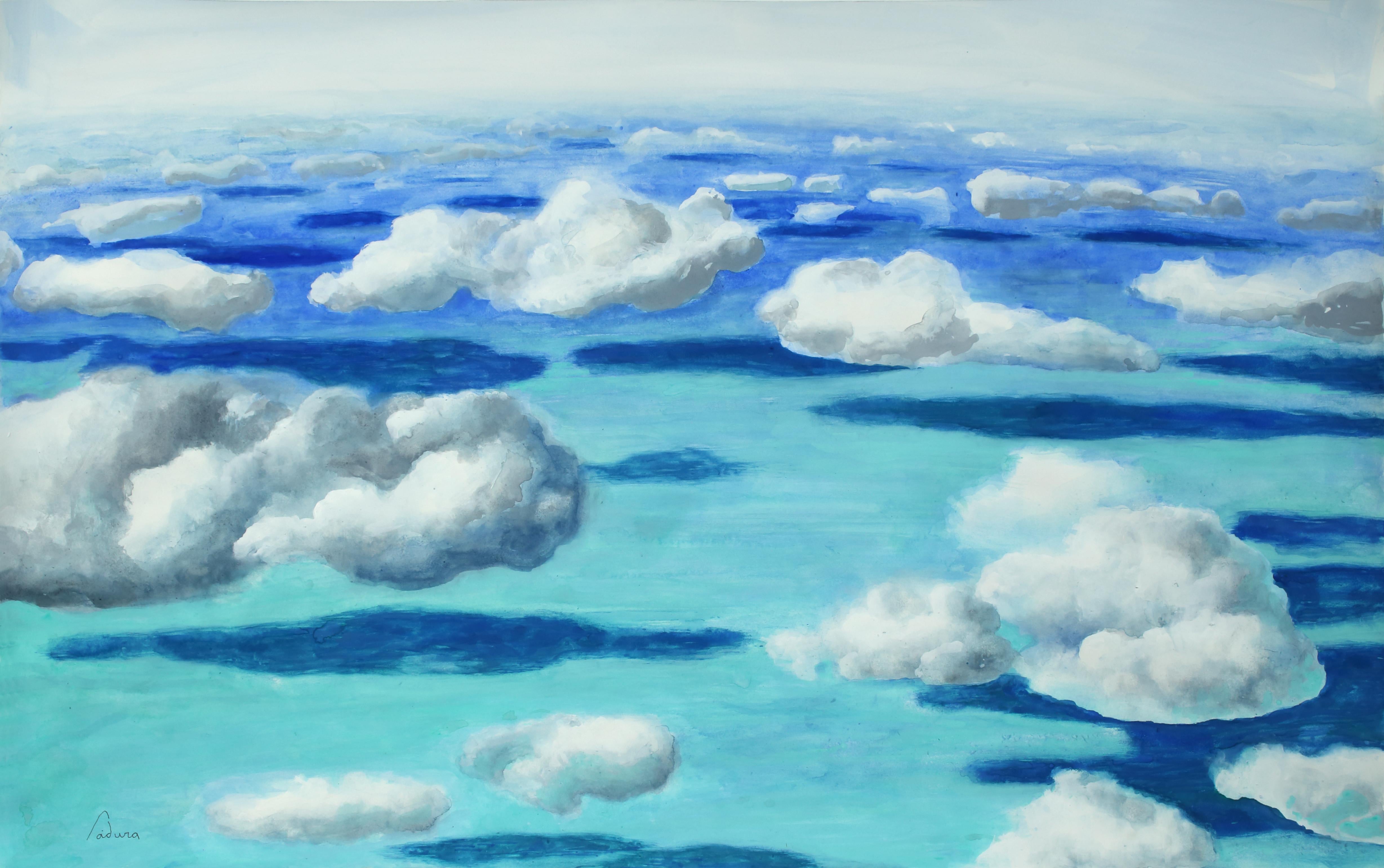
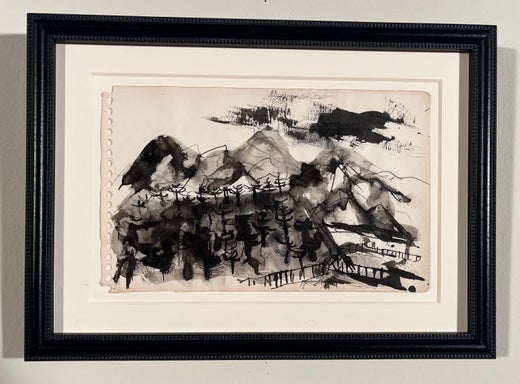
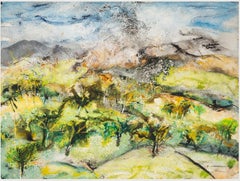
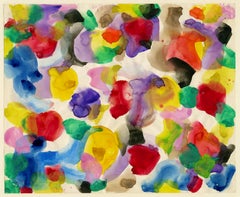
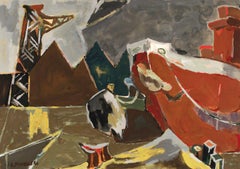
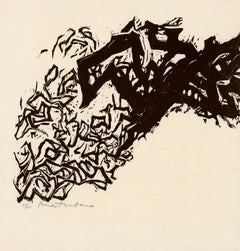
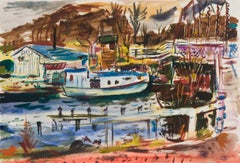
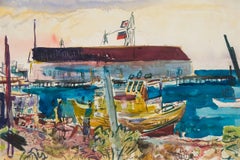
William Thon, 'The Ruby R', watercolor, c. 1990. Signed, lower right; titled verso. A fine, expressionist work, on off-white watercolor paper; the image extending to the sheet edges. A reinforced crease in the bottom left sheet corner, not visible recto, otherwise in excellent condition. Image size 17 7/8 x 23 7/8 inches. Matted to museum standards, unframed.
Provenance: Estate of the Artist.
"Rather than working a watercolor rapidly, the mid-twentieth-century landscape watercolorist William Thon tended to devote numerous sessions of work to each sheet, always painting indoors, where he could best control the drying rates of washes and ink drawings. As a result, Thon’s watercolors have denser, more built-up surfaces than the modernist watercolors of the teens and twenties. Thon particularly liked the interplay of the successive layers of wash and ink and the fortuitous blurring that often occurred."
—Brooklyn Museum
ABOUT THE ARTIST
William Thon (1906-2000) is acclaimed for his highly personal expressionistic landscape and seascape paintings. Thon was born in New York City and spent his childhood summers camping on Staten Island.
Thon debuted as a career artist in the 1939 Corcoran Gallery Biennial exhibition. He joined the Navy during World War II, and shortly after the war won the Prix de Rome, a fellowship in Rome to the American Academy, for which he later served as a trustee. He received further recognition with his participation in the 1942 'Artists for Victory' exhibit at the Metropolitan Museum of Art. In 1944, Midtown Galleries in New York held his first one-person show—the gallery continued to represent him throughout his career. He had subsequent solo exhibitions at Smith College Art Museum, Fort Wayne Museum, and Farnsworth Museum in Rockland, Maine.
Thon received an honorary Doctor of Arts from Bates College in Lewiston, Maine, in 1957. He was a member of The American Academy and Institute of Arts and Letters and the National Academy of Design. In 1947, Thon’s year-long study at the American Academy proved pivotal in his career, when he began working in watercolor. Upon returning to America, he submitted a watercolor to the 1949 exhibition of the National Academy of Design, and that year was voted into Academy membership. He exhibited regularly at the Academy and frequently won prizes, including the Benjamin Altman Prize in 1951, 1954, 1961, 1967, and 1969.
In 1951, Thon was awarded a grant from the American Academy of Arts and Letters. He often traveled to Italy and, in 1955, served in Rome as Artist-in-Residence at the American Academy.
Thon chose to live in the relative isolation of Port Clyde, Maine, on a peninsula overlooking the sea, a quiet place, especially in winter. He preferred the company of sailors, craftsmen, lobstermen, a few fellow artists, and his beloved wife, Helen. This area proved to be the impetus for a stylistic breakthrough for Thon when he discovered an abandoned quarry near his property. He was inspired to create numerous, increasingly abstract renderings of the native trees contrasted with the rectilinear slabs of adjacent granite. His works evolved to convey ever more fully his vital connection and resonance with the raw, natural beauty of rural Maine, its rugged terrain, beautiful virgin forests, intemperate seas, and the humanmade scatter of wooden buildings along its rocky shoreline.
William Thon was awarded numerous prizes and is represented in over 60 museum collections, including, the Metropolitan Museum of Art, Brooklyn Museum, Hirshhorn Museum, The Butler Institute of American Art, Columbus Museum of Art, and in Maine, Farnsworth Art Museum, Portland Museum of Art, and Ogunquit Museum of Art.