Francesco Spicuzza
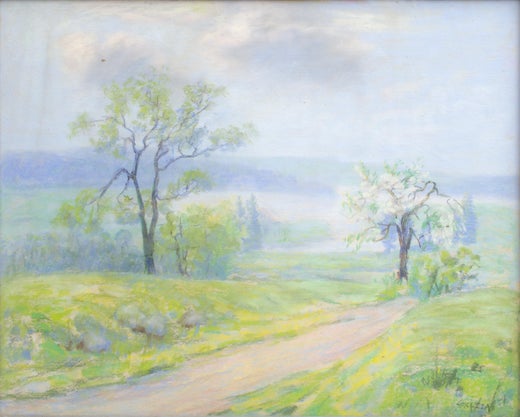
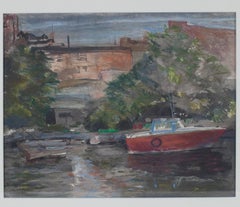
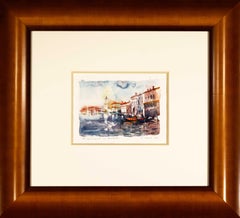
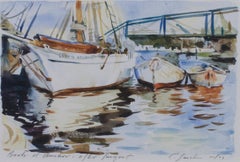
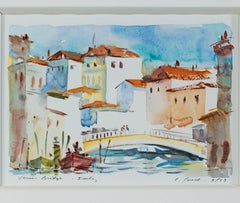
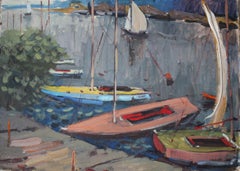
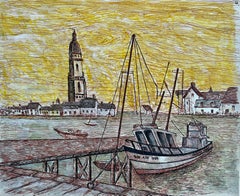
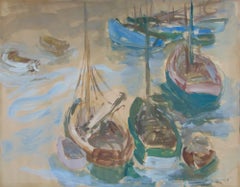
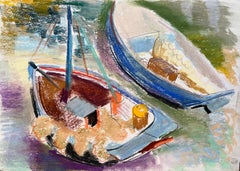
Italian-born Francesco Spicuzza was primarily a Wisconsin painter who did portraits, still-lives and local landscapes. He spent the first part of his life in near-poverty to become a painter. An eternal optimist, in 1917, the artist reported: "I am happy and my only ambition now is to paint better and better until I shall have reached the measure of the best of which I am capable." (Spicuzza, 1917, p. 22). His predilection for beach scenes germinated early: reportedly, the five-year-old boy first drew the outlines of his father's fishing boat in the sand on the seashore near their home in Sicily. After setting himself up as a fruit peddler in Milwaukee, Spicuzza's father sent for his family when Francesco was eight years old. In 1899 or 1900, Spicuzza began studying drawing and anatomy under Robert Schade (1861-1912), a painter of panoramas who had been trained in Munich under Carl Theodor von Piloty. Spicuzza was also taught by Alexander Mueller (1872-1935), a product of the Weimar and Munich academies. The earliest influences in his work appear to be from Edward H. Potthast and Maurice Prendergast, though Spicuzza never mentioned either artist. Already in August 1910, Spicuzza was described in a newspaper as "one of the most talented of Milwaukee's rising workers." He undoubtedly received lasting inspiration from his one summer study period in 1911 with John F. Carlson at the Art Students League's Summer School in Woodstock, New York. Although he executed numerous still-lives and an occasional religious work, Spicuzza is best known for his Milwaukee beach scenes populated with frolicking bathers in multi-colored attire, not unlike the images of Potthast, who used a similar technique. These beach genre scenes reflect the attitude of American impressionists who depicted the more pleasant side of life. Spicuzza manipulated a successful balance of rich pigment applied in varying degrees of impasto texture with subtle nuances of hue. Working all'aperto, he sought "the soft enticing shades of yellow, blue, green, pink and lavender . . . to get the effects of bright glistening summer air." (L.E.S., n.d.). As a painter whose color not only derived from direct observation but also from a personal theory of color symbolism, Spicuzza traded the linear approach of lithography for dynamic patches of brilliant color. Like Prendergast, he would often tilt the angle of the picture plane to bring the viewer's position above the scene. Spicuzza spent a great deal of time painting en plein air and by 1925 he began summering at Big Cedar Lake, near West Bend, Wisconsin to gather his subject matter. During the difficult era of the Depression, patrons came to Spicuzza's aid and during the 40s, he taught housewives, businessmen and students at the Milwaukee Art Institute, the Milwaukee Art Center, and in his studio. In the following decade, although his kind of art was no longer popular in the "make-it-or-break-it" New York gallery world, Spicuzza enjoyed regular patronage and sales. Bio by Richard H. Love and Michael Preston Worley, Ph.D.