Want more images or videos?
Request additional images or videos from the seller
1 of 7

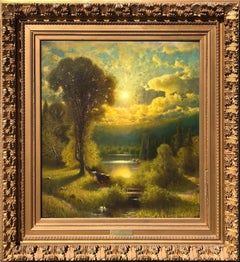
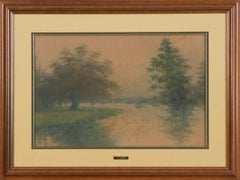
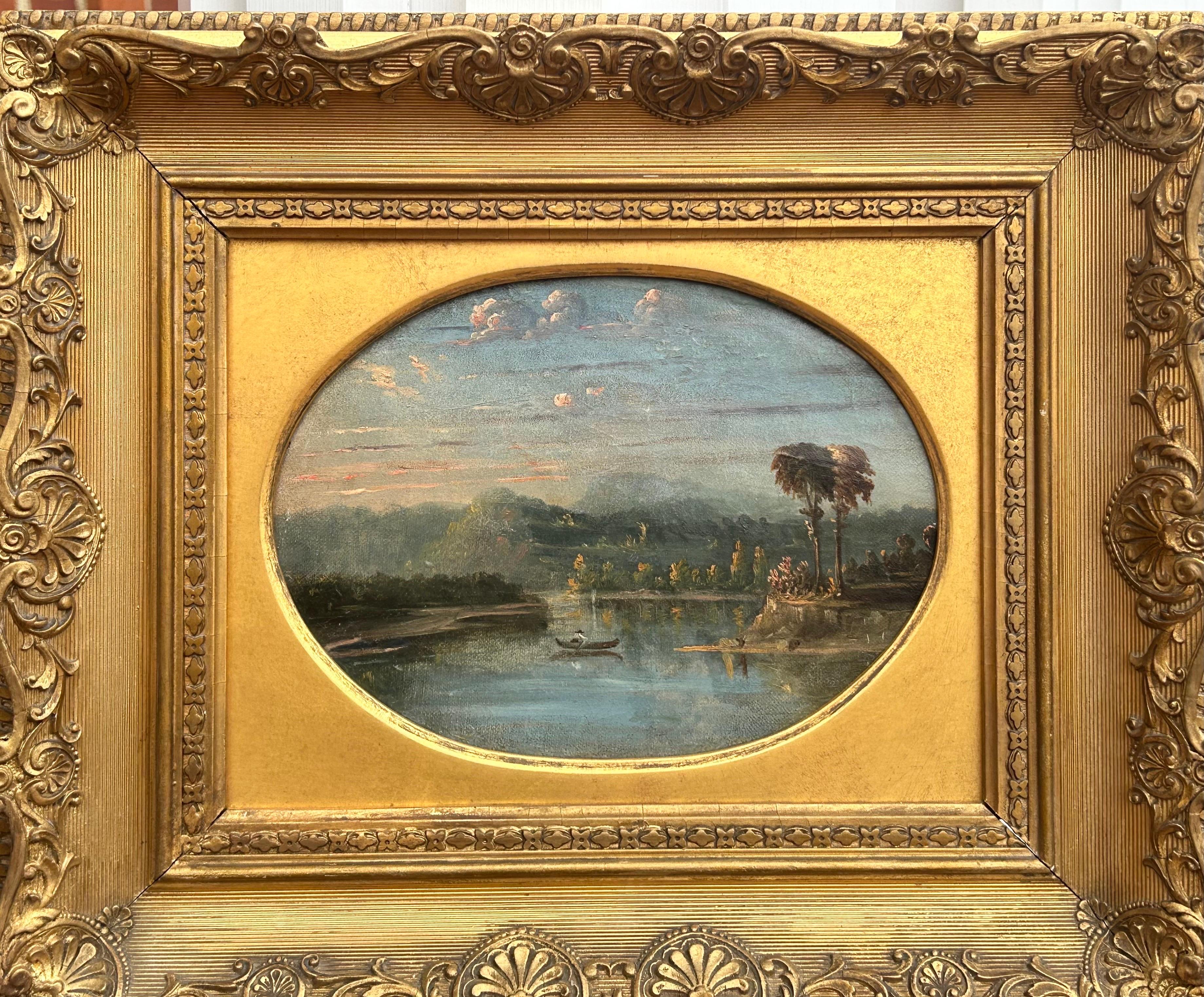
Joseph Rusling Meeker
Bayou Twilight

1870

$15,000
£11,226.07
€13,121.36
CA$21,196.13
A$21,395.76
CHF 12,294.07
MX$259,342.45
NOK 142,297.65
SEK 145,349.02
DKK 98,085.78

About the Item

Signed and Dated Lower Right SIte Size: 14" Diameter Born in Newark, New Jersey, April 21, 1827, Meeker was raised in Auburn, a town in the Finger Lakes district of New York State. There he received encouragement, if not actual lessons in art from Thomas J. Kennedy, a local decorator. He went to New York City in 1845 with George L. Clough, another aspiring artist from Auburn. They studied with Charles Loring Elliott, a portraitist who had previously worked as an itinerary in the Finger Lakes. Meeker spent three years in New York. He returned to Auburn briefly, but by the autumn of 1849 was living in Buffalo. The American Art Union of New York purchased some of landscapes of the Buffalo area. In the winter of 1852 Meeker moved west, settling in Louisville, Kentucky. In his seven years there he painted views on the Ohio, Kentucky, and Salt rivers. He also gave art lessons in his studio. In 1859 Meeker settled in St. Louis, a city which then rivaled Cincinnati as a western center with a substantial base of art patronage. The Western Academy of Art was founded in St. Louis the year of Meeker's arrival. The stated purpose of the academy was to form a collection of art, to establish an art school, and to provide gallery space in which artists could regularly display their work. Artists who had already found St. Louis to be a rich and rewarding environment in which to work and were established there by the time of Meeker's arrival included Carl Wimar, Ferdinand Boyle, Manuel de Franca and Alban Jasper Conant. During the War Between the States Meeker served the Union cause as paymaster on a gunboat that patrolled the Mississippi Delta. The humid landscape of swamp and bayou made a profound impression upon him, influencing his production for the rest of his life. He was touched by the element of mystery that he found in this landscape. Returning to St. Louis at the end of the War, Meeker took studio space at Chestnut and Fifth Streets. There he began to paint easel pictures based on his sketches and memories of southern Louisiana. He traveled extensively in the summer months to the upper Mississippi River, the Adirondack Mountains, Colorado, and Wyoming. At the St. Louis Exposition and Fair of 1878, Meeker exhibited five paintings, two of which were scenes of the Mississippi delta region and three of which were scenes on the upper Mississippi. Meeker also exhibited his work in the St. Louis galleries of Harding's, Zeeger's, and Pette and Leathe. Meeker was active in St. Louis art circles. He was a founding member of the St. Louis Art Society in 1872, and served several terms as its president before the organization dissolved in 1880. He was active in the St. Louis Sketch Club, formed in 1877, which was open to professional and amateur artists alike. This club met in the artists' studios, and at each meeting the host for the subsequent meeting would announce a subject which all the members would sketch. When they next gathered, they would view and discuss each other's work. Meeker's suggestions included Longfellow's poem "Evangeline," the setting of which was the swamps of southern Louisiana. After a full and successful career as a painter of the southern and western landscape, Meeker died at his St. Louis home on September 27, 1887.
  • Creator:
    Joseph Rusling Meeker (1827 - 1887)
  • Creation Year:
    1870
  • Dimensions:
    Height: 22.5 in (57.15 cm)Width: 20.5 in (52.07 cm)
  • Medium:
  • Period:
  • Condition:
  • Gallery Location:
    Missouri, MO
  • Reference Number:
    1stDibs: LU747318060142

More From This Seller

View All
Shere Mill Pond

Shere Mill Pond

By Sir Francis Seymour Haden, R.A.

Located in Missouri, MO

Shere Mill Pond, No. II (large plate). 1860. Etching and drypoint. Schneiderman 37.v/ix. 7 x 13 1/8 (sheet 10 3/4 x 16 3/8). This state is prior to publication in Études à l'Eau-Forte. Illustrated: Keppel The Golden Age of Engraving; Print Collector's Quarterly 1 (1911): 18; : Guichard, British Etchers, 1850-1940. A rich, brilliant proof with drypoint burr printed on white laid paper. Signed in pencil. ------------------------------------------------------------------------------------------- Shere Mill Pond, No. II was one of the most highly praised landscape prints of the etching revival. An impression was exhibited at the Royal Academy in 1861 under Haden’s pseudonym, H. Dean. Francis Seymour Haden used this anagram of his own name early in his career as an artist, in order to retain his anonymity and preserve his professional reputation as a surgeon. Biography: Sir Francis Seymour Haden (16 September 1818 - 1 June 1910), was an English surgeon, best known as an etcher. He was born in London, his father, Charles Thomas Haden, being a well-known doctor and lover of music. He was educated at Derby School, Christ's Hospital, and University College, London, and also studied at the Sorbonne, Paris, where he took his degree in 1840. He was admitted as a member of the College of Surgeons in London in 1842. In 1843-1844, with his friends Duval, Le Cannes and Colonel Guibout, he travelled in Italy and made his first sketches from nature. Haden attended no art school and had no art teachers, but between 1845 and 1848 he studied portfolios of prints belonging to a second-hand dealer named Love, who had a shop in Bunhill Row, the old Quaker quarter of London. Arranging the prints in chronological order, he studied the works of the great original engravers, Albrecht Dürer, Lucas van Leyden and Rembrandt. These studies, besides influencing his original work, led to his important monograph on the etched work of Rembrandt. By lecture and book, and with the aid of the memorable exhibition at the Burlington Fine Arts Club in 1877, he tried to give a true reflection of Rembrandt's work, giving a nobler idea of the master's mind by taking away from the list of his works many dull and unseemly plates that had long been included in the lists. His reasons were founded upon the results of a study of the master's works in chronological order, and are clearly expressed in his monograph, The Etched Work of Rembrandt critically reconsidered, privately printed in 1877, and in The Etched Work of Rembrandt True and False (1895). Haden's printmaking was invigorated by his much younger brother-in-law, James Whistler, at the Haden home in Sloane Street in 1855. A press was installed there and for a while Haden and Whistler collaborated on a series of etchings of the Thames. The relationship and project did not last. Haden followed the art of original etching with such vigour that he became not only the foremost British exponent of that art but brought about its revival in England. His strenuous efforts and perseverance, aided by the secretarial ability of Sir WR Drake, resulted in the foundation of the Royal Society of Painter-Etchers and Engravers. As president he ruled the society with a strong hand from its first beginnings in 1880. Notwithstanding his study of the old masters of his art, Haden's own plates were very individual, and are particularly noticeable for a fine original treatment of landscape subjects, free and open in line, clear and well divided in mass, and full of a noble and dignified style of his own. Even when working from a picture his personality dominates the plate, as for example in the large plate he etched after J.M.W. Turner's "Calais Pier," which is a classical example of what interpretative work can do in black and white. Of his original plates, more than 250 in number, one of the most notable was the large "Breaking up of the Agamemnon." An early plate, rare and most beautiful, is "Thames Fisherman". "Mytton Hall" is broad in treatment, and a fine rendering of a shady avenue of yew trees leading to an old manor-house in sunlight. "Sub Tegmine" was etched in Greenwich Park in 1859; and "Early Morning--Richmond", full of the poetry and freshness of the hour, was done, according to Haden, actually at sunrise. One of the rarest and most beautiful of his plates is "A By-Road in Tipperary"; "Combe Bottom" is another; and "Shere Mill Pond" (both the small study and the larger plate), "Sunset in Ireland," "Penton Hook," "Grim Spain" and "Evening Fishing, Longparish," are also notable examples of his genius. A catalogue of his works was begun by Sir William Drake and completed by Harrington in 1880. During later years Haden began to practise the sister art...

Category

Late 19th Century Old Masters Landscape Prints

Materials

Drypoint, Etching

Flamingos

Flamingos

By William R. Leigh

Located in Missouri, MO

Flamingos By William Robinson Leigh (1866-1955) Signed Lower Left Unframed: 12" x 10" Framed: 21" x 17.5" Born near Falling Waters, West Virginia on a plantation a year after the Civil War, and raised in Baltimore, William Leigh became one of the foremost painters of the American West with a career of seventy-five years. Some people referred to him as the "Sagebrush Rembrandt". He was the son of impoverished Southern aristocrats and took his first art training at age 14 from Hugh Newell (1830-1915) at the Maryland Institute where he was regarded as one of the best students in his class. From 1883 to 1895, he studied in Europe, mainly at the Royal Academy in Munich with Ludwig Loefftz. From 1891 to 1896, he painted six cycloramas or murals in the round, a giant German panorama. In 1896, he began working as a magazine illustrator in New York City for Scribner's and Collier's Weekly Magazine, and he also painted portraits, landscapes, and genre scenes. However, he was not a very successful artist in those years in New York. Trips to the Southwest began in 1906 when he made an agreement with William Simpson, Santa Fe Railway advertising manager, to paint the Grand Canyon in exchange for free transportation West. In 1907, he completed his Grand Canyon painting...

Category

20th Century Naturalistic Animal Drawings and Watercolors

Materials

Ink, Pen

Sunset

Sunset

By James Fairman

Located in Missouri, MO

James Fairman "Sunset" c. 1880 Oil on Canvas Signed Lower Left Site: 32.5 x 29.5 inches Framed: 46 x 42 inches James Fairman worked as a landscape painter, critic, lecturer, musicia...

Category

1880s American Realist Landscape Paintings

Materials

Canvas, Oil

River Access

River Access

By Joseph Orr

Located in Missouri, MO

Joseph Orr (Japanese, American, b. 1949) River Access Signed Lower Right 30 x 30 inches 39.5 x 39.5 inches with frame BORN in Tokyo, Japan, Oct 31,1949, Joseph lived his first years in an orphanage sponsored by American Armed Forces. He was adopted April,1954 and came to the US at age 5 where he became an American citizen. As the Orr’s traveled for the US military Joseph enjoyed a childhood rich in experiences from Germany and back to California where he attended High School and started College. Following his parents to Missouri In 1971 he took a job with Hallmark Cards as machine operator in the cardboard fold dept. It sparked an interest in art, so after a few months he sought out some of the Hallmark artists at their work for private lessons. He learned basic drawing and watercolor from Anthony Allison and, “Probably before I was ready”, he admits, Joseph was entering local art shows and even winning prizes. At that time Joseph also enrolled for art instruction under John Coleman at Longview Community College. He spent one semester there. By the end of 1972 Joseph had quit his day job to become a full time painter, joining an art show tour group called Word Of Art, which was a new concept: culture meets promotion. Booking weekly art exhibits in the new indoor shopping malls across America, The idea transformed part of the art world by bringing art to the masses. For Joe and many other artists in the early 1970’s, it created the chance to paint full time and sell their work to an otherwise unobtainable audience. During this time of continuous self study and painting Joseph transitioned from watercolor to the newer acrylic painting medium. Believing that acrylic, as a fine art painting medium, can be as viable as oil, Orr has always promoted it as the modern medium that it is. In 1990 Joseph, along with his wife, Rita and two other artists, founded the National Oil & Acrylic Painter’s Society. The Orr’s brainchild, they were aided in founding NOAPS organization by local art patrons, Wm & Martha Mitchell and fellow artists Pete Peterson and Dennis T. Yates. While traveling with the World of Art Tour Joseph had met Rita Mathews, an aspiring artist, in Columbia, MO. They were married in June 1974 and stayed in Missouri, traveling and exhibiting their art together. Orr had a brief encounter with printmaking in 1977. He took private instruction in stone lithography and copper plate etching from Frank Stack, professor of art at the Univ of MO, Columbia, but painting remained his principal devotion. By 1999 Joseph had become proficient enough to have obtained Gallery representation with several Fine Art Galleries across the US. Joseph Orr currently resides in Osage Beach, Missouri, but travels to paint and visit his gallery representatives and Exhibit Openings. PHILOSOPHY: For me the idea is that painting should follow some form of illustration and truth telling. Basically, the premise of my painting philosophy, is to build layers of narrative into my paintings. A place or landscape scene is never defined satisfactorily without it’s relationship to color and composition. It is important to balance fact with imagination. “ART REFLECTS THE SOUL OF SOCIETY. A JUDGMENT CAN BE MADE FOR THE ATTITUDE OR CONDITION OF SOCIETY BY INSPECTING THE POPULAR ‘IDEAS’ OF ART OR, IN SOME INSTANCES, THE LACK OF ART.” (JOSEPH C. ORR) NOTED SOLO EXHIBITS : *BIRGER SANDZEN MEMORIAL, LINDSBORG, KS; *HARWELL ART MUSEUM, POPLAR BLUFF, MO; *ASHBY-HODGE GALLERY OF AMERICAN FINE ART, FAYETTE, MO; *NORFOLK ART CENTER, NORFOLK, NE; *KODNER GALLERIES...

Category

20th Century Contemporary Landscape Paintings

Materials

Canvas, Acrylic

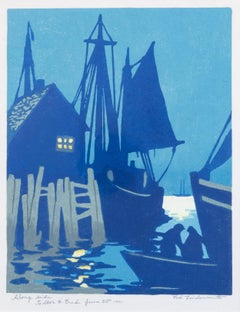
Alongside

Alongside

By Tod Lindenmuth

Located in Missouri, MO

Alongside, 1941 Tod Lindenmuth (American, 1885-1976) Color Woodblock Print 9 x 7 inches 19.75 x 14.5 inches with frame Signed Lower Right Titled and Dated Lower Left A founder of the Provincetown Art Association and one of the original Provincetown Printers, Tod Lindenmuth was a semi-abstract painter and graphic artist who did much to promote modernist styles. Although he was much influenced by Abstract Expressionism, his subject matter was realistic enough to be recognizable. He did linoleum cuts and was one of the first to work with that medium, and towards the end of his life, he experimented with collage. In the 1930s, he had commissions for the Public Works of Art Project and the Works Progress Administration. Lindenmuth was born in Allentown, Pennsylvania. He studied with Robert Henri at the New York School of Art in Manhattan, and in Provincetown with E. Ambrose Webster and George Elmer Browne. He first exhibited in Provincetown in 1915, and between 1917 and 1928 served on the jury for the Provincetown Art Association's 'First Modernistic Exhibition". He exhibited regularly with the Society of Independent Artists in New York. He married artist and illustrator Elizabeth Boardman Warren...

Category

1940s American Modern Figurative Prints

Materials

Color

You May Also Like

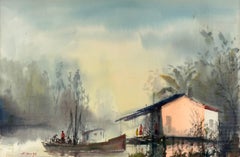
Bayou Landscape (New Orleans Louisiana Artist)

Bayou Landscape (New Orleans Louisiana Artist)

Located in Wilton Manors, FL

Nestor Fruge (1916-2012). Bayou Landscape, ca. 1970. Watercolor on paper, 13 x 19.25 inches. Framed measurement: 18 x 24.25 inches. Excellent condition. Signed lower left. B...

Category

Mid-20th Century Impressionist Landscape Paintings

Materials

Watercolor

Bayou Teche

Bayou Teche

By Hunt Slonem

Located in Fort Lauderdale, FL

Hunt Slonem Bayou Teche, 2025 Oil on Wood 22 x 34 in (55.88 x 86.36 cm) Framed: 26 x 38 in

Category

2010s Contemporary Landscape Paintings

Materials

Oil

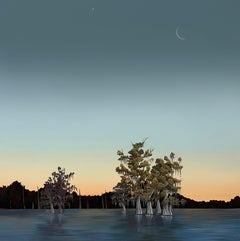
Bayou Moon

Bayou Moon

By Kristin Moore

Located in New Orleans, LA

Archival pigment ink print on Hahnemuhle cotton paper. Each print is uniquely hand embellished by the artist with acrylic paint and prismacolor. Edition 2 of 5. Kristin Moore says o...

Category

21st Century and Contemporary Contemporary Landscape Prints

Materials

Acrylic, Rag Paper, Archival Pigment

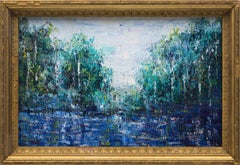
Alexander Drysdale, "Louisiana Bayou Scene" - Framed Antique Landscape Painting

Alexander Drysdale, "Louisiana Bayou Scene" - Framed Antique Landscape Painting

By Alexander Drysdale

Located in New Orleans, LA

A painting by iconic Louisiana painter Alexander Drysdale, in his classic style. As you probably know if you clicked on this, Drysdales grace the mantels of many of New Orleans' nice...

Category

1920s Impressionist Landscape Drawings and Watercolors

Materials

Oil

Evening, Bayou St. John, New Orleans

Evening, Bayou St. John, New Orleans

Located in New Orleans, LA

Beautiful Jack Kleinberg New Orleans scene of Bayou St. John at Sunset. Jack Kleinberg (New Orleans LA/ Los Angeles CA 1946-2022) was a well-known New Orleans scene painter, remembe...

Category

Early 2000s Contemporary Landscape Paintings

Materials

Canvas, Oil

Bayou, Original Acrylic Painting, 2019

Bayou, Original Acrylic Painting, 2019

By Robert Crooker

Located in Boston, MA

Artist Commentary: I visited a Bayou once in Louisiana on a boat. I tried to capture that moment here... Keywords: Landscape, Swamp, Serene, dusk, twilight, bird, blue Artist Biogr...

Category

21st Century and Contemporary Realist Landscape Paintings

Materials

Canvas, Acrylic