Want more images or videos?
Request additional images or videos from the seller
1 of 9

Royal Charles Steadman
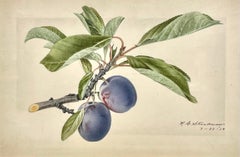
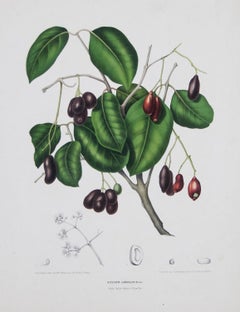
Still Life Botanical of Plum Branch with Three Plums

c. 1919

$5,000
£3,768.01
€4,403
CA$7,095.38
A$7,116.94
CHF 4,128.23
MX$86,875.95
NOK 47,816.58
SEK 48,937.05
DKK 32,912.34

About the Item

This beautifully detailed botanical watercolor of a plum branch is the work of Royal Charles Steadman (1875–1964), one of America’s most accomplished botanical illustrators. Notably, this piece is signed by the artist at the lower right, affirming its authenticity as part of his meticulous body of work. Steadman was widely celebrated for his contributions to the U.S. Department of Agriculture’s Pomological Watercolor Collection, where his paintings documented countless varieties of fruit with scientific precision while elevating them to works of art. Here, three ripe plums hang from a slender branch, rendered with extraordinary care in texture, shading, and color. The rich purple tones of the fruit are balanced by the crisp, lifelike greens of the foliage, while even the cut end of the branch is described with technical accuracy. Steadman’s art bridged the gap between agricultural science and fine art, ensuring that each subject was both botanically correct and aesthetically captivating. This signed example is not only a testament to his technical mastery but also a reflection of the early 20th-century effort to preserve natural beauty through careful documentation. It remains an elegant and historically significant piece, appealing to collectors of both botanical art and American illustration. size: 6 x 9
  • Creator:
    Royal Charles Steadman (1875 - 1964, American)
  • Creation Year:
    c. 1919
  • Dimensions:
    Height: 10 in (25.4 cm)Width: 13 in (33.02 cm)
  • Medium:
  • Period:
  • Condition:
  • Gallery Location:
    Fredericksburg, VA
  • Reference Number:
    1stDibs: LU2574216846342

More From This Seller

View All
Botanical Still Life of Plum Branch with Two Plums

Botanical Still Life of Plum Branch with Two Plums

Located in Fredericksburg, VA

This exquisite botanical study of a plum branch was created by Royal Charles Steadman (1875–1964), a highly regarded American botanical illustrator known for his precise yet graceful...

Category

Early 20th Century Still-life Paintings

Materials

Paper, Watercolor, Engraving

Oriental vase, flowers, and fruits still life titled "from nature"

Oriental vase, flowers, and fruits still life titled "from nature"

Located in Fredericksburg, VA

Ellen Weigall’s From Nature is a captivating still life that showcases her remarkable attention to detail and her skill in composition. The painting presents a sumptuous arrangement ...

Category

Mid-19th Century Still-life Drawings and Watercolors

Materials

Paper, Watercolor

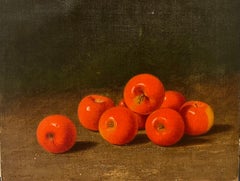
Mid-19th Century Signed Still Life of Apples by Hudson River School

Mid-19th Century Signed Still Life of Apples by Hudson River School

By George Harvey

Located in Fredericksburg, VA

George Harvey was born in 1800 in Tottenham, England but moved to the United states at 20 years old and spent several years in the west before he established himself in New York City...

Category

Mid-19th Century Hudson River School Still-life Paintings

Materials

Canvas, Oil

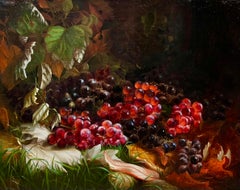
Still Life of Grapes Within Nature, Hudson River School, Oil on Canvas

Still Life of Grapes Within Nature, Hudson River School, Oil on Canvas

By Virginia Granbery

Located in Fredericksburg, VA

Grapes Within Nature is a luminous Hudson River School still life by Virginia Granbery, one of the very few women artists to work with distinction in this genre during the 19th centu...

Category

Late 19th Century Hudson River School Still-life Paintings

Materials

Oil, Canvas

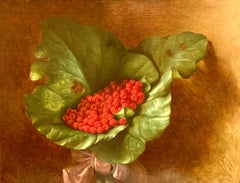
Mid-19th Century Signed Oil Painting of Raspberries Still Life

Mid-19th Century Signed Oil Painting of Raspberries Still Life

By George Henry Hall

Located in Fredericksburg, VA

Raspberries by George Henry Hall is a striking and beautifully refined still life painted in 1865, demonstrating the artist’s extraordinary attention to texture, color, and compositi...

Category

Mid-19th Century American Realist Still-life Paintings

Materials

Board, Oil

You May Also Like

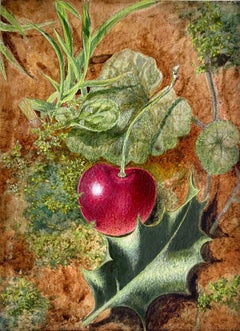
19th Century British School Still Life Watercolour of Holly and a Cherry

19th Century British School Still Life Watercolour of Holly and a Cherry

Located in London, GB

BRITISH SCHOOL (19th Century) Still Life of Cherry and Holly Leaf Watercolour and bodycolour Unframed, in mount only 10.5 by 7.5 cm., 4 ¼ by 3 in. (mount size 25 by 21 cm., 6 by 8...

Category

Late 19th Century Realist Still-life Drawings and Watercolors

Materials

Watercolor

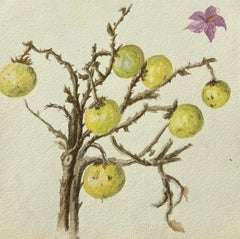
Fine Antique British Botanical Painting Wild Gooseberries On Vine Plant

Fine Antique British Botanical Painting Wild Gooseberries On Vine Plant

By Caroline Worsley

Located in Cirencester, Gloucestershire

Very fine original antique English botanical watercolour paintings depicting this beautiful depiction of a flower/ plant. The work came to us from a private collection in Surrey, Eng...

Category

Early 20th Century Victorian Still-life Paintings

Materials

Watercolor

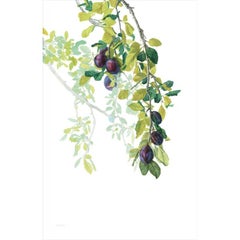
Purple and green plum tree, painted by fine Italian watercolourist

Purple and green plum tree, painted by fine Italian watercolourist

By Margherita Leoni

Located in Milan, IT

Plum Watercolor on paper inch 39.7 x 25.5 - cm 101 x 65 Botanical watercolourist. Born in Bergamo in 1974. She graduated from the Brera Academy of Fine Arts in Milan in 1997. In th...

Category

2010s Contemporary Figurative Paintings

Materials

Watercolor, Paper

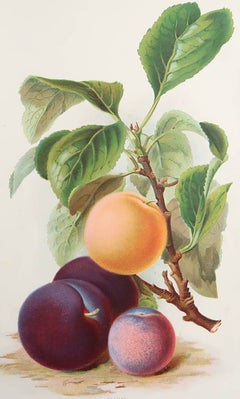
Original Antique Print of Plums, C. 1900

Original Antique Print of Plums, C. 1900

Located in St Annes, Lancashire

Great image of plums Lithograph with original color. Published, circa 1900 Unframed.  

Category

Antique Early 1900s English Other Prints

Materials

Paper

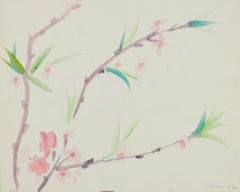
Plum Branches and Flowers

Plum Branches and Flowers

By Joseph O'Sickey

Located in Fairlawn, OH

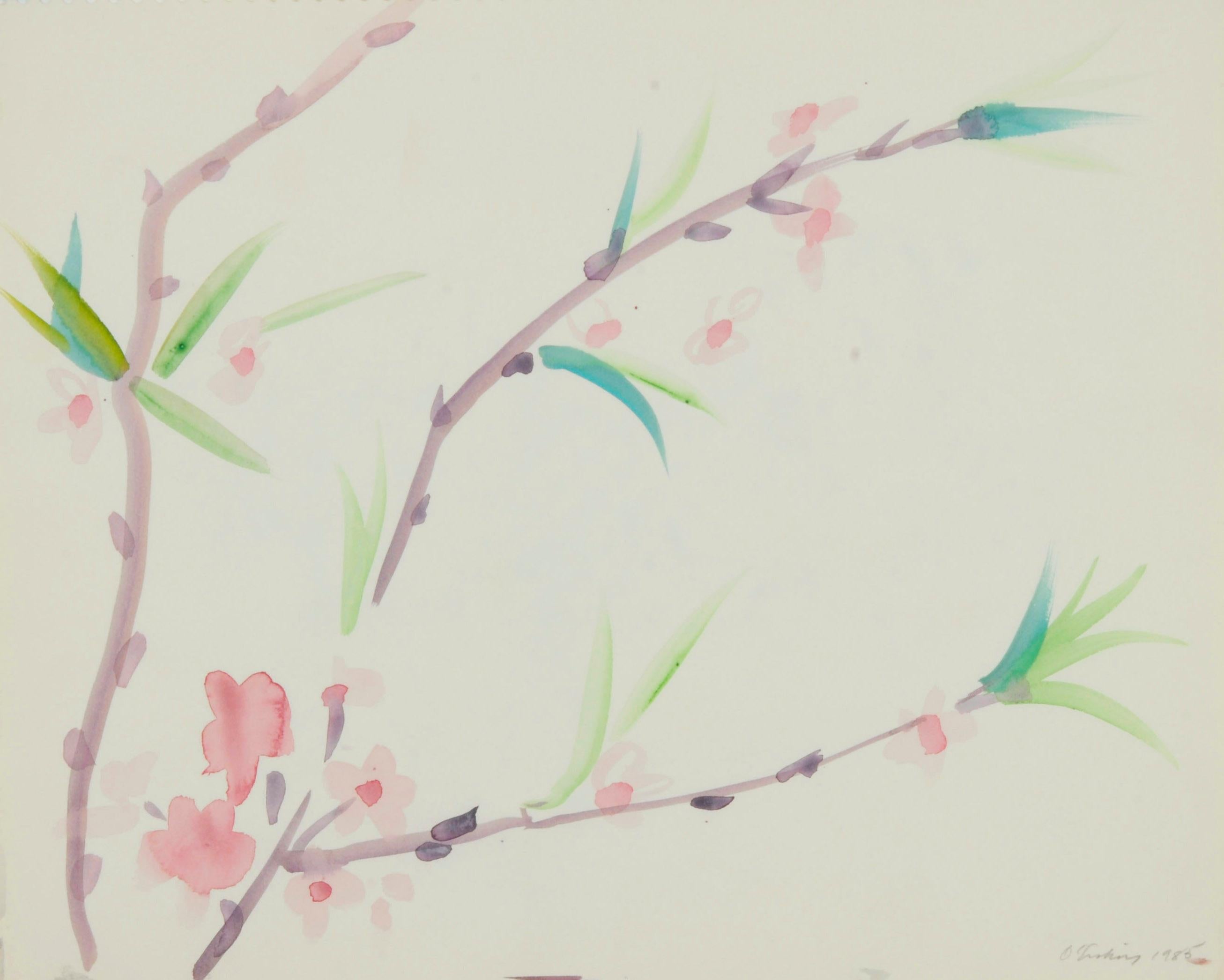
Plum Branches and Flowers watercolor on wove paper, 1985 Signed and dated in pencil lower right corner From the artist's 1985 sketchbook Inspired by O'Sickey's love of Japanese and Chinese art and calligraphy. Provenance: Estate of the artist Condition: Excellent Image/Sheet size: 13 5/8 x 17 inches Joseph B. O’Sickey, Painter 1974 CLEVELAND ARTS PRIZE FOR VISUAL ARTS The title conferred on him by Plain Dealer art critic Steve Litt in a 1994 article, “the dean of painting in northeast Ohio,” must have pleased Joseph O'Sickey. It was more than 30 years since he had burst onto the local (and national) art scene. O’Sickey was already in his 40s in that spring of 1962 when he had his first one-man show at the Akron Art Museum and was signed by New York’s prestigious Seligmann Galleries, founded in 1888. In the decade and a half that followed, he would have seven one-man shows at Seligmann, which had showed the work of such trailblazing figures as Seurat, Vuilliard, Bonnard, Leger and Picasso, and appear in all of the group shows. O’Sickey took the Best Painting award in the 1962 May Show at the Cleveland Museum of Art (CMA). He and would capture the same honor in back-to-back May Shows in 1964 and ’65, and again in 1967. The remarkable thing, noted the Plain Dealer’s Helen Borsick, was that he accomplished this sweep in a variety of painterly styles, even using that most hackneyed of subjects, flowers. “The subject doesn’t matter,” he told her, “what the artist brings to it is the important thing.” O’Sickey’s garden and landscape paintings were big and bold, eschewing delicate detail in favor of vitality and impact. The great art collector and CMA benefactor Katherine C. White, standing before one of O’Sickey’s vivid garden paintings, compared the sensation to “being pelted with flowers.” Though he might represent an entire blossom with one or two smudged brush strokes or a stem with a simple sweep of green, O’Sickey rejected the moniker of Impressionist—or Pointillist or Abstract painter or Expressionist. “My work,” he said, “is a direct response to the subject. I believe in fervor and poetic metaphor. I try to make each color and shape visible and identifiable within the context of surrounding colors and shapes. A yellow must hold its unique quality from any another yellow or surrounding color, and yet read as a lemon or an object, by inference. It does not require shading or modeling—the poetic evocation is part of the whole.” “The subject,” O’Sickey used to tell his students at Kent State University, where he taught painting from 1964 to 1989, “has to be seen as a whole and the painting has to be structured to be seen as a whole.” He liked to think of it as “a process of controlled rapture.” When, in the 1960s, fond childhood memories drew him to the zoo, he found himself responding to the caged animals in their lonely dignity (or indignity) with sharp-edged, almost silhouette-like forms that evoked Matisse’s paintings and cut-paper assemblages. One observer was left with the impression that the artist had “looked at these animals, past daylight and into dusk when they lose their details in shadow and become pure shapes, with eyes that are seeing the viewer rather than the other way around. This is a world of shape and essence,” wrote Helen Borsick. “All is simplification.” O’Sickey attributed his ability to capture his subjects with just a few strokes—in an almost iconographic way—to a rigorous exercise he had imposed upon himself over a period of several months. Limiting his tools to a large No. 6 bristle brush and black ink, he set himself the task of drawing his pet parakeet and the other small objects in its cage (cuttlebone, feeding dish, tinkling bell) hundreds of times. The exercise gave him “invaluable insights into painting. . . . Because of the crudity of the medium, every part of these drawings had to be an invention and every mark had to have its room and clarity.” Then he began adding one color at a time—“still with the same brush and striving for the same clarity”—and headed off to the zoo where “the world opened up to me. I learned how little it took to express the subject.” Born in Detroit at the close of the First World War, O’Sickey grew up in St. Stanislaus parish near East 65th and Fleet on Cleveland’s southeast side. (The apostrophe was inserted into the family’s proud Polish name by a clerk at Ellis Island.) An early interest in drawing and painting may have been kindled by the presence on the walls of Charles Dickens Elementary School, one of only three grade schools in the district with a special focus on the arts, of masterful watercolors by such Cleveland masters as Paul Travis, Frank N. Wilcox and Bill Coombes. As a youngster O’Sickey took drawing classes at the Cleveland Museum of Art, and he and his brother spent hours copying famous paintings; while a student at East Tech High School in the mid-’30s, he attended free evening classes in life drawing with Travis and Ralph Stoll at the John Huntington Art and Polytechnic Institute, and Saturday classes at the Cleveland School (later the Cleveland Institute) of Art, where he earned his degree in 1940 under the tutelage of Travis, Stoll and such other legendary figures as Henry Keller, Carl Gaertner, William Eastman, Kenneth Bates...

Category

1980s Contemporary Still-life Drawings and Watercolors
Materials

Watercolor