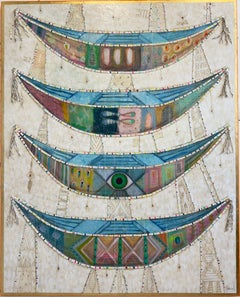
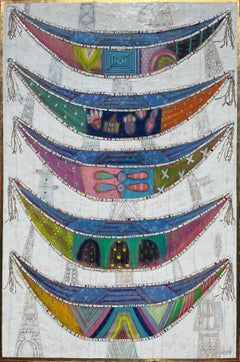
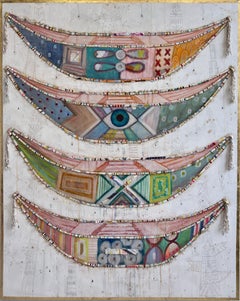
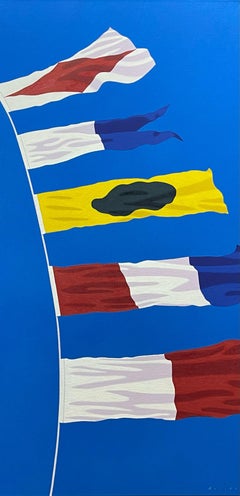
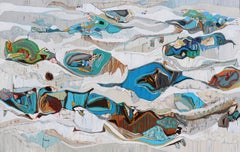
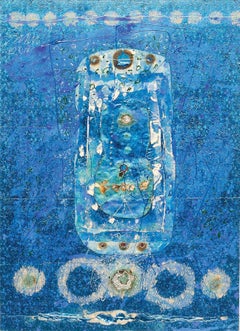
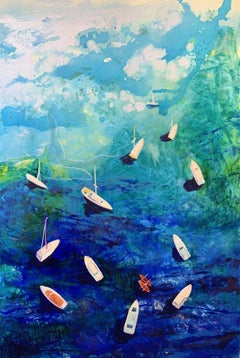
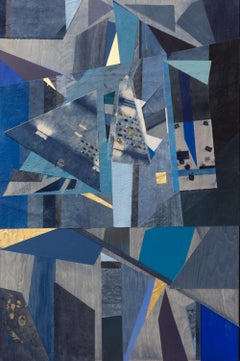
"Close to Shore" features four blue and teal boats stacked atop one another. This layered mixed media composition filled with symbolic boats, ladders, and fragments of memory suspended against a textured white ground. Four vessel-like forms float vertically through the painting, each carrying vivid patterns, geometric symbols, and luminous bands of color that suggest journeys through emotion, history, and personal transformation. Howard, a self-described colorist born and raised in New Orleans, often uses recurring imagery such as boats, bridges, birds, and ladders to create what she describes as a visual language of memory and rebirth. In this work, the boats become carriers of stories and resilience, connected by delicate ladder structures that imply movement between worlds, generations, and experiences. The surfaces of the vessels are especially poignant because they incorporate repurposed fragments of canvases salvaged from Howard’s destroyed studio after Hurricane Katrina, physically embedding the remnants of loss and survival into the painting itself. After returning to Pass Christian, Mississippi following the storm, Howard discovered damaged paintings gathered beneath a lone surviving oak tree and later tore them into strips that became part of her artistic process and symbolism.
Gretchen Weller Howard was born and raised in New Orleans, LA. A self-described colorist, she employs both symbols and color to communicate the deeply personal meaning of each work. Over the years, she has developed a distinct vocabulary of images to describe the emotional threads that tie her work together. The vessels, or boats of sorts, “appeared” first, and initially held within them the shredded remains of paintings she had lost during Katrina. After the storm, when Gretchen and her husband returned to their home in Pass Christian, MS, all that remained standing was a huge oak on the beach. Surrounding it were the remnants of an extensive collection of paintings that neighbors had collected and placed beneath the tree. Unable to throw them away, she tore them into strips and later incorporated them into her work. These boats held safe the memory of the past and yet celebrated the rebirth of the entire region. Soon after, bridges appeared as Gretchen returned to her birthplace and committed to laying down her family roots in New Orleans once again. And finally, the bird. Like the others, she appeared suddenly and stood upon the bridges, a sentinel of possibility, never in flight, but poised for the great leap.
Today Gretchen’s work still primarily revolves around birds and boats, but the meanings have shifted and grown to take on a new, rich, and ever evolving language. They have both become vessels through which an idea is conveyed, and together with a supporting cast of symbolic characters, a story is told and a mystery unfolds.