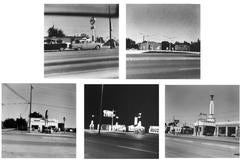
“I don’t have any Seine River like Monet, I’ve just got US 66 between Oklahoma and Los Angeles.” — Ed Ruscha
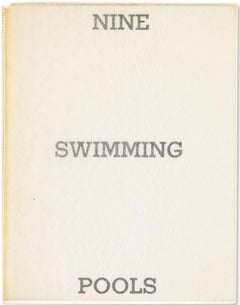
True First Edition of Ruscha's most iconic book - hand signed with exceptional provenance.
An example of this rare Artist Book was exhibited prominently at the Museum of Modern Art in New York for the 2023-4 Ed Ruscha retrospective. Keep scrolling right of header image to see installation photographs of that exhibit to show how MoMA displayed this accordion style book with slipcase. (the last images)
This is the 1966 true 1st Edition of Ed Ruscha's groundbreaking self-published artist book "Every Building on Sunset Strip." The book itself was published in an unsigned edition of 1000. However, in 1980, exceptionally, Ruscha hand signed and beautifully inscribed this book in red ink to football legend Joe Fields.
(Joseph Charles Fields Jr. is an American former professional football player who was a center and guard in the National Football League for the New York Jets and the New York Giants.)
This book is also in the original slipcase.
Dimensions
slip case: 7 5/16 x 5 13/16 x
9/16" (18.5 x 14.7 x 1.5 cm)
Publisher:
Dick de Ruscha, Los Angeles, California, Copyright 1966 Edward Ruscha, Los Angeles
Edition of 1000 (uniquely signed)
This historic limited edition Artists Book is in the permanent collection of the Getty Museum in California which explains its importance as follows:
In the 1960s, Ed Ruscha more or less reinvented the artist’s book. By turning away from the craftsmanship and luxury status that typified the livre d’artiste in favor of the artistic idea or concept, expressed simply through photographs and text, Ruscha opened the genre to the possibilities of mass-production and distribution. The 25-foot length of the accordion-folded Every Building on the Sunset Strip affords the viewer two continuous photographic views of the mile and a half section of this landmark stretch of Sunset, one for each side of one of the city’s landmark thoroughfare.
Among many other institutions, it also in the permanent collection of MOMA, which describes "Every Building on the Sunset Strip" thus:
Ruscha's photography books are antithetical to the traditional limited-edition livre d'artiste, or artist's book. Their banal subject matter and documentary style are indebted to the remarkable pictures of signs and vernacular architecture that American photographer Walker Evans made in the 1930s, but their deadpan, cool aesthetic is radically different. While each book chronicles an aspect of Los Angeles or the artist's round-trip drives between LA and Oklahoma, their use of photography as a form of map-making or topographical study signals a conceptual, rather than documentary, thrust.
Edward Ruscha: Editions 1959-1999, Catalogue Raisonné, Engberg, vol. 1, ppg. 84-85 and vol. 2, pg. 124, no. B4
More about Ed Ruscha:
There are things that I’m constantly looking at that I feel should be elevated to greater status, almost to philosophical status or to a religious status. That’s why taking things out of context is a useful tool to an artist. It’s the concept of taking something that’s not subject matter and making it subject matter.
—Ed Ruscha
At the start of his artistic career, Ed Ruscha called himself an “abstract artist ... who deals with subject matter.” Abandoning academic connotations that came to be associated with Abstract Expressionism, he looked instead to tropes of advertising and brought words—as form, symbol, and material—to the forefront of painting. Working in diverse media with humor and wit, he oscillates between sign and substance, locating the sublime in landscapes both natural and artificial.
In 1956, Ruscha moved from Oklahoma City to Los Angeles, where he attended the Chouinard Art Institute. During his time in art school, he had been painting in the manner of Franz Kline and Willem de Kooning, and came across a reproduction of Jasper Johns’s Target with Four Faces (1955). Struck by Johns’s use of readymade images as supports for abstraction, Ruscha began to consider how he could employ graphics in order to expose painting’s dual identity as both object and illusion. For his first word painting, E.Ruscha (1959), he intentionally miscalculated the space it would take to write his first initial and surname on the canvas, inserting the last two letters, HA, above and indicating the “error” with an arrow. After graduation, Ruscha began to work for ad agencies, honing his skills in schematic design and considering questions of scale, abstraction, and viewpoint, which became integral to his painting and photography. He produced his first artist’s book, Twentysix Gasoline Stations—a series of deadpan photographs the artist took while driving on Route 66 from Los Angeles to Oklahoma City—in 1963. Ruscha since has gone on to create over a dozen artists’ books, including the 25-foot-long, accordion-folded Every Building on the Sunset Strip (1966) and his version of Kerouac's iconic On the Road (2009). Ruscha also paints trompe-l’oeil bound volumes and alters book spines and interiors with painted words: books in all forms pervade his investigations of language and the distribution of art and information.
Ruscha’s paintings of the 1960s explore the noise and the fluidity of language. With works such as OOF (1962–63)—which presents the exclamation in yellow block letters on a blue ground—it is nearly impossible to look at the painting without verbalizing the visual. Since his first exhibition with Gagosian in 1993, Ruscha has had twenty-one solo exhibitions with the gallery, including Custom-Built Intrigue: Drawings 1974–84 (2017), comprising a decade of reverse-stencil drawings of phrases rendered in pastel, dry pigment, and various edible substances, from spinach to carrot juice. The first retrospective of Ruscha’s drawings was held in 2004 at the Whitney Museum of American Art. Ruscha continues to influence contemporary artists worldwide, his formal experimentations and clever use of the American vernacular evolving in form and meaning as technology and internet platforms alter the essence of human communication. Ruscha represented the United States at the 51st Venice Biennale (2005) with Course of Empire, an installation of ten paintings. Inspired by nineteenth century American artist Thomas Cole’s famous painting cycle of the same name, the work alludes to the pitfalls surrounding modernist visions of progress. In 2018 Ruscha’s Course of Empire was presented concurrently with Cole’s at the National Gallery in London.
-Courtesy of Gagosian Gallery