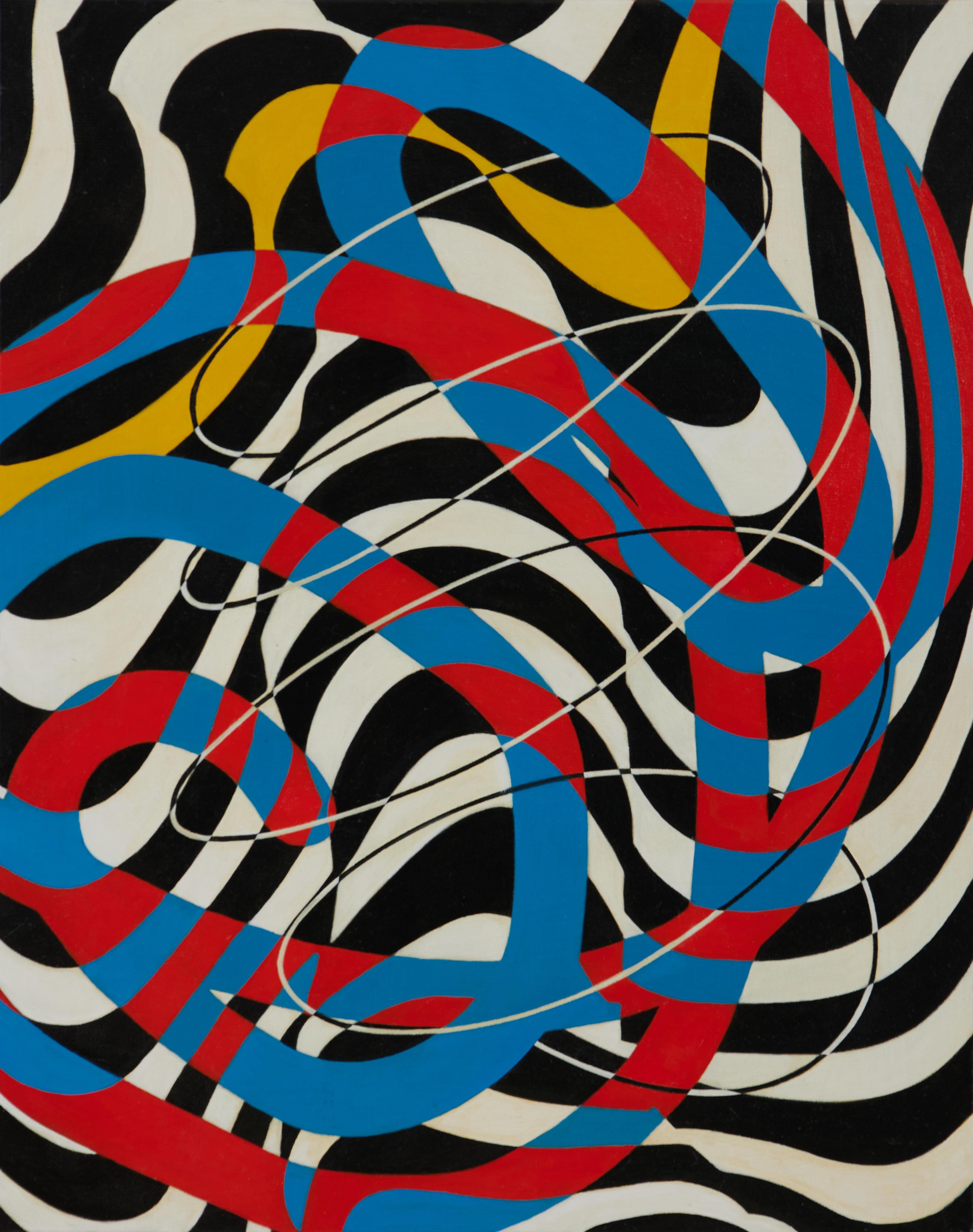
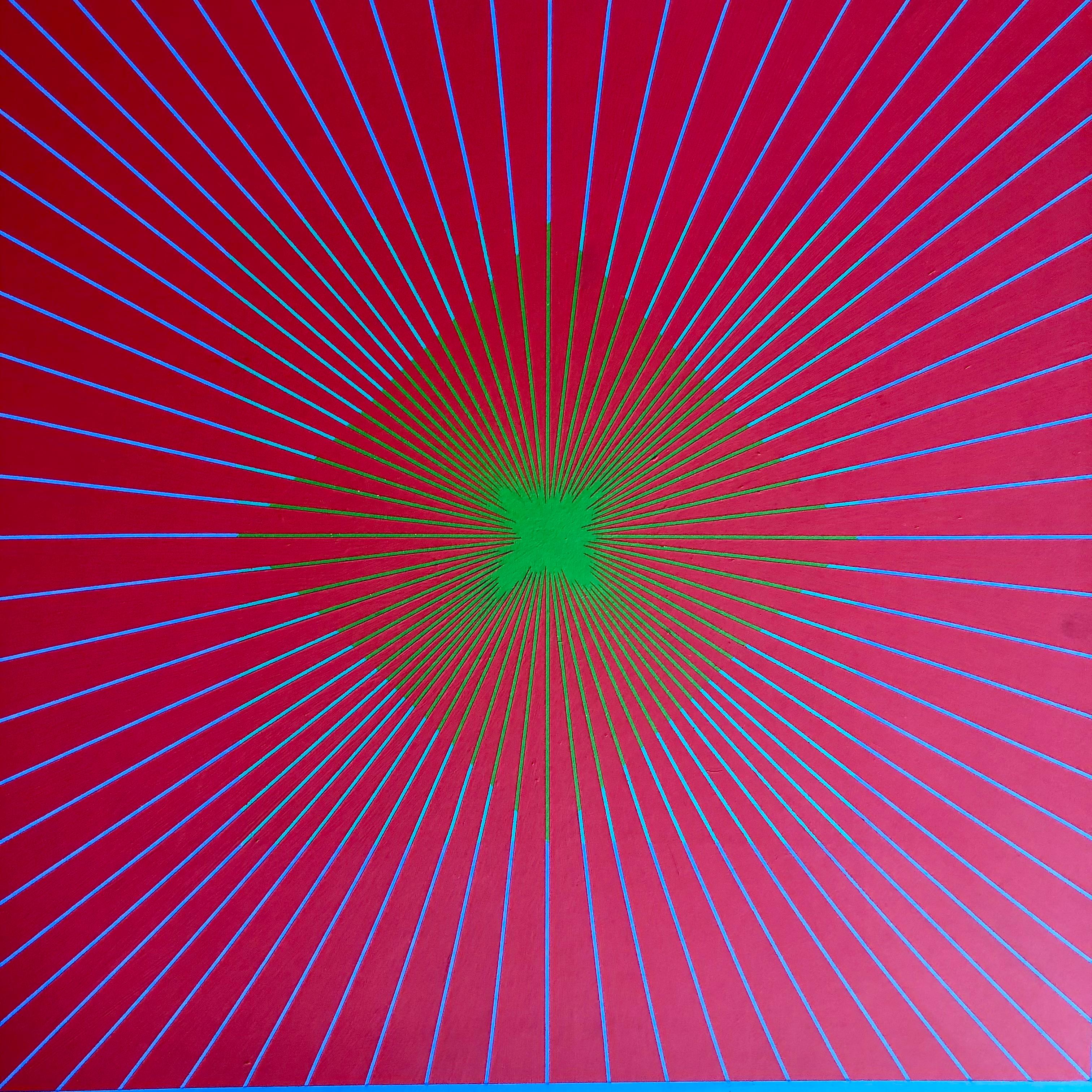
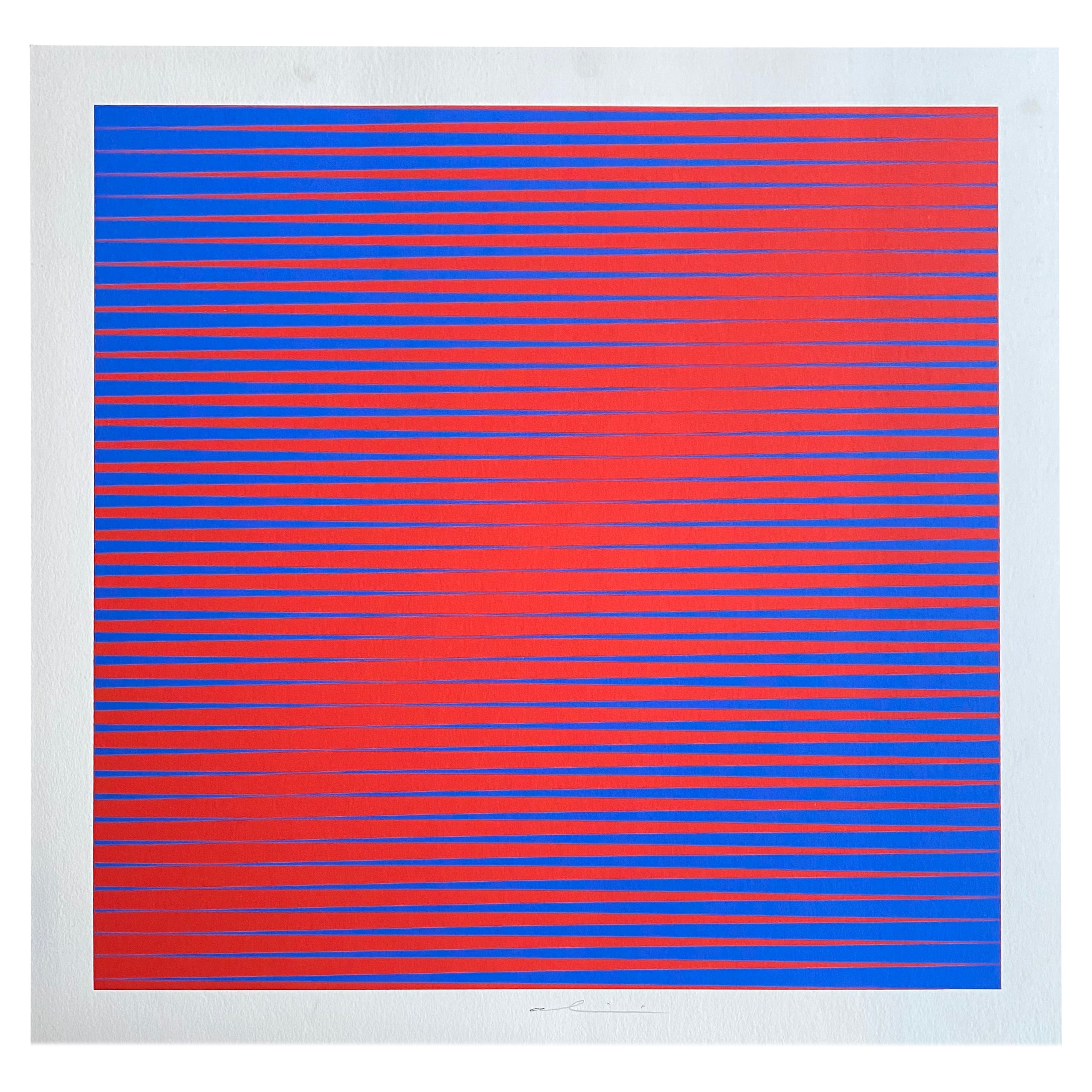
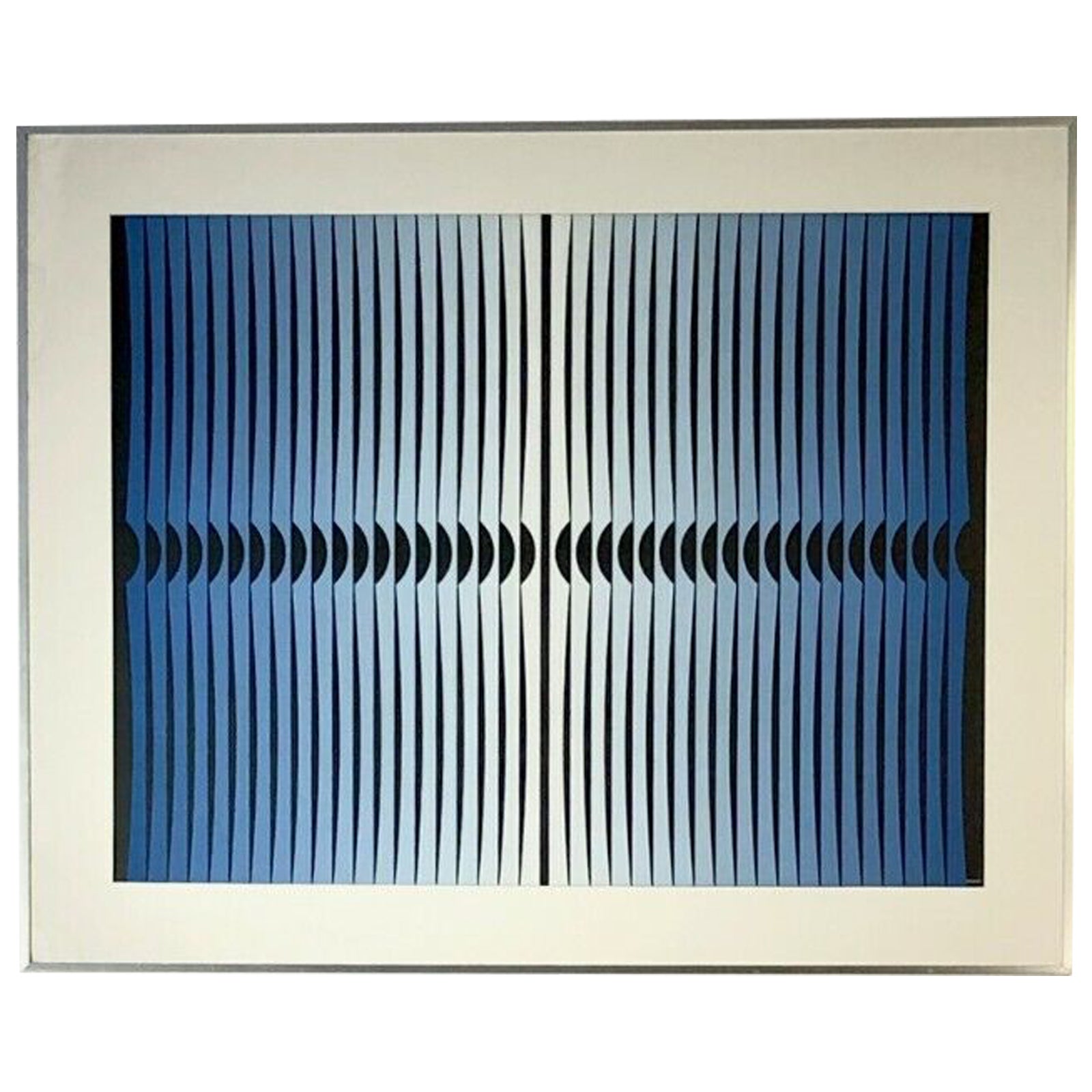
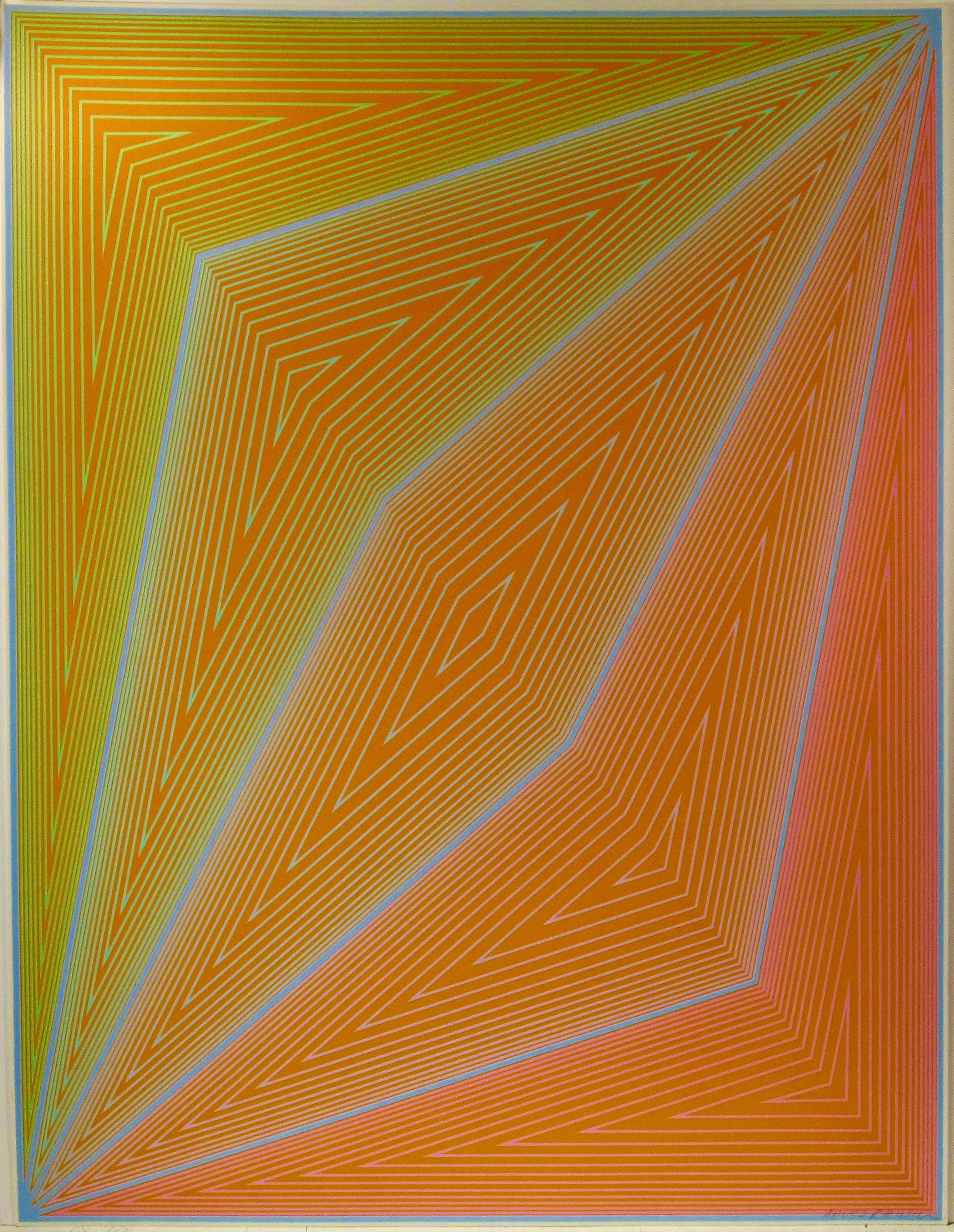
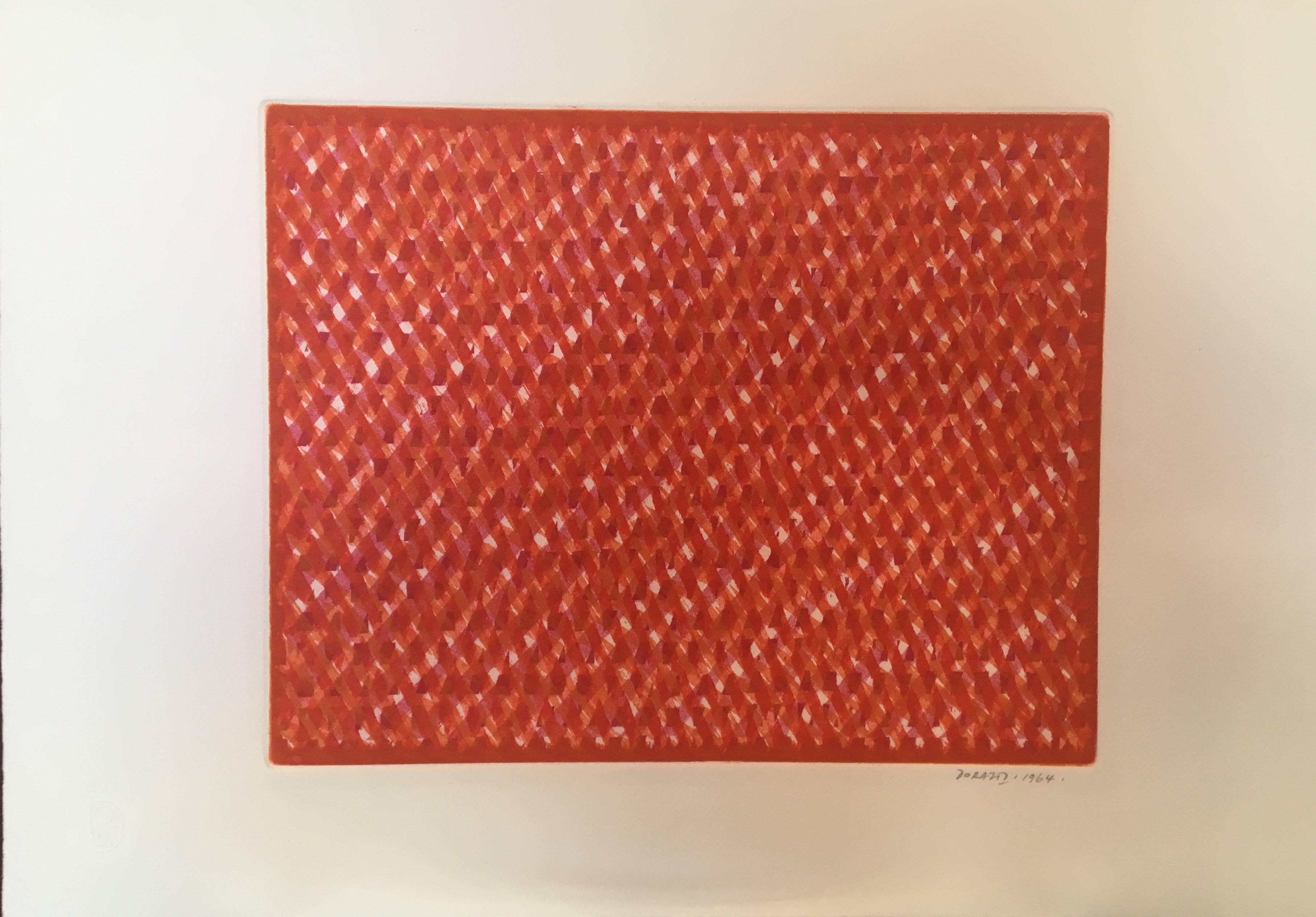
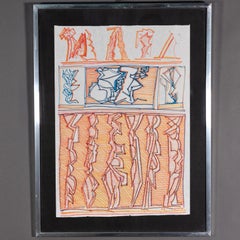
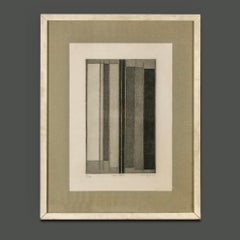
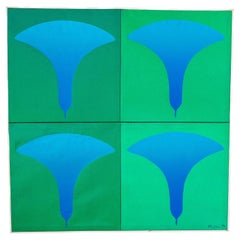
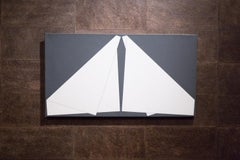
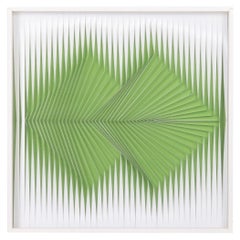
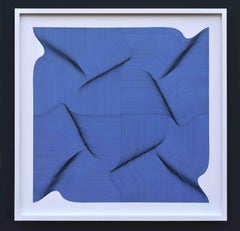
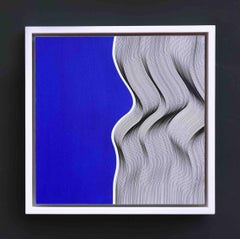
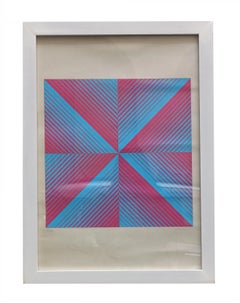
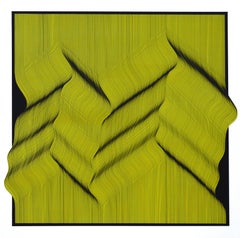
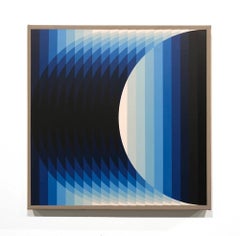
A marvellous and extremely rare work by one of the most important artists of contemporary kinetic art, Alberto Biasi (Padua, 1937).
This work bears the artist's own handwritten inscription on the back with the wonderful title
“L’essere umano era ed è circondato dall’ignoto” (Human beings were and are surrounded by the unknown) and the datet 1973
It is part of the prestigious series of works called Politipo, created using the extremely difficult technique invented by Biasi, which involves relief PVC strips on a painted board.
The greatest artists of the Kinetic Art movement, such as Alexander Calder, Jean Tinguely, Jesus Rafael Soto and Carlos Cruz-Diez, have inspirate the work of Alberto Biasi, who has reinterpreted their ideas through the innovative use of PVC slats.
The work, signed, titled and dated on the back, is protected by glass and a frame.
This artwork, never before on the market, comes from an important
European private collection and is beautified by an impressive original frame in ebanised wood, in almost perfect condition.
Every item of our Gallery, upon request, is accompanied by a certificate of authenticity issued by Sabrina Egidi official Expert in Italian furniture for the Chamber of Commerce of Rome and for the Rome Civil Courts.
Our company has been present on this platform for many years, with more than 100 sales made and just as many excellent reviews received that you can under our Furniture account.
In 1959, Gruppo N was founded in Padua, a collective of visionary artists including Alberto Biasi (Padua, 1937). Together with Ennio Chioggia, Toni Costa, Edoardo Landi and Manfredo Massironi, they created luminescent rooms where mechanics danced with artificial light, creating an immersive experience for visitors.
In his relentless optical-kinetic research, Alberto Biasi explored the magic of lamellae, which, when applied to a background, gave life to a constantly evolving work, dancing under the gaze of the observer.
This innovative approach is evident in works such as “Torsioni”, where the continuous mobility of the work is a metaphor for human perception.
Alberto Biasi's imagination knows no bounds, and to the painted lamellae with their blurred edges, he adds colourful, multi-layered backgrounds, summarised in his optical-kinetic works or in his Polyptychs, right up to his most recent Assemblages.
Alberto Biasi (Padua, June 2, 1937) is an Italian painter among the co-founders of the N Group and an exponent of Italian programmed art and kinetics
Born in Padua on June 2, 1937, where he currently lives and works, he is one of the main exponents of Italian kinetic art.
In particular, his name is linked to the season of maximum popularity of optical-kinetic art, thanks to his artistic creations built on the basis of precise optical illusions.
His paintings generally have surfaces that change appearance depending on the angle of observation, thus giving the illusory sensation of movement.
In 1959, together with some peers students of Architecture, he founded the Enne-A Group. In 1960 he exhibited together with Agostino Bonalumi, Enrico Castellani, Piero Manzoni and other European artists at the Azimut Gallery in Milan. In the same year, with Ennio Chiggio, Toni Costa, Edoardo Landi and Manfredo Massironi formed the Group N.
In 1961 he joined the "Nuove tendenze" movement and, in 1962, exhibited together with Gruppo N at the Arte exhibition programmed at the Olivetti Store in Milan and with Bruno Munari, Enzo Mari and Gruppo T (Giovanni Anceschi, Davide Boriani, Gabriele Devecchi, Gianni Colombo, Grazia Varisco).
Between 1959 and 1960 he made the Plots, reticular and permeable objects made with perforated papers.
This series is soon compared to that of optical-dynamic reliefs, in which lamellar structures superimposed on tables with contrasting colors create particular visual effects.
The first Twists also date back to the same period, works developed on classic geometric shapes (square, circle, triangle and rectangle), made with PVC slats on a table, capable of creating perceptive effects that vary with the movement of the viewer. In 1962 he designed the Light prism that will be made in environmental dimensions in 1969.
After the experience of Gruppo N, Alberto Biasi proceeds with his investigation as a soloist and, at the end of the sixties, elaborates the first Polytypes.
A few decades later, at the end of the 1990s, he made the Assemblaggios.
His collective and personal exhibitions are countless, his participation in fundamental exhibitions in the history of kinetic art, such as "Nove Tendencije" in Zagreb and the great exhibition "The responsive eye" at the MoMa in New York.
More recently, a large anthology at the Museum of the Hermits in Padua is remembered in 1988, in 1995 the retrospective "Biasi and the ENNE Group at the Venice Biennale, in 2006 the exhibition of about thirty of his historical works in the Hermitage Halls in St. Petersburg, in 2007 the exhibition at the Diocesan Museum of Barcelona and the participation in 2008 in the International Triennale of Contemporary Art in Prague.
Alberto Biasi in the museums
Ca' Pesaro, Venice
National Gallery of Modern and Contemporary Art, Rome
Museum, Bolzano
Peggy Guggenheim Collection, Venice
MAGI '900, Pieve di Cento (BO)
Roberto Casamonti Collection, Florence
George Pompidou Center, Paris
Hermitage, Saint Petersburg
MoMA - Museum of Modern Art, New York
Ritter Museum, Waldenbuch
Kulturspeicher Museum - Collection C. Peter Ruppel, Würzburg
Museum of contemporary art, Zagreb
Exhibitions (selection)
1960 - With the door closed, no one is invited to intervene, Studio Enne, Padua
1967 - Group N, Art Museum, Lodz
1970 - Alberto Biasi: dynamics, multiples and polytypes, Galleria La Chiocciola, Padua
1972 - Alberto Biasi, Art Museum, Lodz
1979 - Alberto Biasi, Artistic Research Center, Kansas City
1986 - Alberto Biasi, the polytype cycle, La Chiocciola Gallery, Padua
1988 - Anthology, Civic Museum of the Hermits, Padua
2005 - The art of instability, Casa del Mantegna, Mantua
2006 - Alberto Biasi: testimonies of kinetics and programmed art in Italy and Russia, Hermitage Museum, St. Petersburg
2007 - Alberto Biasi, imagination: movement, space, Diocesan Museum, Barcelona
2011 - Alberto Biasi, the 60s the 2000s, Narodni Muzei Slovenije-Metelkova, Ljubljana
2013 - Alberto Biasi. Optical-dynamic reliefs. Dep Art Gallery, Milan
2014 - Alberto Biasi in San Vitale. The light and the environments of history, National Museum and Mausoleum of Theodoric, Ravenna
2014 - Alberto Biasi and Jorrit Tornquist. From light to image , MACBA , Buenos Aires
2014 - Alberto Biasi. Optician/Dynamic , The Mayor Gallery, London
2014 - Alberto Biasi. Exordiri / the Plots, MAAB Gallery, Milan
2015 - “Alberto Biasi. Start up & Environment” , Marca museum, Catanzaro
2015 - Alberto Biasi, Galerie Tornabuoni Art, Paris
2016 - Alberto Biasi, Light Visions, Dep Art Gallery, Milan
Under existing legislation, any artwork can requires a license for export regardless of the work’s market price. The shipping may require additional handling days to require the license according to the destination of the artwork.