Want more images or videos?
Request additional images or videos from the seller
1 of 5

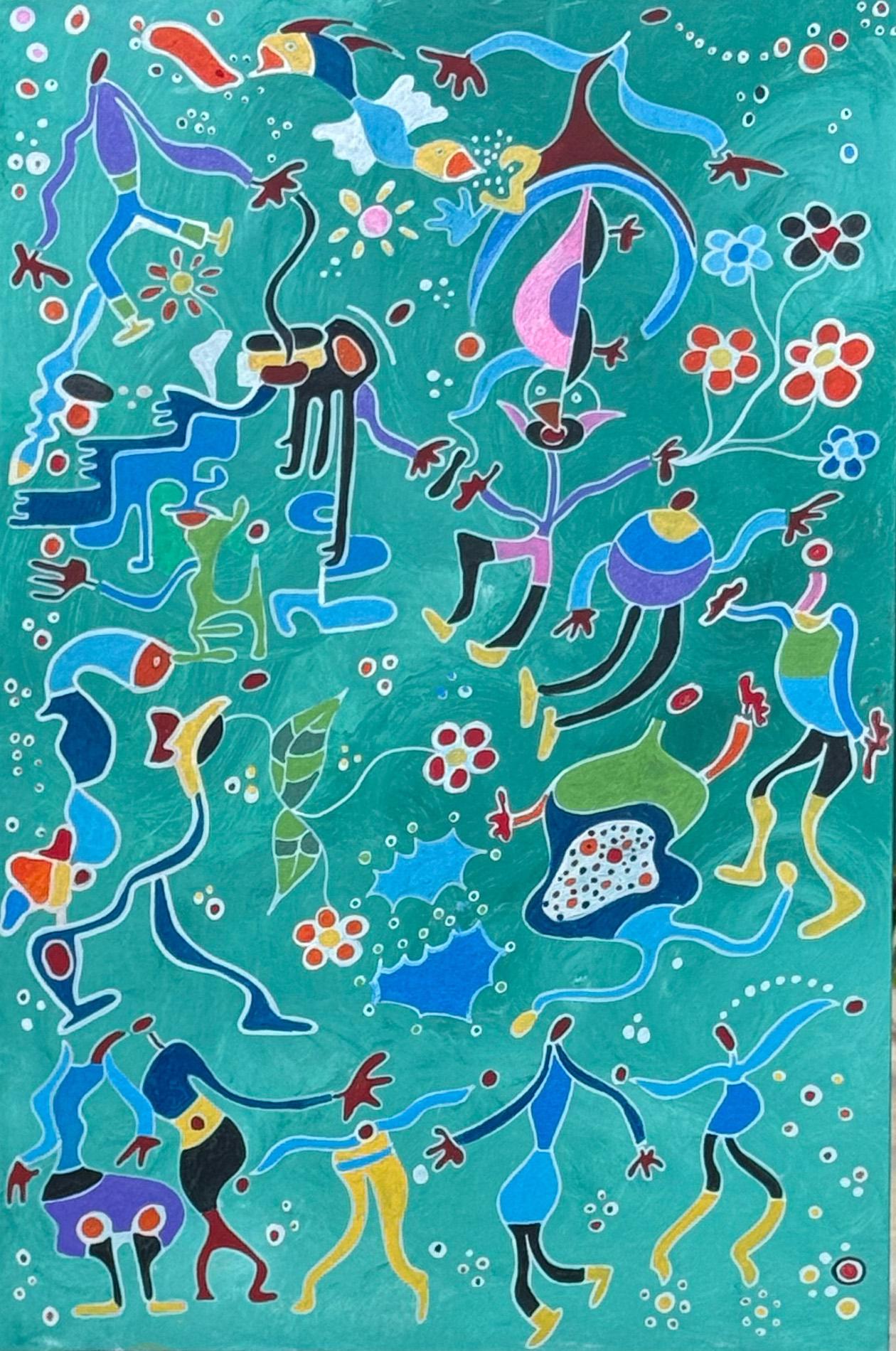
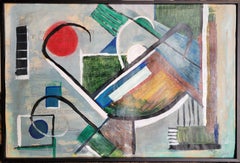
Baruch Nachshon
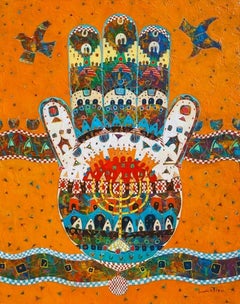
The Song of Peace

On Hold
$24,000
On Hold
£18,186.80
On Hold
€21,197.62
On Hold
CA$34,306.37
On Hold
A$34,736.04
On Hold
CHF 19,761.24
On Hold
MX$422,151.85
On Hold
NOK 233,587.67
On Hold
SEK 232,360.54
On Hold
DKK 158,457.38

About the Item

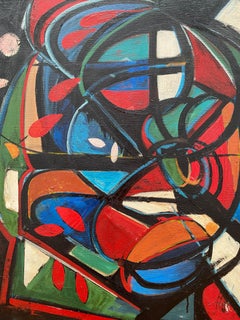
Baruch Nachshon, was born in Mandatory Palestine in 1939, in the city of Haifa. Nachshon began to paint in early childhood, and developed his relationship to art and to artists throughout his youth. During his military service Nachshon herded flocks for the IDF, an experience that imbued in him a love and appreciation for nature which figures prominently in his work until today. Upon completing his military service the young artist was torn between the temptation to travel to Paris, then the cultural center of the art world, and his deep love of the land of Israel, the spiritual center of the Jewish world. Opting to stay in Israel, Nachshon studied under Shlomo Nerani, Cezanne’s only pupil, with whom he had enjoyed a deep friendship extending back to his childhood. Nachshon, whom Nerani viewed as his spiritual heir, was the only one of his students allowed to see the master at work. Nachshon’s lifelong involvement in Lubavitch Hassidut began in his early adulthood, when he was drawn to the movement by its uniquely beautiful traditional melodies. In 1965 Nachshon was invited to an unprecedented three- hour private session with the Rebbe of Lubavitch, Menachem Mendel Schneerson, in New York. The young artist used the opportunity to share his concerns and misgivings about the role of the Jewish artist and the many inherent conflicts which confronted him. The Rebbe blessed Nachshon with the advice that for many generations the art of painting had failed to find its ultimate rectification in holiness, but that with the help of God he might come to bring about that long anticipated rectification. The Rebbe then offered to fund Nachshon’s studies in New York on the condition that he would find a program of study acceptable to Jewish religious values. Despite the difficulty inherent in such a task, Nachshon gladly received the Rebbe’s offer and devoted himself fully to the celebration of the wisdom of the Creator through visual art. In 1967 Nachshon and his wife Sara, along with six other families renewed the Jewish presence in Hebron for the first time since the city’s Jewish residents were massacred by Arabs in 1929. To underscore the significance of Jewish culture to the city, Nacshon opened a gallery of his art beside the Tomb of the Patriarchs. During this period Nachshon also used to visit the houses of Hebron’s Arab residents in order to paint the city from unique angles. On one of his regular visits to the Tomb of the Patriarchs, Nachshon met an elderly Breslov Hassid. The hassid urged him to recite Psalms every night for forty days, and assured him that if he did so he would merit profound revelation. Nachshon did so, and as soon as the forty days had passed he saw the heavens open, receiving visions that would charge his art forever. Since that first time, Nachshon has seen the heavens open many times and, indeed, the opening of the heavens is a recurring motif in his work. According to Nachshon, “the open sky means going beyond what is reality, seeing through.” Nachshon’s art covers a wide range of thematic material through equally diverse stylistic approaches, all of which are uniquely his own. He paints in order to define and to emphasize the presence of the active Divine Will in creation, and in order to inspire himself and others. Nachshon paints what he sees through the eyes of an inspired painter, communicating those visions to the world. Each of his paintings can be studied in the manner of a sacred text, providing numerous and vivid insights into the workings of creation and the promises held for the future. Many of his paintings describe visions of the future, of the world after its final redemption, of a world where all is peace and joy and where the revelation of divine beneficence is clear to all. Until that time, Nachshon’s paintings offer a glimpse of what could be, of what ought to be and of what will be when the work of humanity has reached its successful completion The Artist’s Prayer I express my gratitude to you, artisan of creation, for you have endowed me with the spirit of your holy inspiration. I beseech you- in your vast kindness- impart to me more and more of your holy inspiration so that I may rejoice in you, and give cause for rejoicing to your creations. Give me inspiration to reveal your presence, even in the darkest places, because everything is from you and before your presence all darkness is also light. You created your universe, and within it crafted all of your creatures so that they would come to acknowledge you. And so- this, indeed is all I ask- kindness! For there is nothing else, no words in our mouths sufficient to thank you for having created us, having made us your children- the Children of Israel- and having brought us close to you in order to serve you. You have drawn forth our spirit and illuminated all- Well of Life. -Baruch Nachshon, Hebron, 5749 Participated in group exhibitions in the Artists' Quarter in Safed, Tel Aviv, Jerusalem, in the Chai Gallery, Chabad Chassidic Art Institute in Brooklyn, and in other art galleries in Brooklyn. Championed by the Chai Gallery in Crown Heights, Brooklyn New York, they have represented all of the major Lubavitch Hasidic artists such as Baruch Nachshon, Hendel Lieberman, Zalman Kleinman, Michoel Muchnik as well as artists such as Samuel Rothbort, Harry Mccormick, Meer Akselrod and the Rebbe photos of Fridrich Vishinsky.

More From This Seller

View All
Rare Abstract Judaica Hebrew Calligraphy Modernist Painting

Rare Abstract Judaica Hebrew Calligraphy Modernist Painting

By William Proweller

Located in Surfside, FL

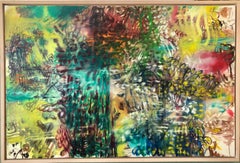
Abstracted colorful painting of the first verse of the Shema Prayer. (VeAhavta... and you shall love...) William Proweller is an associate professor of art history at S.U.N.Y., Fred...

Category

20th Century Conceptual Abstract Paintings

Materials

Other Medium

Celestial Fields Post Soviet Avant Garde Russian Israeli Art, Leviathan Group

Celestial Fields Post Soviet Avant Garde Russian Israeli Art, Leviathan Group

By Shmuel Ackerman

Located in Surfside, FL

Genre: Contemporary Subject: Abstract Medium: Oil Surface: Canvas Hand signed and dated lower left Dimensions: 23 3/4" x 19 3/4" x 1/2" Dimensions w/Frame: 24" x 20 1/2" A bright and colorful abstract oil painting from Ackerman's Celestial Field series. While most pieces in this series are gouache, this electric blue painting is done in oil. Shmuel Ackerman (also spelled Shmuel Akkerman, Samuel Ackerman, Samuel Akkerman) Israeli Symbolist Painter and Co-Founder of the Leviathan Group Shmuel Ackerman (b. 1951, Soviet Union) is an Israeli painter known for his abstract symbolist works exploring the intersection of Jewish mysticism, folk art and folkloric motifs, and modern Western art. Born in Ukraine to a religious family, Ackerman trained at the Institute for Monumental Art in Ukraine from 1965 to 1970 before immigrating to Israel in 1973, settling in Jerusalem. Founding the Leviathan Group In 1976, Ackerman co-founded the Leviathan group in Jerusalem alongside Avraham Ofek and Mikhail Grobman, aiming to enrich Israeli art by drawing on Jewish sources, myth, and symbolism. The group combined conceptual and land art with Jewish mysticism and Kabbalah, seeking to forge a distinctly "national" style of Israeli art — publishing its ideas through a Russian-language periodical, also titled Leviathan, that Grobman edited. Within the group, Ofek pursued sculptural and performative work rooted in Kabbalistic symbolism, staging pieces like Ornament in the Landscape (1979) and projecting Hebrew letters onto the soil of the Judean Desert in works such as Letters of Light (1979), while Grobman's paintings and prints wove Hebrew and Russian text through images drawn from Jewish mystical tradition. Ackerman was an active member of the group until 1981, when both he and Ofek departed; Grobman continued the Leviathan project afterward with newer members including Lena Zaidel, who joined following her graduation from the Bezalel Academy of Art and Design in 1987, and staged further performances such as Khlebnikov 100 (1985) and Messiah (1987). Context: The Post-Soviet Jewish Avant-Garde Ackerman's formation belongs to a broader generation of Soviet-born Jewish artists whose emigration to Israel and the West reshaped both Israeli and international art in the 1970s and '80s. Grobman himself had been an active figure in the Second Russian Avant-Garde in 1960s Moscow, a milieu of unofficial, nonconformist artists resisting Soviet Socialist Realism that also produced émigré figures such as Ilya Kabakov, Erik Bulatov, Viktor Pivovarov, Vladimir Yankilevsky, Eduard Steinberg, Yuri Kuper, Grisha Bruskin, and the duo Komar and Melamid — many of whom, like Ackerman, carried the visual language of Soviet nonconformism into new engagements with Jewish identity and symbolism after leaving the USSR. Ofek's work from this same period was later exhibited in the landmark survey Chagall to Kitaj: The Jewish Experience in Twentieth Century Art at London's Barbican Art Gallery, situating the Leviathan group's project within this larger international conversation about modern Jewish art. Later Career in Paris In 1984, Ackerman relocated to Paris, France, where he continued to develop his abstract practice, producing large-scale mixed-media works on paper engaging with the legacy of twentieth-century modernism — his mature series paying explicit homage to Piet Mondrian, Wassily Kandinsky, Clyfford Still, and Robert Motherwell. Ackerman remains active in both Israel and France, continuing a practice that bridges Soviet-era training, Jerusalem's postwar avant-garde, and the broader trajectory of international abstraction. Keywords: Shmuel Ackerman, Shmuel Akkerman, Samuel Ackerman, Israeli painter, Soviet-Israeli artist, Leviathan group, Avraham Ofek, Mikhail Grobman, Second Russian Avant-Garde, Moscow Nonconformist art, post-Soviet Jewish avant-garde, Kabbalah art...

Category

1970s Contemporary Abstract Paintings

Materials

Canvas, Oil

Untitled Dynamic Colorful Abstract Expressionist Oil Painting, Israeli-American

Untitled Dynamic Colorful Abstract Expressionist Oil Painting, Israeli-American

Located in Surfside, FL

Nachume Miller (1949–1998) was a German born Israeli artist who immigrated to New York City in 1973, where he made a name for himself in the American Modern Art scene. Miller immigrated to New York to study at the School of Visual Arts, where he would later become a professor of painting and drawing. He was quickly identified as a star on the rise and at the age of 29, was included in the Guggenheim Museum’s “Young American Artists,” Exxon National Exhibition. A decade later he was granted a solo show at the Museum of Modern Art, where his work is now part of the permanent collection. Though his career was cut short by his untimely death in 1998, Nachume exhibited at some of the most prominent galleries in New York and around the world. Miller's parents were both Holocaust survivors. His father was a captain in the front lines of the Russian Army during World War II and his mother was a Lithuanian who had once been held captive in a concentration camp. Both escaped the Nazis, re-united and fled to Israel. Nahum was born during their voyage, in Frankfurt, Germany, on January 28, 1949. He grew up in the town of Holon, Israel, where he was inspired by his father who spent most of his post-war days carving elaborate wood sculptures of Cubist human forms. Nachum, on the contrary, excelled in painting. By the age of 16, Miller was painting elaborate surreal dream lands referencing religion, politics and the history of Modern Art. His earlier works show similarities to Hieronymus Bosch, Salvador Dali and Francisco Goya. Miller was enlisted in the Israeli Army where he worked as one of Ariel Sharon's personal assistants and also fought in the 1973 Yom Kippur War. He went to New York in 1966 to study at the School of Visual Arts, and joined the faculty in 1977 to teach painting and drawing. He was enlisted in the Israeli Army and fought in the 1973 Yom Kippur War. That same year, he received a scholarship from the Israeli-American Cultural Foundation. He married his girlfriend Ruth and moved to New York to study at the School of Visual Arts. In 1977, he joined the faculty to teach painting and drawing. Over the next two decades, Nachume was prolific in the range of media, styles, and references he incorporated into his art. His paintings and three-dimensional works pay homage to artists throughout history, from the classical Greeks to Robert Rauschenberg. He prioritized craft over concept and was a disciplined painter, never neglecting workmanship in favor of a trend. His work is marked with curiosity, sincerity and intensity. Cara McCarty, an assistant curator in the department of architecture and design, organized the current show. It reveals Mr. Miller as someone who finds common ground with both Turner and Jackson Pollock - with the former's Romantic re-creations of storms at sea and with the latter's search for content in abstract gesture. Selected One-Person Exhibitions 1976: "Drawing Show", Bertha Urdang Gallery, New York 1981: "Figures", A&M Artwork, New York 1988: Exit Art, New York; "Projects: Nachume Miller", Museum of Modern Art, New York 1989: E.M. Donahue Gallery, New York 1990: "Nachume Miller: Views", E.M. Donahue Gallery, New York 1993: "Sensual Painting", E.M. Donahue Gallery, New York 1994: The Genia Schreiber University Art Gallery, Tel Aviv University Selected Group Exhibitions 1968: "10+ For and Against", Tel Aviv Aviva Uri, Michael Druks, Nahum Miller, Izzika Gaon, Izzika Raffi Lavie. 1970: "10+ In a Circle", Tel Aviv Moshe Gershuni, Buky Schwartz, Igael Tumarkin, Reuven Kadim (Berman), 1972: "Symbols and Imagination", Artists' Pavilion, Tel Aviv; "July '72", Gallery 220, Tel-Aviv 1975: "The Work of Nine Graduates of the School of Visual Arts", New York; 112 Greene Street Gallery, New York; "Group Indiscriminate", 112 Green Street Gallery, New York 1976: "8 Israeli Artists", Bertha Urdang Gallery, New York 1978: "Young American Artists", Exxon National Exhibition, Guggenheim Museum, New York 1979: The Kadishman Connection Israel Museum, Jerusalem Menashe Kadishman, Larry Abramson, Yaacov Agam, Nachum Miller, Jacob El Hanani,Samuel Bak, Koki Doktori...

Category

1990s Abstract Expressionist Abstract Paintings

Materials

Canvas, Oil

Peace Mid-Century Modern Pop Art Enamel Painting Chaim Gross Modernist Ltd Ed

Peace Mid-Century Modern Pop Art Enamel Painting Chaim Gross Modernist Ltd Ed

By Chaim Gross

Located in Surfside, FL

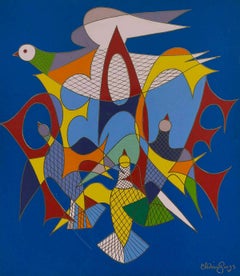
Mod, Hippie era Peace art. Chaim Gross, born in Wolowa, Austria in 1904, was educated at the Beaux Arts Institute of Design and at the Art Student's League in New York. Chaim Gross's work was greatly influenced by his experiences during a period of international conflict, World War II. He had moved to Kolomyia from Wolowa to get a better education, but the Germans came to occupy, killing, raping, and looting. Gross and his family were chased from one village to the next. He wrote, "We were sleeping on roofs and in the fields, with the sound of cannon fire always in the distance,". Eventually, he ended up in Budapest with his two brothers, where Anti­ Semitism was not as severe, and that is where he began to sculpt and draw. He even had a few odd jobs there as a gold­ and silversmith. When he was seventeen, Gross immigrated to America where his older brother was. There he was a student and then a teacher at the Educational Alliance on the Lower East Side. Teaching became a big part of his philosophy, as he believed that an artist must pass on the knowledge which he had received from others in his artwork. He was part of an artist emigre community which included Raphael Soyer, Moses Soyer, Arnold Newman, Max Weber and David Burliuk. His daughter is the artist Mimi Grooms and his son in law was Red Grooms. Chaim Gross works reflect his Jewish and Austrian roots and his Hasidic Jewish upbringing. The figures in his art reflect the Hasidic spirit of being happy and making other people happy. In his pieces, Jews sing and dance in celebration of the Jewish Sabbath and festivals. They are shown rejoicing in the great gifts of love and life. Chaim Gross was honored with a number of prestigious awards including: the Award of Merit Medal from the National Institute of Arts and Letters in 1963, and the Gold Medal award from the National Academy of Design in 1985. He often used his creative abilities to explore and experiment with media. In his artwork he retains an optimistic philosophy, even when facing somber issues such as war, depression, and the Holocaust. He is in the collections of the Museum of Modern Art; the Metropolitan Museum of Art; the Whitney Museum of American Art; the Philadelphia Museum of Art; the Art Institute of Chicago; the Tel Aviv Museum of Art, Israel. And the EIN HAROD Museum's Holdings: Israeli art is represented by the works of Reuven Rubin, Zaritzky, Nahum Gutman, Mordechai Ardon, Aharon Kahana, Arie Lubin, Yehiel Shemi, Yosl Bergner and others. The graphic arts collection contains drawings and graphic works by Pissaro, Amedeo Modigliani, Jules Pascin, Marc Chagall (almost all of his graphic work), and numerous other artists. The sculpture collection includes works by Jewish sculptors from all over the world including leading Israeli sculptors; Ben Zvi, Lishansky, David Palombo, Yehiel Shemi, Aharon Bezalel and Igael Tumarkin. Many Jewish sculptors from all parts of the world, beginning with Mark Antokolsky, are represented in the collection. In the sculpture courtyard there are works by Chana Orloff, Jacob Epstein (the works he bequeathed to the Museum), Enrico Glicenstein, Loutchansky, Joseph Constant and Leon Indenbaum...

Category

Mid-20th Century Modern More Art

Materials

Metal

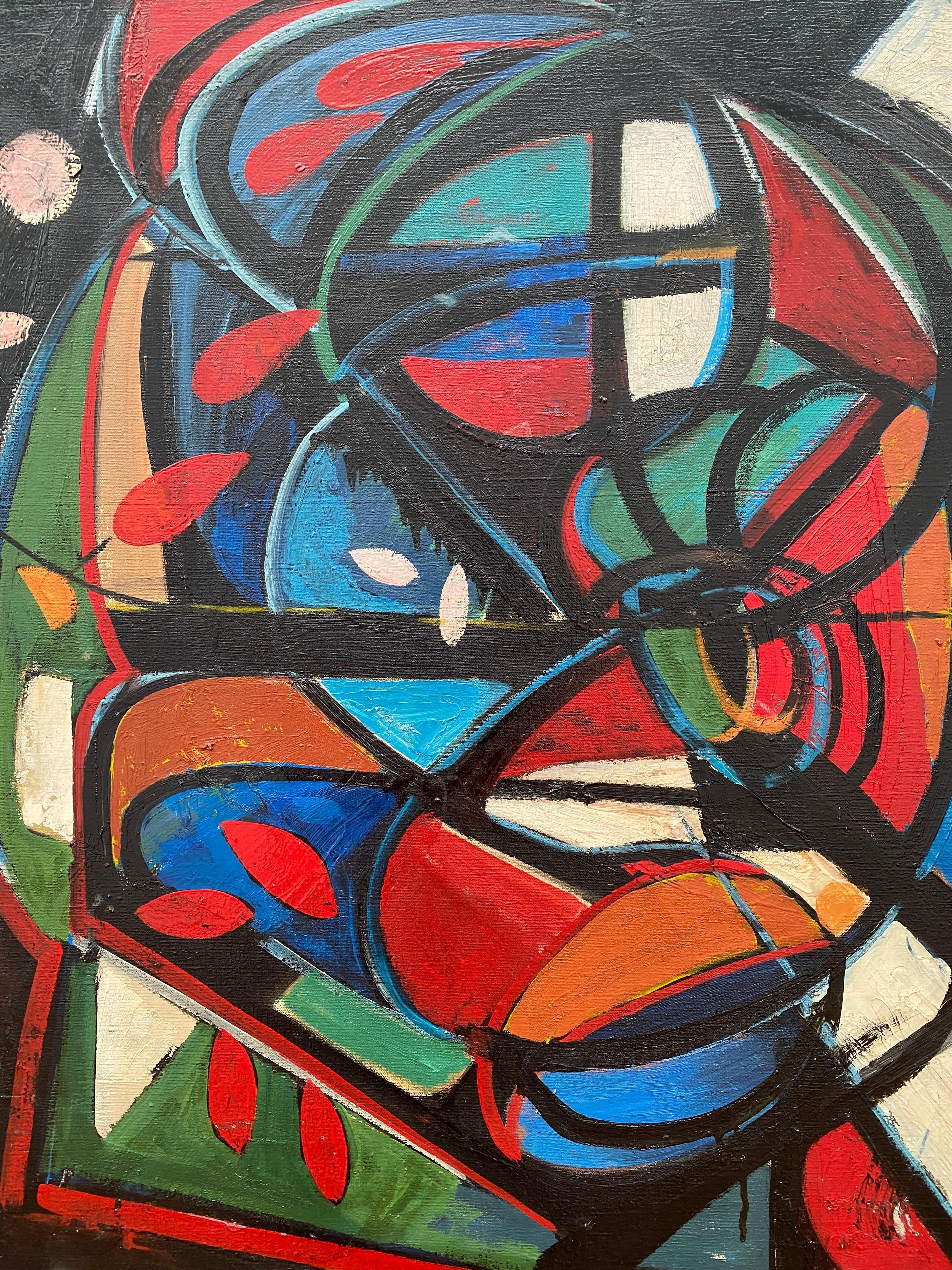
Large Israeli Abstract Pattern & Decoration Oil Painting Yuval Shaul Steel Frame

Large Israeli Abstract Pattern & Decoration Oil Painting Yuval Shaul Steel Frame

Located in Surfside, FL

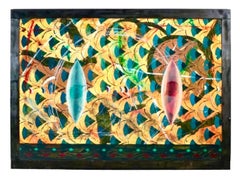
Yuval Shaul, (Israeli, Born 1961) Hand signed Large Scale Mural Abstract Mixed Media Oil Painting on Board Framed in Artist's Metal (welded steel or iron) frame. Measures 54.5 X 75 inches Yuval Shaul was born 1961 in Tel Aviv, Israel, He is one of the most important artists in Israel, Yuval graduated from the Avni Institute, Tel Aviv with Art Studies in 1988 as-well as studying under Zvi Millstein Studio in 1984. Winner of the 2011 Cutlog Prize, Paris, he has also achieved the Young Artist Prize from the Ministry of Education, Culture and Sports in 1991 and completed 2 one-year scholarships from the America-Israel Cultural Foundation and Sharet Foundation 1989-1990. more recently he has returned to painting after two decades of focusing on making sculptures. In the exhibition 'New Abstract' Shaul presented colorful, abstract paintings that interact with each other and creating dynamic compositions. Shaul works as an alchemist who uses oil paints mixed with industrial metal paints, thinners, and more materials to creates his dynamic compositions by lifting the papers in different directions and propping them up on various stands so that the colors mix, drip, run and eventually settle. This painting process emphasizes Shaul's individual painting, which he calls "painting in action / in motion". This bears the influence of the Pattern and Decoration movement artists such as Brad Davis, Mary Grigoriadis, Joyce Kozloff, Robert Kushner, Kim MacConnel, Sonya Rapoport, Miriam Schapiro and Valerie Jaudon. YUVAL SHAUL Born in Israel in 1961. Lives and works in Tel Aviv, Israel EDUCATION 1984 – 1988 Art Studies at Avni Institute, Tel Aviv 1983 – 1984 Zvi Millstein Studio, Paris SELECTED SOLO EXHIBITIONS 2019 Gal Gaon Gallery, TLV 2018 Christine Parker Gallery, NYC 2015 Beijing 3 Gallery, Beijing 2014 Lebenson Gallery, Paris 2013 Yves Saint Laurent Fondation, Paris; Pierre Bergé & Associés, Paris 2010 Lebinson Gallery, Paris 2009 Tavi Dresdner Gallery, Tel Aviv 2008 Tavi Dresdner Gallery, Tel Aviv 2004 Minoriten-Galerie, Graz 2002 Herzliya Museum of Art, Herzliya 2001 Gulman Gallery, Moscow 2000 July M. Gallery, Tel Aviv 1999 Janco Dada Museum, Ein Hod Buro Empty Gallery, Amsterdam 1997 Art Gallery, Bezalel Academy of Art, Jerusalem 1996 Beit Ha'amudim Gallery, Tel Aviv 1995 Haifa University, Haifa 1993 Artifact Gallery, Tel Aviv 1992 Bograshov Gallery, Tel Aviv SELECTED GROUP EXHIBITIONS 2016 Post=Postmodernism # Utopia. Haifa Museum of Art, Haifa THE WALK. Yehuda Altmann, Peter Krauskopf, Yuval Shaul, Halle 9 Kirowwerk, Leipzig 2015 Boys and their Toys, Künstlerhaus Bethanien, Berlin 2011 Post Fossil, Design Museum Holon, Holon Ceramics Biennale, Israel Museum, Jerusalem Tel Aviv Photo, Rothschild 12, Tel Aviv 2010 3 Exhibition, Pure Evil Gallery, Tel Aviv Umm El Fahem Art Gallery, Umm El Fahem The Tiger, Florentine Gallery, Tel Aviv Lebinson Gallery, Paris 2009 Nahum Gutman Museum, Tel Aviv 2008 Ein Harod Museum, Ein Harod 2003 Double Vision: The Works of Aissa Deebi & Yuval Shaul, The Art Gallery, Haifa Israeli Contemporary, Robert Sandelson Gallery, London Thou Shalt Make...: The Resurgence of Judaism in Israeli Art, Time for Art, Tel Aviv Herzliya Museum of Art, Herzliya To Wake the Leopard, Florentin 45, Tel Aviv 2001 Cutting Edge, Arco 01, Madrid The Armoury Show, Tel Aviv Museum, Tel Aviv July M. Gallery, Tel Aviv 2000 Contemporary Israeli & Palestinian Art, Galway Arts Center, Ladies & Gentlemen, Tel Aviv Museum of Art, Tel Aviv Language of the Light, Language of the Shadow, Artist Center, Moscow 1997 Virtual Reality Tel Aviv Museum of Art, Tel Aviv Artists: Diti Almog, Ran Hadari, Yarden Wolfson, Gil Shachar, Aram Gershuni. Ladies and Gentlemen - Contemporary Israeli Art Tel Aviv Museum of Art, Tel Aviv 2000 Artists: Tsibi Geva, Yehudit Sasportas, Michal Chelbin, Izhar Patkin, Tal Shochat, Miriam Cabessa, Pinchas Cohen Gan, Office in Tel Aviv Gallery, Tel Aviv Artists: Farid Abu Shakra,David Gerstein, (Dudu) Jacques Jano. Time for Art - Center for Israeli Art, Tel Aviv Artists: Arie Aroch,Mordecai Ardon, Michail Grobman, Boris Schatz, Naftali Bezem, Michael Druks, Zoya Cherkassky...

Category

20th Century Abstract Abstract Paintings
Materials

Steel

You May Also Like

Paix

Paix

By Jean-Francois Larrieu

Located in Atlanta, GA

Jean-François LARRIEU (1960) (France) is an artist born in 1960 The oldest auction result ever registered on the website for an artwork by this artist...

Category

21st Century and Contemporary Abstract Expressionist Figurative Paintings

Materials

Acrylic

“Untitled Abstract”

“Untitled Abstract”

By Nahum Tschacbasov

Located in Southampton, NY

Original mid-century modern abstract oil on canvas painting by the well known Russian/American artist Nahum Tschacbasov. Signed lower right and dated 1945. Condition is very good. P...

Category

1940s Abstract Expressionist Abstract Paintings

Materials

Canvas, Oil

Spiritual Gathering, Original Painting

Spiritual Gathering, Original Painting

By Nathalie Gribinski

Located in San Francisco, CA

Artist Comments
Figures, animals, and flowers dance together in harmony. Painted freehand, each shape flows naturally, embodying movement and connection. The rich green backgro...

Category

21st Century and Contemporary Contemporary Mixed Media

Materials

Mixed Media

Songbirds Sing

Songbirds Sing

By Ford Crull

Located in Brooklyn, NY

“My work can be understood through the mind, but it is best felt with the heart, experienced through the emotions, recognized as a manifestation of the spiritual that is born on the ...

Category

2010s Neo-Expressionist Abstract Paintings

Materials

Canvas, Oil

Abstract On The Theme of Music, Hommage to Kandinsky.

Abstract On The Theme of Music, Hommage to Kandinsky.

Located in Cotignac, FR

An abstract painting on musical notation paper, hommage to Kandinsky, by French artist Delisle. Signed bottom right. This dynamic artwork is an abstract composition characterized by...

Category

20th Century Other Art Style Abstract Paintings

Materials

Paper, Acrylic, Oil