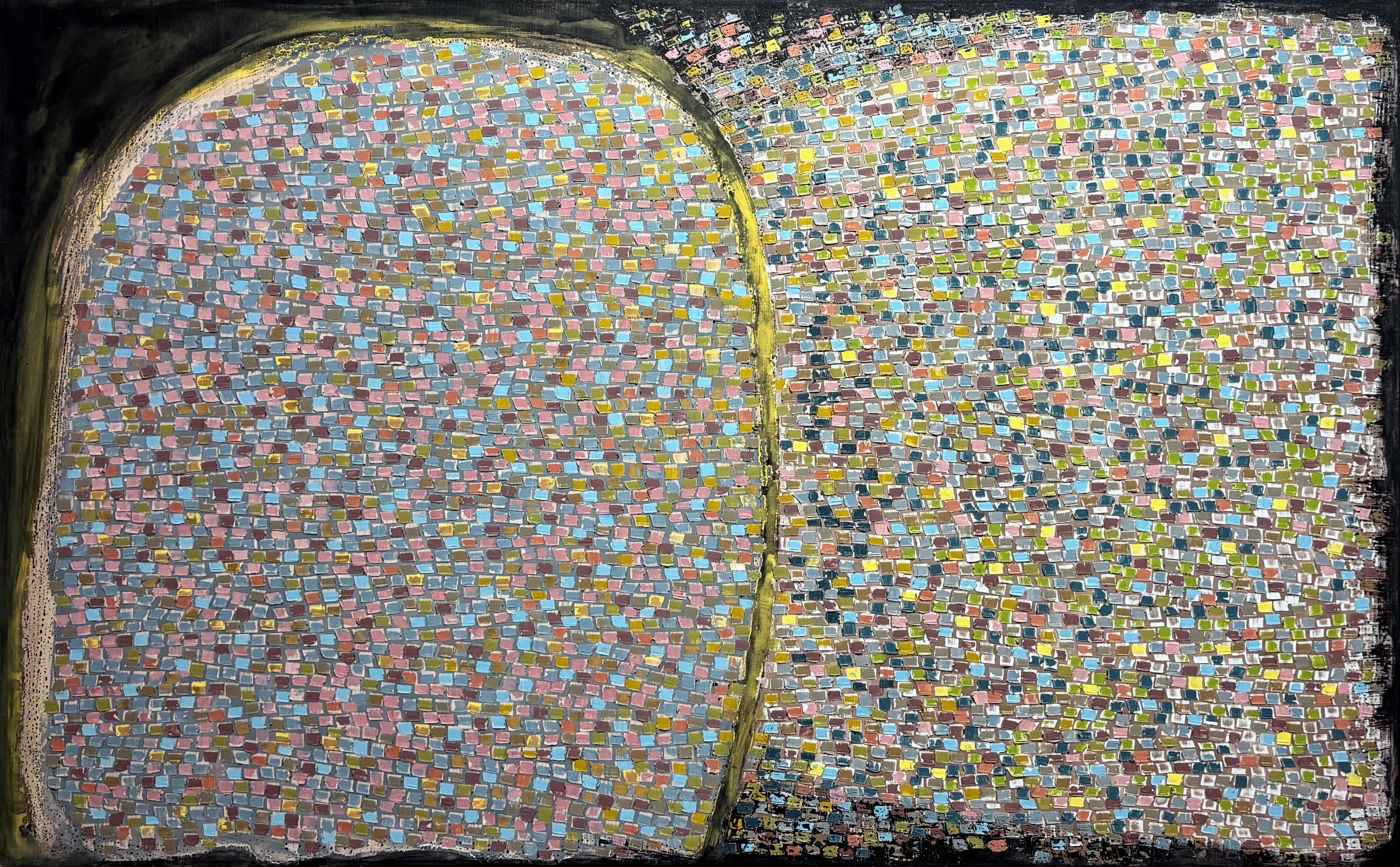
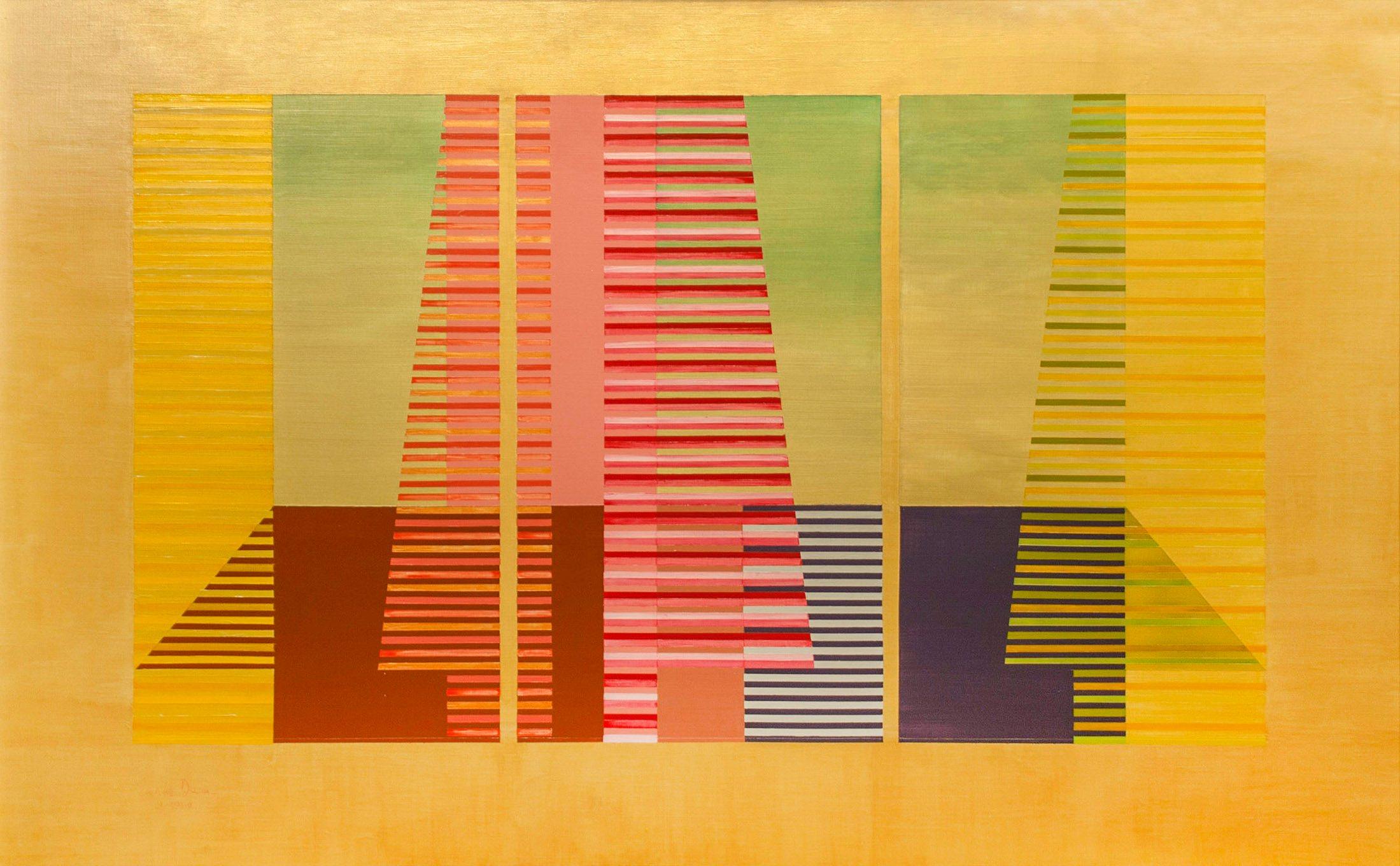
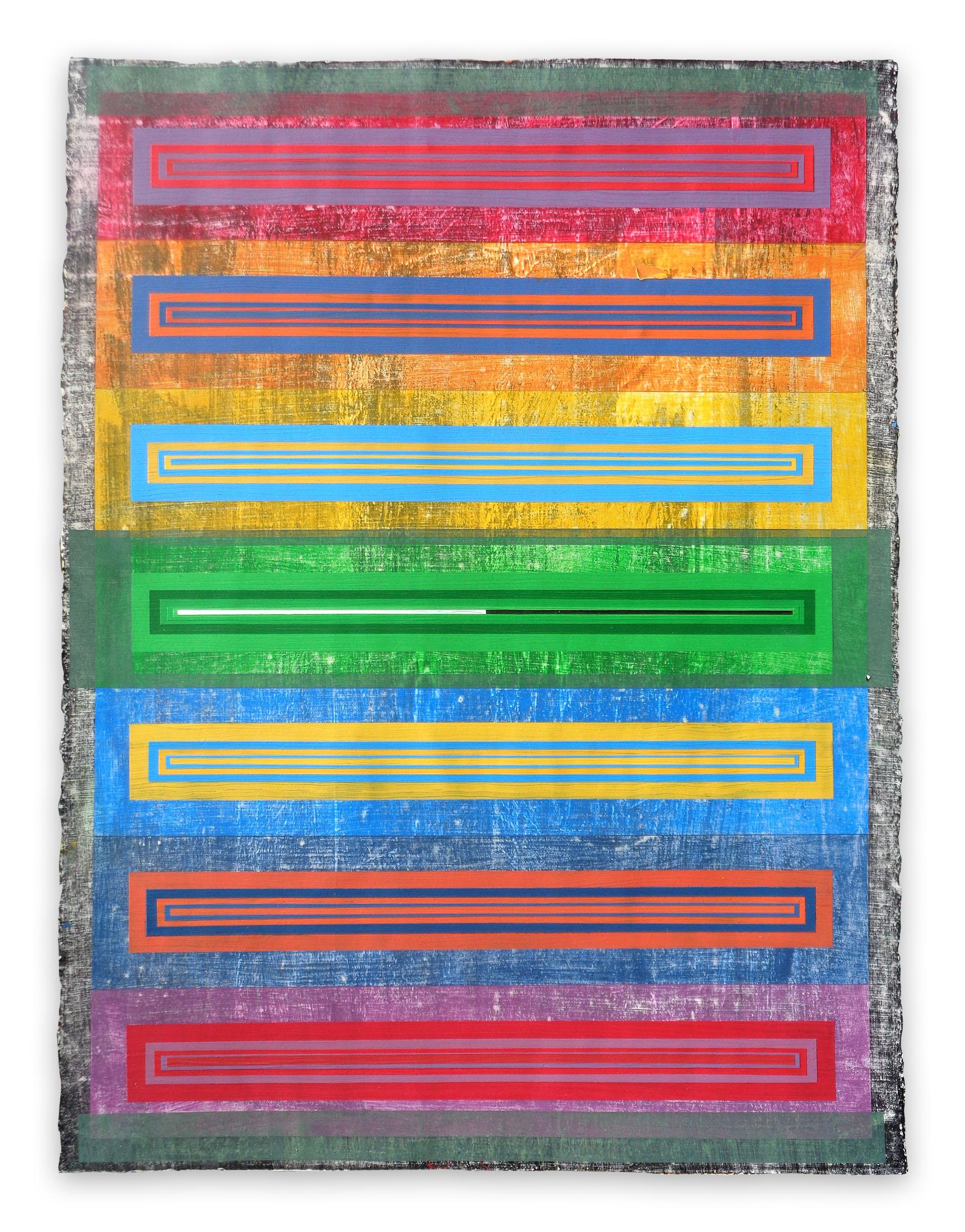
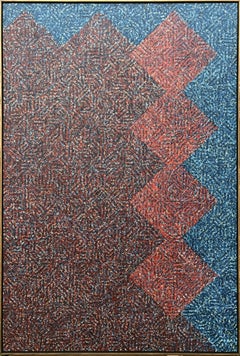
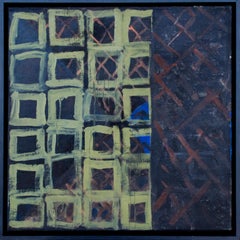
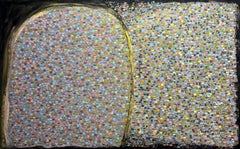
Frank Faulkner’s Untitled Light Cage #9 exemplifies the artist’s distinctive fusion of abstraction, pattern, architecture, and decorative design. Created in 1988, several years after Faulkner settled in New York’s Hudson Valley, the painting belongs to a mature period in which his interest in historic interiors and architectural restoration became increasingly intertwined with his studio practice. The surface is constructed from hundreds of raised acrylic marks arranged into tightly organized geometric units. Their shifting vertical, horizontal, and diagonal directions create a dense, woven structure that suggests basketry, masonry, mosaic, and an illuminated urban grid.
The title introduces a compelling tension between confinement and radiance. Faulkner’s repeated marks form a cage-like network, yet light appears to move through it. Metallic gold and bronze tones catch and reflect the surrounding environment, while flashes of red, blue, turquoise, and violet emerge from beneath the ordered surface. These colors prevent the painting from becoming entirely rigid, suggesting energy, memory, or organic life contained within its geometric system. The central configuration loosely resembles a stepped pyramid, temple facade, or futuristic city, but the image continually returns to abstraction.
Art historically, the painting shares affinities with the Pattern and Decoration movement, whose artists challenged the separation of fine art from textiles, ornament, craft, and domestic design. Faulkner’s serial marks also recall the repetitive structures of Minimalism and Post-Minimalism, though his tactile surfaces and sensuous color depart from Minimalism’s austerity. The work can additionally be understood in relation to ancient mosaics, architectural reliefs, and decorative screens, forms designed to transform light through pattern. Hovering between painting, relief sculpture, and ornamental object, Untitled Light Cage #9 demonstrates Faulkner’s belief that repetition could be both disciplined and expressive. Its visual order offers stability, while its luminous, richly worked surface rewards slow and intimate looking.
Frank Faulkner
Untitled Light Cage #9
acrylic on canvas
48 x 60 x 1.25 in (121.92 x 152.4 x 3.18 cm)
SKU: FFK001
Frank Faulkner (1946–2018) was an American painter whose richly textured abstractions unite the worlds of fine art, decorative design, and architecture. Built through repeated patterns, metallic pigments, raised surfaces, and carefully ordered marks, his paintings shift between the organic and the ornamental. Leaves, scales, architectural fragments, and cellular forms appear to emerge and dissolve within luminous fields of color. From a distance, the compositions possess an atmospheric calm; up close, they reveal an intricate physical presence shaped by Faulkner’s disciplined attention to surface.
Faulkner’s work shares important affinities with the Pattern and Decoration movement of the 1970s and 1980s, which challenged the traditional separation between fine art, craft, ornament, and domestic design. His use of symmetry and repetition also recalls textiles, mosaics, decorative painting, and the accumulated surfaces of historic interiors. Yet his images remain elusive, hovering between abstraction and recognition. Patterns may suggest reptilian skin, botanical growth, armor, or architectural detail without settling into a single interpretation.
Born in Sumter, South Carolina, Faulkner earned both his BFA and master’s degree from the University of North Carolina at Chapel Hill. During the 1970s, he served as a curator at the Southeastern Center for Contemporary Art and received an individual artist grant from the National Endowment for the Arts in 1974. After moving to New York’s Hudson Valley in 1982, his painting developed alongside an extensive practice restoring and designing historic homes. This sensitivity to architecture, aging surfaces, and ornament became inseparable from his art. Faulkner’s paintings invite sustained looking, revealing an artist for whom beauty, structure, and decoration were serious forms of visual and emotional experience.