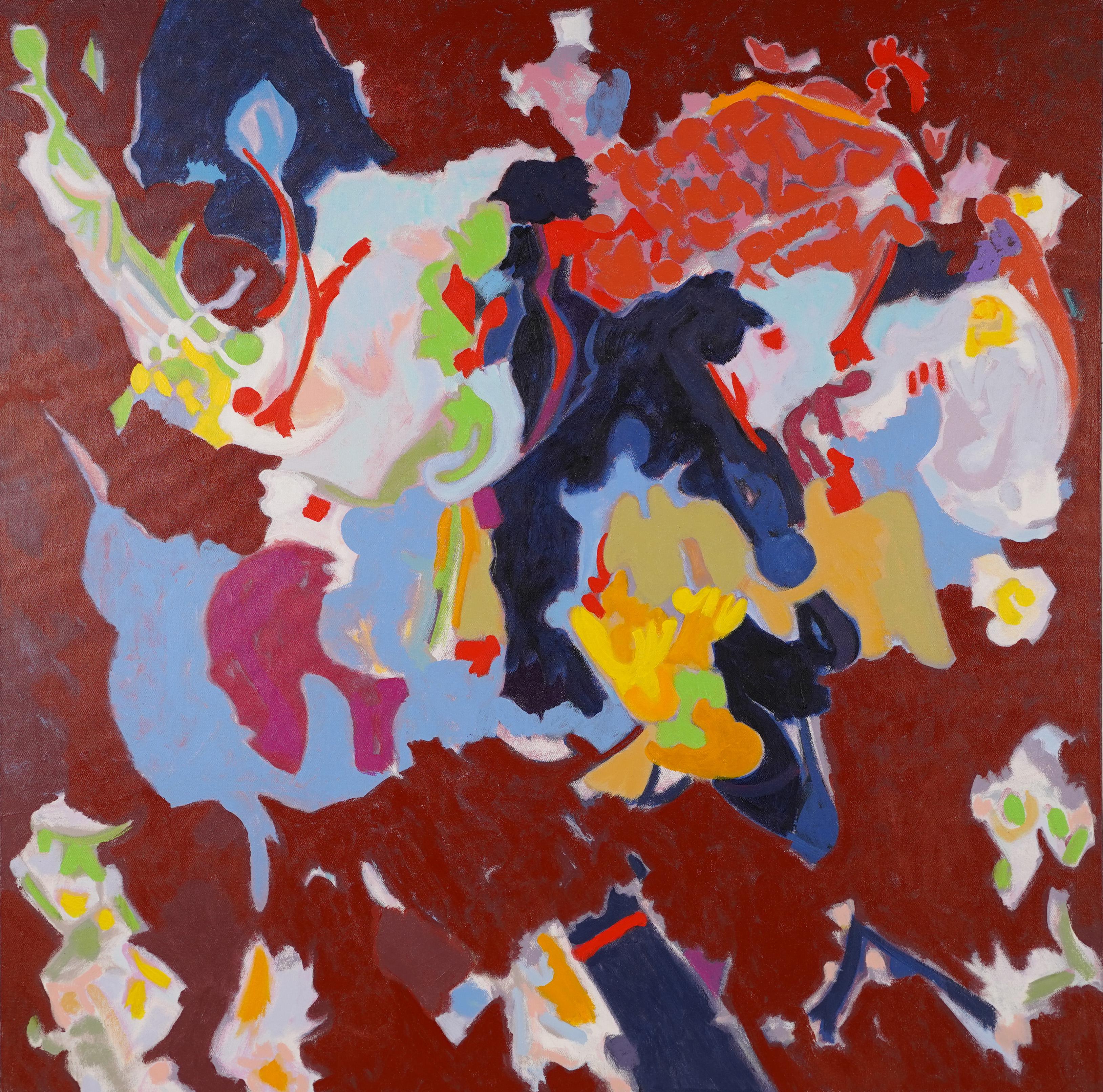
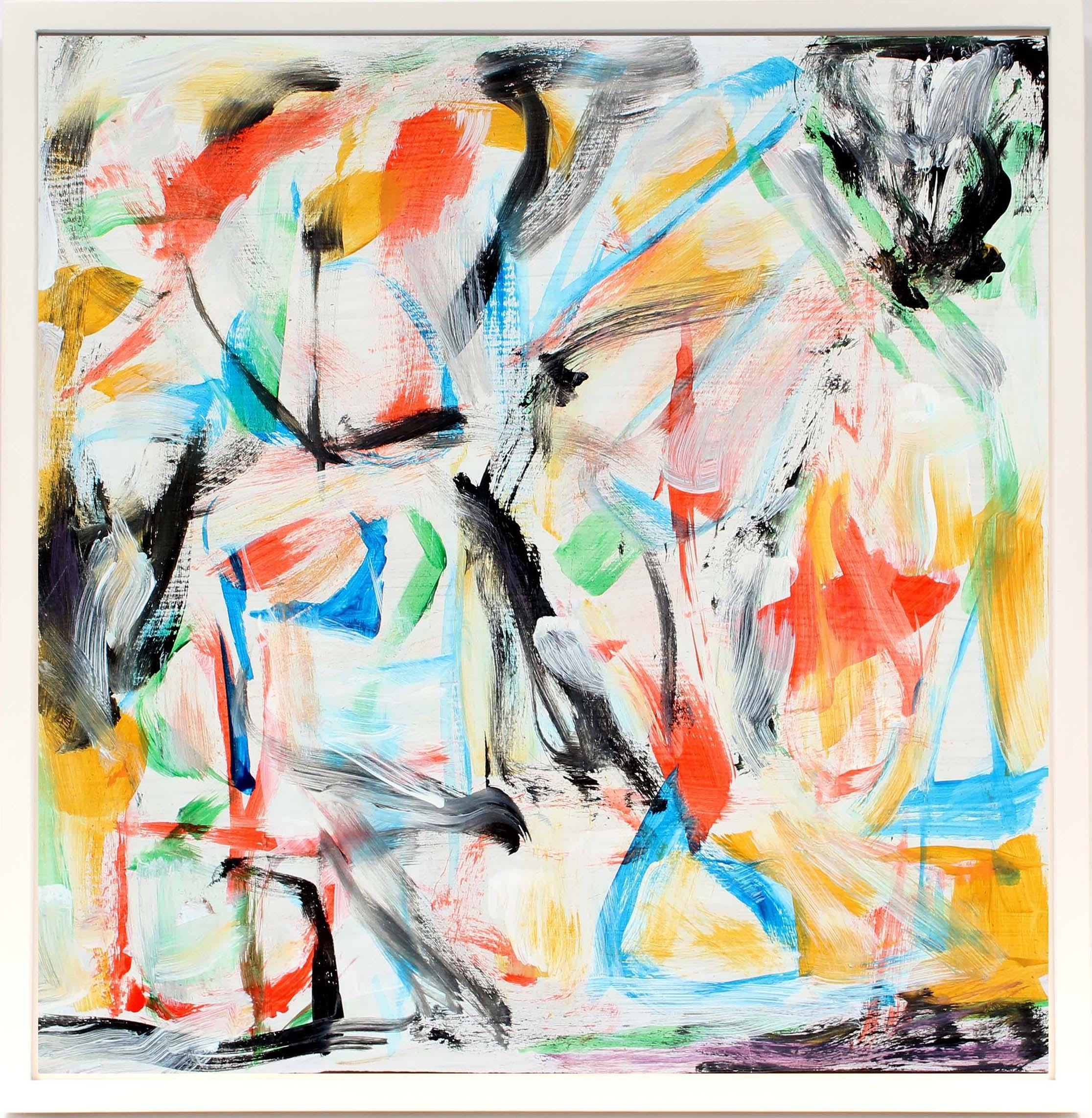
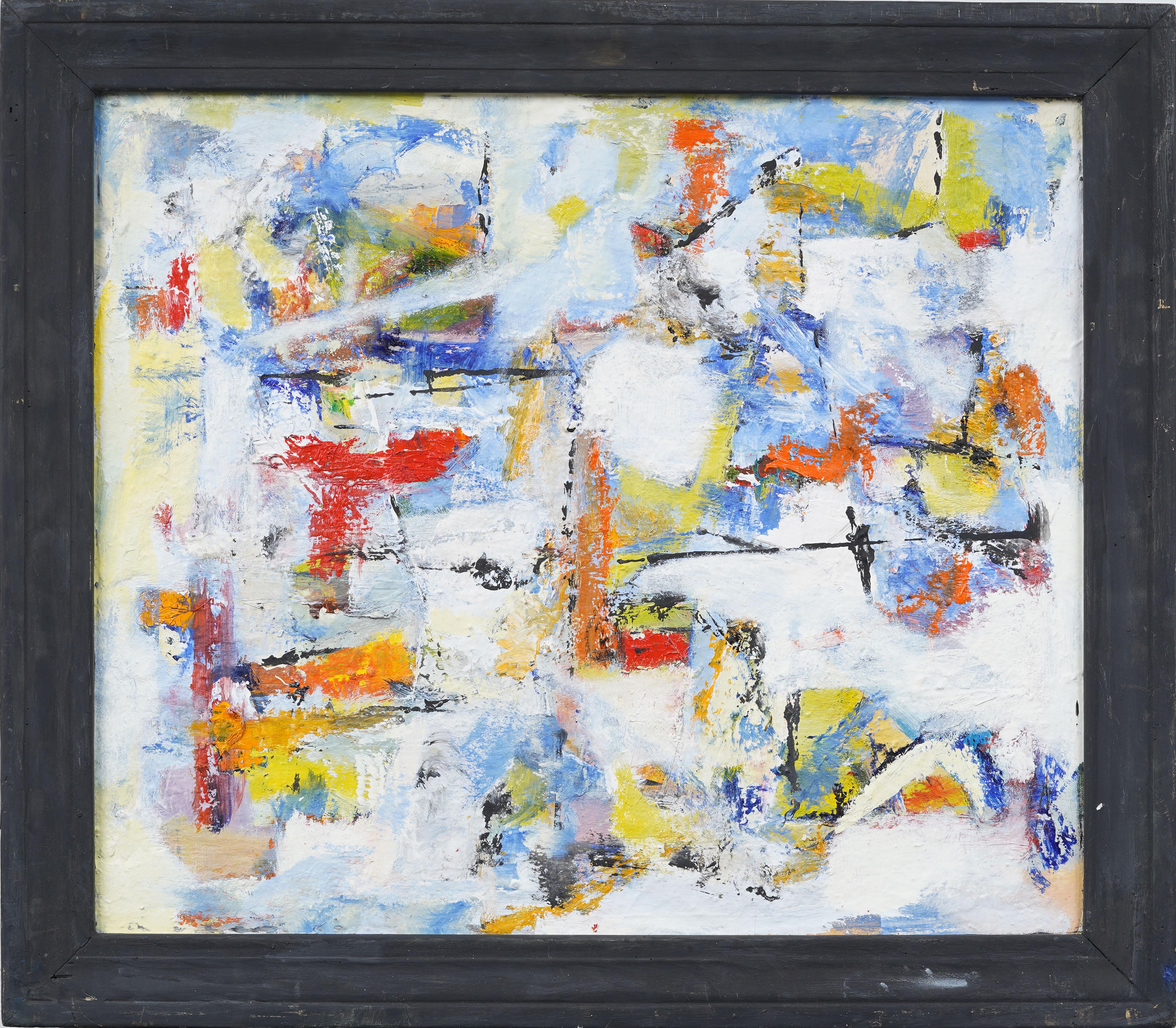
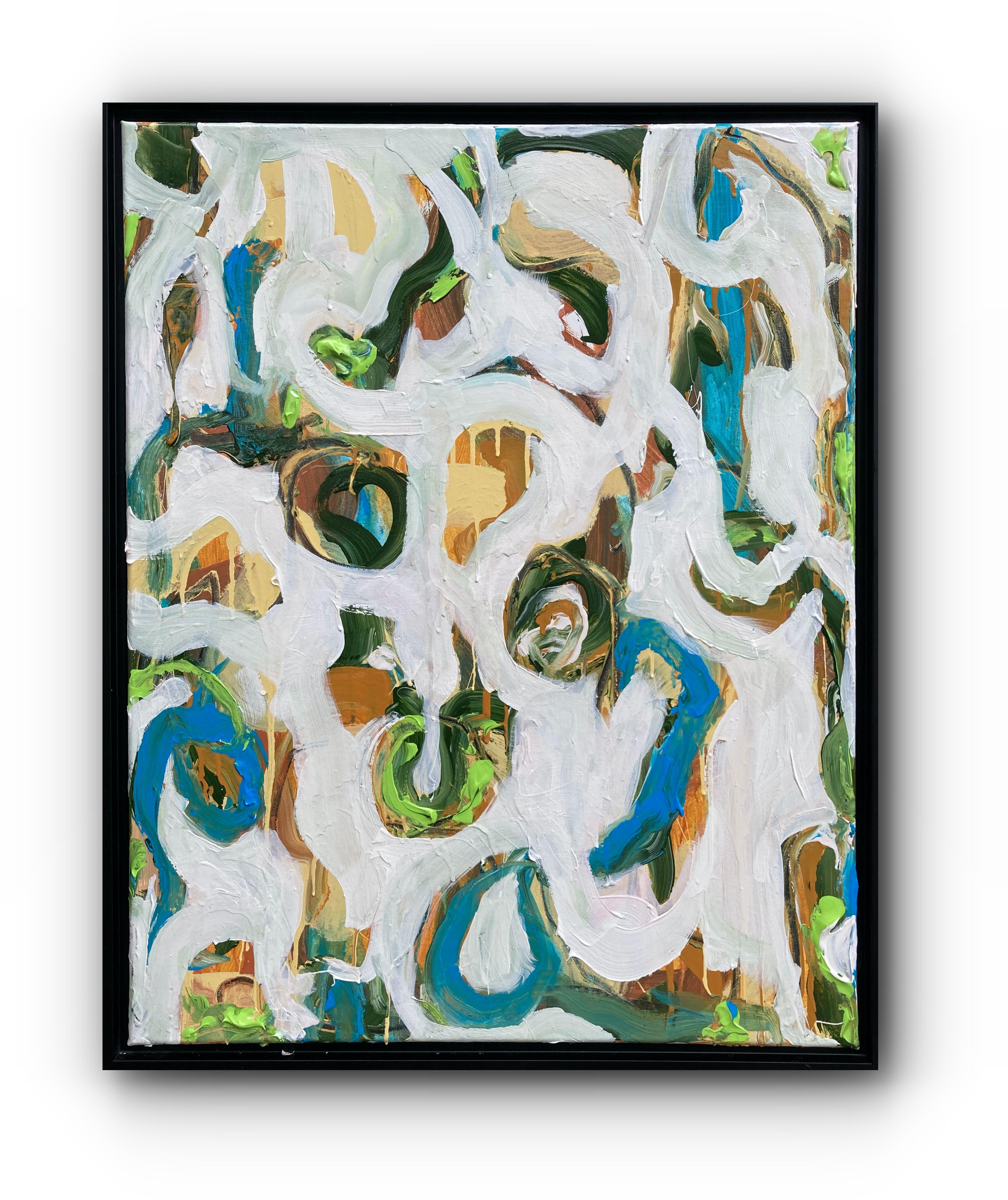
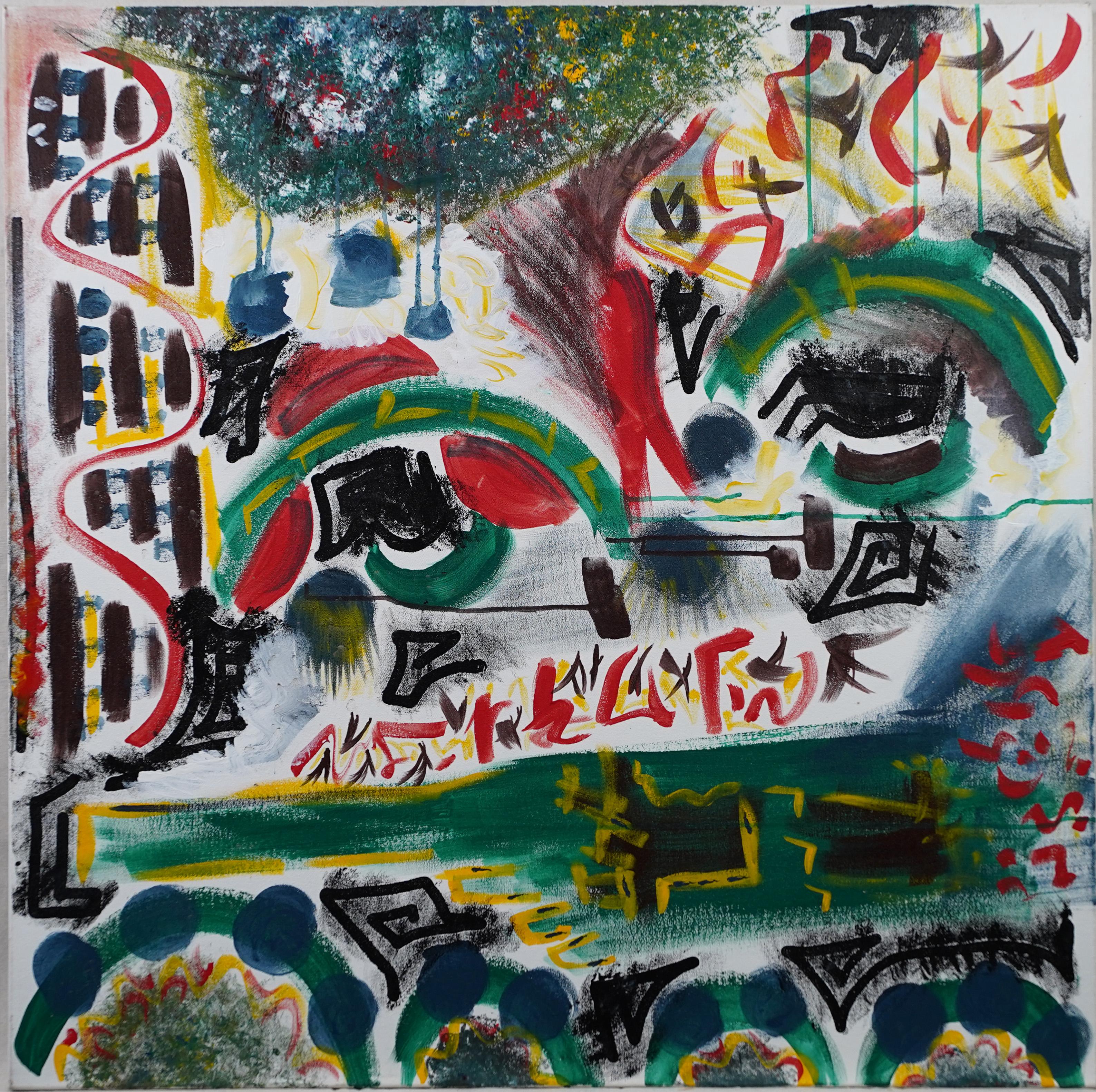
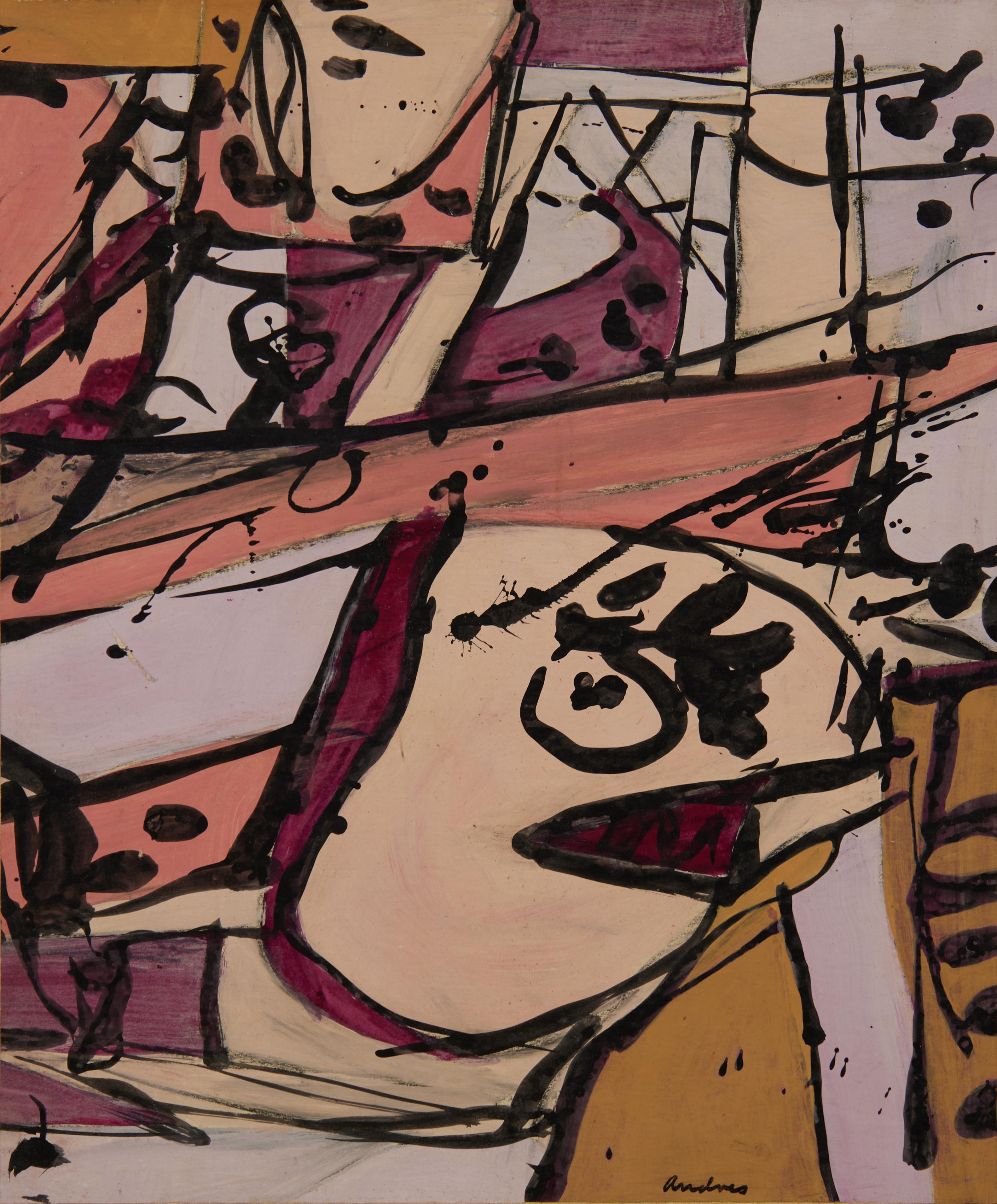
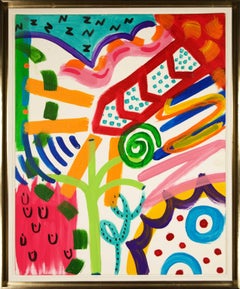
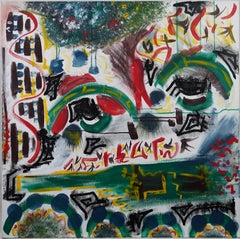
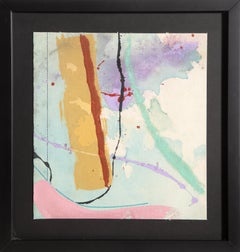
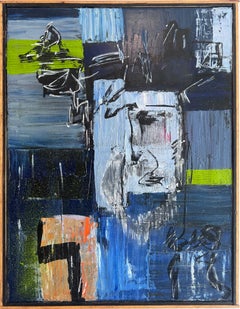
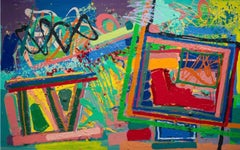
Modern abstract painting acrylic and oil paint, by the celebrated New York artist, Jay Milder (B. 1934), Titled "Noah's Ark II", 1989.
Milder is an abstract painter who made a signikficant impact in the New York art scene in 1958 when he cofounded 'City Gallery'. He was greatly influenced by Abstract Expressionism and considered himself a Figurative Expressionist.
This painting is titled "Noah's Ark" or "Ark II", acrylic and oil paint on paper. Abstract shapes of many colors push tightly against one another, with red circles outlined in black like stylized eyes, are found on most of the forms-- looking out at the viewer from the containment of the frame they are in. Trapezoidal and more rectilinear abstract forms make up a base at the bottom of the composition, like a foundational structure supporting all that is stacked above.
The painting is signed, dedicated, titled & and dated, "Noah's Ark 1989", the painting is in excellent condition and is ready to hang on your wall.
Another such painting from the Noah's Ark series sold at William Doyle auctions in New York 05/102017 for $8,125.
BIOGRAPHY
Jay Milder (b. 1934, Omaha, Nebraska), first exhibited his “Subway Runners” series at Martha Jackson Gallery, NY, in 1964. These paintings, based on the subject of people running to catch trains, are explosive in their energy and materiality: dense, three-dimensional surfaces of oil paint mixed with volcanic ash. The faces and heads are huge, dominating most of the canvas, with arms and legs in motion, and the setting of subway stations and tracks depicted with loose, gestural marks. The work is connected to European sources like Dubuffet and COBRA artists; Milder lived in Paris and studied with André Lhote and Ossip Zadkine in the mid-1950s. There, he also became aware of the work of Chaim Soutine, who would be an important influence in terms of a gestural, painterly approach to Cubism enlivened by spiritual belief. Milder’s early travels to Morocco and Mexico also informed his early development.In the summer of 1958, Milder lived in Provincetown, where he came into contact with Red Grooms and Bob Thompson, and showed at the Sun Gallery alongside Mimi Gross, Alex Katz, and Lester Johnson. Milder became associated with a “second-generation New York School” Figurative Expressionism. Back in New York, he co-founded, with Red Grooms, the artist-run City Gallery in their shared loft in the Flatiron District, giving Claes Oldenberg and Jim Dine their first New York exhibitions. Milder experimented early on with spray paint, and created “walls” of paint with his impasto surfaces; in this and his subject matter, he has been connected to graffiti and subway art. His work and personal symbology also references his lifelong study of Kabbalah and the belief that art can function as a vehicle for social commentary, humanity, and healing.Milder’s work is in the collections of the Brooklyn Museum and the New Museum, both in New York; The Chrysler Museum of Art, Norfolk, VA; and the Museo Nacional de Arte Centro Reina Sofía Museum, Madrid, Spain, among others. Milder is represented by Eric Firestone Gallery where he was the subject of a solo presentation, Jay Milder: Broadway Nonstop, Subway Paintings from the 1950s and '60s (2022), as well as featured in numerous group exhibitions.
Jay Milder (b. 1934, Omaha, Nebraska), first exhibited his “Subway Runners” series at Martha Jackson Gallery, NY, in 1964. These paintings, based on the subject of people running to catch trains, are explosive in their energy and materiality: dense, three-dimensional surfaces of oil paint mixed with volcanic ash. The faces and heads are huge, dominating most of the canvas, with arms and legs in motion, and the setting of subway stations and tracks depicted with loose, gestural marks. The work is connected to European sources like Dubuffet and COBRA artists; Milder lived in Paris and studied with André Lhote and Ossip Zadkine in the mid-1950s. There, he also became aware of the work of Chaim Soutine, who would be an important influence in terms of a gestural, painterly approach to Cubism enlivened by spiritual belief. Milder’s early travels to Morocco and Mexico also informed his early development.In the summer of 1958, Milder lived in Provincetown, where he came into contact with Red Grooms and Bob Thompson, and showed at the Sun Gallery alongside Mimi Gross, Alex Katz, and Lester Johnson. Milder became associated with a “second-generation New York School” Figurative Expressionism. Back in New York, he co-founded, with Red Grooms, the artist-run City Gallery in their shared loft in the Flatiron District, giving Claes Oldenberg and Jim Dine their first New York exhibitions.Milder experimented early on with spray paint, and created “walls” of paint with his impasto surfaces; in this and his subject matter, he has been connected to graffiti and subway art. His work and personal symbology also references his lifelong study of Kabbalah and the belief that art can function as a vehicle for social commentary, humanity, and healing.Milder’s work is in the collections of the Brooklyn Museum and the New Museum, both in New York; The Chrysler Museum of Art, Norfolk, VA; and the Museo Nacional de Arte Centro Reina Sofía Museum, Madrid, Spain, among others. Milder is represented by Eric Firestone Gallery where he was the subject of a solo presentation, Jay Milder: Broadway Nonstop, Subway Paintings from the 1950s and '60s (2022), as well as featured in numerous group exhibitions.
At sight measurements are 18.5" in width and 23.5" in height