Want more images or videos?
Request additional images or videos from the seller
1 of 12

Larry Zox
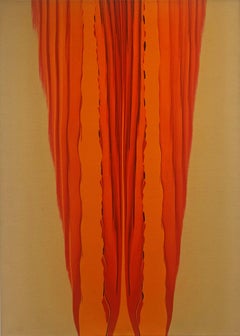
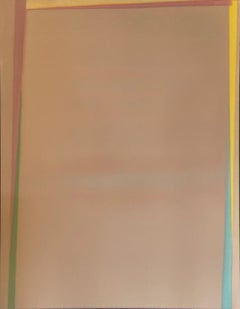
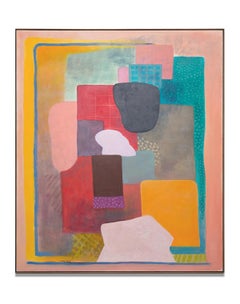
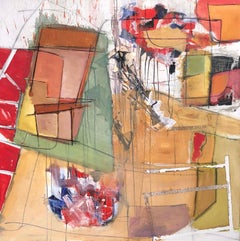
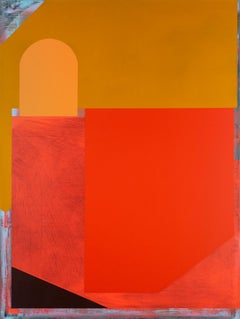
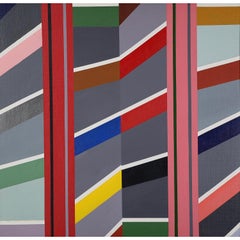
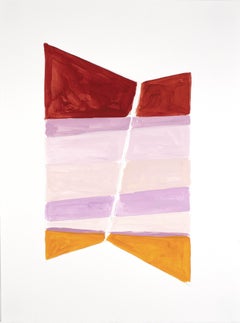
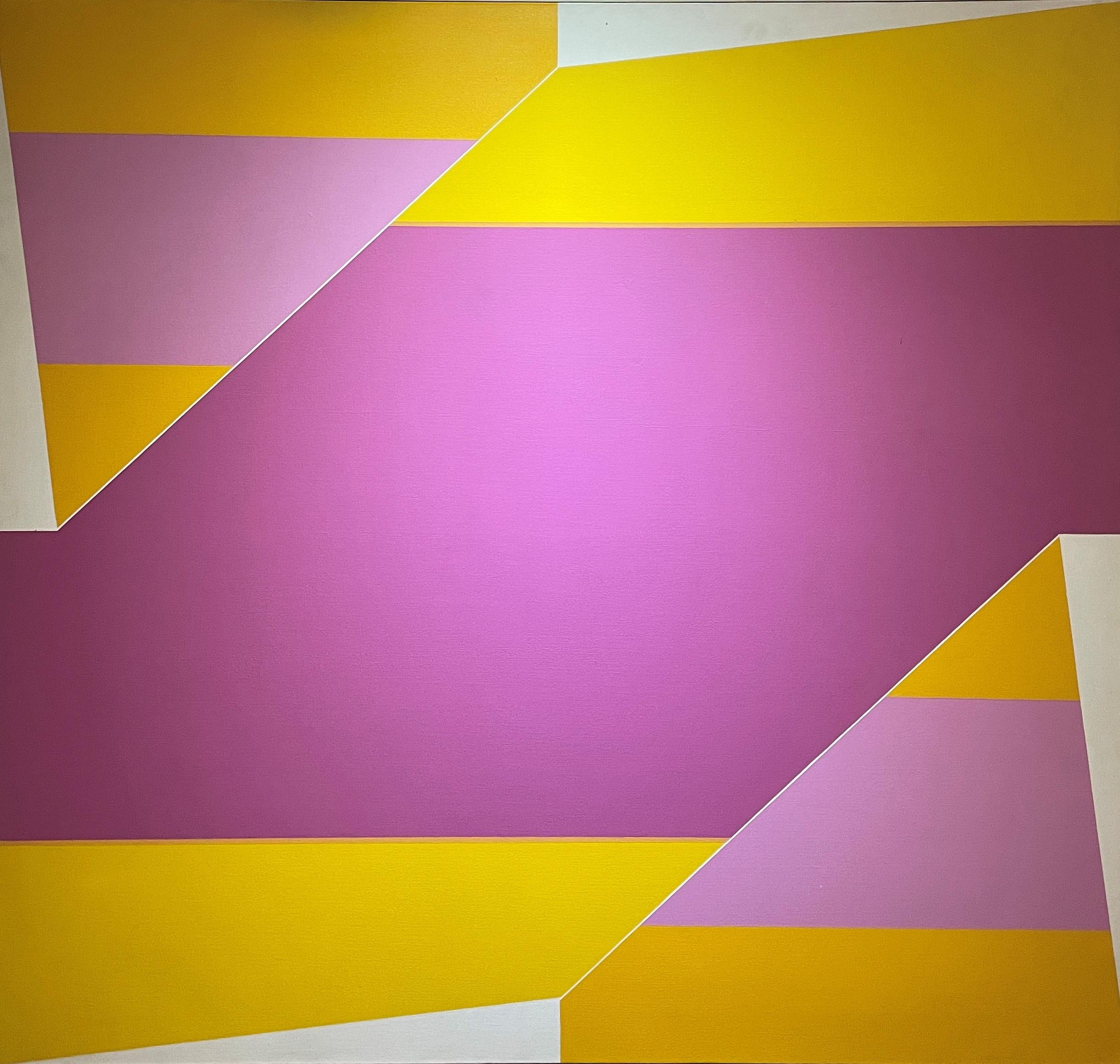
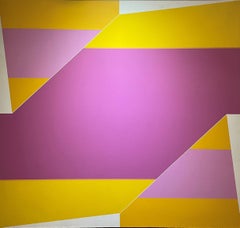
"Untitled" Larry Zox, Hard-edge, Color Field, Red, Orange, Pink, Large Abstract

circa 1965

$45,000
£33,775.19
€39,411.30
CA$63,576.04
A$63,739.77
CHF 36,936.74
MX$778,849.88
NOK 428,044.26
SEK 437,104.92
DKK 294,588.36

About the Item

Larry Zox Untitled, circa 1965 Signed on the stretcher Acrylic on canvas 66 x 72 inches Provenance Hokin Gallery, West Palm Beach Dorothy Blau Gallery, Bay Harbor Islands, Florida Committed to abstraction throughout his career, Larry Zox played a central role in the Color Field discourse of the 1960s and 1970s. His work of the time, consisting of brilliantly colored geometric shapes in dynamic juxtapositions, demonstrated that hard-edge painting was neither cold nor formalistic. He reused certain motifs, but he did so less to explore their aspects than to “get at the specific character and quality of each painting in and for itself,” as James Monte stated in his essay for Zox’s solo exhibition at the Whitney Museum of American Art in 1973. By the 1970s, Zox was using a freer, more emotive method, while maintaining the autonomy of color, which increasingly became more important to him than structure in his late years. Zox began to receive attention in the 1960s, when he was included in several groundbreaking exhibitions of Color Field and Minimalist art, including Shape and Structure (1965), organized by Henry Geldzahler for the Gallery of Modern Art, New York, and Systemic Painting (1966), organized by Lawrence Alloway for the Guggenheim Museum. In 1973, the Whitney’s solo exhibition of Zox’s work gave recognition to his significance in the art scene of the preceding decade. In the following year, Zox was represented in the inaugural exhibition of the Hirshhorn Museum, which owns fourteen of his works. Zox was born in Des Moines, Iowa. He attended the University of Oklahoma and Drake University. While studying at the Des Moines Art Center, he was mentored by George Grosz, who despite his own figurative approach encouraged Zox’s forays into abstraction. In 1958, Zox moved to New York, joining the downtown art scene. His studio on 20th Street became a gathering place for artists, jazz musicians, bikers, and boxers. He occasionally sparred with the visiting fighters. He later established a studio in East Hampton, where he painted and fished including using a helicopter to spot fish. In the 1950s and early 1960s, Zox’s works were collages consisting of painted pieces of paper stapled onto sheets of plywood. He then produced paintings that were illusions of collages, including both torn- and trued-edged forms, to which he added a wide range of intense hues that created ambiguous surfaces. Next, he omitted the collage aspect of his work and applied flat color areas to create more complete statements of pure color and shape. From 1962 to 1965, he produced his Rotation Series, at first creating plywood and Plexiglas reliefs, which turned squares into dynamic polygons. He used these shapes in his paintings as well, employing white as a foil between colors to produce negative spaces that suggest that the colored shapes had only been cut out and laid down instead of painted. The New York Times noted in 1964: “The artist is hip, cool, adventurous, not content to stay with the mere exercise of sensibility that one sees in smaller works.” In 1965, he began the Scissors Jack Series in which he arranged opposing triangular shapes with inverted Vs of bare canvas at their centers that threaten to split their compositions apart. The Diamond Cut and Diamond Drill paintings followed. In these, Zox used regularized formats as a means of revealing how color can change our perception of shape. In a single work he often combined industrial epoxy paints with acrylic to set up tensions between colors that would not exist otherwise. At the time, Peter Schjeldahl observed in The New York Times: Zox “is one painter who shows an ability to play by the rules without cramping at all an essentially romantic and exuberant sensibility.” His art of the period was equated with that of Frank Stella and Kenneth Noland. In the late 1960s, Zox’s paintings, such as in his Gemini Series, became brushier and he often incorporated powdered mica into his paints to increase their visual effect. In the early 1970s, he explored a variety of new means of applying paint, including squeegees and other large tools. With these means, he moved away from preconception, while introducing a drawing procedure in which the outside limits of a painting were determined by cutting or cropping the canvas. Zox’s work is included in many important public collections. In addition to the Hirshhorn, it belongs to the Museum of Modern Art, New York; the Whitney Museum of American Art, New York; the Metropolitan Museum of Art New York; the Guggenheim Museum, New York; the Tate Modern, London; the Neues Museum, Bremen, Germany; the Museum of Fine Arts, Boston; the Fogg Art Museum, Harvard University, Cambridge, Massachusetts; the Museum of Fine Arts, Houston; the Dallas Museum of Fine Arts; and many others.
  • Creator:
    Larry Zox (1936-2006, American)
  • Creation Year:
    circa 1965
  • Dimensions:
    Height: 66 in (167.64 cm)Width: 72 in (182.88 cm)
  • Medium:
  • Movement & Style:
  • Period:
  • Framing:
    Framing Options Available
  • Condition:
  • Gallery Location:
    New York, NY
  • Reference Number:
    1stDibs: LU1841217832542

More From This Seller

View All
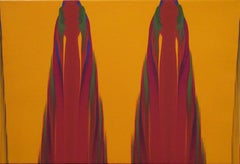
"Jean Jean" Larry Zox, Color Field, Geometric Abstraction, Hard-Edge, Yellow

"Jean Jean" Larry Zox, Color Field, Geometric Abstraction, Hard-Edge, Yellow

By Larry Zox

Located in New York, NY

Larry Zox Jean Jean, 1964 Signed, dated, and titled on the stretcher Liquitex on canvas 58 x 62 inches Provenance: Solomon & Co., New York Private Collection, NJ Estate of the above, 2023 Committed to abstraction throughout his career, Larry Zox played a central role in the Color Field discourse of the 1960s and 1970s. His work of the time, consisting of brilliantly colored geometric shapes in dynamic juxtapositions, demonstrated that hard-edge painting was neither cold nor formalistic. He reused certain motifs, but he did so less to explore their aspects than to “get at the specific character and quality of each painting in and for itself,” as James Monte stated in his essay for Zox’s solo exhibition at the Whitney Museum of American Art in 1973. By the 1970s, Zox was using a freer, more emotive method, while maintaining the autonomy of color, which increasingly became more important to him than structure in his late years. Zox began to receive attention in the 1960s, when he was included in several groundbreaking exhibitions of Color Field and Minimalist art, including Shape and Structure (1965), organized by Henry Geldzahler for the Gallery of Modern Art, New York, and Systemic Painting (1966), organized by Lawrence Alloway for the Guggenheim Museum. In 1973, the Whitney’s solo exhibition of Zox’s work gave recognition to his significance in the art scene of the preceding decade. In the following year, Zox was represented in the inaugural exhibition of the Hirshhorn Museum, which owns fourteen of his works. Zox was born in Des Moines, Iowa. He attended the University of Oklahoma and Drake University. While studying at the Des Moines Art Center, he was mentored by George Grosz, who despite his own figurative approach encouraged Zox’s forays into abstraction. In 1958, Zox moved to New York, joining the downtown art scene. His studio on 20th Street became a gathering place for artists, jazz musicians, bikers, and boxers. He occasionally sparred with the visiting fighters. He later established a studio in East Hampton, where he painted and fished including using a helicopter to spot fish. In the 1950s and early 1960s, Zox’s works were collages consisting of painted pieces of paper stapled onto sheets of plywood. He then produced paintings that were illusions of collages, including both torn- and trued-edged forms, to which he added a wide range of intense hues that created ambiguous surfaces. Next, he omitted the collage aspect of his work and applied flat color areas to create more complete statements of pure color and shape. From 1962 to 1965, he produced his Rotation Series, at first creating plywood and Plexiglas reliefs, which turned squares into dynamic polygons. He used these shapes in his paintings as well, employing white as a foil between colors to produce negative spaces that suggest that the colored shapes had only been cut out and laid down instead of painted. The New York Times noted in 1964: “The artist is hip, cool, adventurous, not content to stay with the mere exercise of sensibility that one sees in smaller works.” In 1965, he began the Scissors Jack...

Category

1960s Abstract Geometric Abstract Paintings

Materials

Canvas, Acrylic

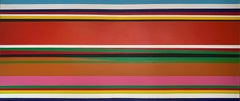
"Untitled, " Jay Rosenblum, Hard-Edge Color Field, Colorful Horizontal Stripes

"Untitled, " Jay Rosenblum, Hard-Edge Color Field, Colorful Horizontal Stripes

By Jay Rosenblum

Located in New York, NY

Jay Rosenblum (1933 - 1989) Untitled, 1973 Acrylic on canvas 54 x 128 inches Signed twice and dated on the reverse Provenance: Private Collection, Long Island Jay Rosenblum experim...

Category

1970s Hard-Edge Abstract Paintings

Materials

Canvas, Oil, Acrylic

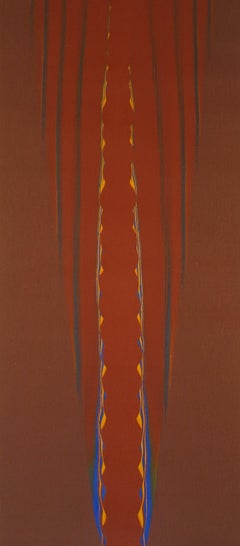
"Lexington, " Larry Zox, Abstract Expressionism, Minimalism, Brown Modernism

"Lexington, " Larry Zox, Abstract Expressionism, Minimalism, Brown Modernism

By Larry Zox

Located in New York, NY

Larry Zox Lexington, 1973 Acrylic on canvas 61 x 49 inches Provenance: Andre Emmerich Gallery, New York Janie C. Lee Gallery, Houston, Texas Private Collection, Greenwood Village, Colorado Exhibited: New York, Andre Emmerich Gallery, Larry Zox: New Paintings, March 10 - 28, 1973. Houston, Texas, Janie C. Lee Gallery, Larry Zox, February - April, 1974. A painter who played an essential role in the Color Field discourse of the 1960s and 1970s, Larry Zox is best known for his intensely and brilliantly colored geometric abstractions, which question and violate symmetry. Zox stated in 1965: “Being contrary is the only way I can get at anything.” To Zox, this position was not necessarily arbitrary, but instead meant “responding to something in an examination of it [such as] using a mechanical format with X number of possibilities." What he sought was to “get at the specific character and quality of each painting in and for itself,” as James Monte stated in his introductory essay in the catalogue for Zox’s 1973–74 solo exhibition at the Whitney Museum of American Art. Zox also at times used a freer, more intuitive method, while maintaining coloristic autonomy, which became increasingly important to him in his later career. Zox began to receive attention in the 1960s, when he was included in several groundbreaking exhibitions of Color Field and Minimalist art, including Shape and Structure (1965), organized by Henry Geldzahler and Frank Stella for Tibor de Nagy, New York, and Systemic Painting (1966), organized by Lawrence Alloway for the Guggenheim Museum. In 1973–74, the Whitney’s solo exhibition of Zox’s work gave recognition to his significance in the art scene of the preceding decade. In the following year, he was represented in the inaugural exhibition of the Hirshhorn Museum, which acquired fourteen of his works. Zox was born in Des Moines, Iowa. He attended the University of Oklahoma and Drake University, and then studied under George Grosz at the Des Moines Art Center. In 1958, Zox moved to New York, joining the downtown art scene. His studio on 20th Street became a gathering place for artists, jazz musicians, bikers, and boxers. He occasionally sparred with visiting fighters. He later established a studio in East Hampton, a former black smithy used previously by Jackson Pollock. Zox’s earliest works were collages consisting of pieces of painted paper stapled onto sheets of plywood. He then produced paintings that were illusions of collages, including both torn- and trued-edged forms, to which he added a wide range of strong hues that created ambiguous surfaces. Next, he omitted the collage aspect of his work and applied flat color areas to create more complete statements of pure color and shape. He then replaced these torn and expressive edges with clean and impersonal lines that would define his work for the next decade. From 1962 to 1965, he produced his Rotation series, at first creating plywood and Plexiglas reliefs, which turned squares into dynamic polygons. He used these shapes in his paintings as well, employing white as a foil between colors to produce negative spaces that suggest that the colored shapes had only been cut out and laid down instead of painted. The New York Times noted in 1964: “The artist is hip, cool, adventurous, not content to stay with the mere exercise of sensibility that one sees in smaller works.” In 1965, he began the Scissors Jack series, in which he arranged opposing triangular shapes with inverted Vs of bare canvas at their centers that threaten to split their compositions apart. In several works from this series, Zox was inspired by ancient Chinese water vessels...

Category

1970s Abstract Expressionist Abstract Paintings

Materials

Canvas, Acrylic

You May Also Like

Abstract expressionist, geometric, large, pink, orange, blue, acrylic on canvas

Abstract expressionist, geometric, large, pink, orange, blue, acrylic on canvas

By Robert Natkin

Located in NEW YORK, NY

Robert Natkin The Stranger, 1984 Acrylic on canvas 84 x 72 inches 213.4 x 183 cm RNa026 Signed on recto Celebrated as an unsurpassed colorist and for the beauty of his large-scale a...

Category

1980s Abstract Expressionist Abstract Paintings

Materials

Canvas, Acrylic

'Untitled' by Steven H. Rehfeld - Large Orange and Red Abstract Painting

'Untitled' by Steven H. Rehfeld - Large Orange and Red Abstract Painting

By Steven H. Rehfeld

Located in Carmel, CA

Steven H. Rehfeld (American, 1954) 'Untitled' 2010 Oil paint, mixed media, canvas, stretcher bars The artist signed the back of the painting. About the Artist: Introducing Steven H....

Category

2010s Abstract Abstract Paintings

Materials

Canvas, Oil, Mixed Media, Stretcher Bars, Paper, Glue, Charcoal

Anthony Falcetta "flimflam" 2025

Anthony Falcetta "flimflam" 2025

By Anthony Falcetta

Located in New York, NY

Anthony Falcetta flimflam, 2025 acrylic, spray paint & gypsum compound on canvas 40 x 30 in. (fal020)

Category

2010s Abstract Geometric Abstract Paintings

Materials

Spray Paint, Acrylic, Panel

Bold and colorful Hard-Edge abstract painting

Bold and colorful Hard-Edge abstract painting

Located in Colfax, CA

Colorful Hard Edge painting by an unknown artist. Possibly created by Canadian artist, Brian Fisher. This painting was purchased from an estate in Seattle, Washington in the early ...

Category

1970s Hard-Edge Abstract Paintings

Materials

Canvas, Oil, Board

Untitled LXVI by Ferle - Large abstract painting, red and orange, colourful

Untitled LXVI by Ferle - Large abstract painting, red and orange, colourful

By Elvire Ferle

Located in Paris, FR

Untitled LXVI is a unique oil on free-standing canvas painting by contemporary artist Ferle, dimensions are 200 cm × 140 cm (78.7 × 55.1 in). The artwork is signed, sold unframed and...

Category

21st Century and Contemporary Abstract Abstract Paintings

Materials

Canvas, Oil

Pink-Orange

Pink-Orange

By Lizzie Scott

Located in Dallas, TX

flashe on paper

Category

2010s Abstract Abstract Paintings

Materials

Paper