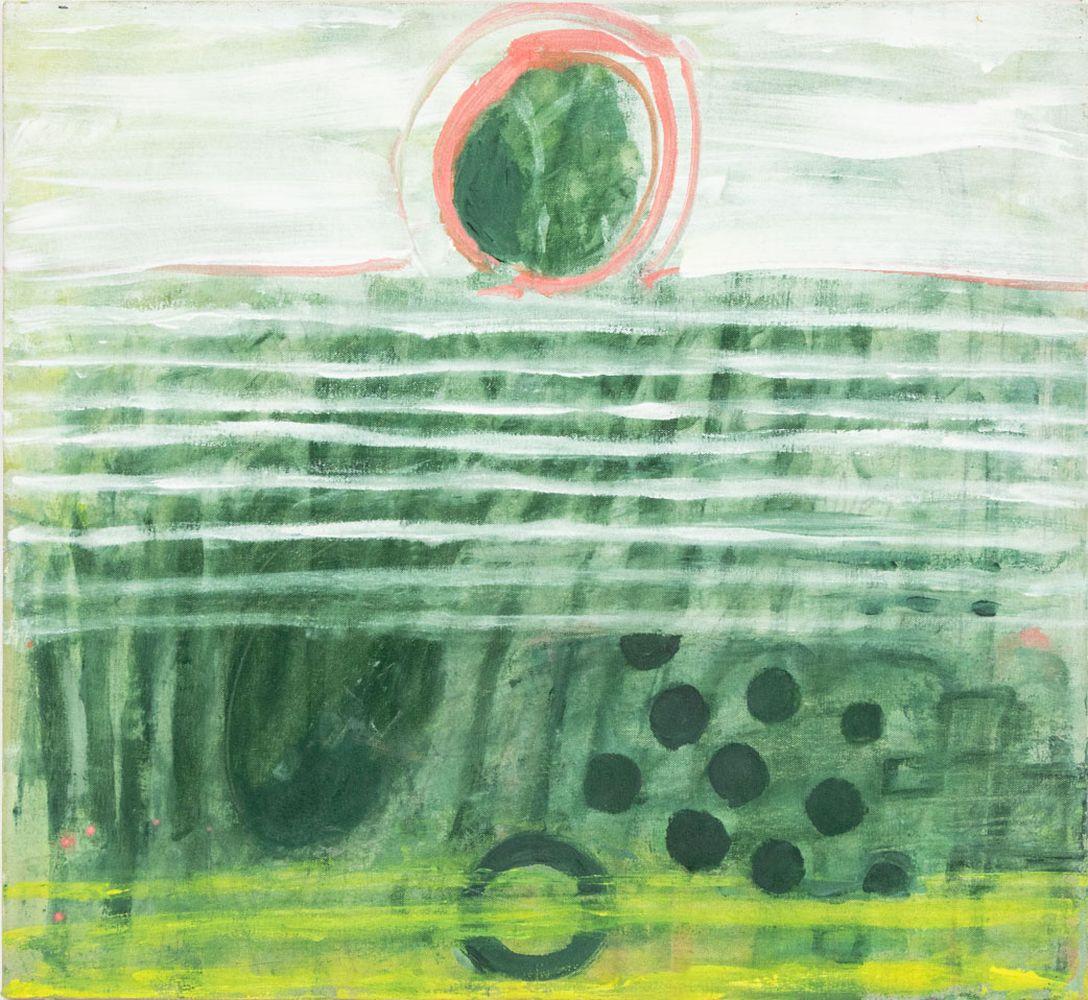
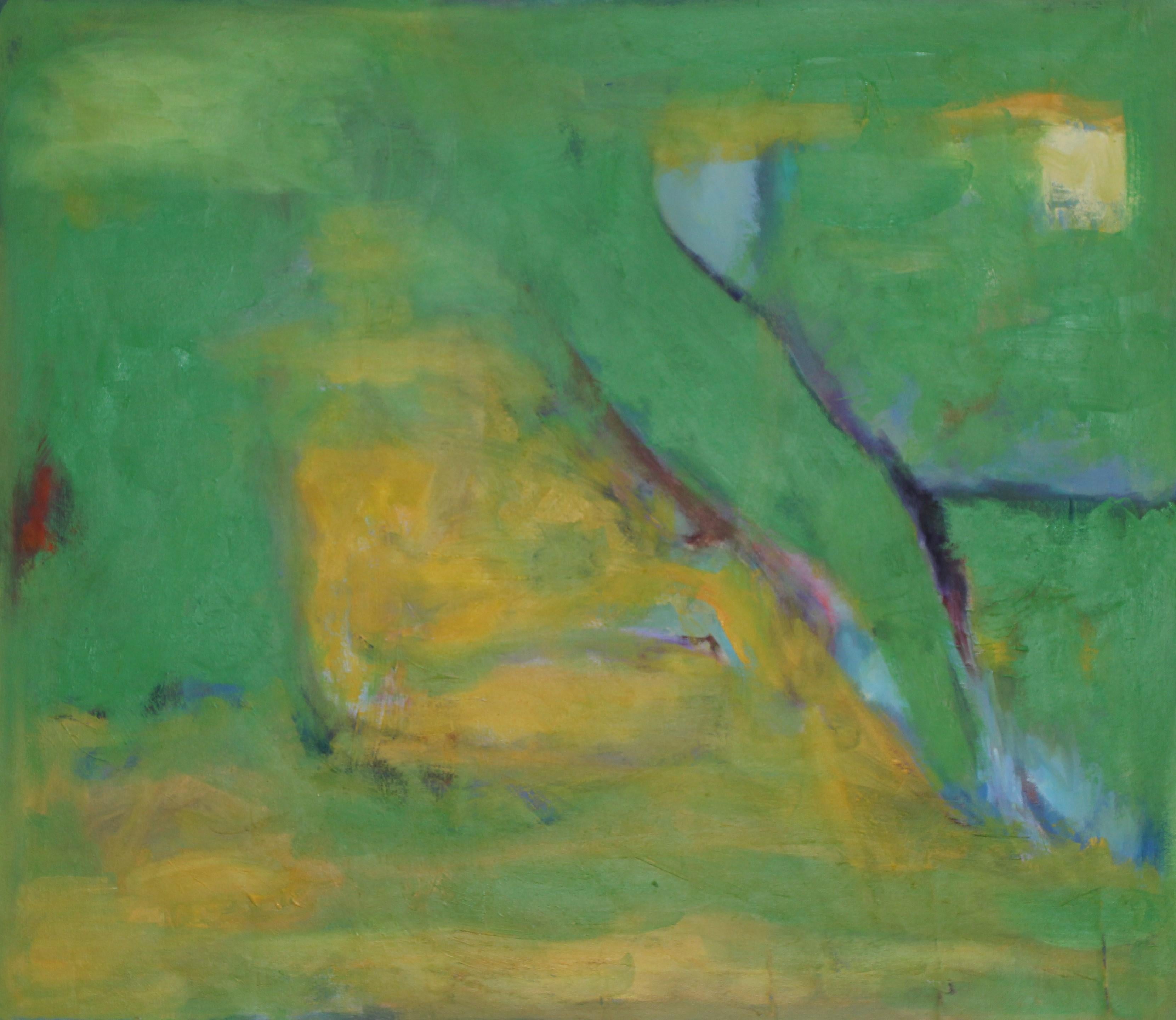
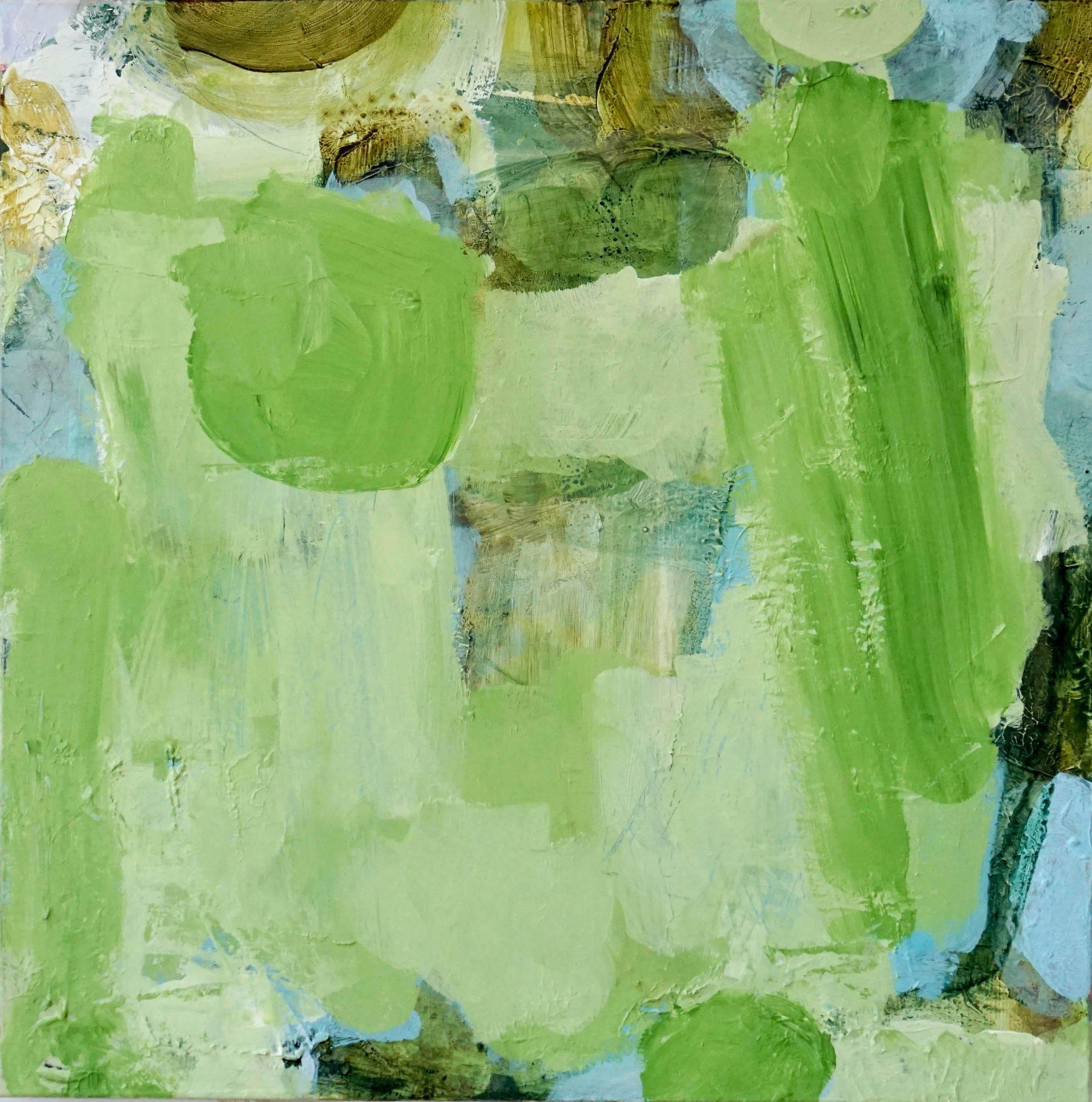
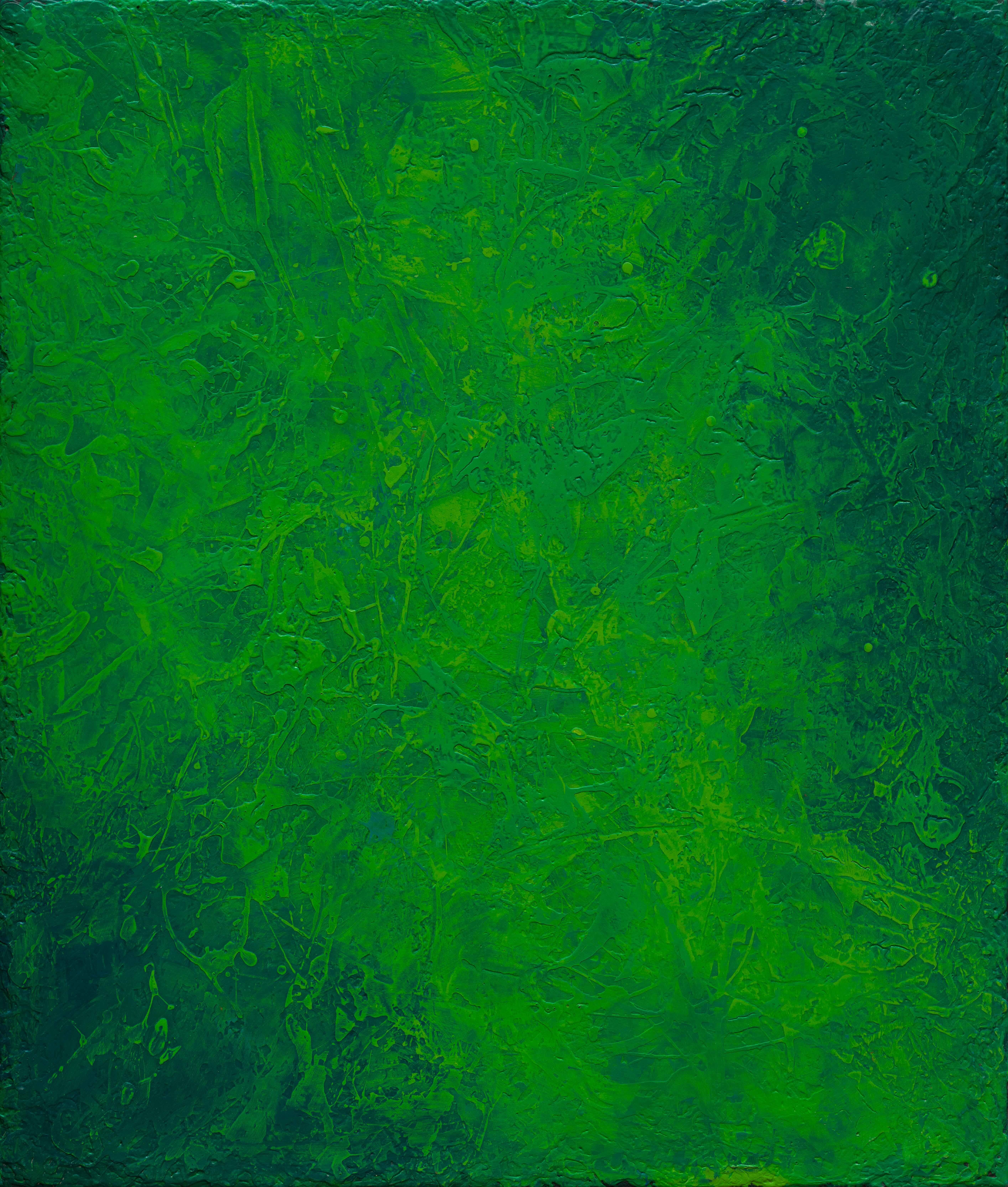
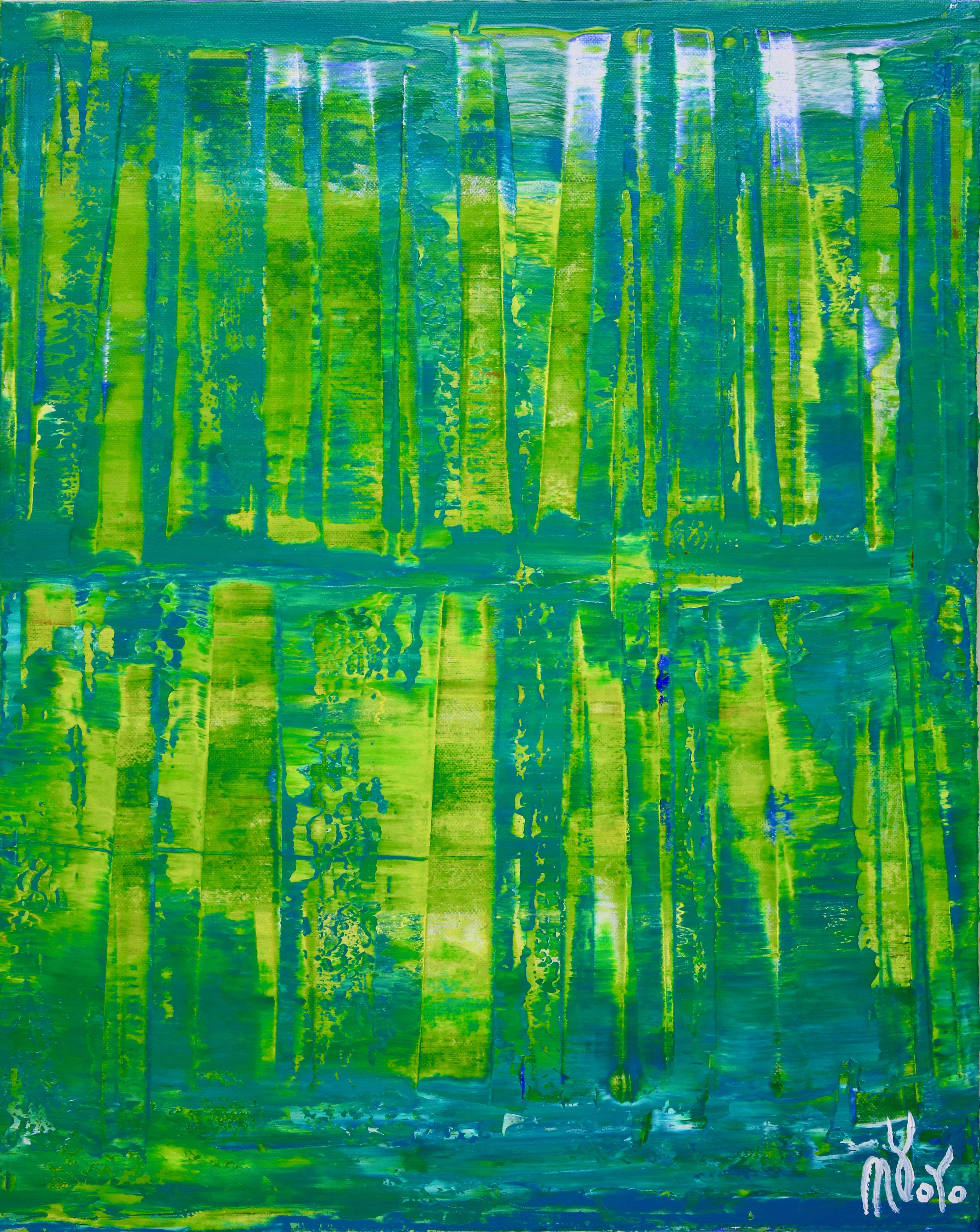
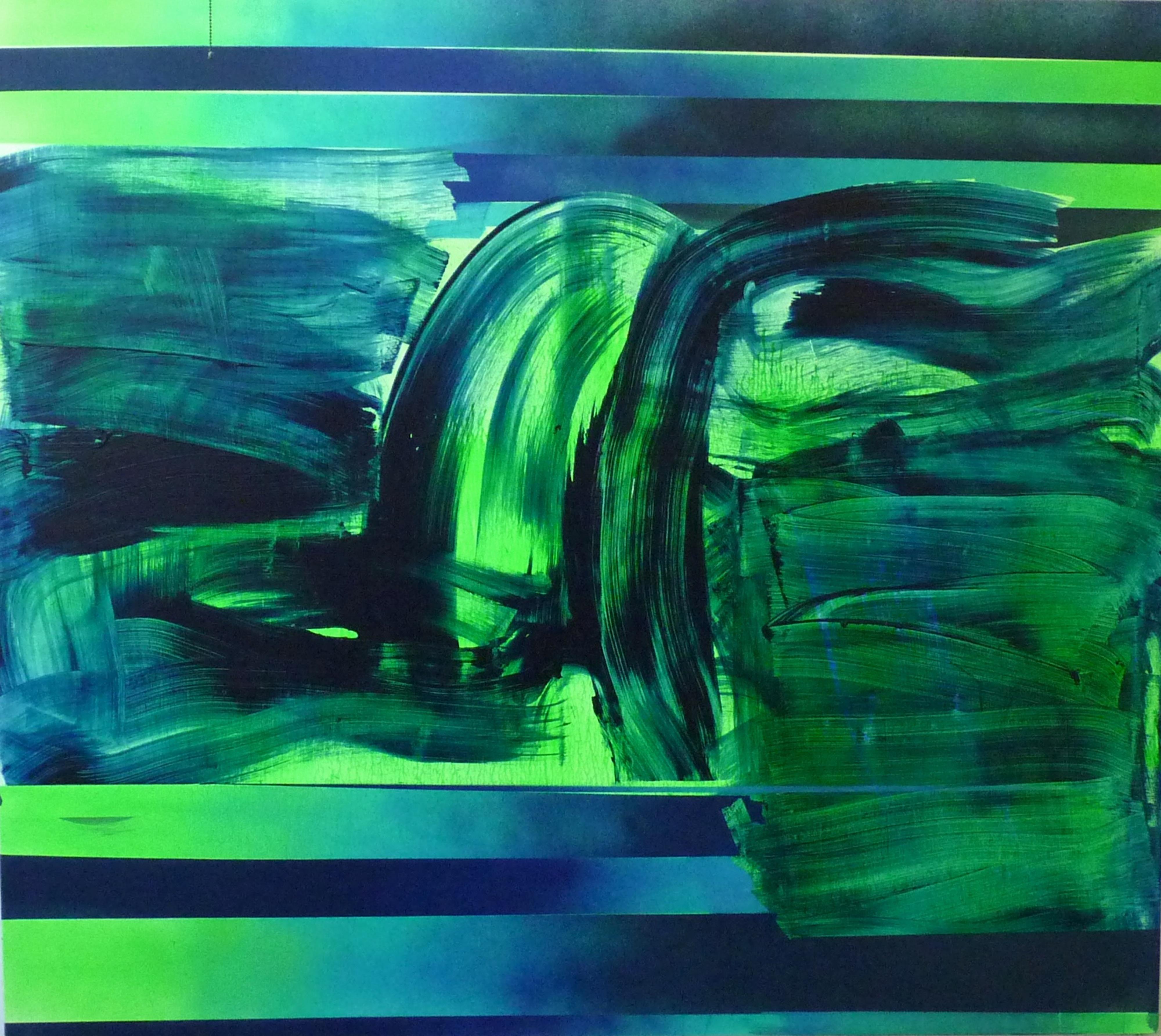
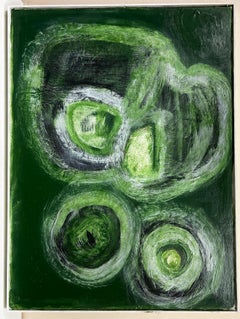
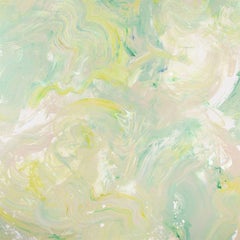
This exquisite oil painting by Lowell Nesbitt (1933–1993), titled Green Oval, was executed in 1962. The masterfully conceived composition belongs to a formative and highly significant period in Nesbitt’s artistic development, when the artist was exploring abstraction, symbolism, and luminous color relationships before achieving widespread acclaim for the monumental floral paintings that would later define his international reputation. Dominated by a radiant green oval form that appears to pulse with energy from within, the painting evokes associations with organic growth, cellular structures, botanical forms, cosmic phenomena, and spiritual illumination. Layers of translucent greens, blues, and silvery whites radiate outward from the central motif, creating a sense of expansion, movement, and transformation. The composition balances geometric structure with organic spontaneity, reflecting the artist’s early interest in synthesizing abstraction and nature into a unified visual language. Rather than depicting a specific subject, Nesbitt invites the viewer into a contemplative experience of color, light, and form, allowing the imagery to function simultaneously as an abstract composition and as a symbolic meditation on vitality, growth, and creative energy. Executed during the early years of his professional career, Green Oval demonstrates the experimental spirit, technical confidence, and sophisticated understanding of color and composition that would later inform the artist’s celebrated mature works. As an example of Nesbitt’s early abstract period, the painting offers a rare and important glimpse into the evolution of an artist who would become one of the most distinctive figures in twentieth-century American realism.
Executed in oil on linen, this work measures 44 x 28 inches (111.76 x 71.12 cm). Signed, dated, and titled by the artist, verso.
Artwork Details:
Artist: Lowell Nesbitt (1933–1993)
Title: Green Oval
Medium: Oil on linen
Dimensions: 44 x 28 inches (111.76 x 71.12 cm)
Inscription: Signed, dated, and titled by the artist, verso
Date: 1962
Condition: Well preserved, consistent with age and medium
Provenance: Estate of Lowell Blair Nesbitt, New York, New York
About the Artist:
Lowell Blair Nesbitt (1933–1993) was an American painter, printmaker, sculptor, and philanthropist whose monumental floral paintings, emotionally charged landscapes, and highly personal approach to realism established him as one of the most distinctive, recognizable, and commercially successful American artists of the late twentieth century. Over the course of a career spanning more than three decades, Nesbitt created a body of work that fused extraordinary technical precision with profound emotional sensitivity, transforming familiar subjects into powerful meditations on beauty, memory, mortality, renewal, and humanity’s enduring relationship with the natural world. Born in Baltimore, Maryland, and educated at the Tyler School of Art and the Royal College of Art in London, he developed an artistic language that combined classical draftsmanship with an awareness of the revolutionary innovations introduced by Pablo Picasso, Alexander Calder, Alberto Giacometti, Salvador Dali, Joan Miro, Wassily Kandinsky, Marcel Duchamp, and Man Ray, while remaining firmly committed to realism as a vehicle for emotional expression and visual transcendence. Through this synthesis of influences, Nesbitt created paintings distinguished by extraordinary technical accomplishment, dramatic scale, luminous color, and an ability to elevate ordinary subjects into images of lasting emotional and symbolic power. He first achieved widespread acclaim during the 1960s and 1970s through the monumental floral paintings that would become his signature contribution to American art, transforming roses, lilies, orchids, tulips, amaryllis, and other blossoms into commanding contemporary icons that explored themes of vitality, fragility, sensuality, impermanence, and transformation. Unlike traditional botanical painters, Nesbitt approached flowers as psychological portraits, imbuing them with individuality, emotional presence, and symbolic significance while presenting them at a scale rarely associated with still-life imagery. Although floral subjects remain central to his legacy, his artistic vision extended far beyond botanical painting to encompass landscapes, trees, architecture, waterways, seasonal imagery, and symbolic studies of nature, all rendered with a combination of meticulous observation and heightened emotional atmosphere. His depictions of trees became particularly admired for their metaphorical complexity, often serving as reflections on endurance, aging, solitude, resilience, and renewal, while his landscapes functioned simultaneously as faithful representations and poetic meditations. Throughout his career, Nesbitt became one of the most commercially successful American artists of his generation, exhibiting extensively throughout the United States and internationally and attracting a diverse audience that included major collectors, museums, corporations, celebrities, political figures, and cultural institutions. His contemporaries included artists such as Andy Warhol, Robert Indiana, Alex Katz, Fairfield Porter, Jamie Wyeth, and Malcolm Morley, yet he maintained a fiercely independent artistic identity that allowed him to create work distinguished by sincerity, emotional authenticity, and enduring visual appeal. Beyond painting, he worked extensively in printmaking and sculpture, expanding the reach of his artistic vision while maintaining the same commitment to beauty, craftsmanship, and emotional depth. His influence extends to later generations of contemporary realist, botanical, figurative, environmental, and representational artists who continue to draw inspiration from his ability to combine technical mastery with emotional accessibility and his pioneering use of monumental scale in floral imagery. The enduring popularity of large-scale botanical painting within contemporary art owes a significant debt to Nesbitt’s innovations and his demonstration that familiar subjects could still yield profound artistic insights. Beyond his artistic accomplishments, he became widely admired for his philanthropy and humanitarian commitments, most notably donating a substantial portion of his estate to support AIDS-related causes following the death of his close friend Arthur Ashe. Today, Lowell Nesbitt’s paintings, prints, and sculptures are held in important public and private collections throughout the United States and internationally and remain highly sought after for their beauty, technical excellence, emotional resonance, decorative appeal, and historical significance. As collectors increasingly revisit major figures of twentieth-century American realism, his reputation continues to strengthen through museum exhibitions, scholarship, publications, and sustained market demand.
Lowell Nesbitt Green Oval, Lowell Nesbitt abstract painting, Lowell Nesbitt 1962, Lowell Nesbitt oil on linen, Lowell Nesbitt early work, Lowell Nesbitt abstract expressionism, Lowell Nesbitt symbolic abstraction, American abstract art, color field painting, modernist painting, museum quality realism, important Lowell Nesbitt, Estate of Lowell Blair Nesbitt, early Lowell Nesbitt painting.