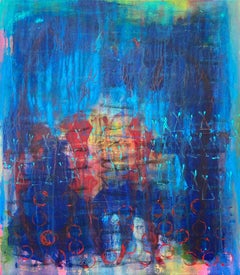
Robert Natkin
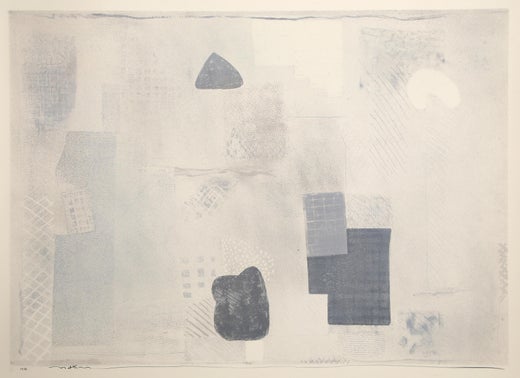
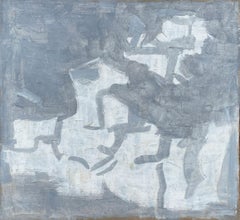
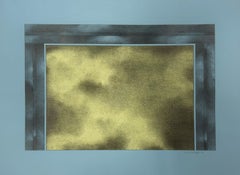
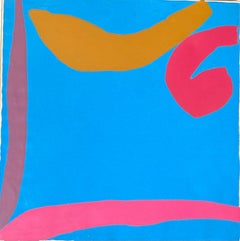
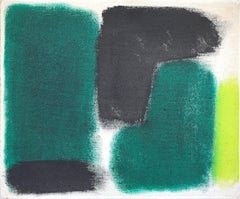
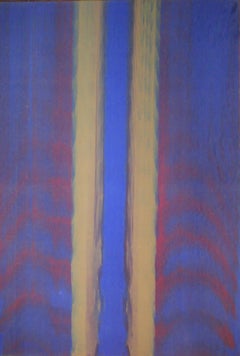
Untitled, 1976
Acrylic on lithograph on paper
20 1/2 x 40 inches
Provenance
The artist
Beat Keerl (gift from the above)
Born in Chicago to Russian-Jewish immigrant parents employed in the garment industry, Robert Natkin discovered an early love of movies, attending screenings several times a week as a child. The escapism and visual storytelling of film would later influence his artistic vision. After a brief family move to Oak Ridge, Tennessee, in 1945, Natkin decided to pursue art as a career. He enrolled at the School of the Art Institute of Chicago from 1948 to 1952, where exposure to French Post-Impressionist masters such as Pierre Bonnard and Henri Matisse encouraged him to pursue painting rather than illustration. He was especially inspired by the work of Paul Klee, whose poetic, semi-abstract imagery reinforced Natkin’s growing interest in conveying emotion through art. Visits to Chicago’s Field Museum further shaped his aesthetic through encounters with Native American art and Peruvian textiles.
A 1949 Life magazine article on Abstract Expressionism proved equally influential. After brief stays in New York and San Francisco, Natkin returned to Chicago, where he worked at the Newberry Library while developing his art. Initially focused on figurative subjects, he turned increasingly toward abstraction by the mid-1950s. In 1957, together with fellow artist Judith Dolnick, whom he married that same year, he founded the Wells Street Gallery in Chicago’s Old Town district. The gallery became an important venue for contemporary art, exhibiting both local innovators and leading New York artists. While Natkin admired painters such as Willem de Kooning, he ultimately forged a more personal approach to abstraction.
Seeking broader opportunities, Natkin moved to New York in 1959 and joined the roster of the Poindexter Gallery. His reputation grew quickly, aided by favorable reviews and his inclusion in the Whitney Museum’s Americans Under 35 exhibition in 1960. During the 1960s he developed a series-based approach to painting that became a hallmark of his career. Early cycles such as the Apollo series explored the interplay of color, light, and structure through vertical bands and geometric forms, while later works, including the Field Mouse paintings, introduced a more lyrical and intricate vocabulary inspired by poetry, memory, and the example of Paul Klee.
Following a retrospective at the San Francisco Museum of Art in 1970, Natkin settled in Connecticut and continued to refine his distinctive style. Around this time he began applying acrylic paint with sponges wrapped in cloth or netting, creating richly textured surfaces and luminous effects. In 1971 he began a long and successful association with the André Emmerich Gallery, where he would have numerous solo exhibitions. Subsequent series—including Intimate Lighting, Bath, Color Bath, and Bern—demonstrated his enduring fascination with color, atmosphere, and decorative structure.
During the 1980s Natkin embarked on the Hitchcock series, arguably the most celebrated body of work of his career. Inspired by the films of Alfred Hitchcock, these paintings combined vibrant color, intricate patterning, and carefully orchestrated compositions that balanced beauty with mystery and psychological depth. Throughout his life Natkin remained an influential voice in contemporary painting, exhibiting widely in the United States, Europe, and Japan while also writing about artists he admired. He died in 2010, leaving a legacy represented in major museum collections including the Metropolitan Museum of Art, the Museum of Modern Art, the Whitney Museum of American Art, and the Centre Pompidou.