full title:
"And, lo, three men stood by Abraham: and when he saw [them], he ran to meet them from the tent door, and bowed himself toward the ground"
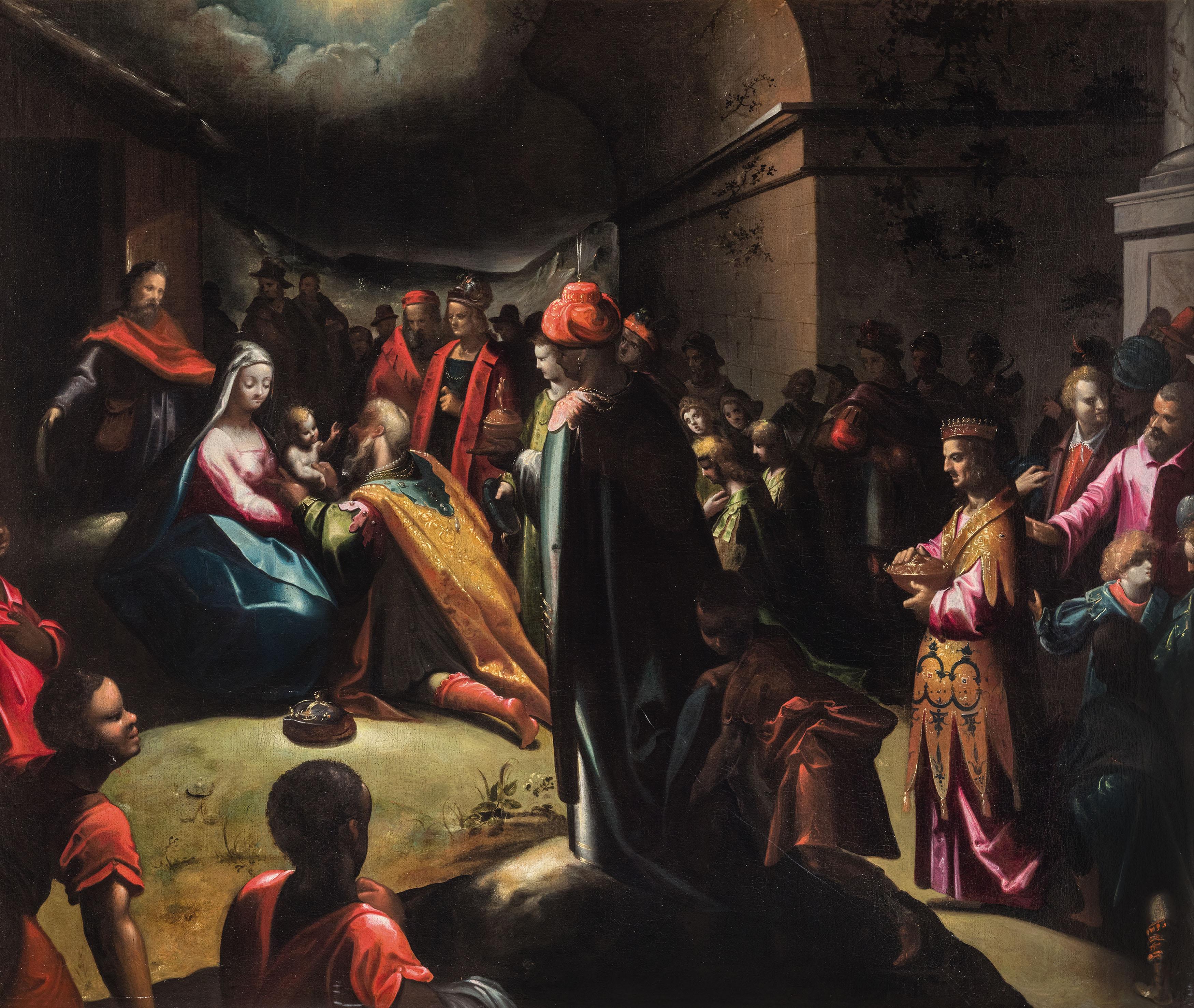
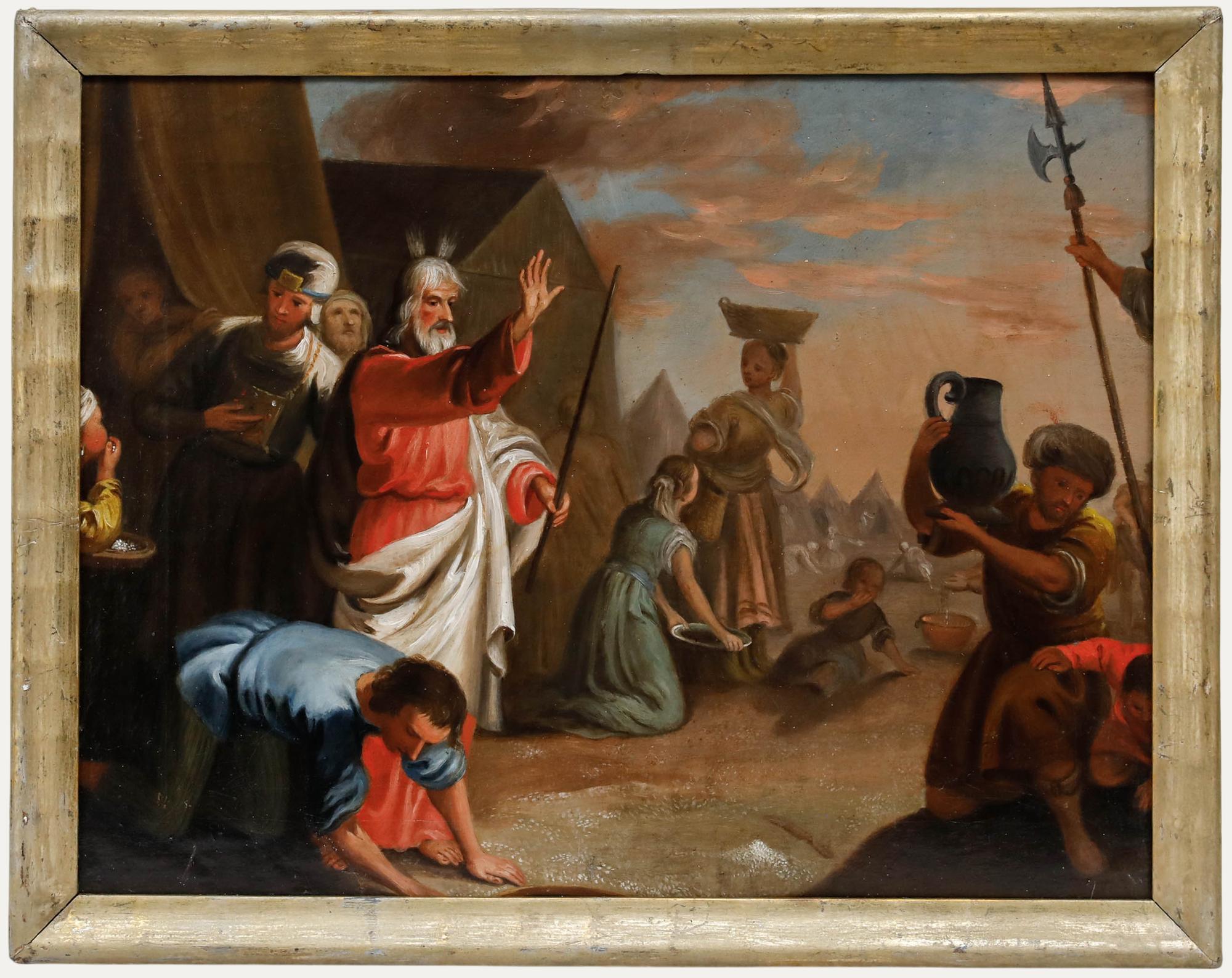
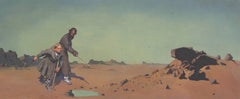
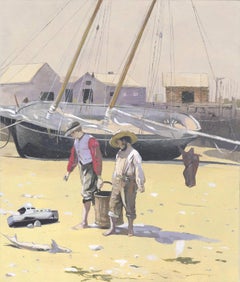
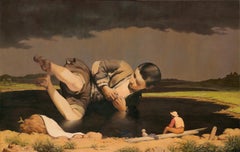
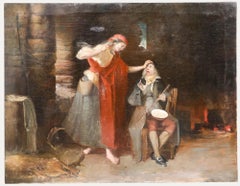
After: “Punishment of Korah” by Domenico Beccafumi (1537) and “The Banjo Player” by William Sydney Mount (1855)
Framed: 6.90h x 8.10w in
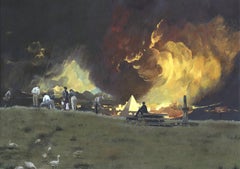
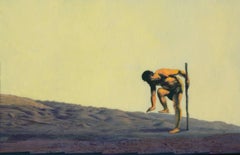
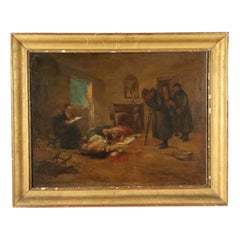
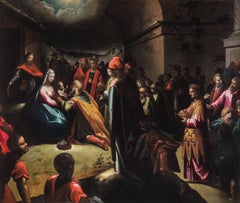
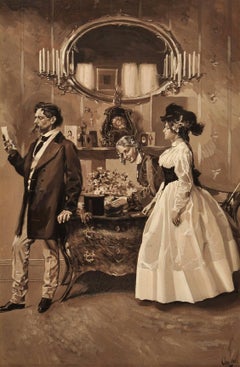
This image really began with my knowledge of the American artist of the source painting – William Sydney Mount. While Mount is acknowledged as one of the first painters to present African- Americans in a positive light, his beliefs about slavery were at odds with Abraham Lincoln’s. In response, he seems to have wrestled with the good and evil aspects of his beliefs. The imagery of Moses on his knees (from Domenico Beccafumi’s Punishment of Korah, Dathan and Abiram) comes from a similar narrative about a struggle between good and evil. In it, Moses’ divine connections were challenged by tribal leaders and as a result the earth split open and swallowed the malicious contenders, leaving only the good. William Sydney Mount’s painting of The Banjo Player serves as a stage that hints at both something positive (the musical reference) and something negative (figures emerging on their knees, as if being released from captivity.) The musical poster (from 1979) is intentionally playful to offset the otherwise tense environment and may reference Lincoln’s action here, a similarity between Moses’ bearded likeness and that of Charlie Daniels, or the connection between a “pure prairie” and the gathered hay in the background.
ABOUT THE ARTIST
Adam Mysock was born in Cincinnati, Ohio in 1983 - the son of an elementary school English teacher and a lab technician who specializes in the manufacturing of pigments. On account of a steady stream of folk tales from his mother, his father's vividly dyed work clothes, and a solid Midwestern work ethic, he developed an interest in painting and drawing all things Americana from a very early age. Mysock earned a Bachelor of Fine Arts degree in Painting and Art History by 2004 from Tulane University. He then received an MFA from Southern Illinois University at Carbondale.
After his studies, he became the mural coordinator for the City of Cincinnati's MuralWorks mural program and worked as an adjunct drawing professor at Sinclair Community College in Dayton. In the summer of 2008, Mysock became a Professor of Practice at Tulane University where he currently teaches and maintains a studio. Mysock's work has been exhibited in Ohio, Kentucky, Illinois, Georgia, Mississippi and Louisiana and is in private collections across the US, including those of Thomas Coleman and Michael Wilkinson. He was a 2009 jury winner in the annual No Dead Artists juried exhibition. On August 4th, 2012 he was awarded first prize “Best in Show” in the Ogden Museum’s Louisiana Contemporary Annual Juried Exhibition. Mysock exhibited at Pulse Miami Art Fair in December 2012 with Jonathan Ferrara Gallery and he was selected for the 2013 Edition of New American Paintings. Mysock was exhibited in a solo project booth at the VOLTA9 Art Fair in Basel, Switzerland where he was acquired by the SØR Rusche Collection. Mysock’s work is currently featured in a Baroque and Contemporary group exhibition from the SØR Rusche Collection, Oelde/Berlin at Kunsthalle Jesuitenkirche as well as in a solo exhibition entitled When Everything Was Wonderful Tomorrow at Galerie Andreas Binder in Munich, Germany.
"I’m a revisionist history painter. Rather than rewrite the narrative of the past to justify an ideology, I repaint yesterday’s imagery in order to rationalize our present circumstances."
Mysock says of his work, “Telling stories is a part of human nature; it’s how we relate to one another. The stories we have in common help us create sincere connections to our neighbors and our surroundings. What’s more, storytelling – for better or worse – typically involves hyperbole. We tend to exaggerate; we tend to lie.
Generally, we believe we control our narrative embellishments. What gets exaggerated from one telling to another gets exaggerated to challenge our listeners. What gets repeated gets repeated because it resonates with them. What gets omitted gets left out because it’s lost its meaning. We actively use embellishment to keep our audiences engaged.
Given enough distance, however, sources and accuracy fade out and substitutions become the new norms. Quietly, time redefines what is truth and what is fiction.
As a painter, I’m preoccupied by the undeniable role that the image plays in creating this acceptance of the fictional. A painting has the authority to make the intangible concrete, and a series of them has the ability to authenticate a fabrication in our collective memory.
When I begin a piece, I typically start with preexisting images, artifacts from this collective remembrance. I look for images that shape my pictorial consciousness, that are hard to question because when I first saw them they were presented as the truth. They have to capture my imagination and they have to feel largely descriptive of a greater story. From them, I’m given my task – I have to “disrepair” them. I have to consolidate an earlier world of historical and cultural visual-fact with an evolving understanding of subtlety and gradation. I find that the discrepancies I discover between the absolute and the nuanced inspire me most.
The resultant work is largely about storytelling, the ownership and authorship of our culture’s visual narratives, and the parallels between those tales. It’s meant to challenge the truth of “source” and the source of truth. After all, as Franz Kafka once wrote, "It is hard to tell the truth, for although there 'is' one, it is alive and constantly changes its face."