Video Loading
Want more images or videos?
Request additional images or videos from the seller
1 of 14

Edward Herbert Miner
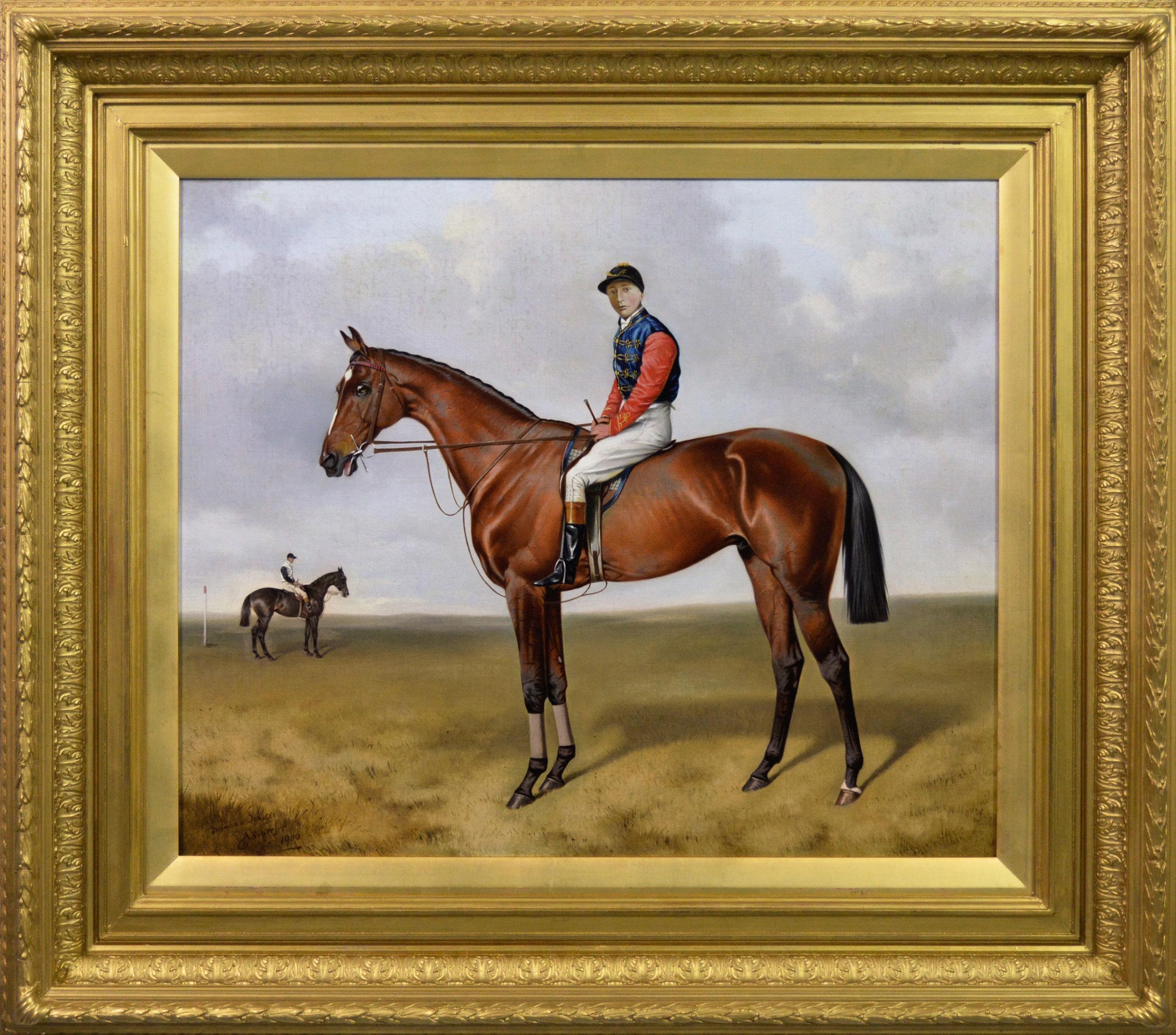
Champion Thoroughbred Racehorse "Sysonby" (1902-1906) Edward Herbert Miner

1905

$7,120
$17,80060% Off
£5,364.72
£13,411.8060% Off
€6,270.73
€15,676.8360% Off
CA$10,082.63
CA$25,206.5760% Off
A$10,268.07
A$25,670.1760% Off
CHF 5,894.30
CHF 14,735.7560% Off
MX$123,902.83
MX$309,757.0660% Off
NOK 68,312.02
NOK 170,780.0460% Off
SEK 69,250.38
SEK 173,125.9660% Off
DKK 46,882.63
DKK 117,206.5760% Off

About the Item

"Sysonby" Edward Herbert Miner (American, 1882-1941) Depicting the champion thoroughbred horse Sysonby (1902-1906) Oil on canvas, signed "E H Miner 1905" 24 x 32 inches (31 1/4 x 39 w/original frame) Purchased 10/28/04 from The Collection of Mr. & Mrs. Walter M Jeffords, a prominent Philadelphia lawyer and racehorse owner, at Sotheby's NY, 2004 This is the only portrait located of this most historic and most important thoroughbred racers. Sysonby (1902–1906) was an American Thoroughbred racehorse. He won every start easily, except one, at distances from one mile to two and a quarter miles. His superiority as a two and three-year-old was unchallenged during his short career of 15 race starts. Sysonby was regarded by many experts as the best horse to have raced in the United States between the Civil War and World War I. His sole loss in 15 starts came after he was doped by his groom as a bribe; even then, it took another member of the Hall of Fame, Artful, to beat him. Foaled in Kentucky, Sysonby was a bay son of the 1885 Epsom Derby winner, Melton, out of the English mare Optime by Orme (by the undefeated Ormonde). The mating of Melton and Optime was arranged by Marcus Daly, who was involved with the Anaconda Copper Mine. Daly died before Optime, stabled in England, foaled. His stock, including the still pregnant Optime, was brought to New York to be auctioned. James R. Keene purchased Optime for $6,600, sending her to his Castleton Stud in Kentucky, which he rarely visited. Apparently Optime's foal, observed in his paddock, was anything but inspiring. Considered unattractive and small, as well as slow, young Sysonby was to be sent back to England for sale. But Keene's trainer, the well-regarded James G. Rowe, Sr., had seen Sysonby in action during some early trials. When it was time for the yearlings to be sent away, Rowe, a leading trainer who had once been a leading jockey (guiding Harry Bassett to his Saratoga Cup win amongst many other successes), covered Sysonby in blankets, convincing Keene he was too ill to make the long ocean journey. In the care of Rowe, Sysonby won everything Rowe entered him in by sizable margins, with the exception of the Futurity Stakes (USA), where he came in an unaccountable third, beaten by the filly Tradition and the filly Artful. Artful ranked 94th in the top 100 U.S. Thoroughbred champions of the 20th century by Blood-Horse magazine). Rowe saw Sysonby's groom exhibiting a large sum of money, and the groom admitted he'd been bribed to drug Sysonby before the race. If not drugged, nothing beat Sysonby. The turf writer Neil Newman ranked Sysonby as one of the three best colts he'd ever seen. The other two were Colin (also trained by Rowe) and Man o' War. Sysonby was the top money earner of 1905. Average winning margin was 4 ¼ lengths. Was ahead at every point of every race, except at the quarter call in the Brighton Junior Stakes, and in the stretch of the Futurity. Sysonby was inducted into the National Museum of Racing and Hall of Fame in Saratoga Springs, New York, in 1956. In the list of the top 100 U.S. Thoroughbred champions of the 20th Century by Blood-Horse magazine, he ranks 30th. Eighteen years after Sysonby's death, a December 11, 1924 Daily Racing Form article looking back on his racing career, called Sysonby "One of Greatest Race Horses in History of the American Turf". James Rowe, Sr. was also inducted posthumously into the Hall of Fame as a trainer. Provenance: Walter Morrison Jeffords Sr. (August 8, 1883 – September 28, 1960) was a successful Investment banker and owner/breeder of Thoroughbred racehorses who, in partnership with his wife's uncle, Samuel Riddle, purchased and operated Faraway Farm near Lexington Kentucky where they stood Man o' War. Jeffords is one of only five people to be named an Exemplar of Racing by the National Museum of Racing and Hall of Fame. His former estate is now Ridley Creek State Park.
  • Creator:
    Edward Herbert Miner (1882 - 1941)
  • Creation Year:
    1905
  • Dimensions:
    Height: 31.25 in (79.38 cm)Width: 39 in (99.06 cm)
  • Medium:
  • Period:
  • Condition:
    The painting is in very good condition and is housed in its original frame.
  • Gallery Location:
    SANTA FE, NM
  • Reference Number:
    1stDibs: LU1408216278832

More From This Seller

View All
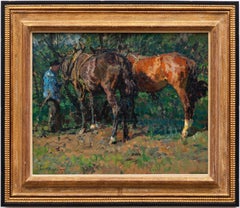
Antique Horse Painting "Standing Grey Horse, Facing Right" Georg Wolf dated 1907

Antique Horse Painting "Standing Grey Horse, Facing Right" Georg Wolf dated 1907

Located in SANTA FE, NM

Antique Horse Painting “Standing Grey Horse, Facing Right” Georg Wolf (Germany 1882-1962) Oil on canvas Signed and dated 1907 lower right 27 x 19 (35 x 27 frame) inches With it's bobbed tail cut short so it doesn't become tangled, it's apparent that this fine specimen was a draught horse...

Category

Early 20th Century Post-Impressionist Animal Paintings

Materials

Oil, Canvas

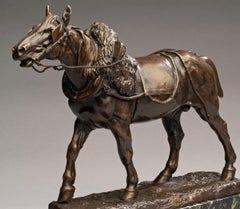
Antique Horse Bronze Trotting Stallion Isidore Jules Bonheur (France, 1827-1901)

Antique Horse Bronze Trotting Stallion Isidore Jules Bonheur (France, 1827-1901)

By Isidore Jules Bonheur

Located in SANTA FE, NM

Antique Horse Bronze Portrait of a Trotting Stallion Isidore Jules Bonheur (France, 1827-1901) Cast bronze mounted on a rectangular plinth with dark brown patina, Signed: I. BONHEUR 17 x 11 3/4 A brilliant exploration of a stallion in full trot. The patina is a deep, warm walnut brown with honey-colored tones. Isidore Bonheur was best known and the most distinguished of the 19th century French animalier sculptors. Isidore, the younger brother of Rosa Bonheur and older brother of Auguste, began his studies of painting initially with his father, who was friends with Francisco Goya. By 1848 he debuted at the Paris Salon having discontinued animal and landscape painting to concentrate on creating sculptures and in 1849, Bonheur enrolled at the Ecole des Beaux Arts. He won medals at the Paris Salon in 1859 and did so again in 1865 and in 1869. After entering the Exposition Universelle 1855, he won the Gold Medal in 1889. In the 1870s exhibited in the London at the Royal Academy of Arts where he earned great prestige and won the coveted Medaille d’Or. After winning numerous other medals and prizes, Bonheur was awarded the Legion d' Honneur in 1895 and he was Knighted in Portugal, Spain and France. Bonheur continued exhibiting at the Paris Salon until 1899. Many of his bronzes were fabricated at the foundry owned by Hippolyte Peyrol, Bonheur's brother-in-law by marriage to Isidore’s youngest sister Juliette Bonheur. The Peyrol casts for both Rosa and Isidore are exceptionally well executed which suggests a strong working relationship between the founder and sculptor. There is little doubt that Isidore Bonheur was an acute observer of nature; his animals were not anthropomorphized but modelled to catch movement or posture characteristics of the particular species he was sculpting. He achieved this most successfully with his sculptures of horses which are usually depicted as relaxed rather than spirited. These figures are among his most renowned works and his equestrian models became very popular, particularly among the British aristocracy. An acute observer of nature, his sculptures reflect his commitment to the Realist school - with precise detailing of the movements of animals in their natural habitats. Ultimately, His naturalistic studies of animals are now some of the most highly sought after works by any of the animalier. He was possibly inspired by his many visits to the Buffalo Bill Wild West Show...

Category

1870s Realist Figurative Sculptures

Materials

Bronze

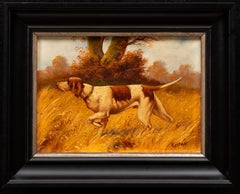
Hunting Dog at the Ready (R)- Louis Lartigau (French, 19th/20th)

Hunting Dog at the Ready (R)- Louis Lartigau (French, 19th/20th)

Located in SANTA FE, NM

Hunting Dog at the Ready (R) Louis Lartigau (French, 19th/20th) Oil on canvas 9 1/8 x 11 5/8 (frame) Signed lower right A very finely drawn and executed painting of a hunting dog at...

Category

1910s Animal Paintings

Materials

Canvas, Oil

You May Also Like

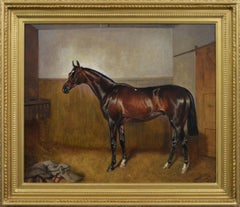
19th Century horse portrait oil painting of the racehorse Worcester

19th Century horse portrait oil painting of the racehorse Worcester

By Albert Clark

Located in Nr Broadway, Worcestershire

Albert Clark British, (1843-1928) Worcester Oil on canvas, signed & dated 1899 Image size: 24.25 inches x 29.25 inches Size including frame: 30.75 inches x 35.75 inches A fine sport...

Category

19th Century Victorian Animal Paintings

Materials

Canvas, Oil

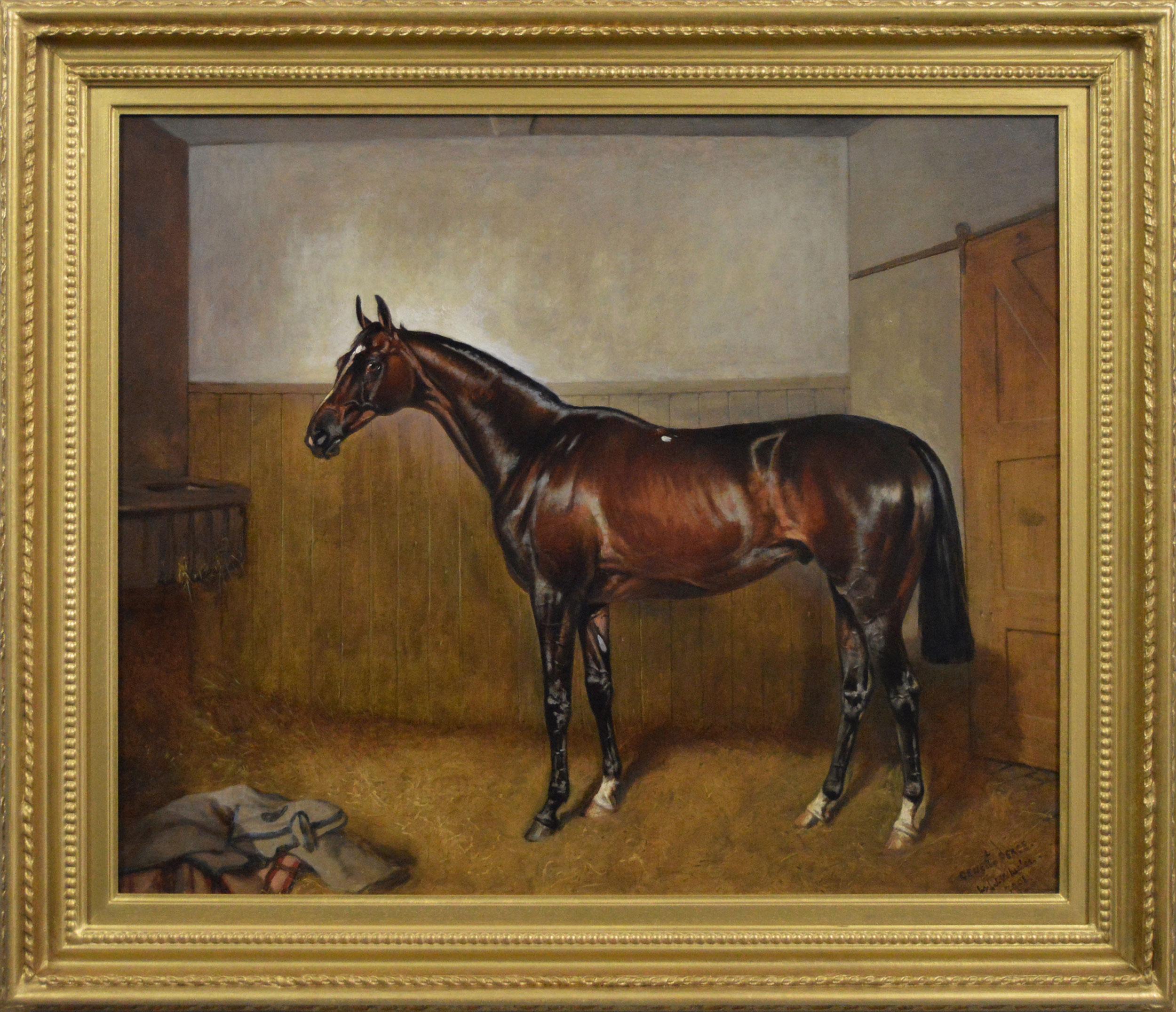
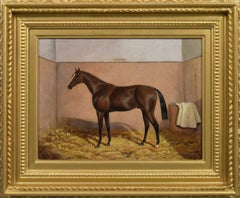
Horse portrait oil painting of the racehorse General Peace

Horse portrait oil painting of the racehorse General Peace

By John Alfred Wheeler

Located in Nr Broadway, Worcestershire

John Alfred Wheeler British, (1821-1903) General Peace Oil on canvas signed & dated 1901 Image size: 24 inches x 29 inches Size including frame: 31.25 inches x 36.25 inches A wonder...

Category

Early 20th Century Animal Paintings

Materials

Canvas, Oil

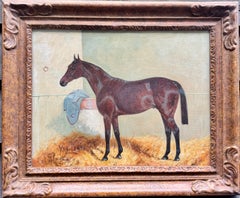
19th Century horse portrait oil painting of the racehorse Flying Fox

19th Century horse portrait oil painting of the racehorse Flying Fox

By Albert Clark

Located in Nr Broadway, Worcestershire

Albert Clark British, (1843-1928) Flying Fox Oil on canvas, signed, old label verso Image size: 11.5 inches x 15.5 inches Size including frame: 18.75 inches x 22.75 inches A wonderf...

Category

Late 19th Century Victorian Animal Paintings

Materials

Canvas, Oil

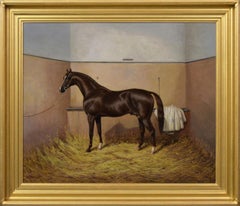
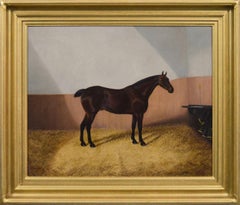
19th Century horse portrait oil painting of a bay horse in a stable

19th Century horse portrait oil painting of a bay horse in a stable

By Albert Clark

Located in Nr Broadway, Worcestershire

Albert Clark British, (1843-1928) Bay Horse in a Stable Oil on canvas, signed Image size: 19.25 inches x 23.25 inches Size including frame: 25.75 inches x 29.75 inches A well-execut...

Category

Late 19th Century Victorian Animal Paintings

Materials

Canvas, Oil

Antique Thoroughbred Horse Portrait, Pur Sang Equestrian Lithograph, ca.1898

Antique Thoroughbred Horse Portrait, Pur Sang Equestrian Lithograph, ca.1898

Located in Langweer, NL

Antique Thoroughbred Horse Portrait 1898, Pur Sang Equestrian Lithograph This original antique colour lithograph from 1898 depicts Le Cheval de Pur-Sang, the Thoroughbred, the most ...

Category

Antique Late 19th Century Belgian Prints

Materials

Paper