
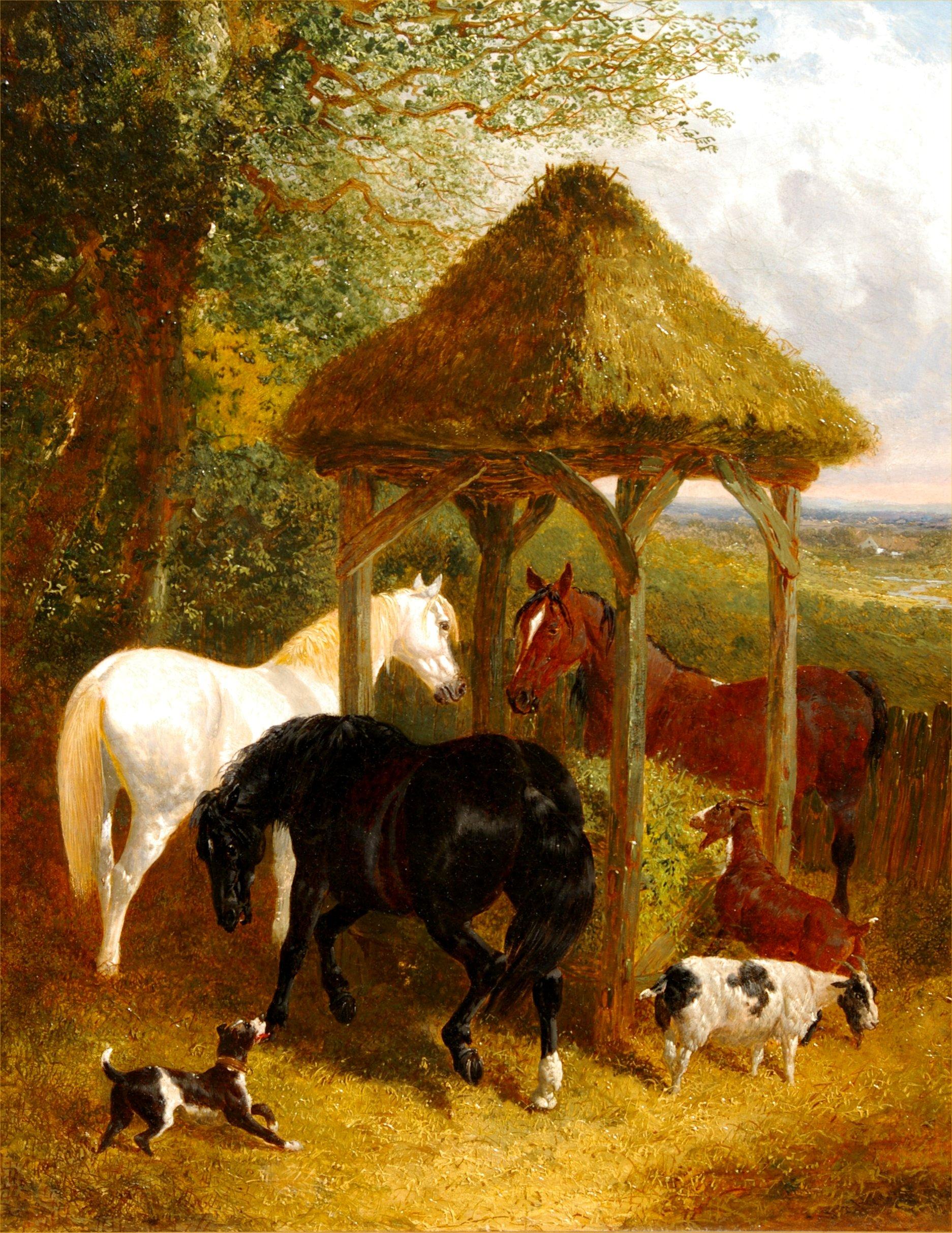
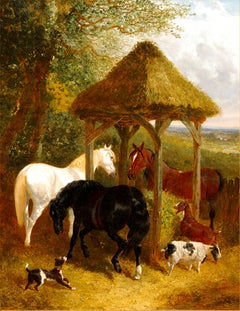
On the Farm
By John Frederick Herring Jr
Located in Belgravia, London, London
Oil on canvas Canvas size: 21 x 17 inches Signed lower right
Category
19th Century Animal Paintings
Materials
Canvas, Oil
John Frederick Herring Sr., born in London in 1795, was the son of a London merchant of Dutch parentage, who had been born overseas in America. The first eighteen years of Herring's life were spent in London, where his greatest interests were drawing and horses. In 1814, at the age of 18, he moved to Doncaster in the north of England, and by 1815, had married Ann Harris. His sons John Frederick Herring Jr., Charles Herring, and Benjamin Herring were all to become artists, while his two daughters, Ann and Emma, both married painters.
In Doncaster, Herring was employed as a painter of inn signs and coach insignia on the sides of coaches, and his later contact with a firm owned by a Mr. Wood led to Herring's subsequent employment as a night coach driver. Herring spent his spare time painting portraits of horses for inns, and he became known as the “artist coachman.” Herring's talent was recognized by wealthy customers, and he began painting hunters and racehorses for the gentry.
In 1830, Herring left Doncaster for Newmarket, England, where he spent three years before moving to London. During this time, Herring might have received tuition from equestrian artist Abraham Cooper. In London, Herring experienced financial difficulties and was given financial assistance by W. T. Copeland, who commissioned many paintings, including some designs used for the Copeland Spode bone china. In 1840–41, Herring visited Paris, painting several pictures, on the invitation of the Duc d’Orleans, the son of the French King Louis-Phillipe.
In 1845, Herring was appointed Animal Painter to the Duchess of Kent, followed by a subsequent commission from the ruling Queen Victoria, who remained a patron for the rest of his life. In 1853, Herring moved to rural Kent in the southeast of England and stopped painting horse portraits. He spent the last 12 years of his life at Meopham Park near Tonbridge, where he lived as a country squire. He then broadened his subject matter by painting agricultural scenes and narrative pictures, as well as his better-known sporting works of hunting, racing and shooting.
A highly successful and prolific artist, Herring ranks along with Sir Edwin Landseer as one of the more eminent animal painters of mid-nineteenth century Europe. The equestrian paintings of Herring were very popular, and many were engraved, including 33 winners of the St. Leger and 21 winners of the Derby. Herring exhibited at the Royal Academy from 1818–65, at the British Institution from 1830–65, and at the Society of British Artists in 1836–52, where Herring became Vice President in 1842.
Find original John Frederick Herring Sr. paintings, prints and other art on 1stDibs.
(Biography provided by Isherwood Fine Art)
On the Farm
By John Frederick Herring Jr
Located in Belgravia, London, London
Oil on canvas Canvas size: 21 x 17 inches Signed lower right
Canvas, Oil
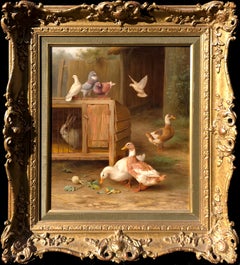
Farmyard Friends
By Edgar Hunt
Located in Belgravia, London, London
Farmyard Friends by Edgar Hunt British, 1876–1953 Oil on Board Board size: 14 x 12 inches Framed size: 20 x 18 inches
Canvas, Oil
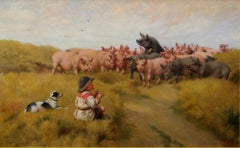
An Appreciative Audience
By Herbert William Weekes
Located in Belgravia, London, London
Oil on canvas Canvas size: 22 x 36 inches Framed size: 30.75 x 44.75 inches Signed lower right
Canvas, Oil
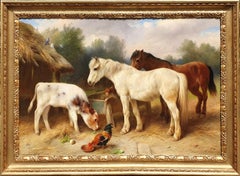
Feeding Companions
By Walter Hunt
Located in Belgravia, London, London
Oil on canvas Canvas size: 30 x 45 inches Framed size: 36.5 x 51.5 inches Signed and dated 1918 lower right
Canvas, Oil
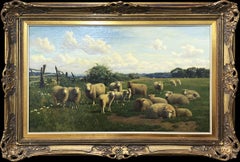
Grazing Pastures
By William Sidney Cooper
Located in Belgravia, London, London
Oil on canvas Canvas size: 18 x 30 inches Framed size: 25.25 x 37.5 inches Signed lower left
Canvas, Oil
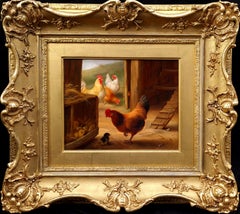
Under Mother's Watchful Eye
By Edgar Hunt
Located in Belgravia, London, London
Under Mother's Watchful Eye by Edgar Hunt British, 1876–1953 Oil on canvas Canvas size: 8.25 x 10 inches Framed size: 17 x 19 inches Signed and dated 1911 lower right
Canvas, Oil
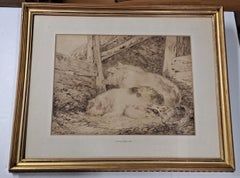
George Morland (1763-1804) "Piglets" Original Watercolor
By George Morland
Located in San Francisco, CA
George Morland (1763-1804) "Piglets" original watercolor on paper Signed & Dated 1791 Unframed 14" x 18" Framed 21" x 26"
Watercolor
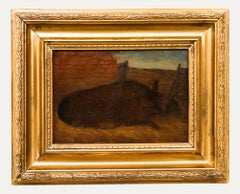
Folk Art Early 20th Century Oil - Large Black Pig
Located in Corsham, GB
This charming folk art painting depicts a prize Large Black lying comfortably in a freshly bedded sty. The oil has been well presented in a handsome gilt-effect frame. Unsigned. On p...
Oil
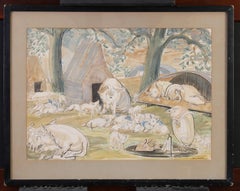
Pigs Delight
Located in Douglas, Isle of Man
Anrid Banniza Johnston was a Swedish born English sculptor, illustrator and animalier. She was born to a Swedish mother and English father, she studied at the Slade School of Art, as...
Paper, Watercolor
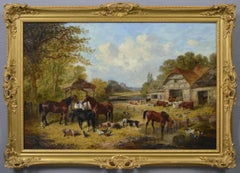
19th Century oil painting of a farm with horses, pigs, goats, poultry & cattle
By John Frederick Herring Jr
Located in Nr Broadway, Worcestershire
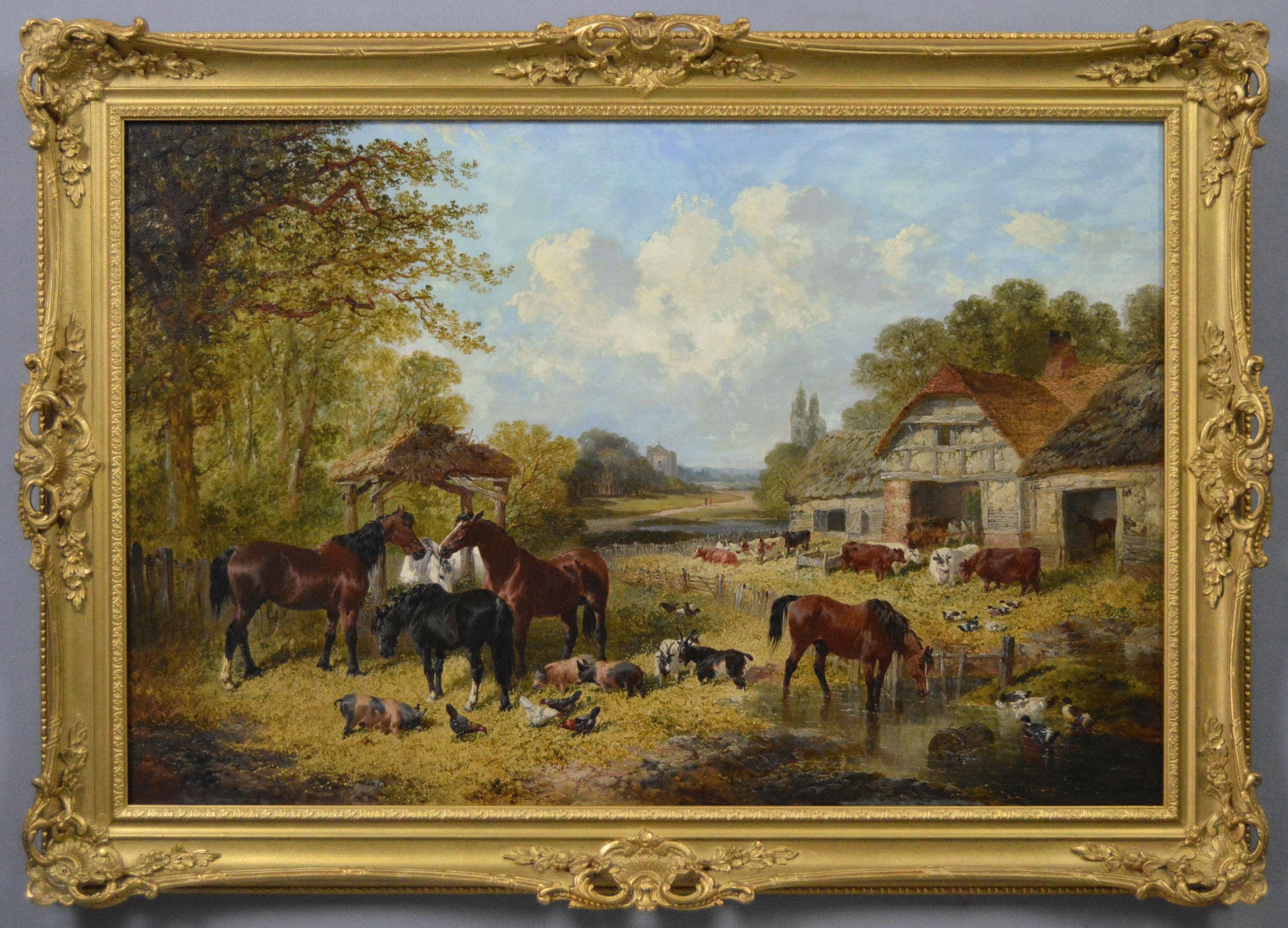
John Frederick Herring Jnr British, (c1820-1907) Farmyard Friends Oil on canvas, signed Image size: 23.25 inches x 35.25 inches Size including frame: 29.75 inches x 41.75 inches Provenance: Frost & Reed; Stacy Marks, Eastbourne A fantastic rural farmyard scene featuring horses, pigs, goats, chickens, ducks and cattle by John Frederick Herring Jnr. In the foreground, pigs, goats and chickens are shown foraging for food whilst horses watch on. To the right, a bay horse drinks from a pond next to some ducks as cattle graze outside a barn. In the distance two figures can be seen walking along a country path towards a church. John Frederick Herring was born in Doncaster c1820 to the artist John Frederick Herring (1795-1865) and his wife Anna Catharina (nee Harris) and was baptised on 2 May, 1821. There is some confusion about the date of his birth due to an earlier birth record existing for 21 June, 1815. To complicate matters further, all of the census records indicate he was born in 1816. Some sources suggest this was an earlier child who died and that Herring was the child born in 1820. Herring’s brothers Charles Herring (1828-1856) and Benjamin Herring (1830-1871) also became artists. He and his brothers were exposed to art at an early age and were all tutored by their father whose subject matter influenced their work. The family moved to Newmarket during the early 1830’s and Herring would visit the racecourse to study the horses. The brothers would often collaborate with their father on paintings, however, Herring Jnr soon developed his own style and began painting farmyard and rustic scenes featuring horses and other farm animals. His emerging success caused some discord with his father, who from around 1836 began adding ‘SR’ or ‘Senr’ to his signature to avoid confusion between the two artists. Herring did not join his father when he later moved to London but at some point moved to Cambridgeshire where he met and married Emma Jane Dawson on 29 August, 1836. Together, they lived at Great Wilbraham with their 5 children. By 1861, he had moved to nearby Fulbourn and continuing his successful career made his debut at the Royal Academy in 1863. He began exhibiting at the British Institution from 1864 and also exhibited at the Royal Society of British Artists at Suffolk Street. After the death of his first wife, Herring married the artist Catherine Augusta Rolfe on 5 December 1865 at St Pauls Church, Hammersmith in London. Catherine (or Kate) was the sister of the artists Alexander Frederick Rolfe (1814-1875) and Henry Leonides Rolfe (1823-1881) and the daughter of William E Rolfe, a friend of his father. They lived at Wilbraham Road in Fulbourn, later moving to The Poplars in Fulbourn where Herring spent the rest of his life. He died at Fulbourn on 6 March 1907. Examples of his work are held by a number of museums and public collections including the Bradford Museum, Hawarth Art Gallery, Government Art Collection, Grundy Art Gallery, the Tate, National Gallery of Art, Washington DC and the Watford Museum & Witt Library. Presentation: The painting is housed in a new, English made gilt frame which is in excellent condition. Condition: As with all of our original antique oil paintings, this work is offered in ready to hang gallery condition, having been professionally cleaned, restored and revarnished. © Benton Fine Art
Canvas, Oil
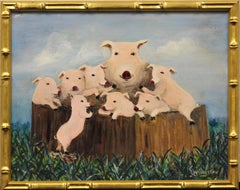
"Piglet Family"
By Bobby Livingston
Located in Bristol, CT
Delightful c1980s oil on canvas depicting a happy 'piglet' family of (8) by (Bobby) Livingston (Broadway producer) Art Sz: 10 1/2"H x 13 1/2"W Frame Sz: 12"H x 15"W w/ gilt bamboo...
Canvas, Oil
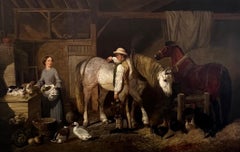
Family Farm
By John Frederick Herring Jr
Located in Lexington, KY
Provenance: Anon. sale, Christie’s, London, 5 June 1998, lot 32 (25,300 Euro), Signed, Oil on Canvas. Son of John Frederick Herring Sr. The Junior Herring painted farm and equestria...
Oil