Want more images or videos?
Request additional images or videos from the seller
1 of 10

Arnold Friedman
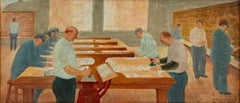
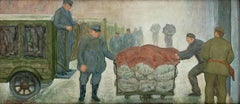
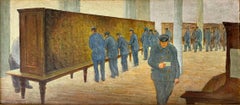
WPA American Scene Social Realism Mid 20th Century Modern Postal Workers Deco SR

1935

$44,000
£33,268.06
€38,949.78
CA$62,601.09
A$63,676.73
CHF 36,543.94
MX$765,469.02
NOK 426,283.70
SEK 430,296.78
DKK 291,185.03

About the Item

WPA American Scene Social Realism Mid 20th Century Modern Postal Workers Deco SR Arnold Friedman (American, 1874-1946) "Swing Room" 11 1/2 x 26 1/2 inches Oil on Wood Panel, 1935, Signed, dated, and inscribed "New York P.O. STA. Y" lower left Hirschl & Adler Galleries, Inc. label verso, Framed:: 15 1/4 x 30 inches This is one of three Arnold Friedman Post Office paintings we have available. Note: Friedman worked for the U.S. Postal Service for over forty years. He was a clerk and Station Y, the branch at 3rd Avenue and East 67th Street in New York City. When not performing his clerical duties at the post office, Friedman spent his spare time at his home studio in Queens, painting scenes from his daily routine. This painting was executed two years after his retirement. They capture urban life during the Great Depression. BIO Arnold Friedman is considered an extremely gifted and original American modern painter by scholars and art historians today. He came to the profession of a painter rather late in life and did not devote himself to his art on a full time basis until 1933, at the age of 59. Friedman was born to Hungarian Jewish parents in Corona, Queens, where he worked as a post office clerk for some forty years, painting on evenings and weekends. Under the auspices of the Federal Arts Project of the Works Progress Administration, Friedman painted murals for Chalfonte-Haddon Hall in Atlantic City, New Jersey and post office buildings in Orange, Virginia; Kingstree, South Carolina; and Warrenton, Georgia. Friedman's style underwent several transformations during his career. He began his career in 1905 under the tutelage of Robert Henri and Kenneth Hayes Miller at the Art Students League in New York. These painters had an important influence on his early style, which was geared towards representational subjects. However, during his studies at the Art Students Leagues, Friedman found himself a misfit as an older postal clerk, and harnessed the belief that "every painter must learn his own trade. " In 1909 Friedman took a six-month leave of absence from his job at the Post Office to study art in Paris. During this time, he was exposed to the virtues of Impressionism. He was most influenced by the Pointillism of Pisarro, and reflected his admiration of other Impressionists and Post-Impressionists was reflected in his own art after his return to New York. Friedman's trip to France also introduced him to Cubi`sm, which he experimented for a brief period. From these European influences, Friedman chartered his own distinctly American course and created a unique approach to painting. Upon his return to New York, Friedman's style consisted of cool tonalities and smooth finish, with two-dimensional objects. He painted traditional subjects of landscapes, portraits, and nudes all expressing his deep commitment to color. It was during this time that he made the bold statement, "Color in painting is the very heartbeat (Hess)." While Friedman developed several styles during the course of his career, his latest work continues to warrant the most attention. The artist maintained s commitment to nature and color as he developed an abstracting style, abandoning the brush for a palette knife. This method of painting allowed for more powerful effects of texture and abbreviated forms. Friedman's abstracted landscapes attain an atmospheric quality through his use of color and unique application. His style during his later career is distinct, as Friedman paints with impastoed surfaces that create contours and texture to define characteristics of his subject. Through these works he pays homage to the influence of Pisarro and Impressionism, yet he does so in his own vocabulary. Where an Impressionist landscape depicts a place and time, Friedman's landscapes evoke mood. As an artist, he was more concerned with the formal aspects of painting rather than with creating the exact appearance of nature. Prior to his death in his seventies, Friedman was still actively painting and developing his unique style. Friedman's oeuvre appears to have been limited to approximately 300 works. He is represented in the Metropolitan Museum of Art, Museum of Modern Art, Smithsonian Museum of American Art, Newark Museum, and Detroit Institute of Art. He was also a member of the Society of Independent Artists and Salons of America.
  • Creator:
    Arnold Friedman (1874-1946, American)
  • Creation Year:
    1935
  • Dimensions:
    Height: 15.25 in (38.74 cm)Width: 30 in (76.2 cm)
  • Medium:
  • Movement & Style:
  • Period:
  • Condition:
  • Gallery Location:
    New York, NY
  • Reference Number:
    1stDibs: LU1156218003462

More From This Seller

View All
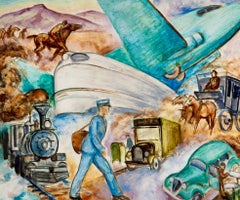
Post Office WPA Mural Study American Scene Social Realism Modern 20th Century

Post Office WPA Mural Study American Scene Social Realism Modern 20th Century

By Carlos Lopez

Located in New York, NY

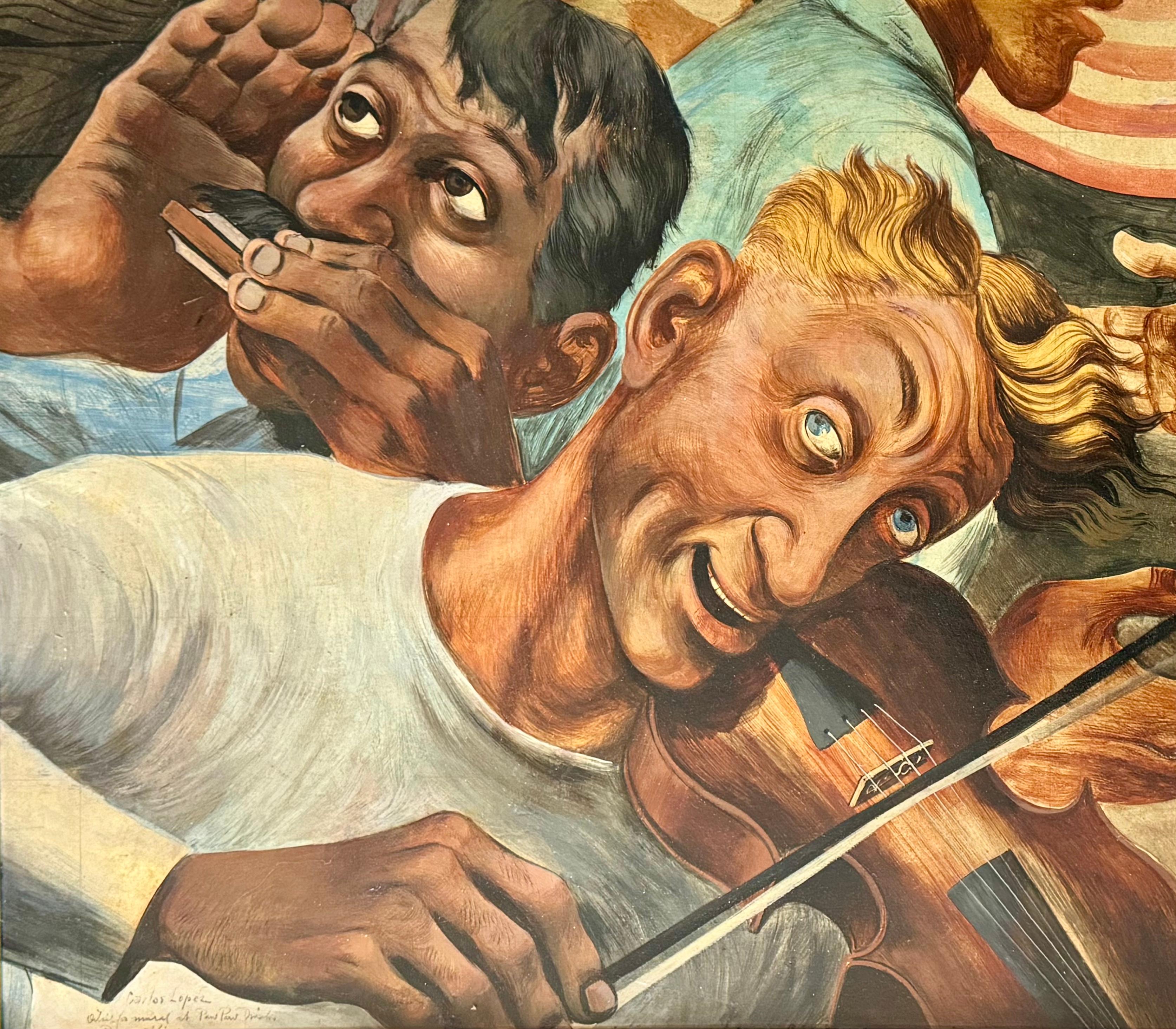
Post Office WPA Mural Study American Scene Social Realism Modern 20th Century Carlos Lopez (1910-1953) "Bounty" WPA Mural Study for Michigan Post Office 19 ½ x 22 ½ inches Oil on B...

Category

1940s American Realist Figurative Paintings

Materials

Oil, Board

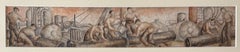
WPA Post Office Mural Study American Scene Regionalism Social Realism Modern Art

WPA Post Office Mural Study American Scene Regionalism Social Realism Modern Art

By Louise Ronnebeck

Located in New York, NY

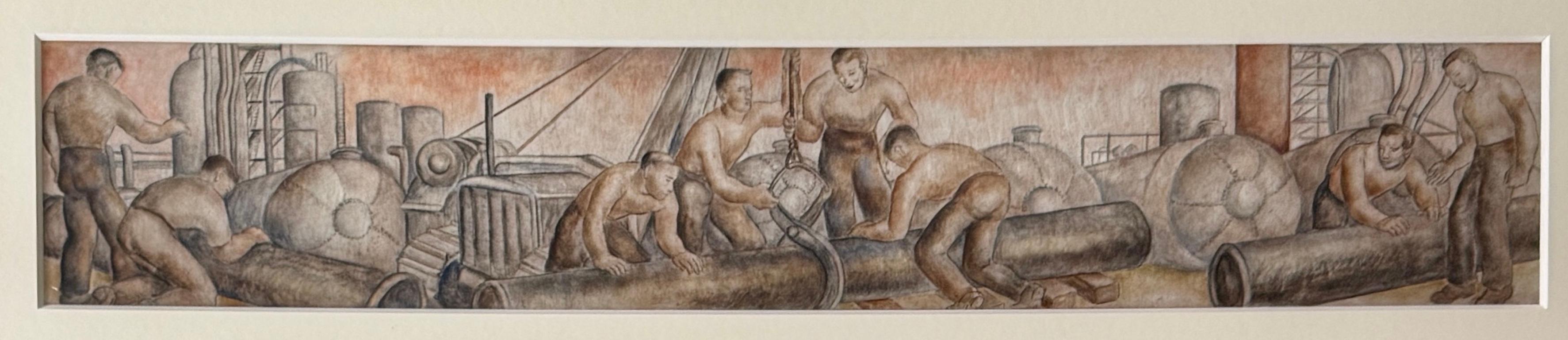
WPA Post Office Mural Study American Scene Regionalism Social Realism Modern Art Louise Emerson Ronnebeck (1901 - 1980) Oil Riggers, Mural Study Image: 6 1/2 x 37 inches Watercolor ...

Category

1930s American Modern Figurative Drawings and Watercolors

Materials

Paper, Watercolor, Cardboard

You May Also Like

American Scene Depression Era New York City Post Office

American Scene Depression Era New York City Post Office

By Arnold Friedman

Located in Miami, FL

This is a painting about a man who travels back into the past and engages with a different stage in his life. Arnold Friedman worked at the New York City Post Office for four decades...

Category

1930s American Realist Figurative Paintings

Materials

Oil, Wood Panel

Depression Era New York City - Journey Back in Time  - American Scene Painting

Depression Era New York City - Journey Back in Time - American Scene Painting

By Arnold Friedman

Located in Miami, FL

This is a painting about a man who travels back into the past and engages with a different stage in his life. Arnold Friedman worked at the New York City Post Office for four decades...

Category

1930s American Realist Figurative Paintings

Materials

Oil, Wood Panel

Post Office Parcel Post Window - Depression Era

Post Office Parcel Post Window - Depression Era

By Arnold Friedman

Located in Miami, FL

Arnold Friedman worked as a clerk for decades at the Station Y, the branch at 3rd Avenue and East 67th Street in New York City. This present work was done two years after his retirem...

Category

1930s American Realist Figurative Paintings

Materials

Oil, Wood Panel

1959 ‘Card Players’, Kenneth Miller Adams American Regionalist Figurative Art

1959 ‘Card Players’, Kenneth Miller Adams American Regionalist Figurative Art

By Kenneth Miller Adams

Located in Denver, CO

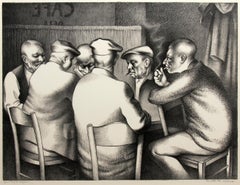
An expressive mid-century lithograph titled “Card Players” (1959) by American artist Kenneth Miller Adams. This hand-signed print depicts a small group of men gathered around a table engaged in a card game. Adams captures the quiet tension and camaraderie of the scene through strong draftsmanship, expressive line work, and carefully structured composition. The intimate interior setting reflects themes common to American Regionalist and social realist imagery of the mid-20th century. Printed in a limited edition of 100 impressions, this example is numbered 16/100 and signed by the artist. The work is professionally framed in a clean black archival frame, presenting the composition beautifully for display. Adams was an important figure in American art of the Southwest and the youngest member of the Taos Society...

Category

1950s American Modern Portrait Prints

Materials

Lithograph

"Colonial Sand and Stone Company, New York, " Industrial WPA Scene, Precisionist

"Colonial Sand and Stone Company, New York, " Industrial WPA Scene, Precisionist

By William Sharp

Located in New York, NY

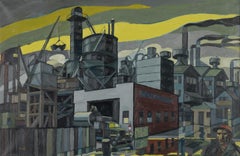
William Sharp (1900 - 1961) Factory on the River Oil on canvas 20 1/2 x 28 1/2 inches Initialed lower left: WS Provenance: Estate of the artist Private Collection, New York Swann Auction Galleries, American Art, June 13, 2019, Lot 178 Private Collection, New York Colonial Sand and Stone Co., founded by Generoso Pope, was once the country’s largest sand and gravel business, providing the concrete for much of New York City’s skyline, including the Empire State Building, Rockefeller Center, Radio City Music Hall, airports and subways. William Sharp was born on June 13, 1900, in Lemberg, Austria, where he attended college and the Academy for Arts and Industry. He later studied in Kraków, Poland, and in Berlin and Munich, Germany. Sharp began his career as a designer of stained-glass windows and as a painter of murals. He served in the German army during World War I. After the war he became a newspaper artist in Berlin and a well-known etcher. Sharp drew political cartoons that were bitterly critical of the growing Nazi movement. As the influence of National Socialism intensified, he began to contribute drawings, under a pseudonym, to publications that were hostile to Hitler. After Hitler assumed power, Sharp was confronted with these drawings and told that he would be sent to a concentration camp. However, in 1934, he escaped to the United States. His first newspaper assignment in America was making courtroom sketches for The New York Mirror...

Category

Mid-20th Century American Realist Landscape Paintings

Materials

Canvas, Paint, Oil