Want more images or videos?
Request additional images or videos from the seller
1 of 11

Cecil Bell
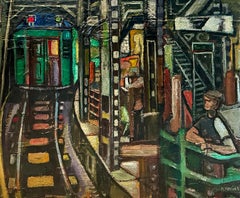
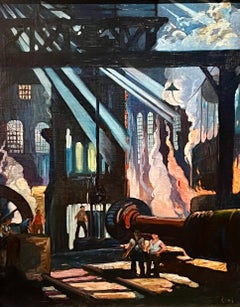
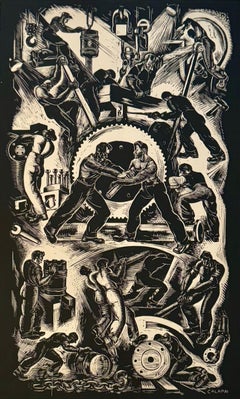
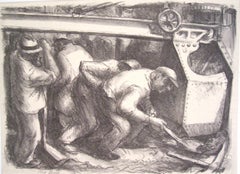
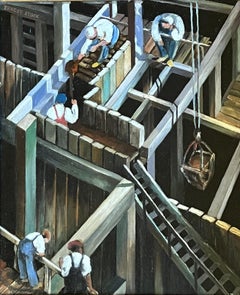
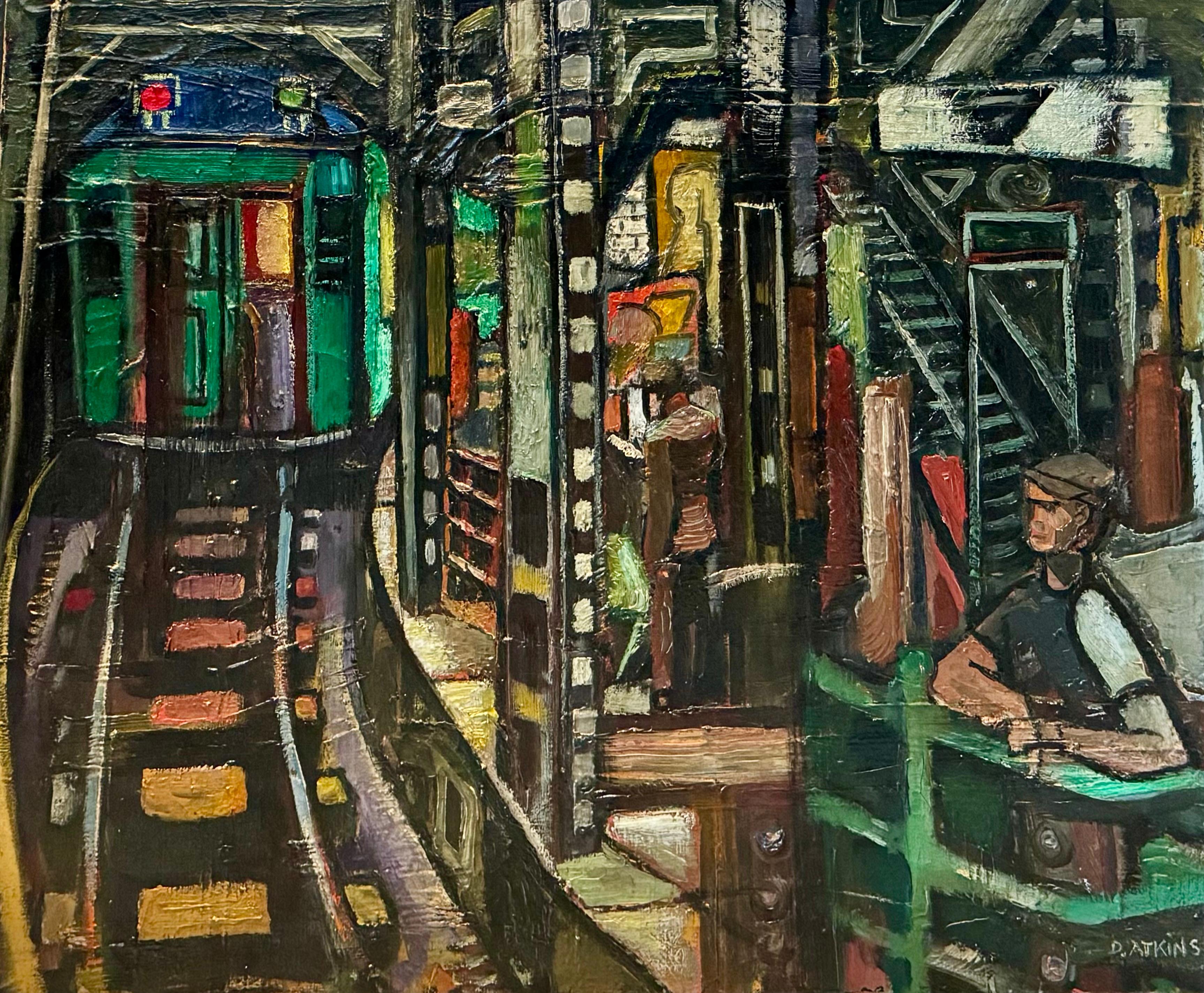
Building the 6th Avenue Subway NYC WPA American Scene Industrial Men Working

1938

$39,000
£29,403.51
€34,385
CA$55,200.72
A$56,194.38
CHF 32,361.51
MX$677,194.83
NOK 375,626.63
SEK 378,984.06
DKK 257,002.67

About the Item

Building the 6th Avenue Subway NYC WPA American Scene Industrial Men Working Cecil Bell (1906-1970) Building the 6th Avenue Subway 22x 30 inches Egg Temera on board Signed and dated '38 lower center Framed: 30 x 38 inches BIO Cecil Crosley Bell was born in 1906, in Seattle, Washington. Cecil studied printmaking at the Chicago Art Institute prior to moving to New York to study at the Art Students League with John Sloan. Cecil remained in New York, eventually settling in Staten Island with his wife. Most of his paintings depict famous locations around New York city. Cecil Crosley Bell died in New York in 1970. Largely unknown during his lifetime, in 1973 a retrospective of his work was held at The Museum of Modern Art, New York.
  • Creator:
    Cecil Bell (1907 - 1970, American)
  • Creation Year:
    1938
  • Dimensions:
    Height: 29 in (73.66 cm)Width: 37 in (93.98 cm)
  • Medium:
  • Movement & Style:
  • Period:
  • Condition:
  • Gallery Location:
    New York, NY
  • Reference Number:
    1stDibs: LU1156217867112

More From This Seller

View All
Industrial Working Man Social Realism Mid-20 Century Modern American Scene Art

Industrial Working Man Social Realism Mid-20 Century Modern American Scene Art

By Edith Kramer

Located in New York, NY

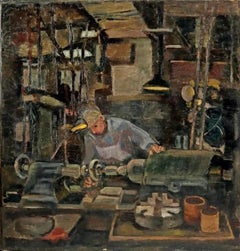
Industrial Working Man Social Realism Mid-20 Century Modern American Scene Art Edith Kramer (1916-2014) "Man on Lathe II" Oil on linen, 1949 23 x 22 inches Signed and dated in blac...

Category

1940s American Modern Figurative Paintings

Materials

Oil, Linen

Industrial Mural Study, Veterans Memorial Building, Santa Barbara WPA American

Industrial Mural Study, Veterans Memorial Building, Santa Barbara WPA American

Located in New York, NY

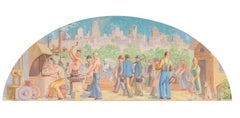
Industrial Mural Study, Veterans Memorial Building, Santa Barbara WPA American Joseph Edward Knowles (1907-1980) "Study for Industry Mural, Veterans Memorial Building, Santa Barbara, CA" 19 1/2 x 50 1/2 inches Oil on board, c. 1930s. Estate stamp verso Framed: 27 x 60 inches The completed mural is currently hanging on the wall, part of the building actually, at the Veterans Memorial Building in Santa Barbara. A photo of the work insitu is included in the attached photos. BIO Joseph Edward Knowles was born in Kendall, Montana, on June 15, 1907. He grew up in San Diego, California. At age twenty, two years before the beginning of the Great Depression, he moved north to another town on the coast of California---Santa Barbara. There he began studying fine art at the Santa Barbara School of the Arts* (1927-1930), under the supervision of Frank Morley Fletcher, previously director of the Edinburgh College of Art. Fletcher, who was trained in portraiture, landscape painting, and woodblock* printing, was a great influence on young Knowles. It was there that Knowles learned the art of color woodblock printmaking, a medium in which he showed great skill. Not long after completing his studies with Fletcher, Knowles began teaching art. For a period of thirty years, from 1930 to1960, he taught at the Cate School in Carpinteria, California. In 1934-1935, Knowles traveled throughout Europe, further developing his artistic skills in England, France, and Italy. Upon his return, he continued to teach art at various schools and institutions: Cate School, Crane Country School, extension classes at the University of California at Santa Barbara (UCSB), and at the Santa Barbara Museum of Art (SBMA). Knowles also served as an art education consultant for the County of Santa Barbara. In addition, he was founding co-director and president of the Santa Barbara Fine Arts Institute (1969-1972), which later developed a specialization in photography and became the Brooks Institute of Photography. Knowles died at his home in Santa Barbara on September 8, 1980. Much of Knowles' watercolor work is associated with what has been termed the "California School*," a loose grouping of artists throughout the state that included such figures as Millard Sheets, Phil Dike, Dong Kingman, George Post, and the Santa Barbara painters Dan Lutz and Standish Backus, Jr. The California School artists, including Knowles, were known for their fresh, direct, spontaneous style of watercolor painting. Knowles and other members of the school found inspiration in nature and the built environment alike, emphasizing elements of design in their exuberant, boldly stated, colorful scenes from everyday life. While painting in a representational* manner, Knowles generally avoided photographic realism, preferring subjective interpretation of his subjects. In this, as well as in his experimental approach and vigorous brushwork, he displayed a strongly modern sensibility. Knowles often used the wet-on-wet watercolor technique as he painted seascapes and landscapes, mostly along the California coast. He also employed dry-brush* techniques in many of his paintings, often leaving some of the white of the watercolor paper exposed. Some of the latter depict trees and other forms in a broken and airy manner that recalls Cezanne. Knowles' colored woodblock prints are more reserved and exact in their draftsmanship than his paintings. Spare, clean, lyrical lines are drawn to illustrate floral motifs and boat scenes with a touch of asymmetry conjuring Japanese woodblock prints. His murals from the post-World War II period are considerably more modern in their approach and show an emphasis on design and color. PROFESSIONAL ORGANIZATIONS California Watercolor Society (1940 - 1955) Santa Barbara Art Association (Vice President - 1952) ONE-MAN EXHIBITIONS Golden Gate International Exposition (GGIE) - San Francisco, California San Diego Fine Arts Gallery (SDMA) - San Diego, California Santa Barbara Museum of Art (SBMA) - Santa Barbara, California Cowie Galleries - Los Angeles, California Gallery de Silva - Santa Barbara, California Bradley Galleries - Santa Barbara, California MURALS Westmont College - Ellen Porter Hall Mural - Santa Barbara, California Safeway Grocery (now Vons Grocery on West Victoria Street) - Exterior Tile Mosaic - Santa Barbara, California Santa Barbara Bank & Trust - Interior Mosaic Panels, Santa Barbara, California Santa Barbara Girls Club - Interior Mosaic Mural - Santa Barbara, California Ernest Righetti High School - Mosaic Mural - Santa Maria, California Shell Oil Company - Mosaic Panel - California Beckman Instruments, Corporate Headquarters - Mosaic - Fullerton, California STAINED GLASS WINDOWS, WALLS and PANELS Katherine Thayer Cate Memorial Chapel - Cate School, Carpinteria, California William S. Porter Memorial Chapel - Cottage Hospital, Santa Barbara, California La Rinconada Building - Santa Barbara, California ILLUSTRATIONS "California's Wonderful Corner: True Stories for Children from the History of the Santa Barbara Region," by Walter A. Tompkins (1962 & 1975) China Designs: Two sets of dinnerware for Winfield China...

Category

1930s American Realist Figurative Paintings
Materials

Oil, Board

You May Also Like

"Colonial Sand and Stone Company, New York, " Industrial WPA Scene, Precisionist

"Colonial Sand and Stone Company, New York, " Industrial WPA Scene, Precisionist

By William Sharp

Located in New York, NY

William Sharp (1900 - 1961) Factory on the River Oil on canvas 20 1/2 x 28 1/2 inches Initialed lower left: WS Provenance: Estate of the artist Private Collection, New York Swann Auction Galleries, American Art, June 13, 2019, Lot 178 Private Collection, New York Colonial Sand and Stone Co., founded by Generoso Pope, was once the country’s largest sand and gravel business, providing the concrete for much of New York City’s skyline, including the Empire State Building, Rockefeller Center, Radio City Music Hall, airports and subways. William Sharp was born on June 13, 1900, in Lemberg, Austria, where he attended college and the Academy for Arts and Industry. He later studied in Kraków, Poland, and in Berlin and Munich, Germany. Sharp began his career as a designer of stained-glass windows and as a painter of murals. He served in the German army during World War I. After the war he became a newspaper artist in Berlin and a well-known etcher. Sharp drew political cartoons that were bitterly critical of the growing Nazi movement. As the influence of National Socialism intensified, he began to contribute drawings, under a pseudonym, to publications that were hostile to Hitler. After Hitler assumed power, Sharp was confronted with these drawings and told that he would be sent to a concentration camp. However, in 1934, he escaped to the United States. His first newspaper assignment in America was making courtroom sketches for The New York Mirror...

Category

Mid-20th Century American Realist Landscape Paintings

Materials

Canvas, Paint, Oil

Subway Construction

Subway Construction

Located in Los Angeles, CA

This painting is part of our exhibition American Coast to Coast: Artists of the 1930s Subway Construction, c. 1928, oil on board, 19 x 15 ¾ inches, signed upper left, artist and title verso; exhibited: 1) 12th Annual Exhibition of the Society of Independent Artists, The Waldorf Astoria, New York NY, from March 9 to April 1, 1928, no. 864 (original price $250) (see Death Prevailing Theme of Artists in Weird Exhibits, The Gazette (Montreal, Quebec, Canada), March 8, 1928); 2) Boston Tercentenary Exhibition Fine Arts and Crafts Exhibition, Horticultural Hall, Boston MA, July, 1930, no. 108 (honorable mention - noted verso); 3) 38th Annual Exhibition of American Art, Cincinnati Art Museum, Cincinnati, OH, June, 1931 (see Alexander, Mary, The Week in Art Circles, The Cincinnati Enquirer, June 7, 1931); and 4) National Art Week Exhibition [Group Show], Montross Gallery, New York, New York, December, 1940 (see Devree, Howard, Brief Comment on Some Recently Opened Exhibitions in the Galleries, The New York Times, December 1, 1940) About the Painting Ernest Stock’s Subway Construction depicts the excavation of New York’s 8th Avenue line, which was the first completed section of the city-operated Independent Subway System (IND). The groundbreaking ceremony was in 1925, but the line did not open until 1932, placing Stock’s painting in the middle of the construction effort. The 8th Avenue line was primarily constructed using the “cut and cover” method in which the streets above the line were dug up, infrastructure was built from the surface level down, the resulting holes were filled, and the streets reconstructed. While many artists of the 1920s were fascinated with the upward thrust of New York’s exploding skyline as architects and developers sought to erect ever higher buildings, Stock turned his attention to the engineering marvels which were taking place below ground. In Subway Construction, Stock depicts workers removing the earth beneath the street and building scaffolding and other support structures to allow concrete to be poured. Light and shadow fall across the x-shaped grid pattern formed by the wooden beams and planks. It is no surprise that critics reviewing the painting commented on Stock’s use of an “interesting pattern” to form a painting that is “clever and well designed.” About the Artist Ernest Richard Stock was an award-winning painter, print maker, muralist, and commercial artist. He was born in Bristol, England and was educated at the prestigious Bristol Grammar School. During World War I, Stock joined the British Royal Air Flying Corps in Canada and served in France as a pilot where he was wounded. After the war, he immigrated to the United States and joined the firm of Mack, Jenny, and Tyler, where he further honed his architectural and decorative painting skills. During the 1920s, Stock often traveled back and forth between the US and Europe. He was twice married, including to the American author, Katherine Anne Porter. Starting in the mid-1920s, Stock began to exhibit his artwork professionally, including at London’s Beaux Arts Gallery, the Society of Independent Artists, the Salons of America, the Cincinnati Art Museum, the Whitney Studio and various locations in the Northeast. Critics often praised the strong design sensibility in Stock’s paintings. Stock was a commercial illustrator for a handful of published books and during World War II, he worked in the Stratford Connecticut...

Category

1920s American Modern Figurative Paintings

Materials

Oil

Quarry Workers

Quarry Workers

Located in Los Angeles, CA

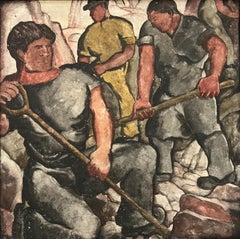
This painting is part of our exhibition America Coast to Coast: Artists of the 1930s Quarry Workers, c. 1930s, mixed media on board, unsigned, 24 x 24 inches, possibly exhibited at...

Category

1930s American Modern Figurative Paintings

Materials

Mixed Media

Niberg Abbey “Working Men” 1940’s New York Scene

Niberg Abbey “Working Men” 1940’s New York Scene

Located in Palm Springs, CA

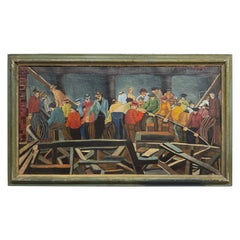
A wonderful evocative painting of workers by the noted New York Artist Niberg Abbey (1920-1990). Likely painted in the 1940’s. The painting is in its original frame which the artist ...

Category

Vintage 1940s American Paintings

Materials

Paint

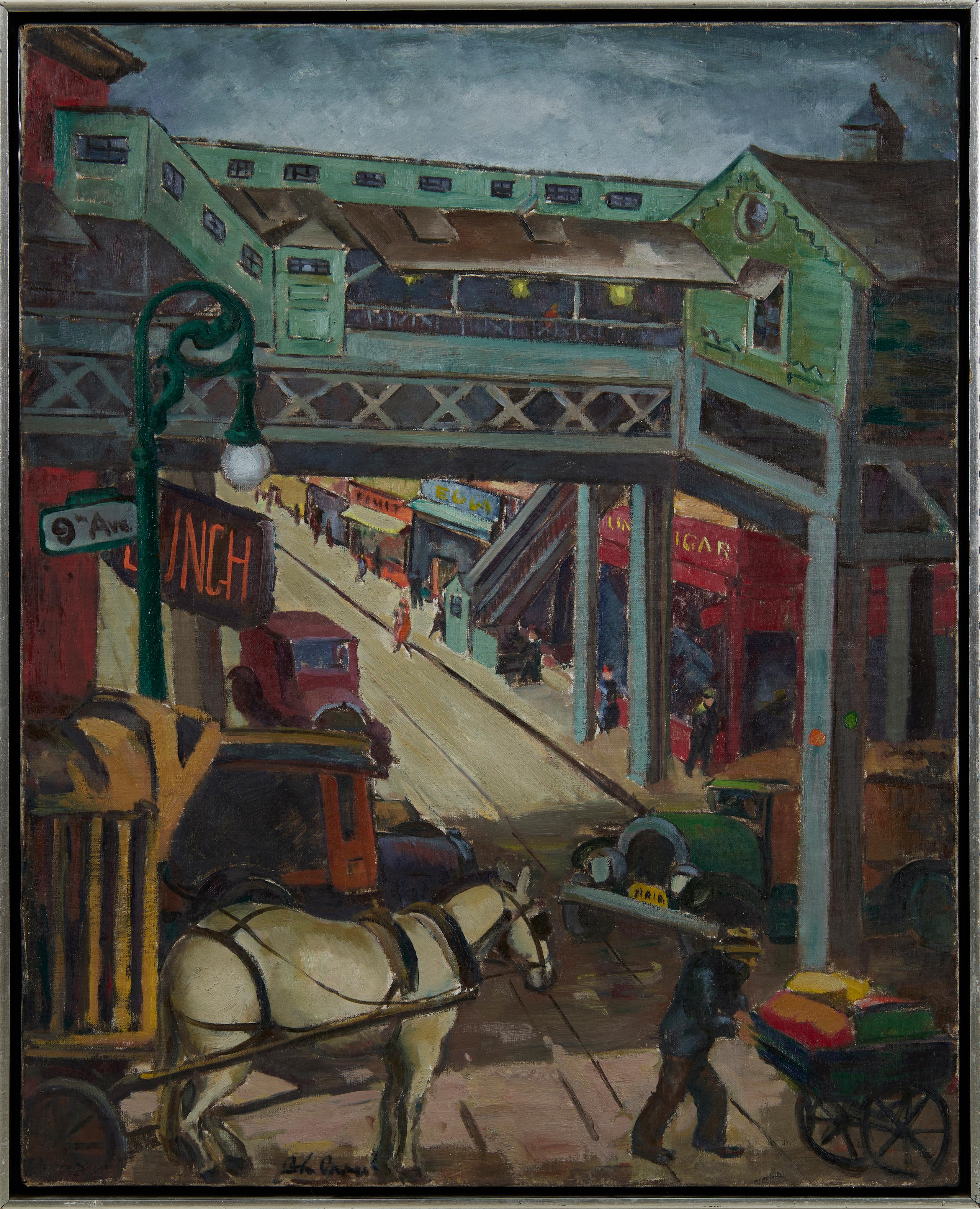
Ninth Avenue El (New York City), Mid 20th Century Cityscape Oil painting

Ninth Avenue El (New York City), Mid 20th Century Cityscape Oil painting

By John Opper

Located in Beachwood, OH

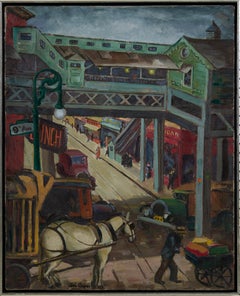
John Opper (American, 1908-1994) Ninth Avenue El (New York City), c. 1935 Oil on canvas Signed lower left and verso 30.125 x 24 inches The Ninth Avenue El was the first elevated rai...

Category

1930s American Modern Figurative Paintings

Materials

Oil