Egon-Josef Kossuth
(Opava, Duchy of Troppau, Silesia, 1874 – Hartford, Connecticut, 1949)
“Reiter oder König”
[Knight or King]
Circa 1900
Oil on canvas laid down on cardboard
36 × 41.5 cm
56 x 53,5 with its original frame
Signed “Kossuth . E . J.” lower right
Original frame with the title inscribed in Gothic letters on a gilt lower entablature: “REITTER [sic] ODER KÖNIG” [Knight or King]
Label affixed to the reverse of the frame: “KARL SCHNEIDER, Rahmengeschäft München, Leopoldstr. 41” [Karl Schneider frame shop, Munich, Leopoldstraße 41]
Born in 1874 in Opava, in the Duchy of Troppau, then part of the Austro-Hungarian Empire, Egon-Josef Kossuth received his initial training at the School of Applied Arts in Prague before continuing his studies at the Academy of Fine Arts in Munich, where he was a pupil of Gabriel von Hackl and Franz von Stuck. Under the influence of these two major figures of the Munich artistic scene, he developed his own style, combining the rigour of academic teaching with a more spiritual symbolism.
A versatile artist of many talents, he worked equally in history painting, portraiture, illustration, engraving and photography, favouring from the late 1890s onwards an expressive line and vivid colours. Shortly after 1900, Kossuth travelled throughout Europe, residing successively in England, France, Italy and Spain, before settling in Wiesbaden and Prague, where he received important commissions from the Austro-Hungarian elite. In addition to portraits of prominent figures, he painted several large religious decorations.
Also active in the decorative arts, he designed resolutely modern Jugendstil posters, notably for the First Exhibition of Crafts, Commerce, Art and Horticulture in Wiesbaden in 1909. By 1914, having established a solid reputation, he moved to Berlin where he embarked on a career as an official portrait painter, successively immortalising Emperor Wilhelm II and the first Chancellor Friedrich Ebert.
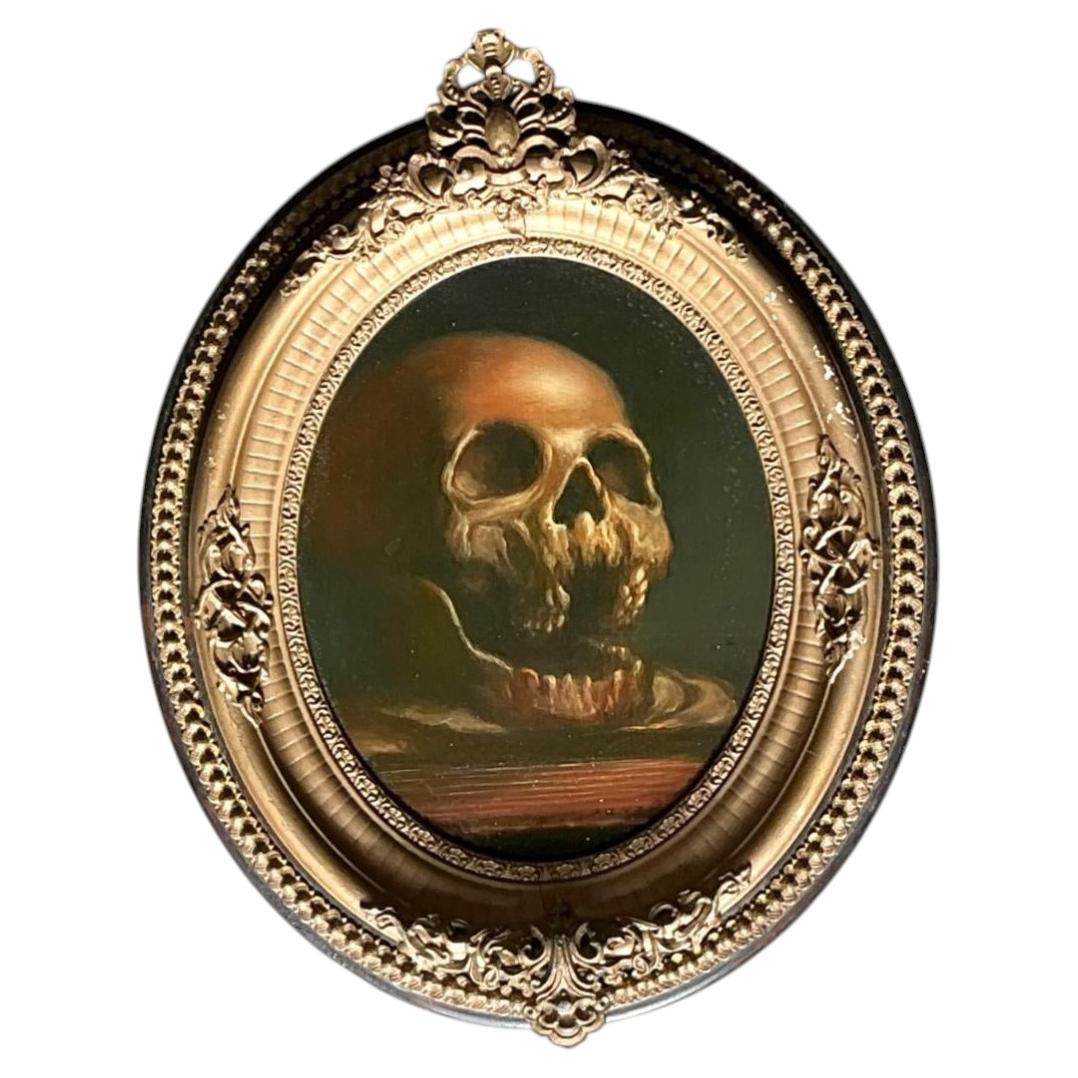
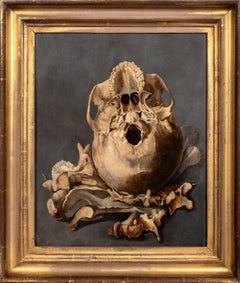
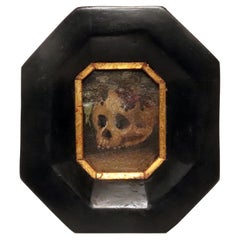
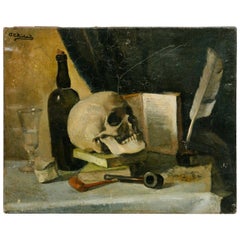
Striking in its macabre subject matter, depicting a skull surrounded by human bones, our oil on canvas belongs to the rare Symbolist corpus within Egon Kossuth’s production. The elegant hand-painted original frame reveals an enigmatic title, inscribed at the lower edge in Gothic letters against a gilded background: “Reitter [sic] oder König”, literally translatable as “Knight or King.”
Occupying the entire pictorial surface within a deliberately compressed composition, a heap of bones emerges in a golden, almost sepulchral light. At the centre, a skull with empty eye sockets invites metaphysical contemplation, surmounted by the imposing arch of ribs standing like the ruins of a collapsed structure. In the background, a lightly clouded blue-and-white sky contrasts with the monochrome browns of the earthly matter, seemingly emphasising the divide between celestial ideal and mortal decline.
The title chosen by the painter, “Reiter oder König”, like an ancient epitaph or a motto engraved upon a tomb, immediately poses a brutal and ironic question: what does it matter whether one is warrior or sovereign, a man of action, wealth or power? All are united beneath the earth, in the indistinction of flesh returning to dust.
Thus elevated as the silent judge of History, the skeleton becomes both memory and prophecy. Drawing inspiration from the old Flemish and Dutch still lifes, Egon Kossuth presents a modern vanitas imbued with the tragic and philosophical overtones of memento mori, in which the skeleton becomes no longer a simple anatomical motif but a spiritual allegory and emblem of the universal human condition.