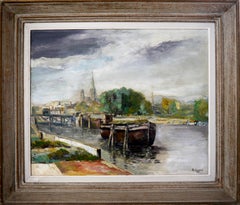
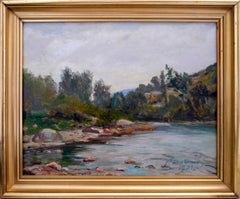
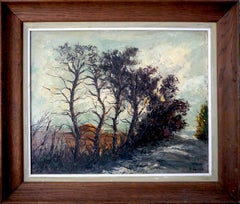
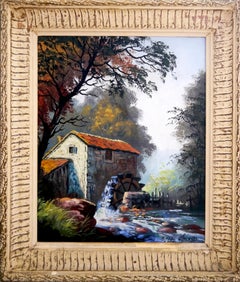
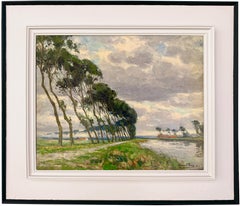
➡️ Canal Landscape with Mill⬅️
⏩It is Antoon De Vaere (1900-1989)⏪
⭐Medium:⭐ Oil on canvas
⭐Technique: ⭐Impasto painting with expressive brushwork.
⭐Size:⭐79.5x60.4cm / 31.3x23.7 inch
⭐Date: 1951⭐
⭐Condition : ⭐ Good condition. NO cracks, vivid colors.
⭐Provenance:⭐ Private collection - France.
⭐Shipping:⭐ from France is fast 4-6 days with Fedex / DHL
🟢🟢🟢🟢🟢🟢🟢🟢🟢🟢🟢🟢🟢🟢🟢🟢🟢🟢
________________________________________
☀️A Canal in Flanders, Frozen in Time☀️
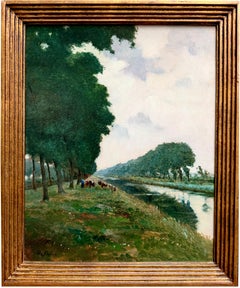
Signed in the lower left corner A. DeVaere 51, this oil on canvas was executed in 1951, during what we may consider the mature period of Antoon De Vaere's artistic life. Born in Kortrijk in 1900 and deeply rooted in the Flemish countryside, De Vaere had by this point settled in Damme, a town intimately bound to the canals, polders, and windmills of the Zwin region. This painting is, in many ways, the quintessential expression of that bond — a deeply personal, quietly meditative vision of the Flemish landscape he had chosen as his lifelong subject matter.
________________________________________
☀️Subject and Composition☀️
The painting depicts a Flemish canal stretching diagonally from the foreground toward a luminous vanishing point deep in the middle distance. This compositional device, the canal as a corridor of perspective, is a classical one in Northern European landscape painting, echoing the Dutch and Flemish traditions of the seventeenth century. De Vaere, however, does not deploy it with the geometrical rigidity of a topographic study. Instead, the canal curves gently, breathes, and dissolves into an atmospheric haze that blurs the boundary between water, land, and sky.
On the left bank, a row of tall, slender trees, likely poplars, so characteristic of the Flemish and Walloon countryside, rises vertically, their trunks dark and assertive against a muted sky. These trees serve a dual structural function: they frame the left edge of the composition with a near-architectural solidity, and they create a rhythmic vertical counterpoint to the horizontal pull of the canal and the diagonal recession of the towpath below them. A narrow dirt path runs alongside the water on the left, reinforcing the sense of depth and suggesting the quiet passage of human or animal traffic through this landscape, though no figure appears. The scene is unpopulated, and deliberately so.
On the right bank, the vegetation is denser, more chaotic, a tangle of bushes, grasses, and shorter trees that spill toward the water's edge. A low farmhouse or mill building with a red-tiled roof peeks through the foliage, anchoring the right side of the composition in the mundane, the inhabited. In the far distance, rising above the tree line, stands what appears to be a windmill, its silhouette barely distinguishable from the surrounding atmosphere, ghostly and vertical, almost like a memory rather than a solid object. Given De Vaere's well-documented series on Flemish windmills executed between 1949 and 1952, this inclusion is no accident. The windmill here is both a topographic detail and a symbolic presence, a monument to a disappearing rural world that De Vaere spent decades recording with the dedication of a cultural archivist.
________________________________________
☀️Palette and Light☀️
The color palette is one of subdued richness. De Vaere works predominantly in ochres, olive greens, muted browns, and smoky grays, punctuated by flashes of brighter yellow-green in the sunlit canopy on the right and the occasional warm amber among the autumn-tinted foliage on the left. The sky is a diffuse, pearly gray-blue, with soft cumulus clouds that neither threaten nor fully illuminate, they simply exist, providing a cool, diffused northern light that falls evenly across the scene.
This quality of light is crucial. It is not the dramatic chiaroscuro of the Baroque tradition, nor the vibrant, fractured light of the Impressionists. It is something quieter, the flat, moist, gentle luminosity of a Flemish autumn morning, the kind of light that makes edges soft, reflections tentative, and colors slightly melancholic. The water of the canal reflects the sky with a steely, greenish calm. There is no wind implied, no movement. The surface of the canal is almost perfectly still, and this stillness pervades the entire canvas.
________________________________________
☀️Technique and Brushwork☀️
De Vaere's handling of paint is assured and controlled, but not academic in a rigid sense. His brushwork is gestural enough to suggest texture, the rough bark of the poplar trunks, the unruly vegetation of the right bank, the soft turbulence of clouds, without ever becoming expressionistic or dissolving into abstraction. He belongs firmly in the post-impressionist tradition, absorbing the lessons of broken brushstroke and plein-air observation without abandoning the structural coherence and tonal sobriety that characterize the Flemish figurative school.
The trees on the left are painted with particular attention: their vertical forms are built up with layered strokes of dark umber, greenish gray, and occasional warm highlights, creating a sense of depth within the grove. The reflections in the canal are handled loosely, with horizontal dabs of color that suggest rather than describe, a technique reminiscent of the quieter moments in Sisley or Pissarro.
________________________________________
☀️Mood, Meaning, and the Flemish Soul ☀️
What strikes the viewer most powerfully is the mood, a mood of profound, undemonstrative melancholy. This is not a dramatic landscape; it does not seek to impress or overwhelm. It is, rather, a landscape that invites contemplation. The absence of human figures, the receding canal, the windmill vanishing into haze, the autumnal palette, all of these elements conspire to create a meditation on transience, on the slow passage of time in a rural world increasingly threatened by modernity.
For De Vaere, who had lived through two world wars, who had lost his brother André to the First World War, and who dedicated much of his artistic life to documenting the mills, canals, and villages of a Flanders that was quietly disappearing, this landscape carries biographical weight. It is the work of a man who understood that painting was a form of preservation, that to render a canal, a poplar, a windmill in oil on canvas was to save them, in some small way, from oblivion.
The year 1951 places this canvas in a period of post-war reconstruction and cultural reaffirmation in Belgium. De Vaere's choice to return, again and again, to these timeless Flemish scenes is itself a cultural and almost political gesture, an assertion of continuity, of rootedness, of identity against the upheavals of the century.