Want more images or videos?
Request additional images or videos from the seller
1 of 14

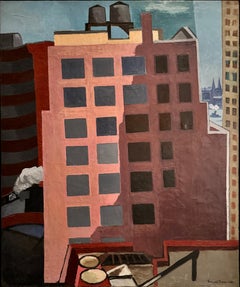
Harold Haydon
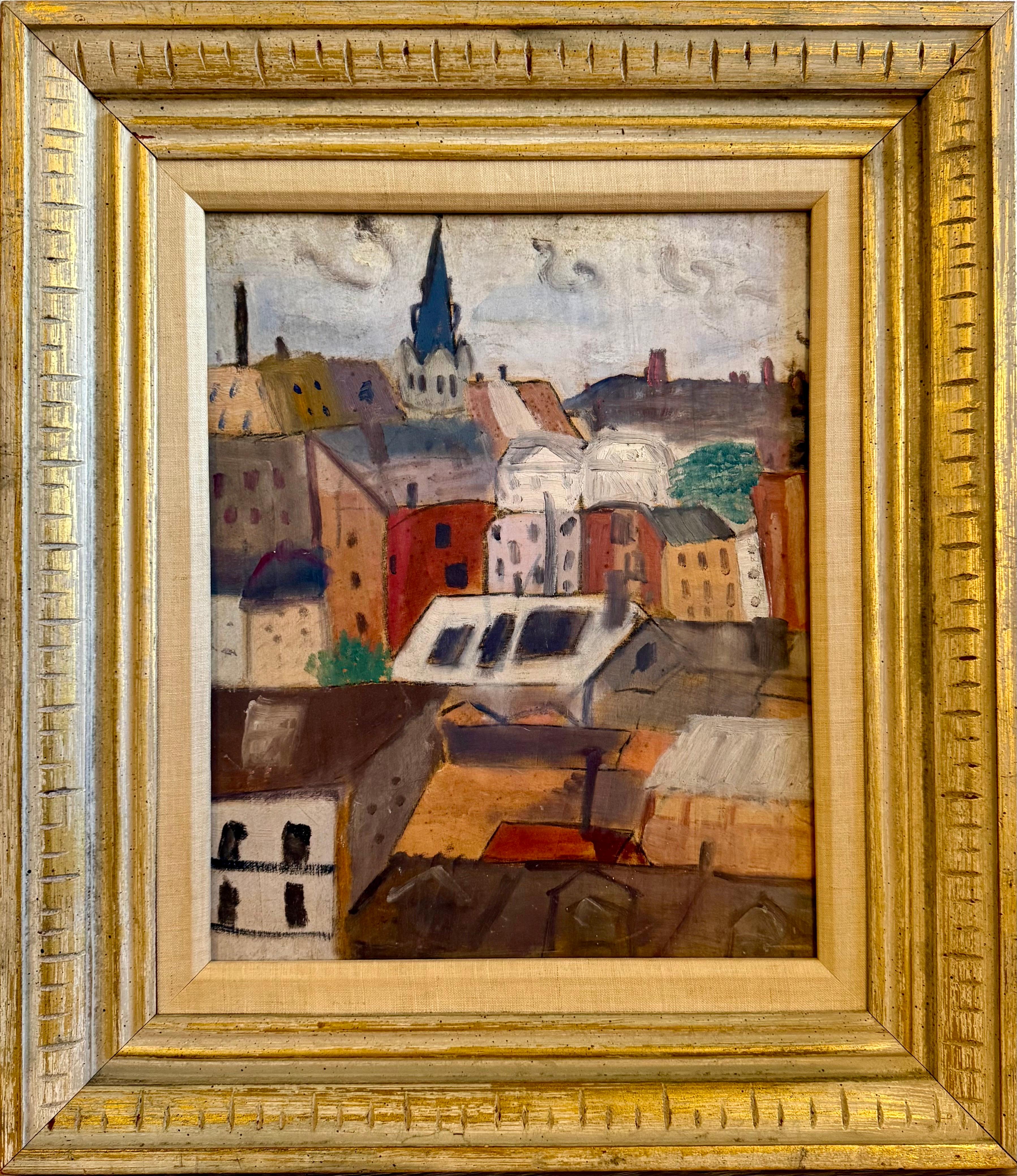
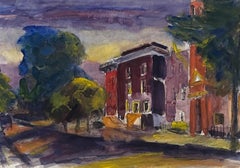
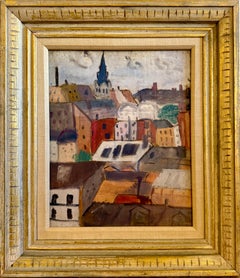
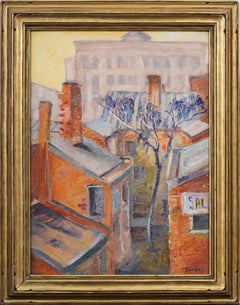
A Charming 1930s Modern City Rooftop Painting, Hyde Park, Chicago

circa 1930

$1,100
£831.41
€972.49
CA$1,561.91
A$1,589
CHF 913.06
MX$19,107.88
NOK 10,659.86
SEK 10,723.67
DKK 7,269.89

About the Item

A Charming 1930s City Rooftop Scene by Notable Chicago Modern Artist, Harold Haydon (Am. 1909-1994). Depicting a colorful, early springtime view likely painted from the artist's studio window in Hyde Park, Chicago. A diminutive and gem-like example of Haydon's early Modern Urban Realism painting from the 1930s, and a wonderful addition to any collection! Artwork size: 11 x 9 1/2 inches, oil on Masonite (Framed size: 12 1/2 x 14 inches). Accompanied with a handsome silver toned Modernist frame. Estate stamped on reverse. Provenance: Estate of the artist. Harold Emerson Haydon was born in 1909 in Fort William, Ontario, Canada. He moved to Chicago with his family in 1917 and became a naturalized U.S. citizen in 1941. Haydon attended the University of Chicago Lab School and the University of Chicago, where he earned a Bachelor’s Degree and Master’s Degree in Philosophy. He also studied at the Art Institute of Chicago in the early 1930s. Haydon became a Professor of Art at the University of Chicago from 1944-1975 and later taught as an instructor at the School of the Art Institute of Chicago from 1975-1981. From 1975-1982, Haydon also taught as an Adjunct Professor of Fine Arts at Indiana University. He is recognized for his vibrant, painterly landscapes of New England, Vermont and Canada, as well as his dynamic urban views of the city of Chicago and its picturesque lakefront. Harold Haydon served as the longtime, respected art critic of the Chicago Sun-Times newspaper from 1963-1985. He died in Chicago in 1994.
  • Creator:
    Harold Haydon (1909 - 1994, American)
  • Creation Year:
    circa 1930
  • Dimensions:
    Height: 12.5 in (31.75 cm)Width: 14 in (35.56 cm)Depth: 1 in (2.54 cm)
  • Medium:
  • Movement & Style:
  • Period:
  • Condition:
    Very good/ fine condition. See photos.
  • Gallery Location:
    Chicago, IL
  • Reference Number:
    Seller: #85841stDibs: LU2591218106012

More From This Seller

View All
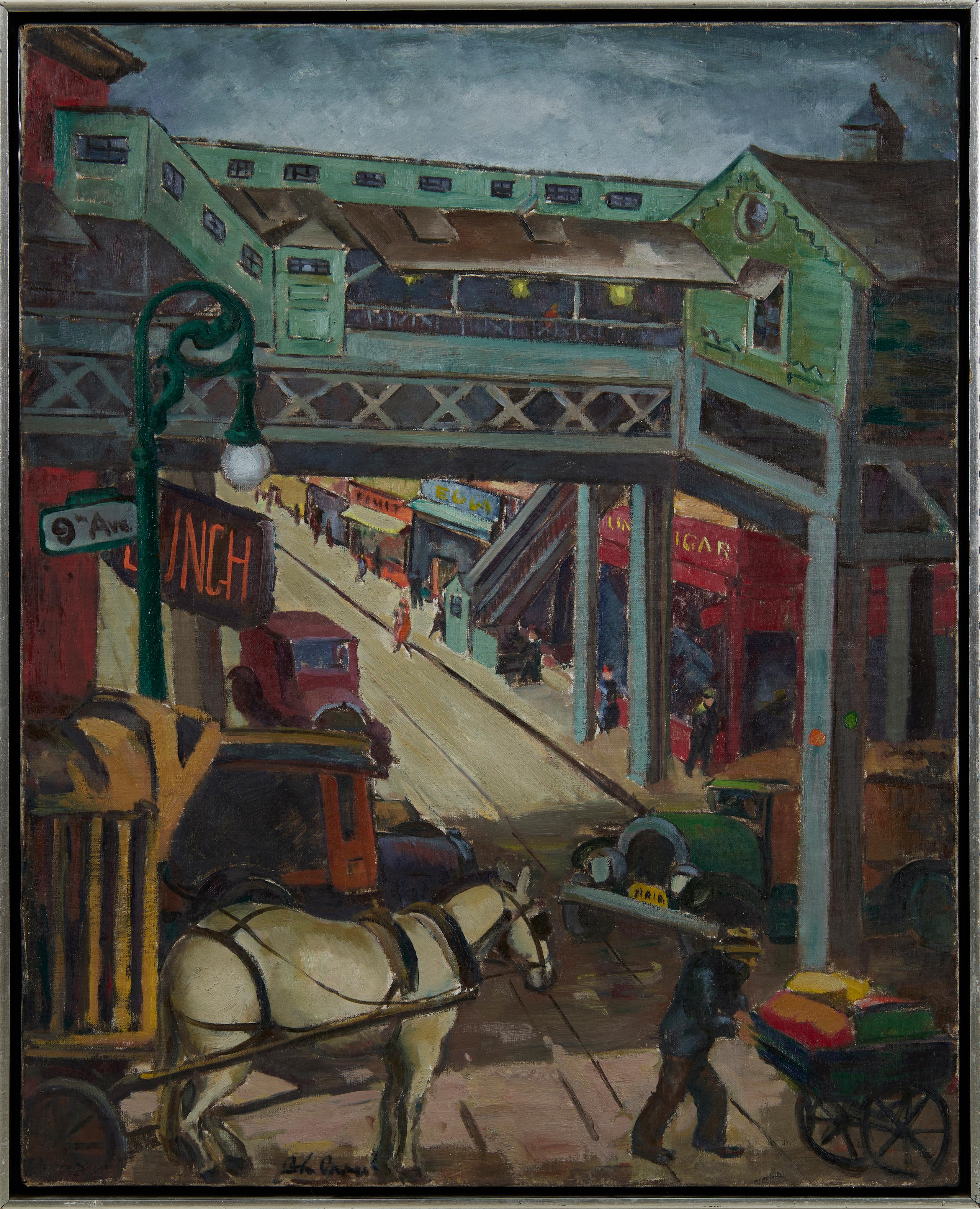
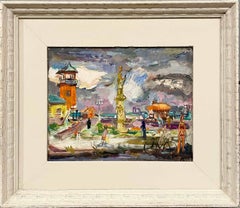
Fabulous 1950 Painting, "47th & Woodlawn Ave in Chicago, ILL" by EC Nieman

Fabulous 1950 Painting, "47th & Woodlawn Ave in Chicago, ILL" by EC Nieman

Located in Chicago, IL

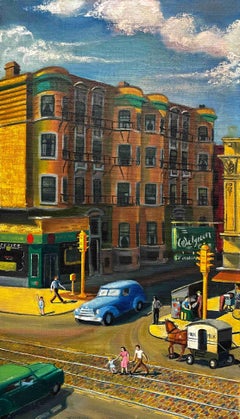
Make it yours! A large fabulous Urban Modern painting titled "47th & Woodlawn Ave in Chicago, ILL" by EC Nieman and dated 1950. Depicts a Walgreen's Drug Store, a horse pulling a m...

Category

1950s American Modern Landscape Paintings

Materials

Canvas, Oil

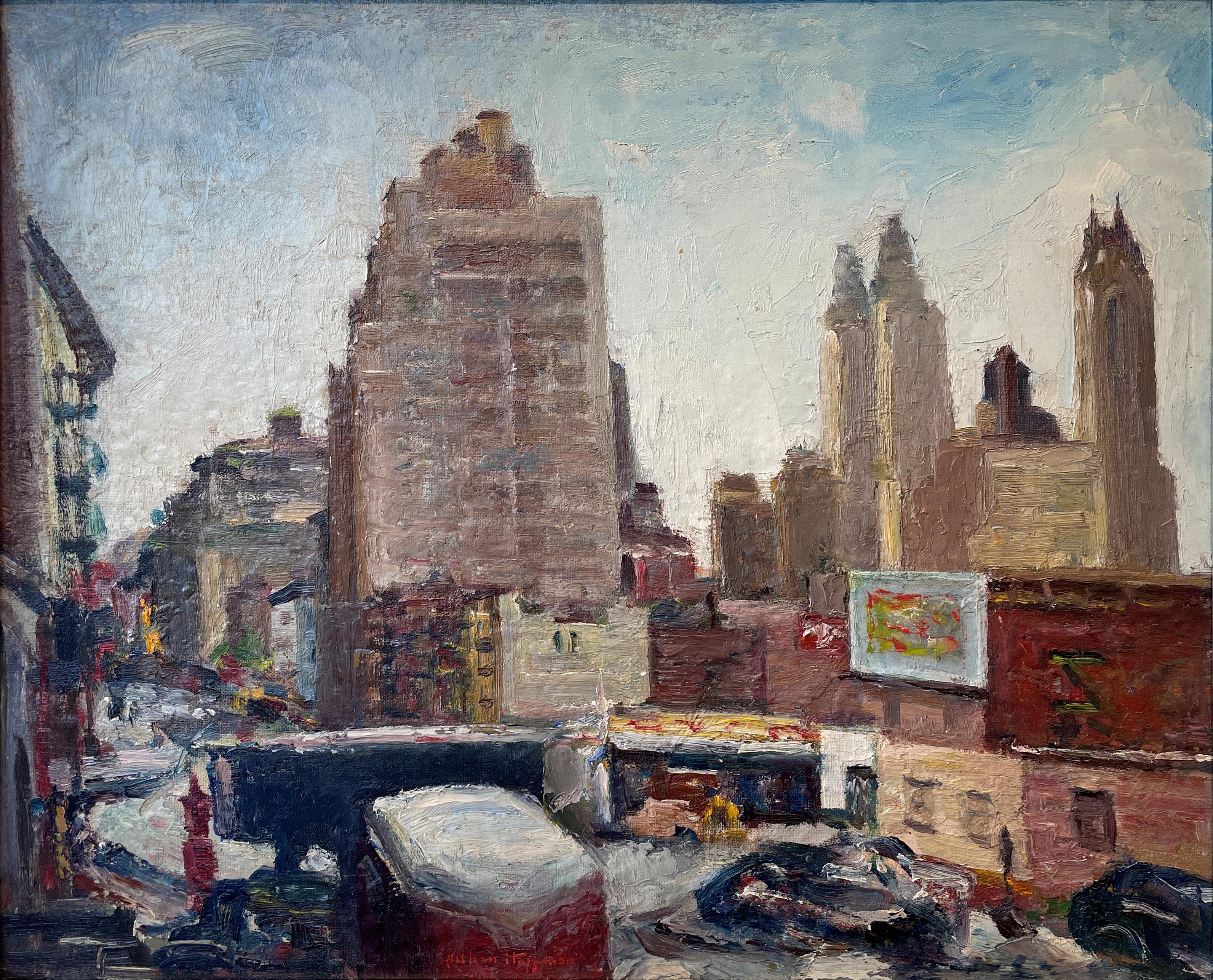
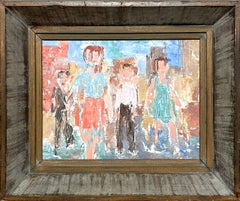
A Unique, Surrealist 1960s Mid-Century Modern Chicago City Scene with Figures

A Unique, Surrealist 1960s Mid-Century Modern Chicago City Scene with Figures

By Harold Haydon

Located in Chicago, IL

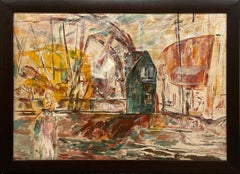
A Unique, Lively 1960s Surrealist Mid-Century Modern Abstract City Scene by Notable Chicago Artist, Harold Haydon (Am. 1909-1994). Titled "City Street with Figures", Depicting an ab...

Category

Mid-20th Century Surrealist Figurative Paintings

Materials

Masonite, Oil

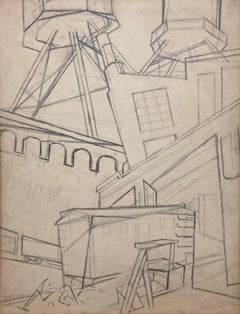
A Bold 1940s Cubist Mural Study of a Chicago City Scene by Rudolph Weisenborn

A Bold 1940s Cubist Mural Study of a Chicago City Scene by Rudolph Weisenborn

By Rudolph Weisenborn

Located in Chicago, IL

A bold 1940s graphite on paper WPA era mural study of a Chicago city scene by Rudolph Weisenborn. Artwork size: 12 1/2 x 9 1/4 inches. Archivally matted to 18 x 16 inches, Provenance: Estate of the artist. Rudolph Weisenborn was born in Strassburg, Germany in 1881, but was orphaned at the age of nine. He was taken-in by Mid-Western farmer Thomas Westaby and spent his early years in Wisconsin, Iowa and North Dakota. Weisenborn first attended the University of North Dakota in 1898, then the Students School of Art in Denver. Various accounts have him working out west as a gold miner and cowboy. Around 1912, he settled in Chicago and worked as a window designer for Marshall Field’s. Weisenborn is best known as the founder of the Chicago No-Jury Society of Artists. The group was founded because many artists could not get their work accepted into the mainstream Art Institute shows. Weisenborn is quoted as saying that he harbored feelings of disdain for any jury and that his own paintings were frequently rejected by conservative jurors. He was also involved and helped found other radical artist’s groups such as the Salon des Refuses, Cor Ardens and Neo-Arlimusic. In 1936, he helped found the New York-based American Abstract Artist’s Group. He created the only abstract mural for the 1933 Century of Progress Exhibition in Chicago and also worked for the Federal Arts Project in the Easel Division. His WPA murals can be found in Crane Technical High School and Nettlehorst Elementary School in Chicago, IL. In 1945, Chicago businessman Herman Spertus...

Category

1940s American Modern Landscape Drawings and Watercolors

Materials

Paper, Graphite

You May Also Like

1930's Modernist Oil Painting Paris Rooftops Hazel Guggenheim Mckinley Fauvist

1930's Modernist Oil Painting Paris Rooftops Hazel Guggenheim Mckinley Fauvist

By Hazel Guggenheim McKinley

Located in Surfside, FL

Hazel Guggenheim King-Farlow McKinley (American, London, New Orleans, 1903-1995), "Paris Rooftops" c. 1930 Oil paint on wood panel Attributed, dated and titled verso (I am not sure in whose hand not signed by the artist herself). Dimensions H.- 18 in., W.- 15 in., Framed- H.- 26 1/2 in., W.- 23 in. Provenance: From an estate New Orleans, Louisiana. Hazel Guggenheim King-Farlow McKinley (born Barbara Hazel Guggenheim; April 30, 1903 – June 10, 1995) was an American painter, art collector, and art benefactor. Hazel Guggenheim was born in New York City to Benjamin Guggenheim and Fleurette (Seligman) Guggenheim. The marriage united two wealthy German-Jewish families. Born into the well-known Guggenheim family, a niece of Solomon Guggenheim who founded the Guggenheim Museum, she grew up in New York, alongside her sisters Benita Guggenheim and Marguerite Peggy Guggenheim who would become the influential gallery proprietor, art collector, museum founder, and midwife to the Abstract Expressionism art movement. Her father Benjamin gave up much of his financial interest in the family's mining business to start his own business in Paris. With his business failing, in 1912 he set out to return to the United States in time for McKinley's ninth birthday on the Titanic. Following the shipwreck, he drowned aged 46; his body was not recovered. McKinley inherited $450,000. She later inherited money on the deaths of her mother, and of her older sister, Benita, who died in childbirth. The loss of her father haunted McKinley for the rest of her life, and in 1969 she recorded "In Memoriam, Titanic Lifeboat Blues." McKinley began painting as a teenager and was a prolific artist throughout her life. When she fled New York for Paris at age 19 she studied at the Sorbonne and became part of 1920's bohemian Paris, France, where she was taught by key modernism artists of the time. Her primary mediums were ink, water color, tempera, and crayon. Some of her work is hand signed and some is not. In 1928 her sister Peggy moved to London and mar­ried the British writer John Holmes. In 1931, McKinley married the Englishman Denys King-Farlow. They settled in Sussex, UK, and had two children, John King-Farlow, who became a philosopher and poet, and Barbara Benita King-Farlow, who became an artist in her own right. In 1938 Peggy opened Guggenheim Jeune, a London gallery of mod­ern art, starring Wassily Kandinsky, Henry Moore, Salvador dali, Constantin Brancusi, Max Ernst, Pablo Pic­asso and Jean Miro with whom they socialized. Whilst living in the south of England with Denys King-Farlow in the 1930s, McKinley was influenced by a group of avant-garde artists, and had her first solo exhibition in London in April 1937 at the Coolings Gallery. She received instruction from British artists Rowland Suddaby, Raymond Coxon, and Edna Ginesi, becoming associated with the London Group and the Euston Road School. She painted primarily in watercolor. Her work included still-life, portraits, townscapes and landscapes. Although her first work was done in a "slightly plain palette," her later work in the 1930s brightened, sometimes falling within the realm of fauvism. "Under the influence of the Surrealist artists, Hazel's paintings after the 1930's became freer, though her work was far more whimsical and humorous than many artists more closely associated with the surrealism movement." In 1939 McKinley fled Europe due to the impending war and returned to the US, living mostly in California. She took brief art lessons from her sister Peggy's one-time husband Max Ernst and much later attended several summer schools taught by muralist and renowned teacher Xavier Gonzalez. In her life in the United States and abroad, McKinley met many prominent artists of the Paris, London, and New York art scenes including Jackson Pollock. McKinley continued to paint, and ran a small gallery of her own in the late 1950s and early 1960s in West Cornwall, Connecticut. One show at her gallery featured the works of British and Irish painters including Rowland Suddaby, Frank Beteson, Tom Nisbett, and Patrick Swift. McKinley showed two of her own works in the same exhibit, a watercolor painted at Positano, Italy and one painted at the Tuileries, Paris. Another featured work was a surrealistic water color portrait of McKinley by London artist Mervyn Peake. McKinley exhibited her work both in Europe and the United States throughout her long career, mostly at smaller venues. An incomplete listing of her exhibits and museum acquisitions of her work include: Berkshire Museum, the Galerie Raymond Duncan in Paris, Stendahl Galleries, the Jake Zeitlin Gallery, the Montgomery Museum of Fine Art, the Artists' Own Gallery in London, the Manchester City Art Gallery, and Santa Fe Art Museum. McKinley's work was only once included in a show by her sister Peggy. In 1943 McKinley was selected to exhibit a painting in Peggy's infamous show Exhibition by 31 Women in her New York gallery Art of This Century. The exhibition was radical at the time for being one of the first all-woman exhibitions, as well as showing only abstract or Surrealist works. The Exhibition by 31 Women was conceived by Peggy Guggenheim in collaboration with Marcel Duchamp, who is usually credited with suggesting the idea. The participating artists were selected by a jury that included André Breton, Max Ernst Duchamp, and Guggenheim. Advice was sought from Alfred H. Barr Jr., first director of the Museum of Modern Art in New York, who provided Guggenheim with five names, of which three were included in the exhibition, Suzy Frelinghuysen, Irene Rice Pereira, and Esphyr Slobodkina. Those already known to Guggenheim through their partners included Xenia Cage, wife of the composer John Cage, Frida Kahlo, wife of Diego Rivera, who was noted for his frescoes, Sophie Taeuber-Arp, wife of the sculptor, Hans Jean Arp, and Jacqueline Lamba, ex-wife of the surrealist André Breton. Guggenheim’s sister, Hazel Guggenheim McKinley and her daughter, Pegeen Vail Guggenheim exhibited. Also in the exhibition was the burlesque dancer, Gypsy Rose Lee, another friend of Guggenheim, who was possibly included more to help publicise the event than for her artistic skills. Other artists were friends of Guggenheim or of Max Ernst. One, Dorothea Tanning, was Ernst's lover, leading Guggenheim to say: "I realized that I should have only had thirty women in the show". Only one artist is known to have refused the invitation to submit works, Georgia O'Keeffe, who reportedly responded that she wished to be identified as a painter, and not singled out because of her gender. In the late 1950s, McKinley moved back to Europe for a while, before returning to the United States in 1969. She lived in New Orleans until her death in 1995. On her death, her only living son, John King-Farlow, wrote a poem in his mother's honor, entitled "Eulogy For My Mother (Hazel Guggenheim McKinley, Artist)." A short obituary distributed by the Associated Press noted she was a member of the illustrious New York Guggenheim family, that she was determined to make a name for herself as an artist, that her art works were shown in museums in the United States and Europe, and were in the collections of such celebrities as Greer Garson, Benny Goodman, and Jason Robards. In 1998 after her death, one of her paintings was exhibited in Peggy Guggenheim's Venice home museum the Palazzo Venier dei Leoni. Guggenheim’s work in various media and her connections to influential artists and collectors provide glimpses into the complex tapestry of the art world in the first half of the 20th century. In her later life she settled in New Orleans, where she continued painting, exhibiting, and studying art into her eighties at Newcomb College, New Orleans. She was part of a regional art scene that included Ida Kohlmeyer, George Rodrigue, Noel Rockmore and Hunt Slonem. Towards the end of her life while confined to bed, her last works were colored pen drawings and sketches. McKinley collected major contemporary artworks and she donated many of these works to public institutions. She donated over 15 works to Wakefield Art Gallery, UK, in the 1930s, and in 1938 presented the painting Cossacks...

Category

1930s Modern Figurative Paintings
Materials

Oil, Panel

Roof Top, Oil Painting by Ben Benn

Roof Top, Oil Painting by Ben Benn

By Ben Benn

Located in Long Island City, NY

Artist: Ben Benn, Polish/American (1884 - 1983) Title: Roof Top Year: circa 1920 Medium: Oil on Canvas, signed l.r. Size: 24 x 18 in. (60.96 x 45.72 cm) Frame Size: 33.5 x 27.5 inche...

Category

1920s American Modern Landscape Paintings

Materials

Oil

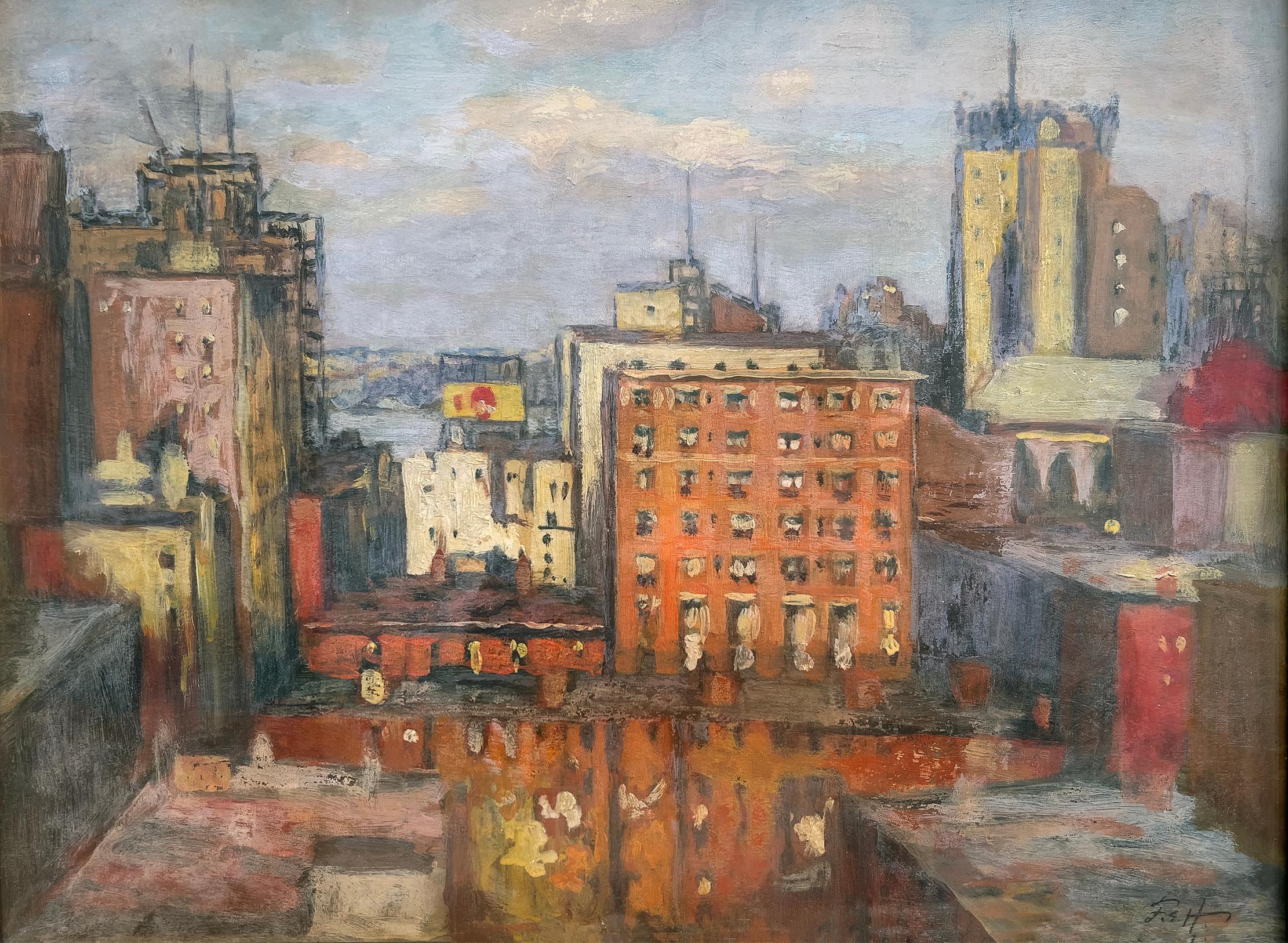
NYC Cityscape American Scene WPA Modern Realism Mid 20th Century Architectural

NYC Cityscape American Scene WPA Modern Realism Mid 20th Century Architectural

By Ernest Fiene

Located in New York, NY

NYC Cityscape American Scene WPA Modern Realism Mid 20th Century Architectural Ernest Fiene (1894-1965) Cityscape 36 x 30 inches Oil on canvas Signed and dated 1930. lower right Provenance Estate of the artist. ACA Galleries, New York Exhibited New York, Frank Rehn Gallery, Changing Old New York, 1931. New York, ACA Galleries, Ernest Fiene: Art of the City, 1925-1955, May 2-23, 1981, n.p., no. 5. BIO Ernest Fiene was born in Elberfeld, Germany in 1894. As a teenager, Fiene immigrated to the United States in 1912. He studied art at the National Academy of Design in New York City from 1914 to 1918, taking day classes with Thomas Maynard and evening classes with Leon Kroll. Fiene continued his studies at the Beaux-Arts Institute of Design in New York from 1916 to 1918, adding classes in printmaking at the Art Students League in 1923. Fiene began his career as an artist in 1919 with his first exhibition of watercolors at the MacDowell Club arranged by his mentor Robert Henri. In 1923 the Whitney Studio Club mounted a large exhibition of his works. The following year he had an exhibition at the New Gallery in New York, which completely sold out all fifty-two works, including paintings, watercolors, drawings, and etchings. With the proceeds of sales from the New Gallery exhibition, Ernest Fiene and his younger brother Paul, a sculptor, built studios in Woodstock, New York in 1925. In the early Twenties Ernest Fiene painted mostly landscapes of Woodstock and both the Ramapo and Hudson River Valleys. The first monograph from the Younger Artists Series was published on Fiene in 1922. Published in Woodstock, the series went on to include Alexander Brook, Peggy Bacon, and Yasuo Kuniyoshi. The book reproduced 1 illustration in color and another 27 reproductions in black and white. Around 1925 Fiene became fascinated with the intensity, excitement, and opportunities for color harmonies New York City offered as a subject. His paintings shifted to urban and industrial themes with architecture, industry, and transportation becoming his subjects. By 1926 Fiene had attracted the dealer Frank K.M. Rehn, who gave him a one-man exhibition that year, which travelled to the Boston Arts Club. C.W. Kraushaar Galleries gave Fiene a one-man exhibition of urban, landscape, portrait, and still life paintings in 1927. Julianna Force, the director of the Whitney Studio Club and first director of the Whitney Museum of American Art, included two of Fiene’s paintings in a fall exhibition in 1928. The Whitney Studio Club showed Fiene’s paintings in a two-man exhibition with Glenn O. Coleman that year and acquired three of Fiene’s paintings. Also in 1928 Fiene became affiliated with Edith Halpert’s Downtown Gallery where he had an exhibition of 20 lithographs in the spring. Fiene sold his house in Woodstock in 1928 to spend more of his time in New York City. With so many successful exhibitions, Fiene returned to Paris in 1928-29 where he rented Jules Pascin's studio and studied at the Académie de la Grande Chaumière. In France, Fiene painted both landscape and urban subjects developed from ideas influenced by Cubist geometry and the use of flat areas of broad color. Upon returning to New York in 1930, Fiene used this new approach to continue to paint New York skyscraper and waterfront subjects, as well as to begin a series of paintings on changing old New York based on the excavations for Radio City Music Hall and the construction of the Empire State Building. Frank K.M. Rehn Galleries exhibited this series, titled “Changing Old New York,” in 1931. Fiene also has solo exhibitions at Rehn Galleries in 1930 and 1932. Fiene’s oil paintings are exhibited at the Chicago Arts Club in 1930 as well. Fiene was included in the Museum of Modern Art’s exhibition Painting and Sculpture by Living Americans in December of 1931. Visiting New York, Henri Matisse saw the exhibition and called Fiene’s Razing Buildings, West 49th Street the finest painting he had seen in New York. Fiene had two mural studies from his Mechanical Progress series exhibited at the Museum of Modern Art’s exhibition Murals by American Painters and Photographers in 1932. Fiene sent View from my Window which depicts Fiene working on a lithograph stone while looking out his window to the newly completed Empire State Building to the Carnegie International in 1931. In 1932 Fiene participated in the first Biennial of American Painting at the Whitney Museum and his prints were included in exhibitions at the Downtown Gallery and the Wehye Gallery. In the same year, Fiene was awarded a Guggenheim fellowship to further study mural painting in Florence, Italy. On his return from Italy in 1933 Fiene re-engaged himself in New York City life and won several public and private mural projects. Fiene resumed his active exhibition schedule, participating in two group exhibitions at the Whitney Museum and a one-man exhibition of recent paintings at the Downtown Gallery in January 1934. In 1933 he purchased a farm in Southbury, Connecticut, which added Connecticut scenes to his landscape subjects. This was also the year Fiene began to spend summers on Monhegan Island, Maine, where he painted seascapes, harbor scenes, and still lifes. Fiene’s landscape paintings attracted numerous commissions as part of the American Scene movement. Through the fall and winter of 1935-36, Fiene took an extended sketching trip through the urban, industrial, and farming areas of Pennsylvania and West Virginia. Most of the twenty-four Pennsylvania urban and rural paintings...

Category

1930s American Modern Landscape Paintings

Materials

Canvas, Oil