Want more images or videos?
Request additional images or videos from the seller
1 of 11

Irene Awret
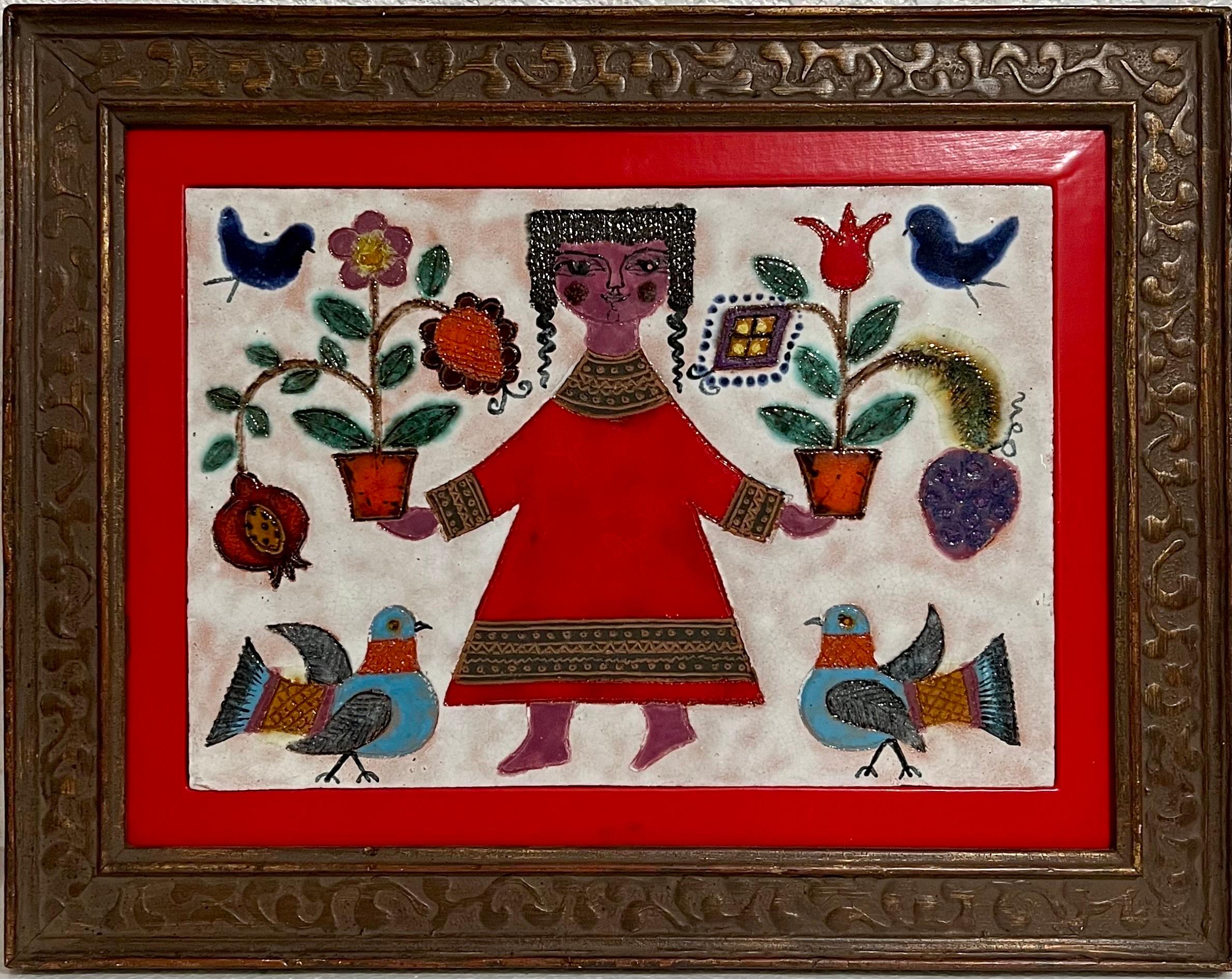
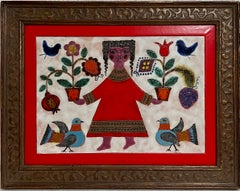
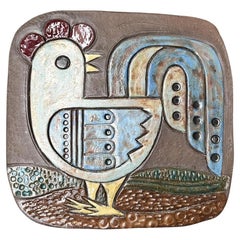
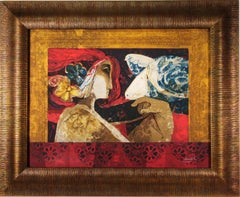
Girl & Rooster Enamel Glazed Ceramic Plaque Israeli Artist Awret Naive Folk Art

$1,200
£905.53
€1,053.81
CA$1,694.08
A$1,700
CHF 991.46
MX$20,669.93
NOK 11,392.87
SEK 11,716.98
DKK 7,877.79

About the Item

This is a rare ceramic plaque painted with enamel glaze by famed Israeli German artist Irene Awret is signed Awret Safed on the verso. the actual glazed ceramic is 10X15 inches. Irène Awret was born to a Jewish family in Berlin called Spicker, the youngest of three children. Her mother died in 1927, when Irène was six years old. In 1937 she was forced to stop high school, due to the Nazi race laws. Because she could not continue her regular studies, her father sent her to study drawing, painting and art restoration with a Jewish painter. Among his students were a large number of German Jews who knew they would have to leave Germany within a short time and would require a profession to enable them to support themselves. When the situation grew worse, following the Kristallnacht (the first major attack on German and Austrian Jews in November 1938), her uncle decided to move to Belgium. In 1939 the situation became even worse - her father was fired from his job and the family were forced to leave their home. As a result, Awret's father tried to send her and her sister to Belgium, with the help of smugglers. The first smuggler proved to be a double agent and they were sent back from Aachen to Berlin. Two weeks later they made a second, successful, attempt to sneak across the border. Awret worked for a Dutch Jewish family as a maid. As she had her room and board there, she was able to save enough money to study art part-time at Brussels' Académie Royal des Beaux-Arts. A few months later Awret's father joined her and her financial situation became easier. She left her job and studied full-time, helping support herself with restoration work when it was available and by painting portraits to order. Later, Awret found a hiding place on a farm in Waterloo with a Jewish family who were connected with the underground. In January 1943 she had to return to Brussels, living with a false identity card which stated she was a married woman with two children. Awret succeeded in renting an attic without informing the police where she was - she told her landlady that she had been forced to flee her husband because he beat her. While there, she supported herself by restoring wooden sculptures. A Jewish informer gave her up to the Gestapo, accompanying the two Gestapo men who arrested her. Awret was able to take a bag containing food and drawing materials. She was detained in the Gestapo cellars in Brussels where she drew. Because there was nothing there to draw, she sketched her own hand (view this work). Awret was interrogated in order to reveal the hiding place of her father who was still in Brussels. The National Socialist regime was determined to persecute him, even though he had fought for Germany in World War I and been permanently disabled. They stepped up their torture and brought Awret before Hartmann, the head of the Gestapo in Brussels. When Hartmann saw her block of drawings, he asked her where she had studied art and halted the interrogation. Awret was placed in a narrow cell and then transferred to Malines camp, which the Belgian's called Mechelen. Malines was a transit camp to Auschwitz, regularly sending 2000 people at a time. Although she arrived just before Transport No. 20, Irène Awret avoided being included. Instead she was put to work in the leather workshop, decorating broaches. While she was there, Hartmann visited the camp and spotted her: "I could have discovered where your father is hiding," he told her. When her artistic talents became known, she was transferred to the Mahlerstube (artist's workshop) where she worked producing graphics for the Germans until the end of the war. When Carol (Karel) Deutsch (whose works are now on view at Yad Vashem) was sent from Mechelen to his death with his wife, he left young Irene his paintbox. Irene also recalls seeing the great painter Felix Nussbaum and his wife being pushed into a boxcar bound for the gas, and tells of the aftermath of the famous 20th Train incident, when a young Jewish doctor armed only with a pistol and helped by two unarmed friends with a lantern ambushed one of Mechelen's Auschwitz-bound trains carrying 1,618 Jews, most of whom had fled Eastern Europe for Belgium. Awret's job enabled her to paint and draw - mainly in pencil, but also in watercolors and oils. In the artists' workshop she met a Jewish refugee from Poland - Azriel Awret - who would later become her husband. Among the other artists in the workshop were Herbert von Ledermann-Vütemberg, a sculptor from an aristocratic family with Jewish roots, Léon Landau, and Smilowitz, who perished in the camps in the East. Irène and Azriel tried to bribe a German officer to prevent Smilowitz's deportation. Not only were they unsuccessful, but they were almost put onto the same train. Jacques Ochs was another artist with whom they became friends in the camp. Ochs, a French-born Protestant who lived in Belgium, was interned as a political prisoner. He remained in Belgium after liberation. After the war the Awrets immigrated to Israel and made their home in Safed. They continued to work, and were instrumental in founding Safed's artists' quarter. The Beit Lohamei Haghetaot (Ghetto Fighters' House Museum) art collection holds works donated by Awret. These date from her time in Malines camp and from her stay in Brussels after the war, when she was in the company of orphans who had hidden while their parents were sent to Auschwitz. Her highly expressive works have made their way to exhibitions at theTel Aviv Museum, the Haifa Museum of Modern Art and the Modern Art Gallery in Washington, D.C., as well as into the private collections of such individuals as Dr. Jonas Salk, Charlie Chaplin and Joan Fontaine. She wrote an autobiography "They Will Have to Catch Me First." detailing her life during the Holocaust and how art saved her. Israel has had a Vibrant Folk Art, Naive art scene for a long time now artists like Israel Paldi, Nahum Guttman, Reuven Rubin had naive periods. The most well know of the strict naive artists are Shalom of Safed, David Sharir, Irene Awret, Gabriel Cohen, Natan Heber, Michael Falk and Kopel Gurwin.
  • Creator:
    Irene Awret (1921 - 2014, German)
  • Dimensions:
    Height: 22.5 in (57.15 cm)Width: 17.5 in (44.45 cm)
  • Medium:
  • Movement & Style:
  • Period:
  • Condition:
    wear to frame and matting. piece is in great condition.
  • Gallery Location:
    Surfside, FL
  • Reference Number:
    1stDibs: LU38216839722

More From This Seller

View All
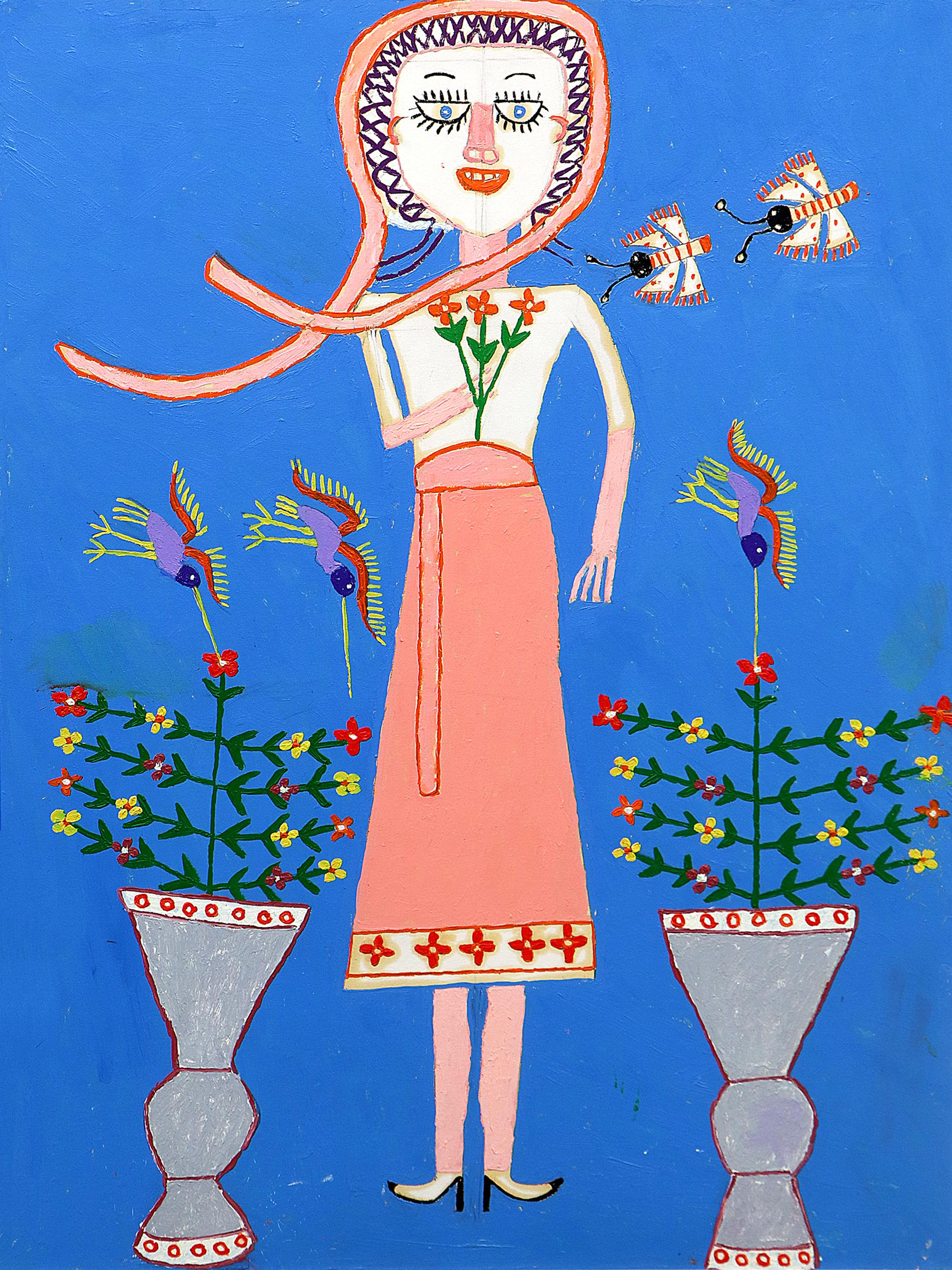
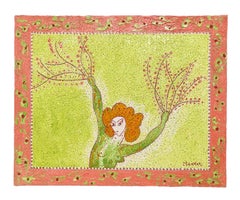
Girl & Plants Enamel Glazed Ceramic Plaque Israeli Artist Awret Naive Folk Art

Girl & Plants Enamel Glazed Ceramic Plaque Israeli Artist Awret Naive Folk Art

By Irene Awret

Located in Surfside, FL

This is a rare ceramic plaque painted with enamel glaze by famed Israeli German artist Irene Awret (these are generally hand signed Awret Safed on the verso. I just have not opened t...

Category

1950s Expressionist Figurative Paintings

Materials

Enamel

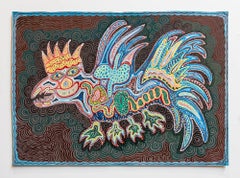
German Israeli Expressionist "Rooster" Batik Style Painting Print on Silk Fabric

German Israeli Expressionist "Rooster" Batik Style Painting Print on Silk Fabric

By Jacob Pins

Located in Surfside, FL

Jacob Otto Pins (17 January 1917 – 4 December 2005) was a German-born Israeli woodcut artist and art collector, particularly of Japanese prints and paintings. Jacob Pins was born in ...

Category

20th Century Expressionist Mixed Media

Materials

Silk, Ink

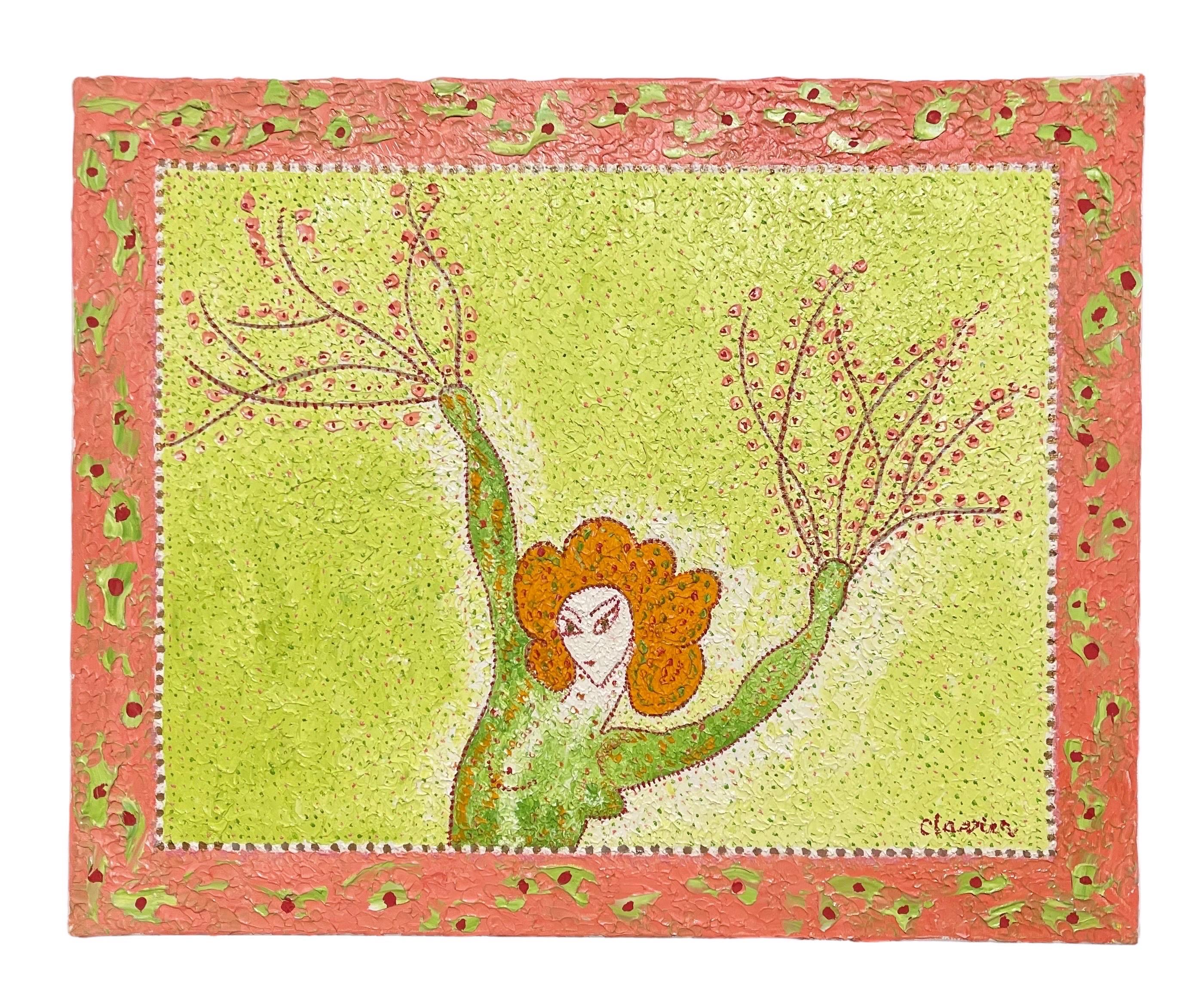
Whimsical French Folk Art, Naive, Oil Painting Madeline Marie Christine Clavier

Whimsical French Folk Art, Naive, Oil Painting Madeline Marie Christine Clavier

By Madeline Christine Clavier

Located in Surfside, FL

MADELINE CHRISTINE CLAVIER (1913-2015) Signature: Signed lower right & titled verso Medium: Oil on canvas Provenance: The collection of the artist's family Marie Christine Clavier ...

Category

20th Century Folk Art Animal Paintings

Materials

Canvas, Oil

Whimsical French Folk Art, Naive, Oil Painting  Madeline Marie Christine Clavier

Whimsical French Folk Art, Naive, Oil Painting Madeline Marie Christine Clavier

By Madeline Christine Clavier

Located in Surfside, FL

MADELINE CHRISTINE CLAVIER (1913-2015) Signature: Signed lower right & titled verso Medium: Oil on canvas Provenance: The collection of the artist's family Marie Christine Clavier was born in Saigon, Vietnam in 1913 to French parents and lived there for her formative years. She returned to France as a teenager and began to study painting. Her work quickly developed into whimsical paintings of poetry and songs – harmonized in a unique and distinct painting technique. Her work has an impasto feel and a folk art, outsider artist sensibility to it. Similar in style to Maik and other fantasy realists who use animals, flowers and foliage in their artworks. Marie Clavier painted ro herself rather than for profit as she was quite independently wealthy. She exhibited extensively in the United States in the 1970s especially across Connecticut and New York, showing at various galleries and cultural centres. She had numerous solo exhibitions in the 1970’s- notably at the Maison Francaise in New York and New York University. She showed at Galerie Bernheim Jeune in Paris. She won many awards for her work including Gold Medals and Palme D’Or medals. In 1988 the prestigious art publisher Leopard D’Or produced catalogue book on her life and work – by this point she had virtually given up painting. She died in 2015 aged 102. Bernheim-Jeune gallery is one of the oldest art galleries in Paris. Opened on Rue Laffitte in 1863 by Alexandre Bernheim (1839-1915), friend of Delacroix, Corot and Courbet, it changed location a few times before settling on Avenue Matignon. The gallery promoted realists, Barbizon school paintings and, in 1874, the first impressionist and later post-impressionist painters. It closed in 2019. In 1901, Alexandre Bernheim, with his sons, Josse (1870-1941), and Gaston (1870-1953), organized the first important exhibition of Vincent van Gogh paintings in Paris with the help of art critic Julien Leclercq. In 1906, Bernheim-Jeune frères started presenting works by Pierre Bonnard, Edouard Vuillard, Paul Cezanne, Henri-Edmond Cross, Kees van Dongen, Henri Matisse, Le Douanier Rousseau, Raoul Dufy, Maurice de Vlaminck, Amedeo Modigliani, Maurice Utrillo and Georges Dufrenoy. From 1906 to 1925, art critic Félix Fénéon was the director of the gallery and was instrumental in bringing in the art of Georges Seurat and Umberto Boccioni. In 1922, an exhibition brought together works by Alice Halicka, Auguste Herbin, Pierre Hodé, Moise Kisling, Marie Laurencin, Henri Lebasque, Fernand Leger and Henri Matisse. The gallery now exhibits painters and sculptors in the tradition of the École de Paris and artists such as Jean Carzou, Shelomo Selinger or Pollès. Her style is a recognizable, cheerful, whimsical and a happy creation. Naïve art is any form of visual art that is created by a person who lacks the formal education and training that a professional artist undergoes (in anatomy, art history, technique, perspective, ways of seeing). Unlike folk art, naïve art does not necessarily evince a distinct cultural context or tradition. Naïve art is recognized, and often imitated, for its childlike simplicity and frankness. Paintings of this kind typically have a flat rendering style with a rudimentary expression of perspective. One particularly influential painter of "naïve art" was Henri Rousseau (1844–1910), a French Post-Impressionist who was discovered by Pablo Picasso. Naïve art is often seen as outsider art that is by someone without formal (or little) training or degree. While this was true before the twentieth century, there are now academies for naïve art. Naïve art is now a fully recognized art genre, represented in art galleries worldwide. Museums devoted to naïve art now exist in Kecskemét, Hungary; Riga, Latvia; Jaen, Spain; Rio de Janeiro, Brasil; Vicq France and Paris. Another term related to (but not completely synonymous with) naïve art is folk art. There also exist the terms "naïvism" and "primitivism" which are usually applied to professional painters working in the style of naïve art (like Paul Gauguin, Mikhail Larionov, Paul Klee). At all events, naive art can be regarded as having occupied an "official" position in the annals of twentieth-century art since - at the very latest - the publication of the Der Blaue Reiter, an almanac in 1912. Wassily Kandinsky and Franz Marc, who brought out the almanac, presented 6 reproductions of paintings by le Douanier' Rousseau (Henri Rousseau), comparing them with other pictorial examples. However, most experts agree that the year that naive art was "discovered" was 1885, when the painter Paul Signac became aware of the talents of Henri Rousseau and set about organizing exhibitions of his work in a number of prestigious galleries. The Earth Group (Grupa Zemlja) were Croatian artists, architects and intellectuals active in Zagreb from 1929 to 1935. The group included the painters Krsto Hegedušić, Edo Kovačević, Omer Mujadžić, Kamilo Ružička, Ivan Tabaković, and Oton Postružnik, the sculptors Antun Augustinčić, Frano Kršinić, and the architect Drago Ibler. A term applied to Yugoslav (Croatian) naive painters working in or around the village of Hlebine, near the Hungarian border, from about 1930. Some of the best known naive artists are Dragan Gaži, Ivan Generalić, Josip Generalić, Krsto Hegedušić, Mijo Kovačić, Ivan Lacković-Croata, Franjo Mraz, Ivan Večenaj and Mirko Virius. Camille Bombois (1883–1970) Ferdinand Cheval, known as 'le facteur Cheval' (1836–1924) Henry Darger (1892–1973) L. S. Lowry (1887–1976) Grandma Moses, Anna Mary Robertson...

Category

20th Century Folk Art Animal Paintings
Materials

Canvas, Oil

Israeli Folk Art Bright Colorful Naive Dragon Painting

Israeli Folk Art Bright Colorful Naive Dragon Painting

By Menia Litvak

Located in Surfside, FL

My life as an artist started in 1976 when I left Kishinev (Bessarabia) for Israel. In my youth I did not have the opportunity to study an regularly, although I learned painting durin...

Category

20th Century Folk Art Figurative Paintings

Materials

Gouache

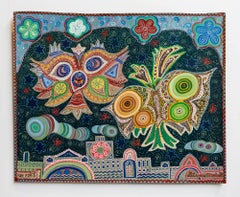
Israeli Folk Art Bright Colorful Naive Jerusalem Vibrant Landscape Painting

Israeli Folk Art Bright Colorful Naive Jerusalem Vibrant Landscape Painting

By Menia Litvak

Located in Surfside, FL

My life as an artist started in 1976 when I left Kishinev (Bessarabia) for Israel. In my youth I did not have the opportunity to study an regularly, although I learned painting durin...

Category

20th Century Folk Art Figurative Paintings

Materials

Gouache

You May Also Like

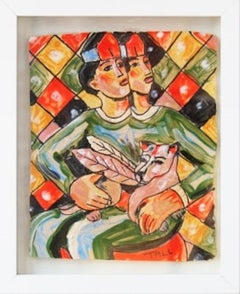
"The Harlequin Griffon", Surrealist Painting on Glazed Tile, Framed, 2010

"The Harlequin Griffon", Surrealist Painting on Glazed Tile, Framed, 2010

By Cheryl Tall

Located in San Diego, CA

This is an original painting on glazed tile by Southern California artist, Cheryl Tall. Its dimensions are 8.8" x 10.8" x 1.5". It is framed as pictured. A certificate of authenticit...

Category

2010s Surrealist Mixed Media

Materials

Mixed Media

Mid-Century Pottery Wall Plaque with Chicken Rooster Decor, 1960s

Mid-Century Pottery Wall Plaque with Chicken Rooster Decor, 1960s

Located in Hamburg, DE

Mid-Century Pottery Wall Plaque with Chicken Rooster Decor, 1960s, in Very Good conditions. Designed 1960 to 1969. Additional information: Materials: Ceramic Style: Mid-Century Mode...

Category

20th Century Mid-Century Modern Decorative Art

Materials

Ceramic

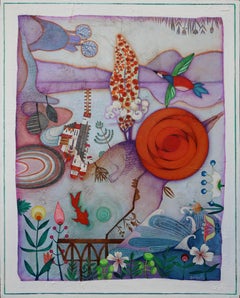
"En Oriente"  (In the East). Symbolic Paint. Folk Art Landscape.

"En Oriente" (In the East). Symbolic Paint. Folk Art Landscape.

By Raquel Fariñas

Located in Segovia, ES

"En Oriente" (In the East). Symbolic paint. Folk Art Landscape by spanish artist Raquel Fariñas. Acrylic mixed media/ wood panel, 62 x 50 x 4 cm. In inches: 24.41" x 19.69" x 1.57" ...

Category

2010s Folk Art Figurative Paintings

Materials

Mixed Media, Acrylic, Wood Panel

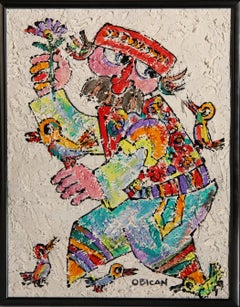
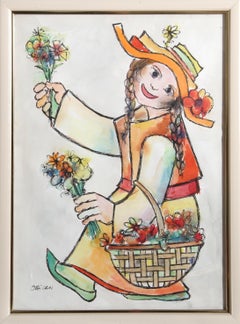
Woman with Flowers, Watercolor Folk Art by Jovan Obican

Woman with Flowers, Watercolor Folk Art by Jovan Obican

By Jovan Obican

Located in Long Island City, NY

Woman with Flowers Jovan Obican French/Yugoslavian (1918–1986) Date: circa 1980 Watercolor on Paper Size: 27.5 x 19 in. (69.85 x 48.26 cm) Frame Size: 30.5 x 22.5 inches

Category

1980s Folk Art Drawings and Watercolor Paintings

Materials

Watercolor

Woman with Birds

Woman with Birds

By Sunol Alvar

Located in San Francisco, CA

Artist: Alvar Title: Woman with Birds Year: c.1980 Medium: Color lithograph Paper: Wove Image size: 18.5 x 24.5 inches Framed size: 26.5 x 32.65 inc...

Category

Late 20th Century Romantic Figurative Prints

Materials

Lithograph