Want more images or videos?
Request additional images or videos from the seller
1 of 6

Maxfield Parrish
Prometheus

1919

$1,590,000
£1,198,396.67
€1,414,209.60
CA$2,278,195.98
A$2,316,626.15
CHF 1,306,877.25
MX$28,201,728.34
NOK 15,677,267.55
SEK 15,560,592.02
DKK 10,572,687.73

About the Item

Medium: Oil on Panel Sight Size 31.00" x 21.25", Framed 36.00" x 22.00" Signature: Signed Lower Left Maxfield Parrish began his career at age 25 as an illustrator, painting magazine covers, advertisements, posters and book illustrations. He was already a well-respected commercial artist when, in 1917, he received a commission from General Electric to produce annual calendar illustrations to advertise the company’s Electric-Edison Mazda Lamps. Eager to sell their product as new and innovative, GE executives asked the artist to emphasize the many facets of light: natural, manmade and fantastical. Over the course of the next 15 years, Parrish created a group of 17 paintings illustrating the progression of the history of light, the immense popularity of which transformed the artist into a national icon. Between 1917 and 1931, over 20 million copies of the calendar were painstakingly reproduced in two different sizes and four different colors. Parrish enjoyed painting images for calendars, because he loved the immediacy and ubiquity of these commissions: far more people would gain exposure to his work in the offices, banks and stores where the calendars commonly hung. If the artist was not already well-known in popular culture through his illustrations and other ads, Parrish became a household name through the Mazda commission. Prometheus, painted in 1919 and published the following year, visually translates a mythical tale of Prometheus, the Titan who stole fire from the Olympian gods and presented it to early man, thus allowing for the evolution of civilization and cultural progress. As a result of this act, Prometheus became the patron of all earthly artists and thinkers as he brought enlightenment to the world. Parrish emphasizes this heroic interpretation in the present work by depicting the subject in clear mythological glory. Bathed in a warm golden light, Prometheus is rendered in the classical Greek style, idealized and youthful, returning triumphantly to earth bearing the flame of the gods. Although the scene’s iconography is predominantly appropriated ancient Greek sources, Prometheus characteristically incorporates such diverse influences as Old Master principles, Pre-Raphaelite aesthetics, and Parrish’s own vivid imagination to achieve a fantastical scene that both appealed to popular imagination and was perfectly suited to the corporate image GE wanted to project. The preternatural landscape rendered behind the figure was likely conjured by Parrish’s fertile imagination; he created these make-believe “Parrishscapes” by synthesizing both real and imagined natural elements. Behind the protagonist, a distant view reveals a mysterious mountainous landscape. The artist’s dazzling gifts as a colorist reveal themselves as the dramatic moonlight beams down upon the crystal calm lake and the craggy outcroppings that surround it. The velvety, midnight blue was reportedly inspired by the effects of light filtering through the cloud layer that Parrish felt was specific to New England: “There is an intense blue in New England,” he once wrote. “Put a mountain here, against the east, in a clear sunset glow, and it would be more startling than in Arizona” (quoted in Alma Gilbert, The Masterworks, Berkeley, California, 1992, p. 103). The present work exhibits a remarkable luminosity and purity of colors that Parrish attained by painting with layers of transparent colored glazes, now considered a hallmark of his distinctive style. Displaying lush color effects and an extraordinary attention to detail, Prometheus impressively demonstrates the unique style and vivid imagination that has earned Parrish his place among the most celebrated and beloved of American illustrators. Exhibited Chadds Ford, Pennsylvania, Brandywine River Museum, Maxfield Parrish, Master of Make-Believe: An Exhibition, June-September 1974, no. 58 San Mateo, California, La Galeria, Maxfield Parrish, 1976 Windsor, Vermont, The Oaks: Maxfield Parrish Museum, June-August 1978 Brandywine River Museum, A Date with Art: The Business of Illustrated Calendars, January 25, 2014- May 18, 2014 Woodmere Art Museum, Philadelphia, Pennsylvania, Grand Opening exhibition at Frances M. Maguire Hall, November 1, 2025 - May 5, 2026 Literature Coy Ludwig, Maxfield Parrish, New York, 1973, pp. 126, 137, pl. 37, illustrated in color Paul W. Skeeters, Maxfield Parrish: The Early Years, 1893-1930, Secaucus, New Jersey, 1973, p. 71, illustrated in color Laurence S. Cutler, Judy Goffman and The American Illustrators Gallery,Maxfield Parrish, London, 1993, p. 69, illustrated in color p. 68 Alma Gilbert, Maxfield Parrish: The Masterworks, Berkeley, California, 1995, fig. 5.4, pp. 96, 97, 113, illustrated in color p. 101 Laurence S. Cutler, Judy Goffman Cutler and the National Museum of American Illustration, Maxfield Parrish and the American Imagists, Edison, New Jersey, 2004, p. 269, illustrated in color
  • Creator:
    Maxfield Parrish (1870-1966, American)
  • Creation Year:
    1919
  • Dimensions:
    Height: 31 in (78.74 cm)Width: 21.25 in (53.98 cm)
  • Medium:
  • Period:
  • Condition:
  • Gallery Location:
    Fort Washington, PA
  • Reference Number:
    Seller: 21171stDibs: LU38431688453

More From This Seller

View All
A Dark Futurist

A Dark Futurist

By Maxfield Parrish

Located in Fort Washington, PA

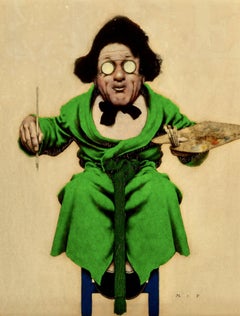
Medium: Oil on Paper Laid on Panel Signature: Signed Lower Right Initialed lower right: M.P. Signed on the reverse: Maxfield Parish Initialed and numbered by the artist's son on the reverse: M.P. Jr. / No. 68. When Maxfield Parrish painted the comical A Dark Futurist in 1923 for Life magazine, he had already established himself as America's leading book and magazine illustrator. His early artwork for children's classics like L. Frank Baum's Mother Goose in Prose (1897), Kenneth Grahame's Dream Days (1900), and Eugene Field's Poems of Childhood (1904) popularized his signature atmospheric settings, cobalt blue-and-gold palette, and dreamy figures inhabiting magical worlds. Likewise, his covers for Century, Collier's, Harper's Bazaar, Ladies' Home Journal, Life, and Scribner's Magazine were highly desirous and instantly recognizable, often more stylized than his book imagery; no other journal illustrator could match Parrish's winning combination of precise draftsmanship, strong graphic design, and amusing characters. According to David Apatoff, Art Critic, The Saturday Evening Post, "Parrish abandoned his customary heavy details and rainbow colors to present a bolder, more high-contrast design silhouetted against a stark white background - a treatment more suitable for a modern magazine cover vying for attention on a crowded newsstand. A Dark Futurist is silhouetted against a white field with no background or details to prop it up. The composition is carefully centered with only differences in the hands and the artist's necktie to break the symmetry. These are crucial to the success of the design. Just as important as Parrish's clean, high-contrast style in these pictures is the refreshing humor and sophistication in content, which is usually absent from Parrish's fairytale paintings. A Dark Futurist shows us a different kind of modernism. Parrish steps out of his timeless fairy tales to tweak one of the most incendiary artistic movements of his day. Futurism, with its militant manifesto and its outspoken artists, was all the rage in Europe. Parrish pokes them, showing a "dark" and anxious futurist with pursed lips and thick glasses, poised to paint but not exactly sure of, or optimistic about, what the 'future' will hold. This suggests that Parrish was alert to, and had opinions about, current events of the day - something one might never guess from his usual subject matter." In his early Collier's illustrations, Parrish also developed memorable themes that he would return to in his 1920s magazine work. One of his most popular characters was the "seer," or man with keen visual powers, most often depicted as an artist, but also appearing as a tourist, scientist, and philosopher. Parrish's seer was recognizable by particular physical attributes: round glasses, indicating his visual and analytical acuity, and an overcoat and/or hat signifying his role as observer of the outside world. A Man of Letters, sold last year at Heritage Auctions, was one of the first Life covers Parrish rolled out for Gibson, and he repeated the character of the artist-seer, emphasizing the comic spin, for two later editions: A Dark Futurist (Life, March 1, 1923) captures a Parrish-like artist in foggy round glasses and a long green coat...

Category

1920s Figurative Paintings

Materials

Paper, Oil, Panel

Ivanhoe

Ivanhoe

By Maxfield Parrish

Located in Fort Washington, PA

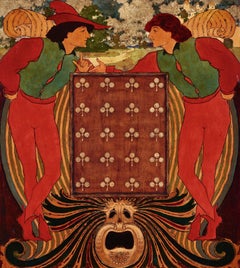
Medium: Mixed Media on Board Signature: Signed on Verso Contact for dimensions. Maxfield Parrish created the present work as a playbill to commemorate a performance of Ivanhoe, whi...

Category

20th Century Mixed Media

Materials

Mixed Media, Board

Cascades (Quiet Solitude)

Cascades (Quiet Solitude)

By Maxfield Parrish

Located in Fort Washington, PA

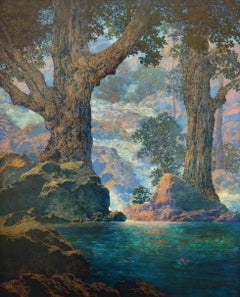
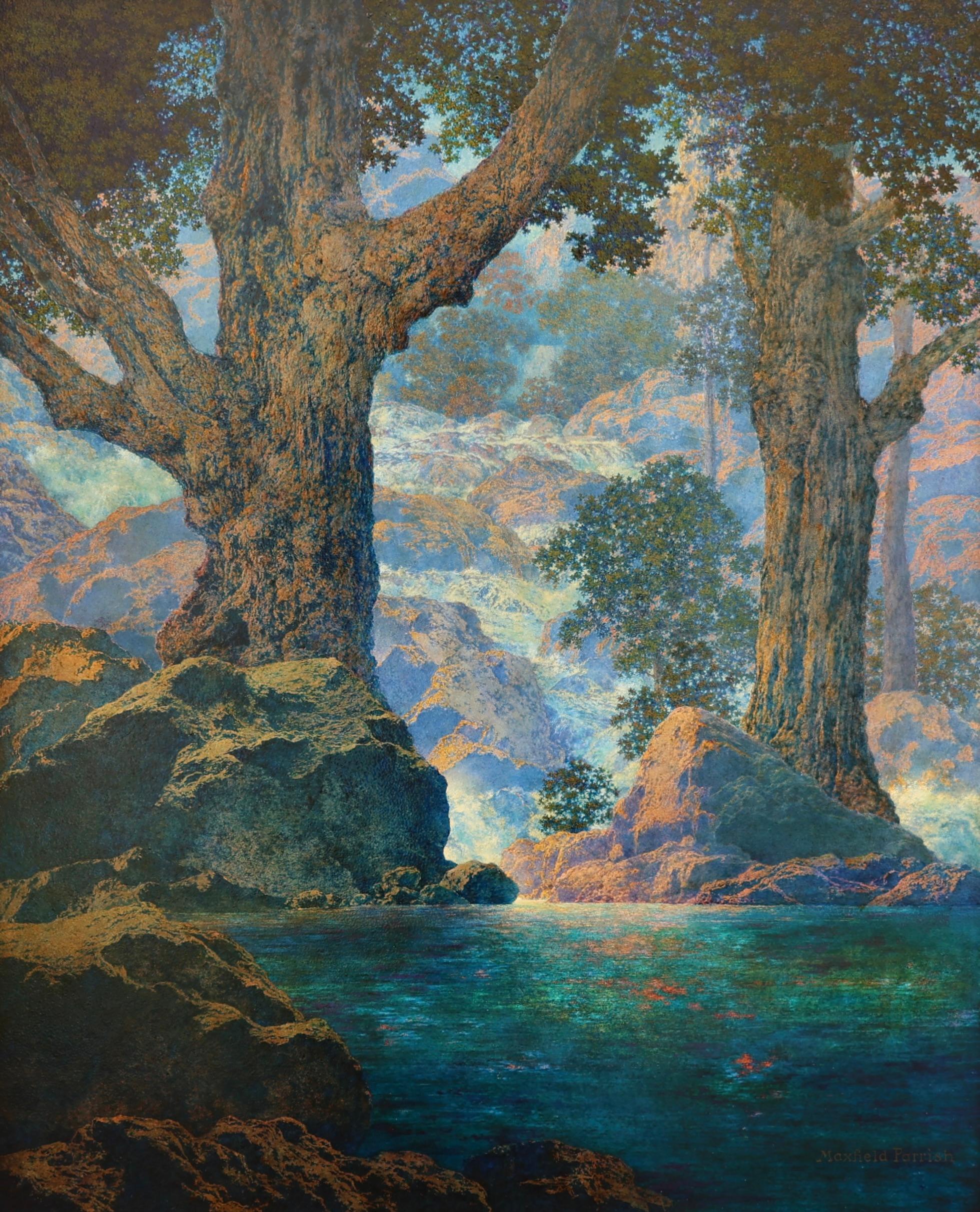
In 1930, Maxfield Parrish turned his attention to painting landscapes exclusively. Cascades is a fine example of the style that defined his late career. The composition features a fa...

Category

1950s Landscape Paintings

Materials

Canvas, Oil

Mask and Wig

Mask and Wig

By Maxfield Parrish

Located in Fort Washington, PA

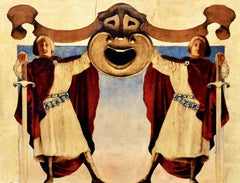
Medium: Oil on Wood Panel Signature: Signed ‘Parrish’ (On the Reverse) Finished painting done as a prototype for the mural at the University of Pennsylvania LITERATURE L.S. Cutler ...

Category

1890s Figurative Paintings

Materials

Oil, Wood Panel

Egypt, Original Edison Mazda Calendar Illustration

Egypt, Original Edison Mazda Calendar Illustration

By Maxfield Parrish

Located in Fort Washington, PA

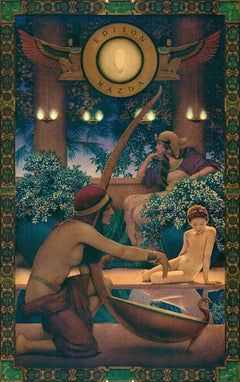
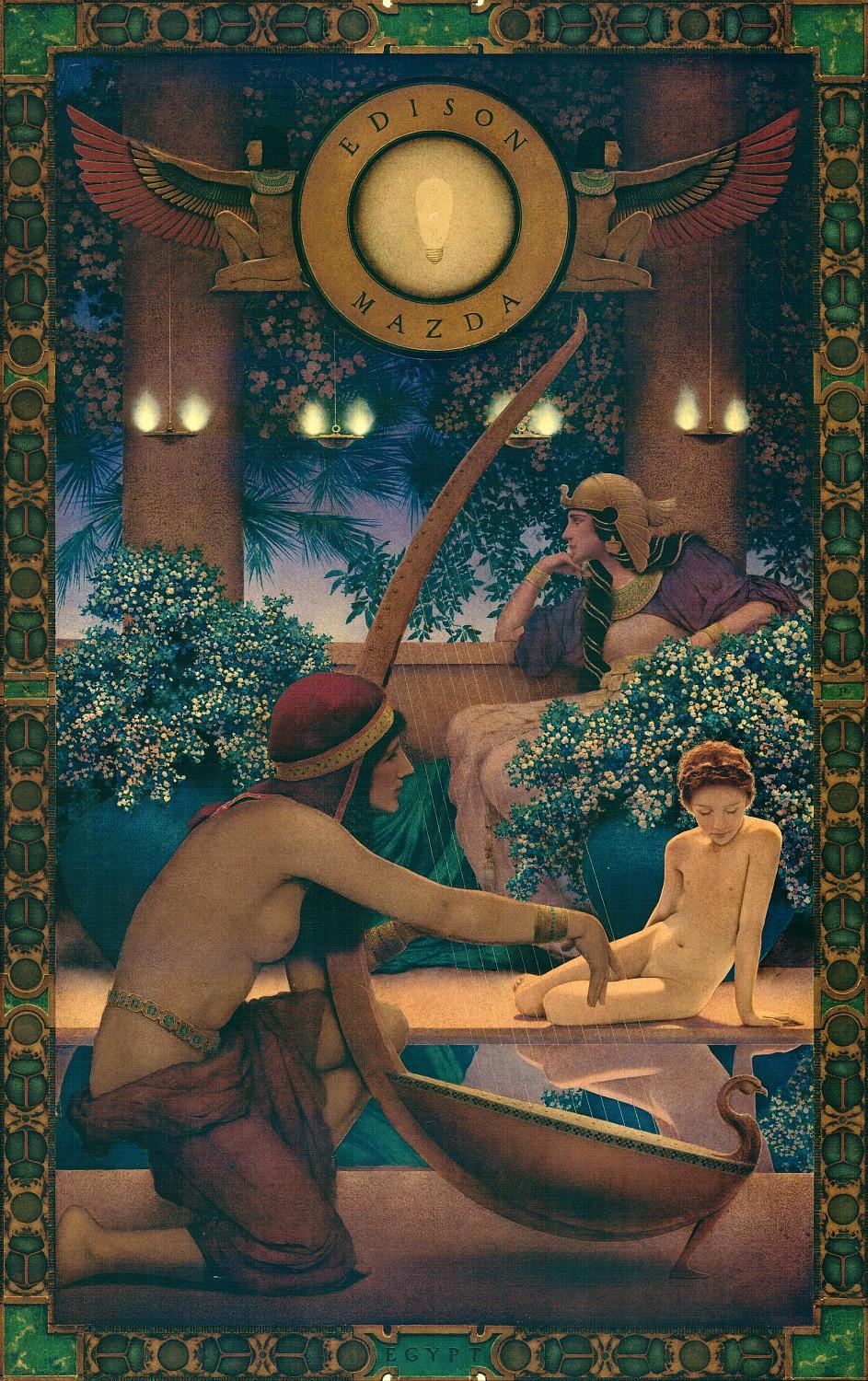
Maxfield Parrish’s Egypt, commissioned for the 1922 calendar and likely painted in 1920 or 1921, formed part of his series chronicling humanity’s evolving mastery of light, following...

Category

1920s Paintings

Materials

Oil, Board

You May Also Like

The Century, Maxfield Parrish

The Century, Maxfield Parrish

By Maxfield Parrish

Located in New York, NY

This image - created as an advertisement for the magazine "The Century" -  is an original lithograph by Maxfield Parrish printed in 1897 measuring 15 ¾ x 11 3/8 in (40 x 29 cm), unfr...

Category

Late 19th Century Prints and Multiples

Materials

Lithograph

Large Antique Maxfield Parrish Print “Cleopatra” c1920

Large Antique Maxfield Parrish Print “Cleopatra” c1920

Located in Big Flats, NY

Large Antique Maxfield Parrish Print “Cleopatra”, Framed and Matted, C1920 Measures - 31 1/2" x 35 1/8" x 1 3/4"

Category

Early 20th Century Prints

Materials

Paper

Art Deco Maxfield Parrish Edison Mazda Calendar Print “Sunrise” c1932

Art Deco Maxfield Parrish Edison Mazda Calendar Print “Sunrise” c1932

Located in Big Flats, NY

A Maxfield Parrish print, titled "Sunrise," originally associated with Edison Mazda calendars from approximately 1932. This print exemplifies Parrish's distinctive style, characteriz...

Category

Early 20th Century Prints

Materials

Paper

Art Deco Maxfield Parrish Print “Garden Of Allah” C1920

Art Deco Maxfield Parrish Print “Garden Of Allah” C1920

Located in Big Flats, NY

This is a vintage Art Deco print titled 'Garden Of Allah' by renowned American artist Maxfield Parrish, created around 1920. Known for his distinctive use of color and romanticized n...

Category

Early 20th Century Prints

Materials

Paper