Video Loading
Want more images or videos?
Request additional images or videos from the seller
1 of 15

Peter Sion
The Rape of Europa, signed Peter Sion (1624-1695), Antwerp, 17th century

$10,848.91
$13,561.1320% Off
£8,041.59
£10,051.9920% Off
€9,200VAT Included
€11,50020% Off
CA$15,134.77
CA$18,918.4620% Off
A$15,353.68
A$19,192.0920% Off
CHF 8,766.13
CHF 10,957.6720% Off
MX$185,909.02
MX$232,386.2820% Off
NOK 103,198.81
NOK 128,998.5120% Off
SEK 102,856.31
SEK 128,570.3920% Off
DKK 70,170.72
DKK 87,713.4120% Off

About the Item

The Rape of Europa By Peter Sion (Antwerp, 1624-1695) Signed in the lower right corner P. Sion 17th century Antwerp School Oil on copper, dim. h. 53 cm, w. 45 cm Moulded and ebonized wood frame with wide mouldings, with reversed profile Framed dimensions: h. 80 cm, l. 72 cm This artwork is sold with a certificate of authenticity guaranteeing its origin, date of execution, and attribution to the artist. Our work illustrates one of the mythological subjects related in Ovid's Metamorphoses, the abduction of Europa by Zeus. Europa is the daughter of the sovereigns of Tyre in Phoenicia, present-day Lebanon. Of great beauty, she is coveted by Zeus. The king of the gods disguises himself as a white bull to approach her on a beach where she is walking. When Europa approaches to caress him, the bull lies down, inviting her to climb on his back. Zeus kidnaps Europa and flees across the sea to Crete. Peter Sion interprets the subject as most Nordic artists of the 17th century did, emphasizing beautiful women sumptuously dressed (and undressed!) and the green landscape. In the center of a wooded clearing, the courageous princess has just climbed on the back of the white bull (Zeus) adorned with a garland of flowers around his neck. The young woman's attendants, all elegantly dressed in colorful fabrics, carry offerings to the princess, a crown of flowers, a basket filled with flowers. One of her attendants celebrates the festivities by playing the lute. In the upper left corner, Cupid, flying in the sky, shoots an arrow. We are witnessing the end of festivities taking place in this joyful atmosphere. Indeed, the bull, having stretched its paw forward, is about to get up and leap in order to kidnap beautiful Europe. Our composition focusing on the first part of the story is endowed with a palette rich in intense colors, favored by the support (copper) which allows for saturated colors and a better state of conservation than wood. Peter Sion (Antwerp, 1624-1695) Peter Sion was an Antwerp painter of landscapes, history paintings and genre scenes. His work was mainly intended for export and he mainly specialized in biblical subjects. Born in Antwerp in 1624, registered in the Antwerp Guild of Saint Luke in 1636-37 as a pupil of Frans van Lanckvelt, he became a master in 1649, he worked in the workshop of Guillaume Forchondt, one of the most important exporters of Flemish works of art to all of Europe. In 1682, he was appointed dean of the Guild of Saint Luke. Peter Sion used copper as a support for the majority of his works. Biblical scenes being his favorite subject, his style is very close to the late Mannerism of Frans Francken and his workshop, with which his works are often confused. One of the characteristics of his work is the quality of the drawing as well as the significant space occupied by the figures in his compositions.
  • Creator:
    Peter Sion (1624 - 1695, Belgian)
  • Dimensions:
    Height: 31.5 in (80.01 cm)Width: 28.35 in (72.01 cm)
  • Medium:
  • Movement & Style:
  • Period:
  • Condition:
    excellent original condition, revarnished by our professionnal restorer, ready to be hanged on the wall.
  • Gallery Location:
    PARIS, FR
  • Reference Number:
    1stDibs: LU2433215925092

More From This Seller

View All
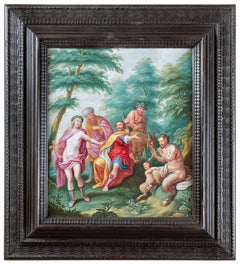
The Musical Contest between Apollo and Marsyas, signed P. Sion, Antwerp 17th c.

The Musical Contest between Apollo and Marsyas, signed P. Sion, Antwerp 17th c.

Located in PARIS, FR

The Musical Contest between Apollo and Marsyas, by Peter Sion (Antwerp, 1624-1695) Signed in the lower right corner P. Sion 17th century Antwerp School Oil on copper, dim. h. 53 cm, ...

Category

17th Century Old Masters Figurative Paintings

Materials

Oak, Oil, Wood Panel

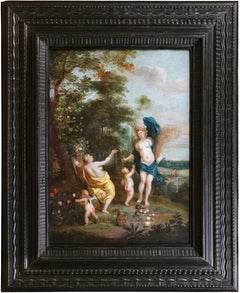
Allegory of Summer, Oil on Copper, Flemish, early 17th Century

Allegory of Summer, Oil on Copper, Flemish, early 17th Century

By Hendrick van Balen

Located in PARIS, FR

Allegory of summer, personified by Ceres Workshop of Hendrick Van Balen Antwerp School, early 17th century. Oil on copper, Dimensions: h. 54 cm, l. 40cm Ebonised wood frame with moulded and guilloché decoration. Framed dimensions: h. 80 cm, l. 66 cm Very good condition This finely executed oil on copper belongs to the rich tradition of allegorical and mythological painting that flourished in Antwerp during the early seventeenth century. Hendrick van Balen and Jan Brueghel the Younger were among the leading exponents of this artistic genre, whose workshops produced numerous compositions depicting the Seasons, the Elements, the Senses, and the gods of Olympus, set within luxuriant landscapes populated by animals and mythological figures. At the centre of a verdant landscape dominated by a flourishing apple tree stands Ceres, the Roman goddess of the Earth, agriculture, and the harvest. Partially draped in a flowing blue garment, she wears a crown of wheat ears, her traditional attribute. In her right hand she holds a sickle and carries sheaves of wheat, symbols of fertility and abundance. Beside her, a nymph presents a cornucopia while playful putti gather and offer flowers. The foreground celebrates the bounty of summer through an abundant still life composed of figs, cherries, apples, and lemons. A squirrel nibbling cherries symbolizes diligence and foresight, virtues echoed by the harvesters working in the wheat fields visible in the distance. The background unfolds in a profusion of vegetation: to the right, a wild rose bush rises against the trunk of a tree, while the centre is animated by majestic trees with silvery-green foliage. The artist, likely a pupil or close follower of Hendrick van Balen, draws direct inspiration from the master's repertoire. The nymph in the yellow drapery seen from behind—a recurring figure in Van Balen’s compositions—is a particularly telling example. The graceful gestures, luminous flesh tones, and wind-swept draperies further reflect the master's distinctive style. The influence of Jan Brueghel the Younger can be seen in the meticulous rendering of the trees, flowers—particularly wild roses and tulips—and in the richly detailed still life with animals in the foreground. Throughout Europe, there was considerable demand for these virtuoso compositions, in which mythological figures served as a pretext for the refined depiction of nature and its abundance. This painting is a charming and accomplished example of that tradition, combining elegant storytelling, technical refinement, and rich iconographic content. Hendrick Van Balen, Flemish painter, born and died in Antwerp (1575-1632). A student of Adam Van Noort, he entered the guild of Saint-Luc in 1593, later trained in Italy and was Van Dyck's first master. He often painted small characters taken from scenes from the Bible or classical mythology, on paintings in which Josse de Momper...

Category

Early 17th Century Old Masters Figurative Paintings

Materials

Copper

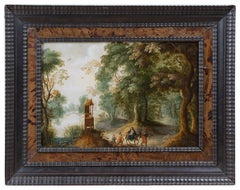
17th c. Flemish - Landscape with Flight to Egypt - Antwerp circa 1630

17th c. Flemish - Landscape with Flight to Egypt - Antwerp circa 1630

Located in PARIS, FR

LANDSCAPE WITH FLIGHT TO EGYPT, JASPER VAN DER LANEN (ANTWERP, 1585 - 1634) 17TH CENTURY FLEMISH SCHOOL ANTWERP CIRCA 1630 Oil on copper, dimensions: h. 10.23 in, w. 14.96 in Flemish style frame in ebonized wood adorned with wavy moldings and wood veneer. Framed dimensions: h. 17.32 in, w. 21.65 in This artwork is sold with a certificate of authenticity guaranteeing its origin, date of execution, and attribution to the artist. Provenance: Philips auction...

Category

Early 17th Century Old Masters Figurative Paintings

Materials

Copper

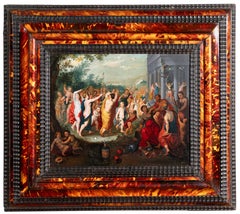
The Triumph of the Infant Bacchus, workshop of H. Van Balen, 16th c. Antwerp

The Triumph of the Infant Bacchus, workshop of H. Van Balen, 16th c. Antwerp

By Hendrick van Balen

Located in PARIS, FR

The Triumph of the Infant Bacchus, Workshop of Hendrick Van Balen (1575-1632) Antwerp, c.1630 Oil on copper, h. 28 cm (11.02 in), w. 35 cm (13.78 in) A large Roman 17th century golden painted frame Framed: h. 52 cm (20.47 in.), w. 58 cm (22.83 in) This artwork is sold with a certificate of authenticity guaranteeing its origin, date of execution, and attribution to the artist. Our finely painted work depicts The Triumph of the Bacchus as a young boy and is one of the most popular mythological subjects in Antwerp at the beginning of the 17th century. Feasting, wine and fun are the themes that constantly appeal to the public. Thus unfolds before our eyes on our painting the procession composed of nymphs, baccantes, fauns, satyrs and children, their bodies naked, partially covered with brightly coloured draperies that help to brighten up the parade. Playing various instruments, dancing and drinking, while carrying vases and poles adorned with grapevines, participants to the rhythm of a noisy brass band make their way to an ancient temple standing on the right. The exaggerated gestures convey to us the frenzy of the excited crowd. The Child Bacchus follows the joyous procession, carried by satyrs and nymphs, crowned with ivy and joyfully raising a cup of wine. In the foreground, the drunken participants leave the procession, the children on the left and the group of bacchantes and satyrs on the right are resting among various objects scattered at their feet: cups, vases, ewers bear witness to the festivities in progress. In the background, a hilly landscape stretches out on the horizon, a semblance of calm that contrasts with the bustle of the foreground. The artist strives to multiply the many details, whether it be figures, costumes, flowers or vegetation, in order to demonstrate his know-how and the perfection of his execution. The acidulous palette with fresh and varied colours is characteristic of Hendrick Van Balen's works. There are several versions identical to ours with similar dimensions painted by Hendrick Van Balen and his workshop. Related works: • Koller Auction, Zurich, 21/09/2007, oil on copper, 28,5 x 37,4 cm. • Staatliche Kunsthalle, Karlsruhe, Inv. N° 809 (oil on copper, 40 x 53,5 cm) • Auktionshaus für Altertümer Glückselig, Vienne, 10/05/1932, ( oil on copper, 34 x 42 cm) • Gemäldegalerie of Pommersfelden, Schloss Weissenstein, oil on panel, 47 x 64 cm Hendrick Van Balen, Flemish painter, born and died in Antwerp (1575-1632). A pupil of Adam Van Noort, he entered the Guild of St. Luke in 1593, later trained in Italy and was Van Dyck's first teacher. He often painted small figures taken from scenes from the Bible or classical mythology, on paintings whose backgrounds and landscapes were painted by Josse de Momper...

Category

17th Century Old Masters Figurative Paintings
Materials

Copper

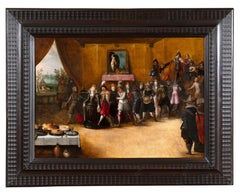
Attributed à H. Francken II, 17th c. Anwerp - The prodigal son among courtesans

Attributed à H. Francken II, 17th c. Anwerp - The prodigal son among courtesans

Located in PARIS, FR

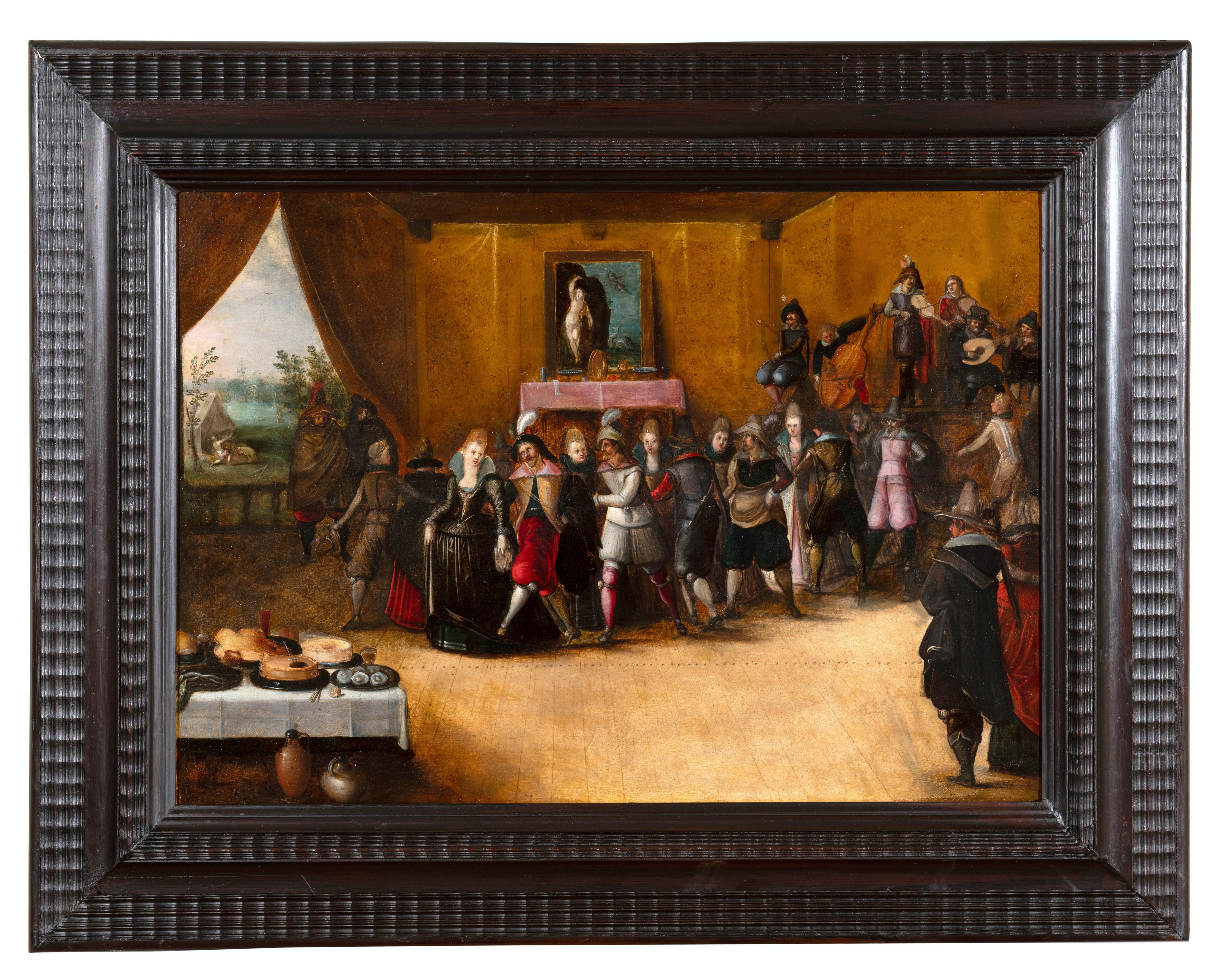
The Prodigal Son Among Courtesans Attributed to Hieronymus Francken II (Antwerp 1578-1623) Early 17th century Antwerp school Oil on oak panel, Dimensions: H. 52.5 cm (20.67 in), W. 74 cm (29.14 in) Flemish-style moulded wood frame Frame: h. 78 cm (h. 30.70 in.), w. 100 cm (39.37 in.) This artwork is sold with a certificate of authenticity guaranteeing its origin, date of execution, and attribution to the artist. At first glance, this festive and joyful painting depicts a group of elegantly dressed people dancing to the sound of an orchestra in a richly decorated interior with a wide opening onto a rural exterior. However, the real theme is cleverly concealed by the painter and is only discernible through the artifice of a small scene in the background where we see a half-naked man, in the company of the pigs next to a makeshift shelter. In fact, beyond the pleasant and apparently superficial character of the painting, it is a subject taken from the parable of the prodigal son in the Gospel. The illustrated episode is the prodigal son among courtesans. Even if the viewer's attention is drawn to the central couple (prodigal son embracing a pretty courtesan) doing the dance steps, the artist takes care in a narrative approach of all the groups and ancillary scenes in order to create a rich and varied composition. Thus the musicians seated on a raised platform are depicted with great skill, their faces animated, their clothes abundantly varied. The theme of music, which has always been associated with that of sensuality and physical love, helps to exacerbate licentious pleasures. The merry company dances "Spanish pavane", a slow court dance from the sixteenth century, danced close to the ground by couples arranged in a procession, which was probably introduced to the south of the Netherlands around 1600 during the governance of Albrecht VII and the daughter of the King of Spain Isabella Clara Eugenia in Brussels. The interior of the house is also carefully elaborated, the embossed leather dyes on the walls, the middle sideboard (typical in Francken interiors), where the rich gold and silver crockery is placed in front of the painting "Andromeda chained to the rock and Perseus arriving to rescue her". The inclusion of a contemporary and probably extant pictorial work is also one of the characteristics of the Francken family, among them Frans Francken the Younger...

Category

Early 17th Century Old Masters Interior Paintings

Materials

Oak, Oil

You May Also Like

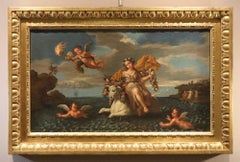
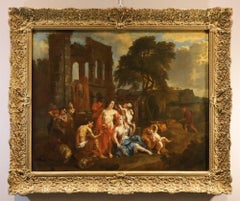
Rape Of Europa Paint De Matteis 18th Century Oil on canvas Old master Italy Art

Rape Of Europa Paint De Matteis 18th Century Oil on canvas Old master Italy Art

Located in Riva del Garda, IT

The Rape of Europa Circle of Paolo De Matteis (Piano Vetrale, 1662 - Naples, 1728) oil on canvas (cm.) 57 x 98 - with gilded wooden frame 77 x 118 cm. FULL DETAILS OF THE PAIN...

Category

18th Century Old Masters Figurative Paintings
Materials

Oil

Mythological Scene & Venus & Cupid , Circle of Georg Engelhard Schröder 18th C.

Mythological Scene & Venus & Cupid , Circle of Georg Engelhard Schröder 18th C.

Located in London, GB

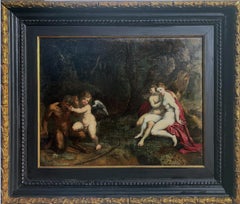
An elegant 18th-century oil on canvas depicting a classical mythological scene, attributed to the circle of Georg Engelhard Schröder. The composition features Venus accompanied by Cu...

Category

Antique 18th Century Swedish Baroque Paintings

Materials

Canvas, Wood, Gesso

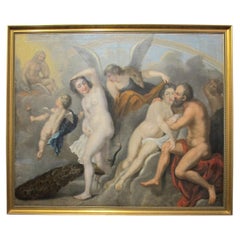
Myth Apollo Issa De Lairesse Paint 17/18th Century Oil on canvas Old master Art

Myth Apollo Issa De Lairesse Paint 17/18th Century Oil on canvas Old master Art

Located in Riva del Garda, IT

Gérard de Lairesse (Liège 1641 - Amsterdam 1711) workshop The Myth of Apollo and Issa (from Ovid, Metamorphoses, book VI, 122-124) Oil on canvas 65 x 82 cm. - Framed 84 x 99 cm...

Category

17th Century Old Masters Figurative Paintings
Materials

Oil