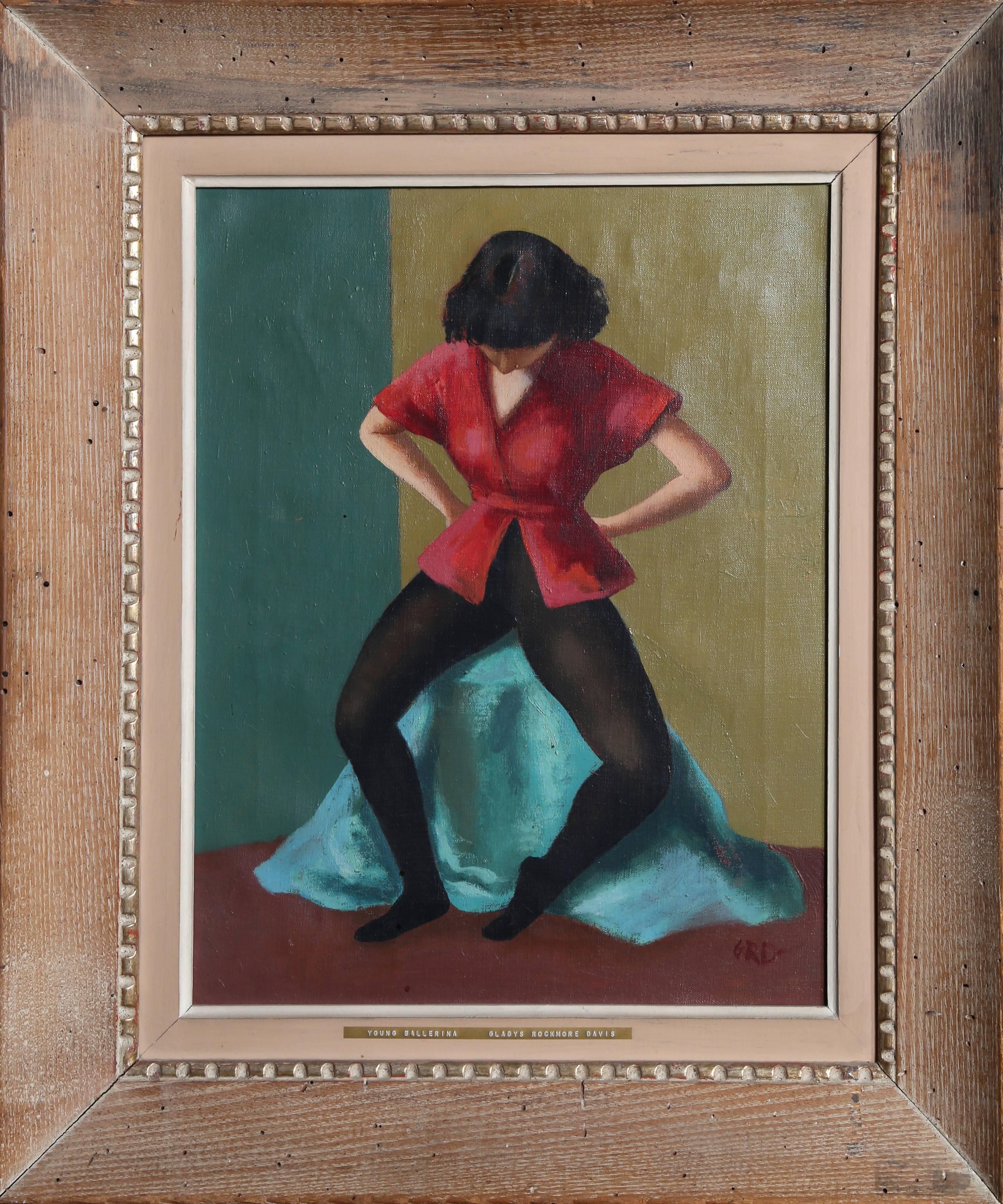
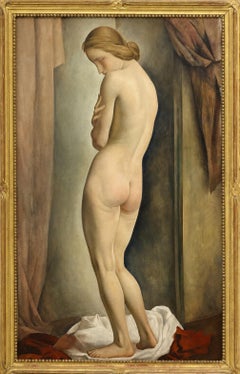
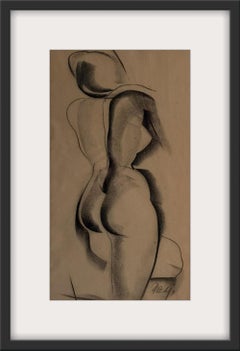
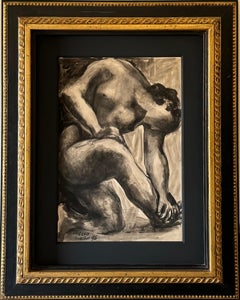
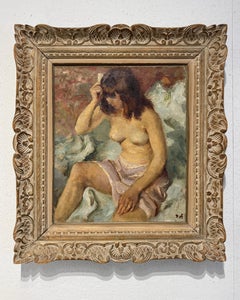
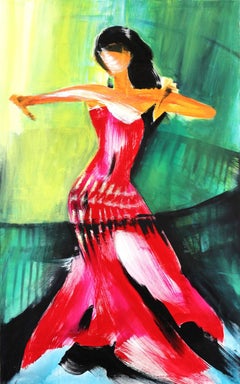
Signed lower right
Raimondo (Raymond) Puccinelli (American, 1904-1986).
Puccinelli began art training at age 15 at the California School of Fine Art (now the San Francisco Art Institute) and the Schaeffer School of Design. While in Italy in 1927, he studied ancient Italian sculpture (Romanesque, Gothic, and late Renaissance) which affected his future work. After a year of studying in France and Italy with various craftsmen, he returned to San Francisco to assist in the studio of J. Vieira and study under Benny Bufano. During the decade 1930-40, he was most influenced by Mexican artist Diego Rivera. In the 1940s he maintained a studio in San Francisco's Chinatown at 15 Hotaling Place and taught sculpture at both UC Berkeley and Mills College in Oakland. He continued teaching at those schools until 1948 when he moved to Flushing, NY to teach at Queen's College. He later taught in Baltimore at the Rinehart School of Sculpture until 1960. He then moved to Florence, Italy where he remained until his death in May 1986. His work, mostly in bronze, was a link between older figurative sculptors such as Rodin and the new figuratives of the post-abstract period. He also worked in unglazed terra cotta, wood, and stone. Excerpts from his autobiographical notes: It was a veritable pleasure to know Henri Matisse whose genuinely elegant personality impressed me. He spent a short time in San Francisco on a trip, which he was making to Tahiti. After a brief meeting with me he invited himself to my studio. In a rather humorous fashion I said that I should think that he saw enough art in Paris. His reply – that he was particularly interested because I was a young sculptor and he too considered himself a sculptor (something which I did not realize) having spent eight years of work under Rodin and Bourdelle. He seemed not too pleased to be known only as a painter. The next day he was promptly at my studio. He looked carefully at all of my work – some pieces in clay were not finished and were covered over with damp cloths which he insisted on seeing also. This made me slightly embarrassed as the works were not ready for viewing. Finally he made the remark that he had been wondering. “Where are all of the men in American Art? Where are the young artists who really work and so many women in the arts and only 1/2 serious, Now I finally find one who is of the family of artists, If you were to come to Paris, you’d be one of us. Come over – and on the way stop in New York and make acquaintance with Herbert Bittner who is a lover of sculpture, - I feel that he will like your work.” Matisse talked a length about his work. He would spend a long time on a painting, turning it to the wall for many months, then taking it up again and reconsidering it. He discussed drawing. He did not feel that many critics were correct in emphasizing so very much the Near Eastern influences in his work. One point surprised me. He said that he had ardently studied and had been influenced by the drawings of Leonardo da Vinci which he said were “nature done over in a new kind of handwriting”. He spoke of finding, losing & finding again the line. – He felt that Rodin had directed him toward new paths. “You know,” he said, “that Rodin was also a colorist in his sculpture.” This discussion, parts of which come back to me from time to time, meant more to me than years of schooling. Many months later I was on my way to New York via the Indian country in the Southwest of the United States. I immediately was hard at work in a studio on 23rd Street, then moving to share a studio with a German sculptor, Carl Schmitz. It was here that Herbert Bittner came to see the work that I had been doing. Bittner, I learned, had a wide experience in the arts, especially sculpture and drawing. He had also spent some years in Rome as director of an important book store. Now director of the Westermann Gallery at Rockefeller Center, he specialized in showing works of noted European artists such as Kathe Kollwitz and Ernst Barlach, Lehmbruck, George Grosz, his emphasis being on Germans not accepted by the Hitler regime. On seeing my work, he was immediately enthusiastic and asked to exhibit my work in the gallery, that he directed. I didn’t have enough work for a one-man show (it was a large, elegant gallery), nor could I promise one in the near future as I didn’t have the capital for the castings and these works that I was doing were for bronze. Fortunately, I had worked with a Sicilian bronze caster on Long Island, Mario Scoma. He did a fine job for me and Herbert Bittner, exhibited them in a three-man show with two noted German sculptors Barlach and Lehmbruck.
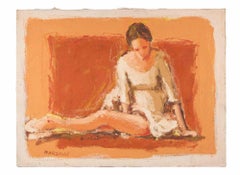
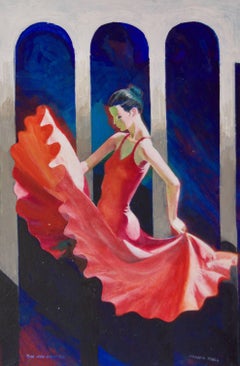
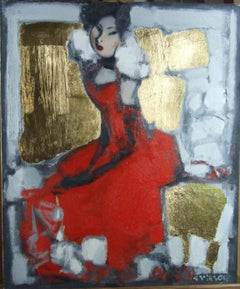
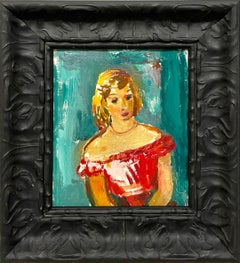
Modern Dance Female Dancer in Red Dress Jazz
oil paint on board
circa 1950s