1 of 3

Sertap Yegin
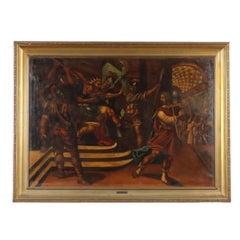
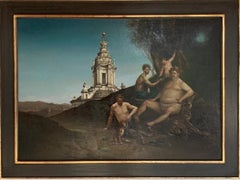
Those from the Past - Figurative Oil Painting Colors Brown Red Orange Black Pale

2021

$17,869.66List Price

You May Also Like

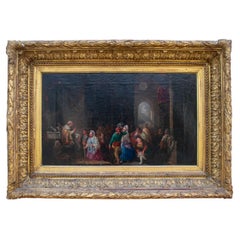
Historical Scene Oil Painting on Canvas, 19th Century, Framed, Large

Historical Scene Oil Painting on Canvas, 19th Century, Framed, Large

Located in Milan, IT

Oil painting on canvas. Mid 19th century. The large scene tells an unidentified historical episode, set in the Renaissance period, in which an archbishop listens to the plea of a you...

Category

19th Century Other Art Style Figurative Paintings

Materials

Oil

19th Century Oil on Canvas Painting Attributed to Eugenio Lucas Villamamil

19th Century Oil on Canvas Painting Attributed to Eugenio Lucas Villamamil

Located in Marbella, ES

Antique 19th century oil on canvas people painting attributed to Eugenio Lucas Villamamil, with acanthus and foliate gilt wood and gesso frame Dimensi...

Category

Antique 19th Century Spanish Paintings

Materials

Canvas

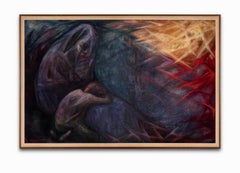
Fanny Rabel Figurative Oil Painting Soulful, Prayerful

Fanny Rabel Figurative Oil Painting Soulful, Prayerful

By Fanny Rabel

Located in Detroit, MI

SALE ONE WEEK ONLY UNTITLED by Fanny Rabel a Mexican artist who was born in Poland in 1922 is a soul wrenching work depicting among other things, the children killed by Nazi bombing in Spain during the Second World War. The lavender and purple surrounding the seated female figure and the kneeling child suggest both grief for the innocents' deaths and the prayers being offered for an end to the carnage. The bright gold and red can be read as either explosions or the hopeful light of redemption after death. Like Picasso's Guernica from 1937, this painting from 1965 can stand as a powerful anti-war statement. Numerous key galleries and museums such as Morton Auctions, Cerro de Mayka have featured Fanny Rabel's work in the past. Her anti-Nazi and anti-Fascism politics resulted in her participation in a mural called Retrato de la Burguesía in 1940 for the Sindicato Mexicano de Electricistas building on Alfonso Caso Street in Mexico City. Rabel met a group of exiled Spaniards in Mexico along with Antonio Pujol, who invited her to take part in a mural project headed by him, David Alfaro Siqueiros, Joseph Renau, Luis Arenal, Antonio Rodríguez Luna and Miguel Prieto. The artist died in 2008. Fanny Rabel born August 27, 1922, in Poland born Fanny Rabinovich, was a Polish-born Mexican artist who is considered to be the first modern female muralist and one of the youngest associated with the Mexican muralism of the early to the mid-20th century. She and her family arrived in Mexico in 1938 from Europe and she studied art at the Escuela Nacional de Pintura, Escultura y Grabado "La Esmeralda", where she met and became friends with Frida Kahlo. She became the only female member of “Los Fridos” a group of students under Kahlo’s tutelage. She also worked as an assistant and apprentice to Diego Rivera and David Alfaro Siqueiros, painting several murals of her own during her career. The most significant of these is "Ronda en el tiempo" at the Museo Nacional de Antropología in Mexico City. She also created canvases and other works, with children often featured in her work, and was one of the first of her generation to work with ecological themes in a series of works begun in 1979. She is considered to be the first female muralist in Mexico. She was an assistant to Diego Rivera while he worked on the frescos for the National Palace and an apprentice to David Alfaro Siqueiros. Her most important mural is Ronda en el tiempo located in the Museo Nacional de Antropología, which was created from 1964 to 1965. She also created murals at the Unidad de Lavaderos Público de Tepalcatitlán (1945), Sobrevivencia, Alfabetización in Coyoacán in 1952 Sobrevivencia de un pueblo at the Centro Deportivo Israelita (1957) Hacia la salud for the Hospital Infantil de México (1982), La familia mexicana at the Registro Público de la Propiedad (1984) (which Rabel preferred to title Abolición de la propiedad privada) and at the Imprenta Artgraf. In collaboration with other artists, she participated in the creation of the murals at the La Rosita pulque bar (disappeared) and at the Casa de la Madre Soltera. She entered the Escuela Nacional de Pintura, Escultura y Grabado "La Esmeralda" shortly after it was established in 1942, taking classes with José Chávez Morado, Feliciano Peña and Frida Kahlo, with whom she became close friends. She changed her last name from Rabinovich to Rabel during her career. Rabel married urologist Jaime Woolrich and had two children Abel and Paloma Woolrich, both of whom became actors. The first exhibition of her work was in 1945 with twenty-four oils, thirteen drawings, and eight engravings at the Liga Popular Israelita with Frida Kahlo writing the presentation. In 1955, she had an individual exhibition at the Salón de la Plástica Mexicana. She had a large exhibition at the Museum of the Palacio de Bellas Artes to commemorate a half-century of her work. Her last exhibition was in 2007 at the Universidad Autónoma Metropolitana. Her work can be found in collections in over fifteen countries including those of the New York Public Library, the Library of Congress in Washington, D.C., the Royal Academy of Denmark, the National Library in Paris, the Casa de las Américas in Havana, the Benemérita Universidad Autónoma de Puebla and the Museo de Arte Moderno in Mexico City. A retrospective of her work after her death called Retrospectiva in Memoriam, Fanny Rabel (1922-2008) was held at the Museum of the Universidad Popular Autónoma del Estado de Puebla . She is considered to be the first modern female muralist in Mexico although she also did significant work in painting, engraving, drawing, and ceramic sculpture. Her work has been classified as poetic Surrealism, Neo-expressionism and is also considered part of the Escuela Mexicana de Pintura (the dominant art movement of the early to mid 20th century in Mexico) as one of the youngest muralists to be associated with it along with Arnold Belkin and José Hernández Delga. Rabel was more drawn to depicting mankind’s pain rather than happiness, sharing other Mexican muralists' concerns about social injustice. However, she stated to Leopoldo Méndez that she could not create combative works, with clenched fists and fierce faces, and she wanted to leave the Taller de Gráfica Popular. Méndez convinced her to stay, saying that more tender images are important to political struggle as well. Children with Mexican faces...

Category

1960s Expressionist Figurative Paintings
Materials

Oil, Canvas

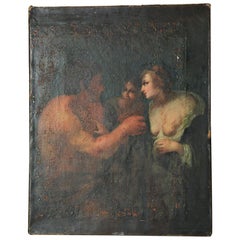
Antique Oil Painting on Canvas

Antique Oil Painting on Canvas

$4,500

H 37 in W 29.5 in D 0.75 in

Antique Oil Painting on Canvas

Located in Sheffield, MA

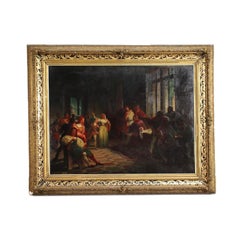
The antique unframed oil painting on canvas is in the Renaissance style. Two ladies are conversing with the man on the right. Canvas is stretched...

Category

Antique Late 18th Century European Renaissance Paintings

Materials

Canvas

Moses brings forth Water from the Rock Oil on canvas. French school late 17th s

Moses brings forth Water from the Rock Oil on canvas. French school late 17th s

Located in Milan, IT

Oil on Canvas. French school of the late 17th century. The painting is inspired by one made by Nicolas Poussin around 1635, now in storage at the National Gallery in Edinburgh, but c...

Category

17th Century Other Art Style Figurative Paintings

Materials

Oil

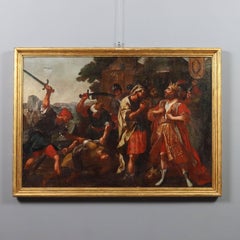
Painting of Scene of Request for Clemency Oil on canvas 17th century

Painting of Scene of Request for Clemency Oil on canvas 17th century

Located in Milan, IT

Oil on Canvas. The scene recounts an incident of a request for clemency to a king: a man begs the king to grant clemency to the young man who is about to be beheaded by two servants;...

Category

17th Century Other Art Style Figurative Paintings

Materials

Oil

Painted Biblical Scene. David playing the harp 17th century

Painted Biblical Scene. David playing the harp 17th century, 1600s

$2,477Sale Price|20% Off

H 43.31 in W 58.67 in D 3.15 in

Painted Biblical Scene. David playing the harp 17th century

Located in Milan, IT

Oil on Canvas. Northern Italian school of the 17th century. The scene depicts the biblical episode from the First Book of Samuel, which thus relates : "Now when the evil spirit permi...

Category

17th Century Other Art Style Figurative Paintings

Materials

Oil

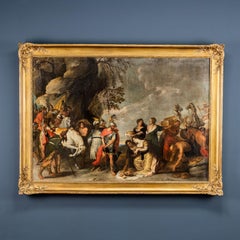
David and Abigail, Oil Painting, 17th Century, Framed, Flemish Style

David and Abigail, Oil Painting, 17th Century, Framed, Flemish Style

Located in Milan, IT

The painting, done in oil on canvas, depicts the meeting between King David and Abigail, as narrated in the biblical text from the First Book of Samuel (I Samuel 25:1-34). David, left without food in the wilderness with his army, seeks relief from the wealthy Nabal, who contemptuously denies him any help, ungrateful of the benevolence he previously received from the king. Upon hearing the rejection, the ruler intends to take revenge by killing his entire lineage. Abigail, Nabal's beautiful and wise wife, decides to right the wrong and bring David plenty of food and gifts. In the king's presence the woman humbles herself, winning his forgiveness and benevolence. Soon afterwards widowed, she will in fact become his bride. The broad scene depicts the climax of the Old Testament episode, the moment when the woman prostrates herself before David and his servants prepare to deliver the gifts. The biblical event is here a pretext, as is customary in modern-age painting, for staging the colorful description of a sumptuous procession, which can be divided into two parts, almost two wings of a crowd divided specularly: on the left David with his dignitaries and the army; on the other, Abigail's retinue, handmaids, servants leading dromedaries and donkeys laden with food. The crowded group of figures is set in a natural proscenium: above a low horizon, barely hinted at by distant blue mountains, rises on the left side a craggy rocky cliff, the shelter of the army led by the ruler. The 'somatic intonation of the characters, as well as the choice of metallic chromatics and the play of light on the shiny fabrics refer to a clear Flemish matrix, particularly the influence of the frothy and sumptuous painting of Rubens and Van Dyck. As well set forth in the expert report prepared by Professor Giuseppe Sava, the work is to be attributed to Vincent Malò...

Category

17th Century Other Art Style Figurative Paintings

Materials

Oil

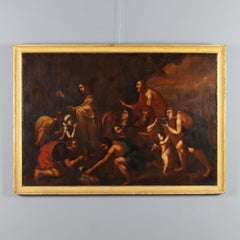
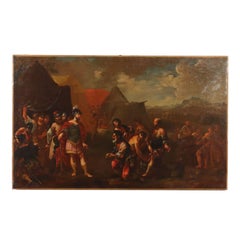
Historic Scene Oil Painting, Late 17th Century, Framed, Restored

Historic Scene Oil Painting, Late 17th Century, Framed, Restored

Located in Milan, IT

Oil on Canvas. The scene takes place at a military camp: outside a tent on the left a leader of an army, probably Greek, is receiving offerings of a group of men, poor and ragged, ...

Category

Late 17th Century Other Art Style Figurative Paintings

Materials

Oil

Baccanale Romano Oil Painting on Canvas Mythology Rome Landscape In Stock

Baccanale Romano Oil Painting on Canvas Mythology Rome Landscape In Stock

By Giovanni Tommasi Ferroni

Located in Utrecht, NL

Baccanale Romano Oil Painting on Canvas Mythology Rome Landscape In Stock Giovanni Tommasi Ferroni (1967, Rome) descended from an artistic Tuscan family...

Category

21st Century and Contemporary Contemporary Figurative Paintings

Materials

Oil, Canvas