By Edouard Goerg
Located in Saint Amans des cots, FR
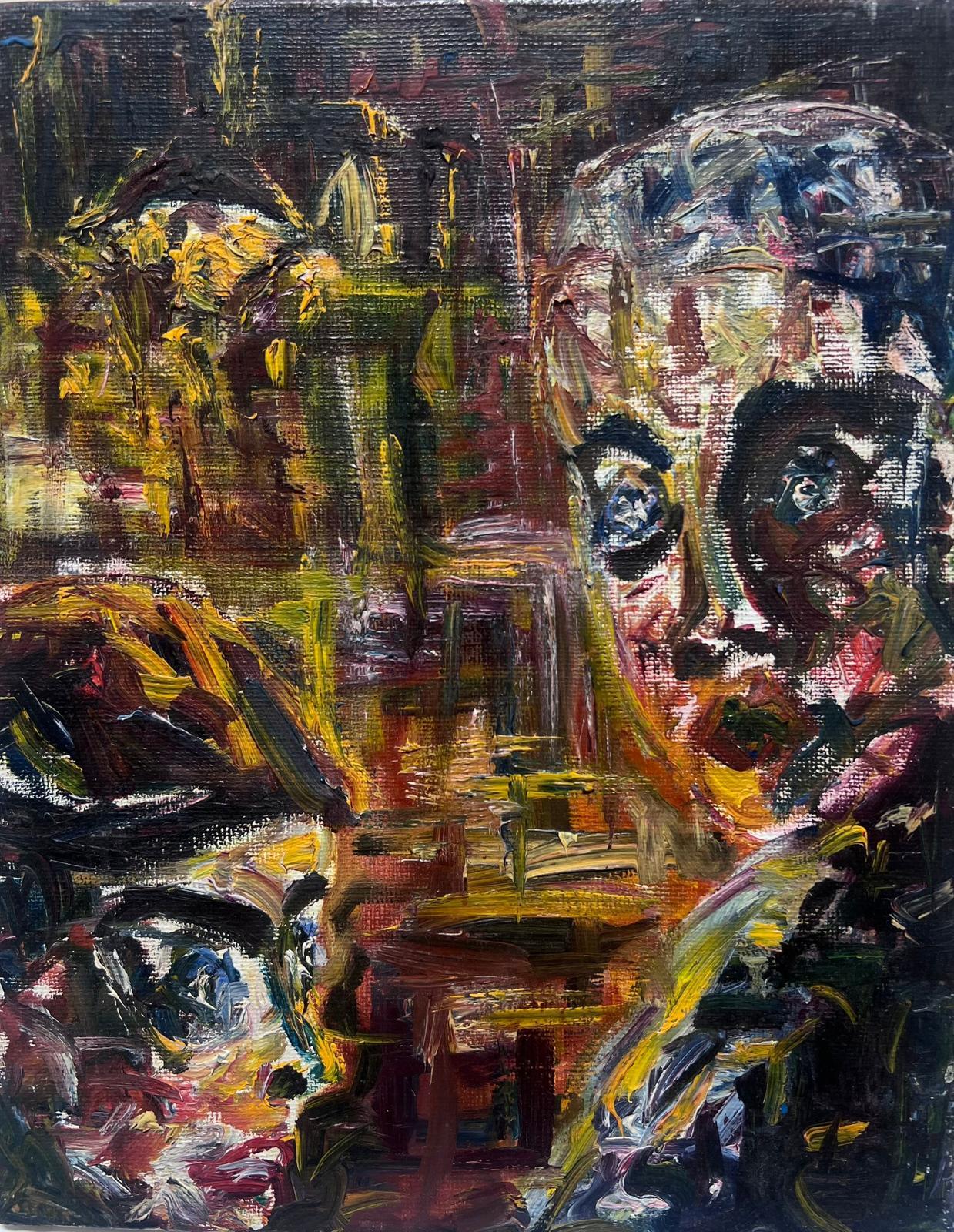
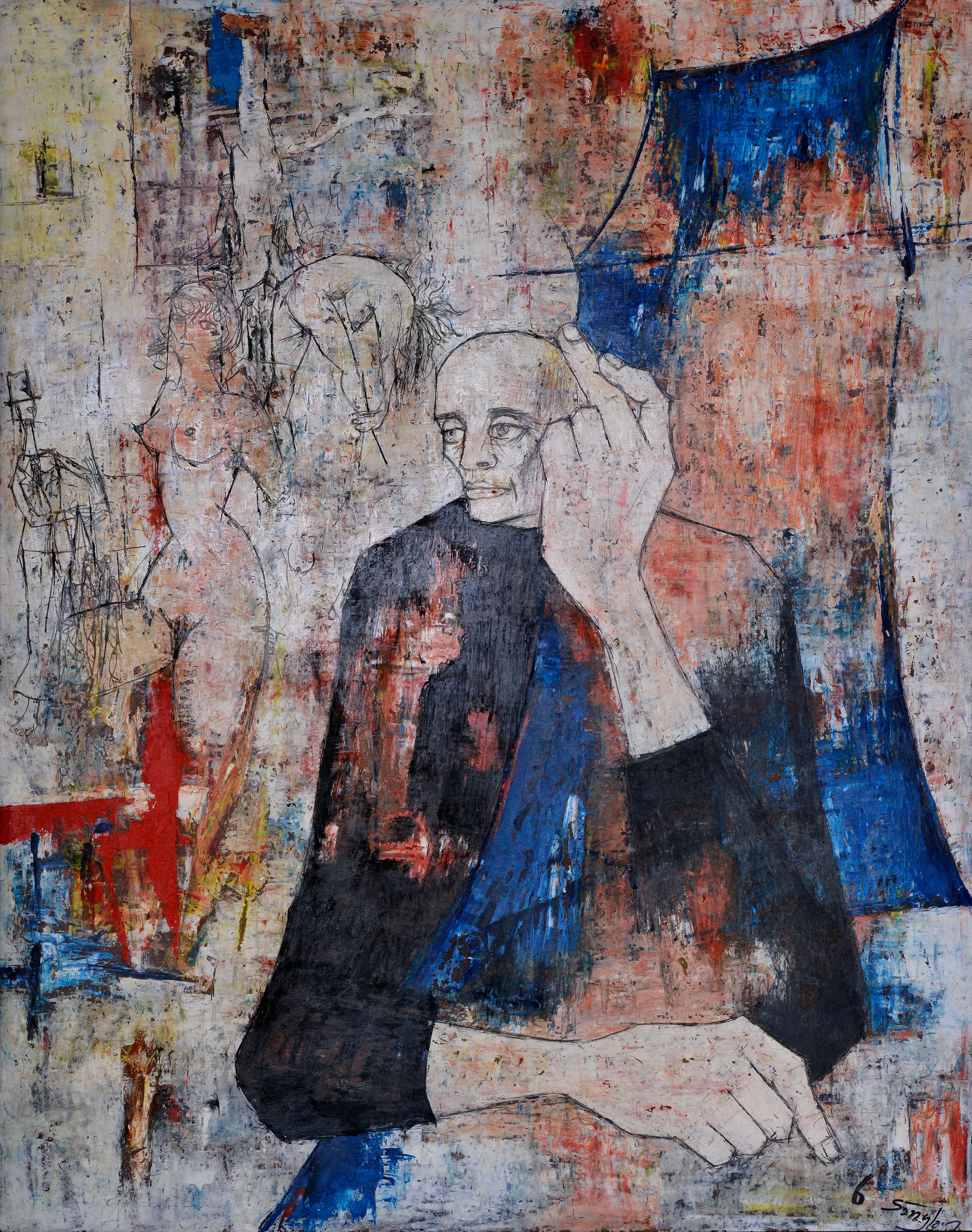
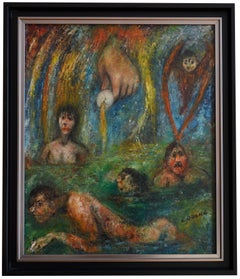
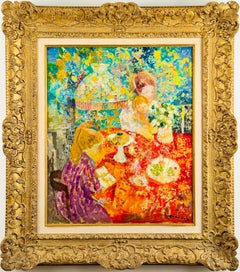
Oil on canvas by Edouard Goerg (1893-1969), France, 1958. Life is always the same. Acquired in 2017 from the personal collection of Edouard Goerg. Measurements : with frame : 62.5x53.4 cm - 24.6x21 inches, without frame : 55x46 cm - 21.7x18.1 inches, format 10F. Signed "E.Goerg" (see photo).
Preserved by the painter, then by his family since his death in 1969, this painting appeared in 2017. Entitled "Always life begins again", it is a crepuscular work. Testamentary one could say, so much the statement which is made there is definitive. The fact that he kept it until his death tends to consolidate this vision. Far from the empty looks and death faces of the rebellious era of sarcastic expressionism, the terrifying and compassionate testimony of the Spanish war, and the post-WWII flower women, we are dealing here with a a form of reasonable abdication, but honest. This idea that although everything changes, nothing changes. Changed times, actors, ideas, the same comedy occupies the society. Having given up the idea of changing the latter, Goerg accepts the fact that the only alternative is to stay there or get lost. But stay afloat with his values, completely independent, whatever the cost is.
This work is similar to La Vie Recommence of 1935, reproduced on page 54 of Gaston Diehl's book devoted to the painter (Éditions de Clermont, 1947). On the latter, the artist depicts his vision of life, from birth to death, made of hope, fear, cruelty, resignation and fatality. 23 years later, Toujours La Vie Recommence shows us the road traveled by the painter. It is no longer a matter of denunciation, but ultimately of acceptance of reality and the difficulty of staying there yourself.
The admirer of Hieronymus Bosch gives us an inspired composition. The hand of God, the only expression of physical beauty in this work, comes down from heaven to give life. Symbolically, it holds an egg that dispenses the element from which the human protagonists find their birth, and in which they move and tangle more than they impose. Beautiful allegory of society. Four characters, two women and two men evolve in this societal marigot. The man in the foreground, ruddy face, evolves with ease. His body is supple, flexible, adaptable. The woman on the left observes him with admiration. Obviously, this man is in his place and causes rapture. The right man with massive shoulders and wrapped, shows a physical maladjustment to the activity he is doing. He struggles to stay afloat, his face expresses effort, even exhaustion. But he assumes. He does with what he has, with what he is. The other woman shows him the greatest indifference. What is not the case of the demonic archangel (recurrent in the works of Bosch) with the stunted body, who leads the dance and holds this character, we understand the painter, under his control as to have fun. As this character cannot change bodies, Goerg cannot change values. He does it with. Had he not said to the critic Roger Brielle: "Independents, sensitive and just men, that's what we must strive to stay in this world in disarray". Goerg will have come to narrative expressionism to give us a balance sheet allegory of his deep self and his condition.
Édouard Goerg is one of the major artists of his generation. Coming from a Champagne family, he was born in Sidney, Australia, in 1893, during a professional stay of his father. After passing through London, he arrives in Paris at the age of seven. At twenty, between 1913 and 1914, he studieds painting at the Académie Ranson with Maurice Denis and Paul Sérusier. He travels to Italy and India. Mobilized in 1914, he is sent to Artois, then to Argonne. From 1920, he exhibits at the Salon des Independants, then at the Salon d'Automne where he joins with Laboureur. At Berthe Weil, in 1924, he participates in the exhibitions of the Gromaire group, a prelude to a series of exhibitions in Paris (Berthe Weill, Bernheim Jeune), as in Brussels (Le Centaure). Goerg illustrates books including Table of the beyond by F.Boutet. In 1928, he meets Paul Guillaume who exhibits his works in Boston and the Art Institute of Chicago. He continues to show his works, satires of the bourgeois manners, at Bernheim Jeune, then at Lucie Krogh. In 1934, he travels to Belgium and Holland where he paints surrealist paintings that will be exhibited at Jeanne Castel. In 1935-1936, he meets Aragon, who opened the doors of the houses of the cultures created by the Association of Writers and Revolutionary Artists. The Spanish war and the Second World War mark it deeply. He must protect his daughter and his Jewish women...
Category
1950s Expressionist Figurative Paintings