Want more images or videos?
Request additional images or videos from the seller
1 of 10

Unknown
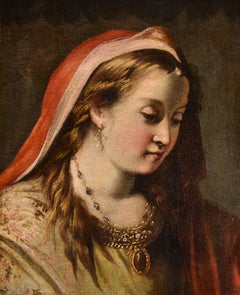
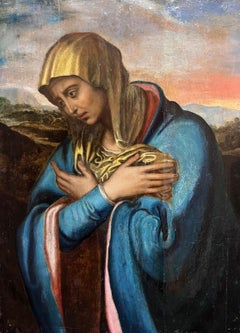
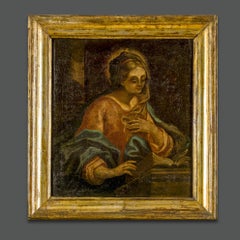
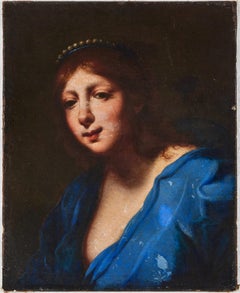
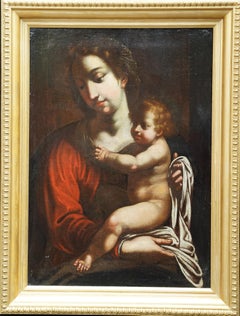
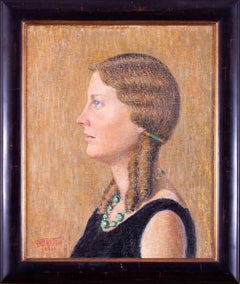
Italian Old Master portrait in the manner of Botticelli, oil on panel

$12,352.41List Price

You May Also Like

Fine 17th Century Italian Old Master Oil Painting Portrait of the Madonna

Fine 17th Century Italian Old Master Oil Painting Portrait of the Madonna

Located in Cirencester, Gloucestershire

Portrait of the Madonna in Prayer 17th Century Italian School oil on board, framed framed: 6.75 x 6 inches board: 5 x 4 inches Provenance: private collection, England Condition: ver...

Category

17th Century Old Masters Portrait Paintings

Materials

Oil

Portrait Woman Princess Diziani Paint 18th Century Oil on canvas Old master Art

Portrait Woman Princess Diziani Paint 18th Century Oil on canvas Old master Art

Located in Riva del Garda, IT

Gaspare Diziani (Belluno 1689 - Venice 1767) Portrait of a Young Princess (Salome?) Oil on canvas 42 x 33 cm Framed 70 x 63 cm A charming portrait of a beautiful young woman with ...

Category

18th Century Old Masters Paintings

Materials

Oil

Very Rare Renaissance Old Master Oil Painting c. 1600 Oil on Panel The Madonna

Very Rare Renaissance Old Master Oil Painting c. 1600 Oil on Panel The Madonna

Located in Cirencester, Gloucestershire

The Virgin Madonna Spanish Renaissance artist, circle of El Greco (1541-1614) circa 1600 oil on wood panel, unframed panel: 20 x 14.5 inches Provenance: private collection, northern ...

Category

Early 17th Century Renaissance Figurative Paintings

Materials

Oil

Portrait of a Woman, 17th Century Oil on canvas, Italian

Portrait of a Woman, 17th Century Oil on canvas, Italian

Located in Stockholm, Stockholm

Portrait of an Italian young woman in half length against a dark background executed with great softness and psychological subtlety. Her head inclines gently downward, her gaze withd...

Category

17th Century Old Masters Portrait Paintings

Materials

Canvas, Oil

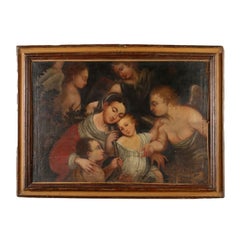
Religious Subject Oil on Canvas Italy XVII Century

Religious Subject Oil on Canvas Italy XVII Century

Located in Milan, IT

Oil painting on canvas. Venetian school of the seventeenth century. Entirely in the foreground, this scene of a group of sacred figures, which presents the faces of Mary and the Chil...

Category

17th Century Other Art Style Figurative Paintings

Materials

Oil

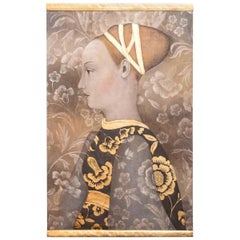
Painted Canvas of a Renaissance Style Woman Portrait, Contemporary Work

Painted Canvas of a Renaissance Style Woman Portrait, Contemporary Work

Located in Saint-Ouen, FR

Painted canvas figuring a side view of a woman portrait in the Renaissance style. She wears a black dress with a gilt collar, belt with gilt flower motifs, grey sleeves adorned with...

Category

21st Century and Contemporary French Renaissance Decorative Art

Materials

Canvas

Copy of "Portrait of Beatrice dʼEste" by Leonardo da Vinci created 15th Century

Copy of "Portrait of Beatrice dʼEste" by Leonardo da Vinci created 15th Century

Located in New York, NY

A masterful copy by an unknown artist, after the portrait of "Beatrice d'Este" by Leonardo Da Vinci also known as ‘Portrait of a Lady’ or ‘La Dama con la reticella di perle (The Lady With a Pearl Hairnet)’. The original work originally created in the 15th Century is currently on display in the Pinacoteca Ambrosiana Museum of Milan. Beatrice d'Este was the Duchess of Bari/Milan and was believed to be one of the most attractive princesses of the Renaissance. Her impeccable style won her many admirers throughout Italy and France, and she became a trendsetter of the highest order. This copy of the original painting, is an oil on canvas done in the 18th Century, and in this exquisite portrait, the artist has masterfully depicted the fine details with draped hair, pearls, royal dress, ornate headgear and sumptuous jewelry in front of a dark background. Once again, capturing the imagination with another enigmatic smile. It comes housed in an elegant period giltwood frame with ebonized trims and ready to be displayed with hanging wire on verso. Art measures 28 x 18 inches Frame measures 34.5 x 24.5 inches There is much debate and controversy over who actually painted the "Beatrice d'Este" was it Leonardo da Vinci (1452–1519), or Giovanni Ambrogio de Predis (1455–1508). So we may never know who executed the original portrait which hangs in the museum, but that need not deter from an appreciation of its singularity. Following the portraiture convention established by painters of the Quattrocentro, the artist has chosen to portray his sitter in profile. In doing so, he magnificently captures the essence of his sitter, a girl on the threshold of womanhood. Bedecked in the adornments—silk, velvet, pearls and embroidery (brocade) crafted of spun gold threads—afforded her by birthright and marriage, Beatrice looks forward in noble serenity. And at the same time her profile with its upturned nose and slight smile betrays an innocence that must have been the basis of the oft-repeated epithet: la più zentil donna in Italia” (“the sweetest lady in Italy”). It is believed the lady is Beatrice d'Este (1475-1497), duchess of Bari and later of Milan, the wife of Ludovico Sforza (known as "il Moro"). One of the most beautiful princesses of the Italian Renaissance, she was known for her good taste in fashion. Beatrice was a member of the Este-Sforza family, which joined by marriage two of the oldest reigning and already powerful houses in Italy. The house of Este, which held court in Ferrara, traced its lineage to the 11th century Dukes of Saxony and Bavaria. Beatriceʼs father, Ercole I ruled the Ferrara commune for 34 years, catapulting the city-state (and the Estes with it) to an unmatched level of economic prosperity and cultural prominence. The family was renowned for its love of letters and patronage of the arts. The first time Leonardo da Vinci’s name resounded in the Ambrosiana, it was through the pen of its founder, Cardinal Federico Borromeo, who attributed this little panel to the great Master, describing it as “A portrait of a Duchess of Milan, by the hand of Leonardo”. Following the Cardinal’s statement, the portrait was for long assumed to depict Beatrice d’Este, the wife of Ludovico il Moro. However, scholars have recently been more cautious and vague in their statements, with regard to both the artist (anonymous Lombard or Emilian...

Category

18th Century Northern Renaissance Portrait Paintings

Materials

Canvas, Oil

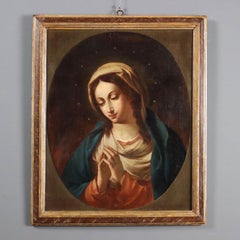
Painting Madonna Orante, Copy from Sassoferrato 18th century

Painting Madonna Orante, Copy from Sassoferrato 18th century

Located in Milan, IT

Oil on Canvas. This is a copy of a Praying Madonna painted by Giovan Battista Salvi, known as Sassoferrato, who became known for this type of depiction of Mary, portrayed in an attit...

Category

18th Century Other Art Style Figurative Paintings

Materials

Oil

More From This Seller

View All
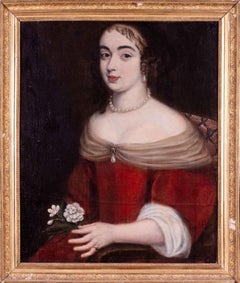
French School, 17th Century, 'Portrait of the Marquise de Grugieres', oil canvas

French School, 17th Century, 'Portrait of the Marquise de Grugieres', oil canvas

Located in Petworth, West Sussex

French school, 17th Century Portrait of the Marquise de Grugieres Oil on canvas 26.1/4 x 21.5/8 in. (66.7 x 54.8 cm.) In a gilded composite frame, later production (possible early 1...

Category

17th Century Old Masters Portrait Paintings

Materials

Canvas, Oil

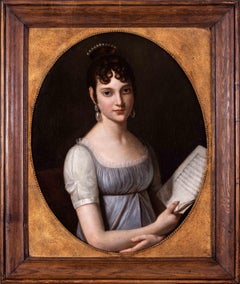
Old Master portrait of a lady musician by the master or portraiture

Old Master portrait of a lady musician by the master or portraiture

Located in Petworth, West Sussex

Attributed to Pierre Paul Prud’hon (French, 1758-1823) 'La belle musicienne' Oil on canvas, oval Signed ‘P. P. Prudon’ (lower left) 28.3/4 x 23.1/2 in. (73 x 59.5 cm.) Pierre Paul Prud'hon is considered a prime example of early French Romanticism. He was born as the seventh and last child of a master tailor. At the age of 16 he was a pupil of the painter and sculptor Francois Devosge. After finishing his studies he moved to Paris, where he first worked for an engraver and became friends with the Baron of Joursanvault, who became his patron. He also made a friendship with the "incorruptible", the politician and revolutionary Maximilien de Robespierre. Despite important friendships and the care of some cardinals, Prud'hon plunges into loneliness and melancholy. He has a good reputation and produces allegorical paintings, but his attachment to Robespierre forces him to leave the French capital. He now lives in the Free County of Burgundy, where he makes portraits and illustrations for Pierre Didot, the owner of the printing house. After a few years he moved back to Paris and his career received a new impetus. In the Louvre, Prud'hon is provided with a studio in which he paints "La sagesse et la vérité descendant sur la terre" (Wisdom and Truth descend to earth) for one year, as well as some ceilings of the Louvre. The government assigns him a studio in the Sorbonne, where his wife Jeanne, whom he married at the age of 19, comes looking for him. To escape her, he asks the museum director for protection. In 1808 he wrote "La justice et la vengeance divine poursuivant le crime" (Justice and divine revenge pursue the crime). In the same year he is also named Knight of the Legion of Honour and is able to break with his grumpy wife once and for all. He soon reconnects with his student and painter of neoclassicism Constance Mayer. Pierre is commissioned to paint a portrait of the Empress and wife of Napoleon, Joséphine de Beauharnais, which can still be seen today in the Louvre. He also paints the small "Roi de Rome" (King of Rome). In 1816 the Academy of Fine Arts elected him a member, where he took over the armchair in the painting section of François-André Vincent. A few years later his depressed wife commits suicide, and full of pain Prud'hon finishes her last work "Une famille malheureuse" (Engl. An Unhappy Family) and exhibits it. He himself dies soon afterwards and is buried in Paris. Many renowned artists admire Prud'hon for his "clair-obscur", the chiaroscuro painting...

Category

18th Century Old Masters Portrait Paintings

Materials

Canvas, Oil

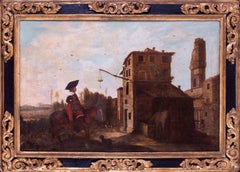
17th Century Spanish school oil painting of a soldier arriving at a village

17th Century Spanish school oil painting of a soldier arriving at a village

Located in Petworth, West Sussex

Spanish School (17th Century) A soldier arriving at a village Oil on canvas Unsigned 29 x 43.1/4 in. (74 x 110 cm.) Oil on canvas, not relined. Surface dirt and varnish discolourati...

Category

17th Century Old Masters Figurative Paintings

Materials

Canvas, Oil