Bartholomeus van Bassen (The Hague 1590-1652)
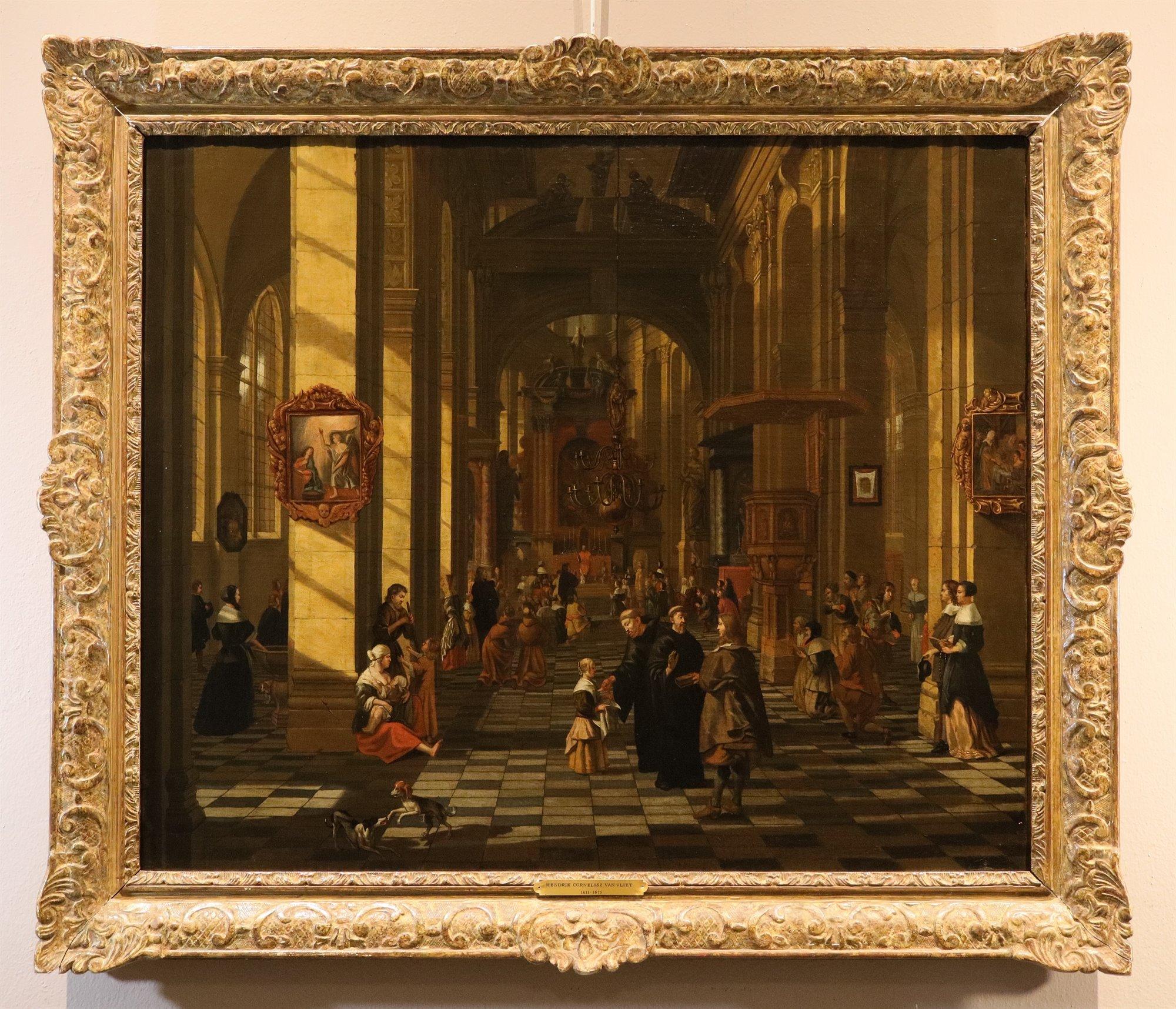
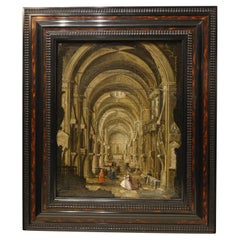
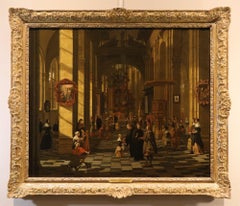
An interior of a Gothic cathedral with figures
signed and dated 'B v Bassen / 1650' (on pillar, lower right)
Oil on panel
Painting size - 17 7/8 x 24 1/4 in
Framed size - 25 x 31 1/2 in
Provenance
Sale, Galerie Fischer, Lucerne, 27-28 August 1929, lot 28
Sale, Sotheby's, London, 17 February 1982, lot 88
Sale, Hôtel President, Geneva, 18 May 1986 (with figures by another hand)
Private Collection, Switzerland
Sale, Hapsburg, Feldman, S.A., Geneva, 18 June 1989, lot 50, where acquired by the present owner
Private collection, Malibu, California
Literature
B.G. Maillet, Intérieurs d'églises 1580–1720. La peinture architecturale des écoles du nord, Brussels 2012, p. 213, cat. no. M-0212, ill.
Bartholomeus van Bassen was a Dutch Golden Age painter, architect, and designer celebrated for his refined architectural interiors and imaginative depictions of churches, palaces, and Renaissance halls. Active during the early seventeenth century, he played an important role in the development of architectural painting in the Netherlands, combining precise perspective with an elegant sense of light and space.
Born in The Hague in 1590, van Bassen emerged during a period of extraordinary artistic innovation in the Dutch Republic. Little is known of his early training, though it is believed he studied within the flourishing artistic circles of The Hague and Delft, where architectural painting was becoming increasingly popular. His work reflects both the influence of Netherlandish perspective traditions and the growing interest in classical architecture inspired by Italian Renaissance design.
Van Bassen became a member of the Guild of Saint Luke in The Hague in 1613 and quickly established himself as both a painter and architect. Unlike many artists who focused solely on easel painting, he maintained a dual career in architecture and civic design. This practical architectural experience gave his paintings an unusual degree of structural credibility and sophistication.
His painted interiors are characterised by soaring vaulted ceilings, grand colonnades, checkerboard floors, and carefully controlled perspective lines that draw the viewer deep into the composition. Although many scenes appear realistic, van Bassen often created imaginary or idealised interiors rather than exact representations of existing buildings. These works blended fantasy with architectural precision, producing scenes of remarkable harmony and theatricality.
Van Bassen is particularly associated with church interiors, a genre that became highly popular in the Dutch Republic during the seventeenth century. His paintings frequently depict elegantly dressed figures conversing within immense sacred spaces flooded with soft daylight. The balance between architectural order and human activity gives his works both monumentality and intimacy. In several paintings, the staffage figures were executed by collaborating artists, including specialists in portraiture and genre scenes, a common practice among Dutch painters of the period.
As an architect, van Bassen held several official appointments. He served as city architect of The Hague and was involved in military and civic building projects. He also worked as surveyor and architect for the Princes of Orange, contributing designs and decorative schemes connected with courtly architecture. Though relatively few of his architectural works survive intact, his reputation during his lifetime rested equally upon his abilities as a designer and painter.
Van Bassen’s paintings reveal the broader cultural ambitions of the Dutch Republic during its Golden Age. His interiors celebrate order, learning, prosperity, and the grandeur of civic and religious architecture. Stylistically, his work helped pave the way for later Dutch architectural painters such as Pieter Saenredam, Gerard Houckgeest, and Emanuel de Witte, though van Bassen’s compositions tend to be more ornate and imaginative than the austere realism favoured by some of his successors.
Today, his works are held in numerous museum collections across Europe and North America, including major Dutch and international institutions. Collectors and historians continue to value his paintings for their mastery of perspective, luminous atmosphere, and insight into seventeenth-century architectural taste.
Bartholomeus van Bassen died in The Hague in 1652. He remains one of the pioneering figures of Dutch architectural painting, admired for his ability to transform built space into scenes of elegance, harmony, and quiet grandeur.