Want more images or videos?
Request additional images or videos from the seller
1 of 9

Douglas Crockwell
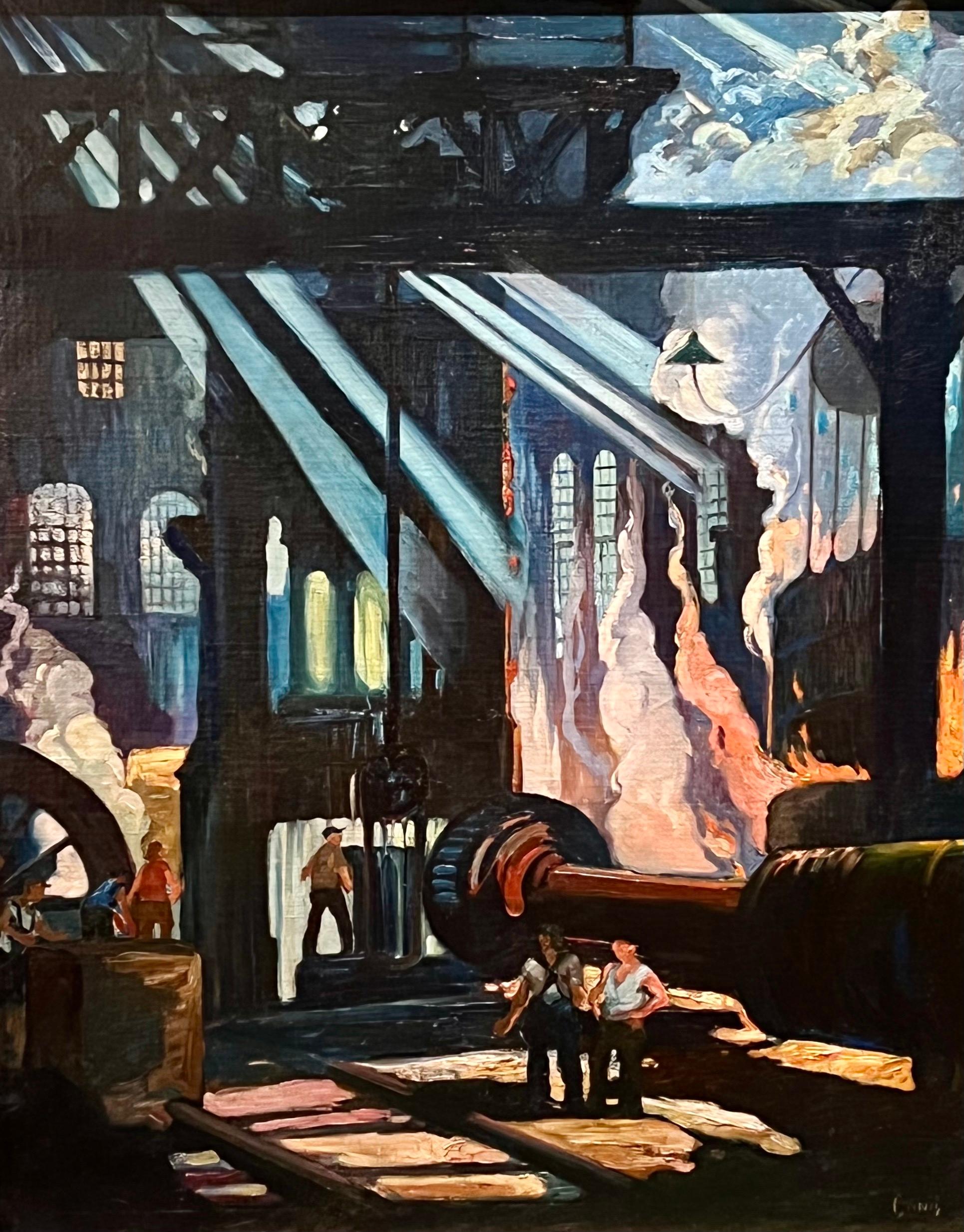
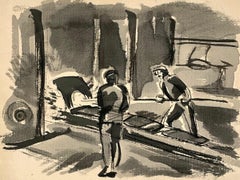
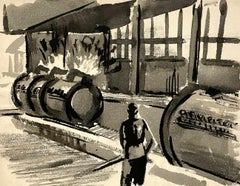
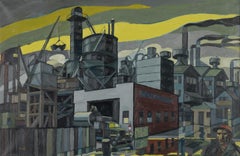
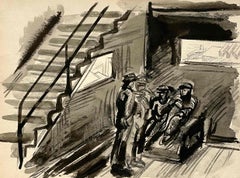
"Paper Making" WPA Industrial Mid-Century American Scene Social Realism Workers

c. 1936

$85,000
£63,806.69
€74,385.48
CA$120,377.31
A$120,710.07
CHF 69,837.28
MX$1,469,841.92
NOK 810,440.99
SEK 826,026.88
DKK 556,129.17

About the Item

"Paper Making" WPA Industrial Mid-Century American Scene Social Realism Workers Douglas Crockwell (1904-1968) "Paper Making" 19 x 39 inches Oil on board, c. 1936 Signed verso Framed: 28 x 47 Provenance: Estate of the Artist BIO Spencer Douglass Crockwell was born into a comfortable middle class household on April 29, 1904 in Columbus, Ohio. His father, Charles Roland Crockwell, was a mining engineer; his mother, Cora, was the daughter of an Iowa attorney. He became a commercial artist and experimental filmmaker who spent a good part of his career creating illustrations and advertisements for the Saturday Evening Post. In 1907 the Crockwell family moved to St. Louis, Missouri, where he graduated from high school and then attended from Washington University. Initially he studied engineering, but soon switched to business. While still an undergraduate, Crockwell took courses at the St. Louis School of Fine Arts and quickly realized that he wanted to be an artist. After graduating from Washington University in 1926, Crockwell continued to study at the St. Louis School of Fine Arts until 1929. The following year he relocated to Chicago and continued his studies at the American Academy of Art. In 1930 and 1931 he studied in Europe on a Traveling Fellowship. In 1932 Douglass Crockwell moved to Glens Falls, New York, which was to be his home for the remainder of his life. The following year he married Margaret Braman. They had three children, a son Douglass and two daughters, Johanna and Margaret. During the depression he created murals and posters for the Works Progress Administration including Post Office murals in White River junction, Vermont; Endicott, New York; and Macon, Mississippi. In 1934 he painted Paper Workers, Finch Pruyn & Co. (the leading Glens Falls, New York company) for the WPA. In the 1930s Crockwell developed an interest in experimental animated films that occupied him for the rest of his life. In 1936 and 1937, he collaborated with David Smith, a sculptor, to create surrealist films. Because of his interest in experimental films, his output of paintings was limited to just twenty to forty illustrations a year during this time. Crockwell painted his first of many Saturday Evening Post cover in 1933. He also worked for Life, Look, and Esquire, and numerous national advertisers including Friskies dog food, Welch’s Grape Juice, Republic Steel, Brown & Bigelow calendars, Avondale Mills, and General Electric. During World War II Crockwell created posters for United Service Organizations (USO), the Army, the Marines, the Nurse Corp. and an award winning poster for the American Relief for Holland. He went on to create poster art for the MGM movie The Yearling in 1946. Douglass Crockwell was hired in 1947 to provide paintings for the United States Brewers Foundation “Beer Belongs” ad campaign. Launched in 1946, the campaign’s goal was to rebranded beer as a part of a wholesome American lifestyle. The campaign ran for 10 years, producing 136 advertisements by various artists. The exact number Crockwell contributed is uncertain, but it is estimated that he did roughly half the total number of illustrations. In fact, he often referred to himself as “the poor man’s Norman Rockwell”. Since both artists produced cover illustrations for The Saturday Evening Post during the same period, Rockwell once suggested that Crockwell consider changing his name. While he did not change his name, Crockwell sometimes signed his work “Douglass,” "DC," or simply "D” to avoid any confusion. Douglass Crockwell also had a lifelong interest in sciences, particularly atomic physics. In 1954 his theory of the particle field was the subject of an "Amateur Scientist" column of Scientific American magazine. Crockwell was an active member of numerous civic organizations, notably a founding trustee and the first director of The Hyde Collection, a respected art museum in Glens Fall, New York. His work received two St. Louis Artists Guild Awards (1930, 1931); the 1942 Art Directors Club of New York Award for best poster; the 1944 and 1945 Art Directors Club of New York Award for best human interest color illustration; the 1947 Art Directors Club of New York Gold Medal for best poster; the 1957 Los Angeles Art Directors Award for best painting; as well as numerous awards for his films. Douglass Crockwell died at home on November 30, 1968. His paintings can be seen in museums nationwide and in the permanent collection of The Smithsonian.
  • Creator:
    Douglas Crockwell (1904 - 1968, American)
  • Creation Year:
    c. 1936
  • Dimensions:
    Height: 28 in (71.12 cm)Width: 47 in (119.38 cm)
  • Medium:
  • Movement & Style:
  • Period:
  • Condition:
  • Gallery Location:
    New York, NY
  • Reference Number:
    1stDibs: LU1156217136632

More From This Seller

View All
Machine Age Industrial WPA Era American Scene Social Realism Mid 20th Century

Machine Age Industrial WPA Era American Scene Social Realism Mid 20th Century

By Jo Cain

Located in New York, NY

Machine Age Industrial WPA Era American Scene Social Realism Mid 20th Century Jo Cain (1904 - 2003) Elliot 17 ¼ x 35 ¾ inches Gouache on board, c. 1930s Signed lower left 27 x 46 in...

Category

1930s Interior Drawings and Watercolors

Materials

Gouache, Board

Industrial Working Man Social Realism Mid-20 Century Modern American Scene Art

Industrial Working Man Social Realism Mid-20 Century Modern American Scene Art

By Edith Kramer

Located in New York, NY

Industrial Working Man Social Realism Mid-20 Century Modern American Scene Art Edith Kramer (1916-2014) "Man on Lathe II" Oil on linen, 1949 23 x 22 inches Signed and dated in blac...

Category

1940s American Modern Figurative Paintings

Materials

Oil, Linen

WPA Mural Study Mid-Century Modern American Scene Social Realism Workers

WPA Mural Study Mid-Century Modern American Scene Social Realism Workers

By Anton Refregier

Located in New York, NY

WPA Mural Study Mid-Century Modern American Scene Social Realism Workers Anton Refregier (1905-1979) Mural Study, Untitled 7 ¾ x 22 inches (sight) Gouache, pencil, and charcoal on board, c. 1940s Unsigned Provenance: Estate of Seymour Fogel, noted verso Thomas McCormick Gallery...

Category

1940s American Modern Mixed Media

Materials

Charcoal, Gouache, Board, Pencil

You May Also Like

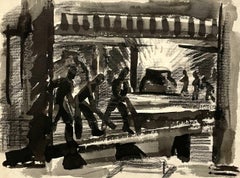
WPA Era, Industrial Scene Steel Mill by Chicago Modern Artist, Harold Haydon

WPA Era, Industrial Scene Steel Mill by Chicago Modern Artist, Harold Haydon

By Harold Haydon

Located in Chicago, IL

A dynamic 1930s, WPA era industrial scene watercolor of steel mill factory workers by notable Chicago Modern artist, Harold Haydon. A wonderful example of early Twentieth Century ar...

Category

1930s American Modern Landscape Drawings and Watercolors

Materials

Watercolor, Paper

WPA Era, Industrial Scene Steel Mill by Chicago Modern Artist, Harold Haydon

WPA Era, Industrial Scene Steel Mill by Chicago Modern Artist, Harold Haydon

By Harold Haydon

Located in Chicago, IL

A dynamic 1930s, WPA era industrial scene watercolor of a steel mill and factory workers by notable Chicago Modern artist, Harold Haydon. A wonderful example of early Twentieth Cent...

Category

1930s American Modern Landscape Drawings and Watercolors

Materials

Watercolor, Paper

"Colonial Sand and Stone Company, New York, " Industrial WPA Scene, Precisionist

"Colonial Sand and Stone Company, New York, " Industrial WPA Scene, Precisionist

By William Sharp

Located in New York, NY

William Sharp (1900 - 1961) Factory on the River Oil on canvas 20 1/2 x 28 1/2 inches Initialed lower left: WS Provenance: Estate of the artist Private Collection, New York Swann Auction Galleries, American Art, June 13, 2019, Lot 178 Private Collection, New York Colonial Sand and Stone Co., founded by Generoso Pope, was once the country’s largest sand and gravel business, providing the concrete for much of New York City’s skyline, including the Empire State Building, Rockefeller Center, Radio City Music Hall, airports and subways. William Sharp was born on June 13, 1900, in Lemberg, Austria, where he attended college and the Academy for Arts and Industry. He later studied in Kraków, Poland, and in Berlin and Munich, Germany. Sharp began his career as a designer of stained-glass windows and as a painter of murals. He served in the German army during World War I. After the war he became a newspaper artist in Berlin and a well-known etcher. Sharp drew political cartoons that were bitterly critical of the growing Nazi movement. As the influence of National Socialism intensified, he began to contribute drawings, under a pseudonym, to publications that were hostile to Hitler. After Hitler assumed power, Sharp was confronted with these drawings and told that he would be sent to a concentration camp. However, in 1934, he escaped to the United States. His first newspaper assignment in America was making courtroom sketches for The New York Mirror...

Category

Mid-20th Century American Realist Landscape Paintings

Materials

Canvas, Paint, Oil

WPA Era, Industrial Scene Steel Mill by Chicago Modern Artist, Harold Haydon

WPA Era, Industrial Scene Steel Mill by Chicago Modern Artist, Harold Haydon

By Harold Haydon

Located in Chicago, IL

A dynamic 1930s, WPA era industrial scene watercolor of a steel mill and factory workers by notable Chicago Modern artist, Harold Haydon. A wonderful example of early Twentieth Cent...

Category

1930s American Modern Landscape Drawings and Watercolors

Materials

Watercolor, Paper

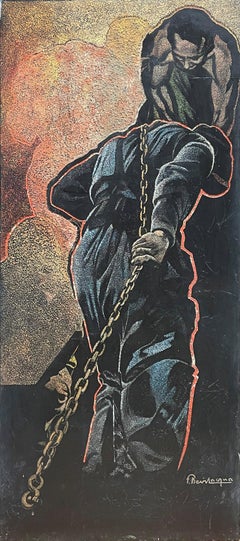
"Working Laborers, " Francis Bevilacqua, Soviet Cold War Art

"Working Laborers, " Francis Bevilacqua, Soviet Cold War Art

Located in New York, NY

Francis Bevilacqua (American, b. 1911) Working Laborers, n.d. Oil and pigment on black granite 44 x 21 inches Signed lower right Born in 1911, Francis Bevilacqua was predominantly influenced by the 1930s. The period of the 1930s is epitomized by the conflict between many political ideologies, including Marxist Socialism, Capitalist Democracy, and the Totalitarianism of both Communism and Fascism. In the Soviet Union, Stalin’s government needed urgent funds to implement the rapid industrialization demanded by the first Five Year Plan. It initiated a secret strategy to sell off treasures from the State Hermitage Museum in Leningrad (St. Petersburg), including a primary list of two hundred and fifty irreplaceable paintings by the Old Masters, a number of which ended up in the collection of Andrew Mellon...

Category

Mid-20th Century Realist Figurative Paintings

Materials

Granite

WPA Era, Industrial Scene Steel Mill by Chicago Modern Artist, Harold Haydon

WPA Era, Industrial Scene Steel Mill by Chicago Modern Artist, Harold Haydon

By Harold Haydon

Located in Chicago, IL

A dynamic 1930s, WPA era industrial scene watercolor of a steel mill and factory workers by notable Chicago Modern artist, Harold Haydon. A wonderful example of early Twentieth Cent...

Category

1930s American Modern Landscape Drawings and Watercolors

Materials

Watercolor, Paper