Alfred Vickers Senior (1786–1868)
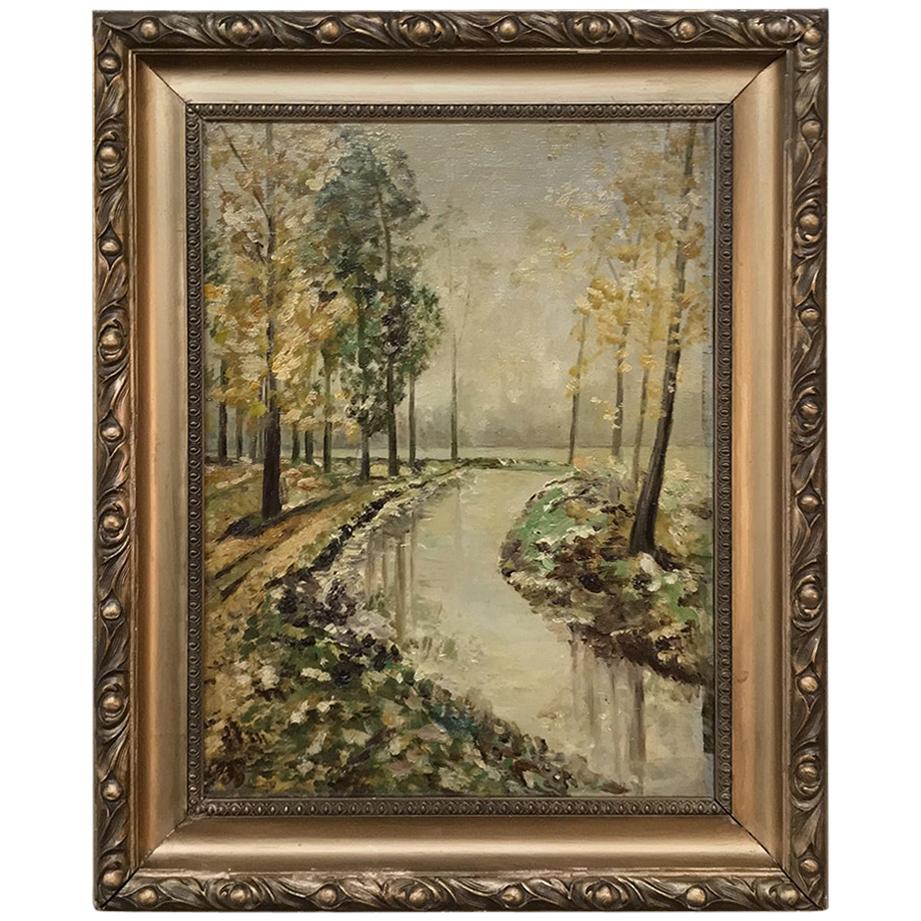
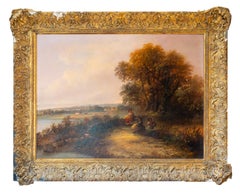
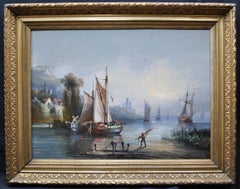
Figures Resting by a Canal
Oil on canvas, signed “A. Vickers” (just above the nameplate)
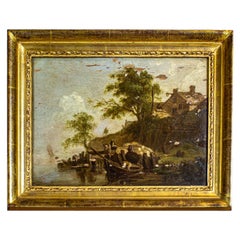
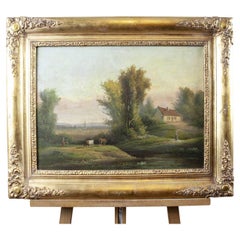
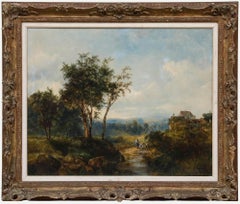
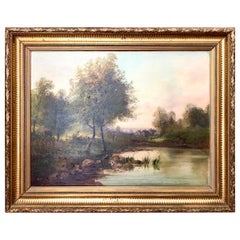
This tranquil landscape exemplifies Alfred Vickers’s lyrical approach to the English countryside, capturing a moment of repose along a peaceful canal.
In the foreground, a small group of figures — perhaps travellers or local villagers — rests on the grassy bank beside the waterway. One may be seated, another reclining, their relaxed attitudes suggesting a brief pause in the rhythm of daily life. The still surface of the canal mirrors the soft blue of the sky and the subtle greens of the vegetation along its edges.
Across the canal, modest rural buildings rise amid trees, while further back, a tall tower — likely that of a church — anchors the composition, adding both height and a sense of local identity. Its warm stone tone contrasts gently with the surrounding foliage and the pale atmosphere beyond.
Vickers’s brushwork is fluid and impressionistic, employing soft transitions of tone rather than hard outlines. His colour palette — composed of silvery blues, soft greens, and amber browns — evokes the shimmering light of an English afternoon. The subtle diffusion of light and shade creates a sense of depth and airiness, typical of his mature style.
The painting’s signature, placed discreetly just above the nameplate, affirms the artist’s authorship while maintaining the picture’s balanced harmony.
Overall, this work reflects Vickers’s quiet poetry and his gift for turning ordinary scenes into moments of contemplative beauty — a serene vision of pastoral England where human presence, nature, and architecture coexist in tranquil accord.
Alfred Vickers Senior (1786–1868)
Alfred Vickers was a British landscape painter active during the mid-19th century, known for his luminous rural scenes and gentle depictions of the English countryside. Born in London, Vickers exhibited regularly at the Royal Academy and the British Institution between 1831 and 1861. Though largely self-taught, his works reveal a deep sensitivity to atmosphere and light, often recalling the influence of Richard Wilson and early Constable.
Vickers worked extensively across southern England — painting riverbanks, meadows, and village views — as well as continental subjects, particularly scenes from France and the Low Countries. His style is recognizable for its loose, fluent brushwork, soft tonal harmonies, and a misty luminosity that lends his landscapes a poetic calm. He often included small figures or rustic details — cottages, bridges, boats, and church towers — to animate the scene with human presence.
His son, Alfred Gomersal Vickers (1810–1837), was also a painter, but Alfred Vickers Senior continued to work for several decades after his son’s death, leaving behind a consistent body of work that celebrates the quiet charm of nature and rural life.