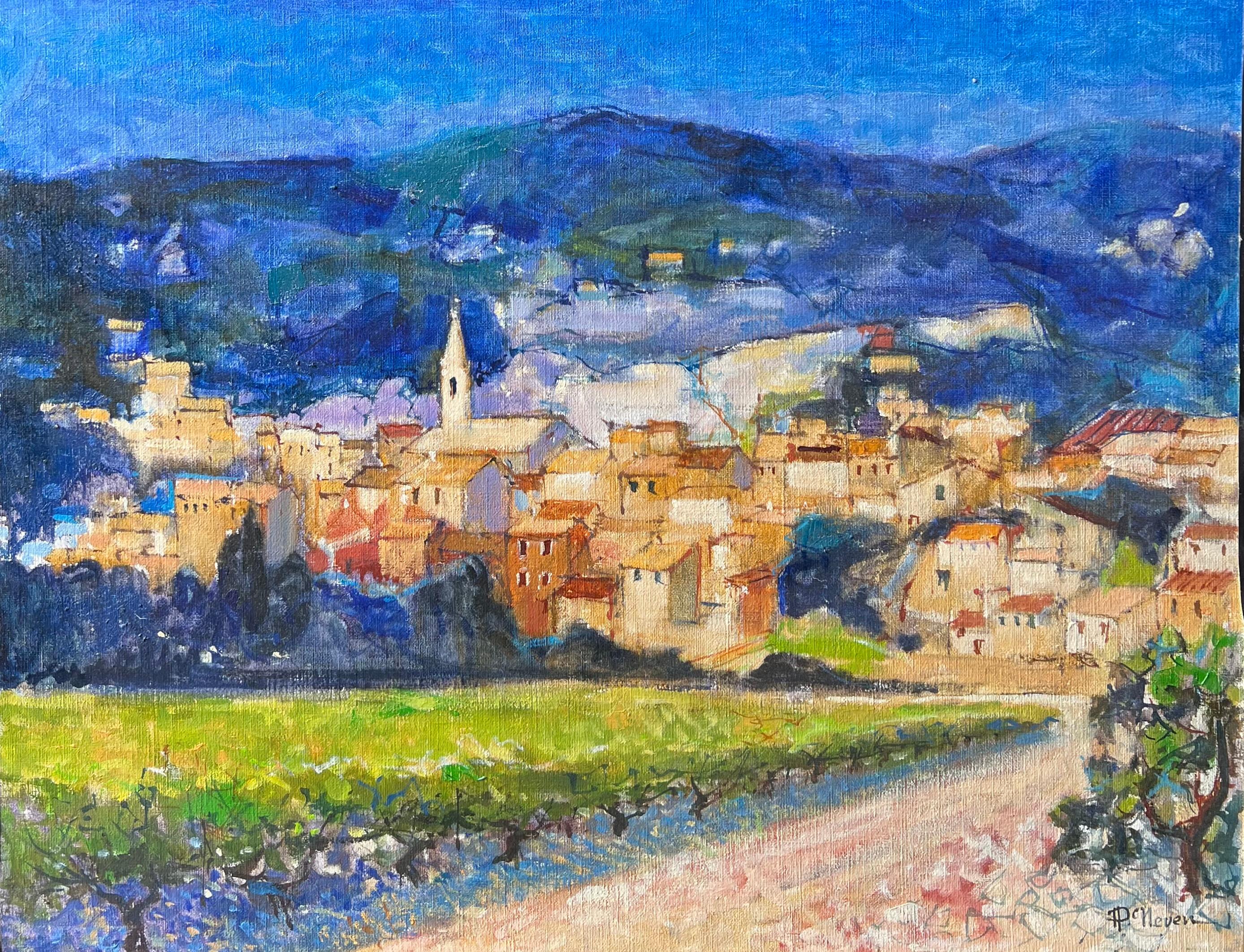
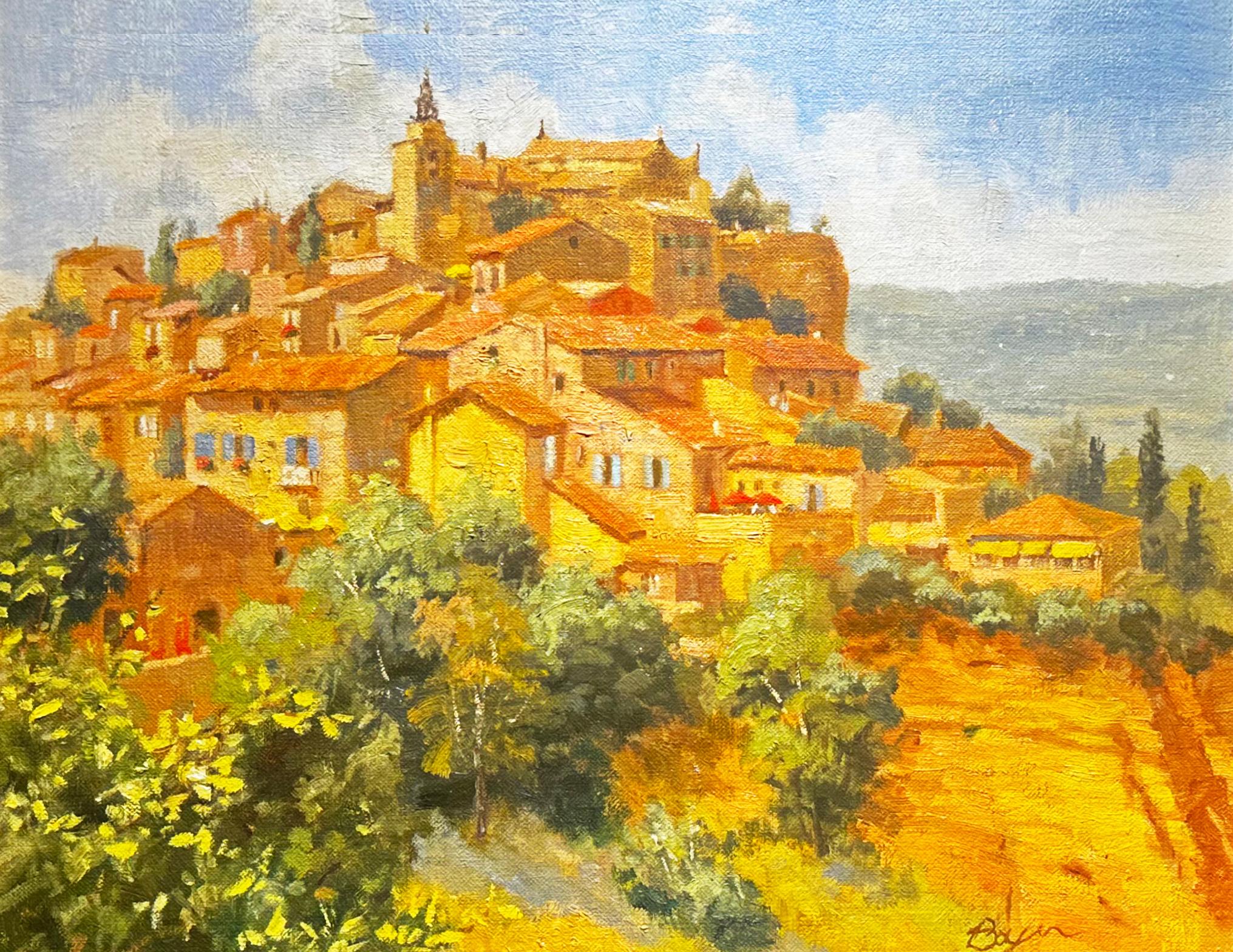
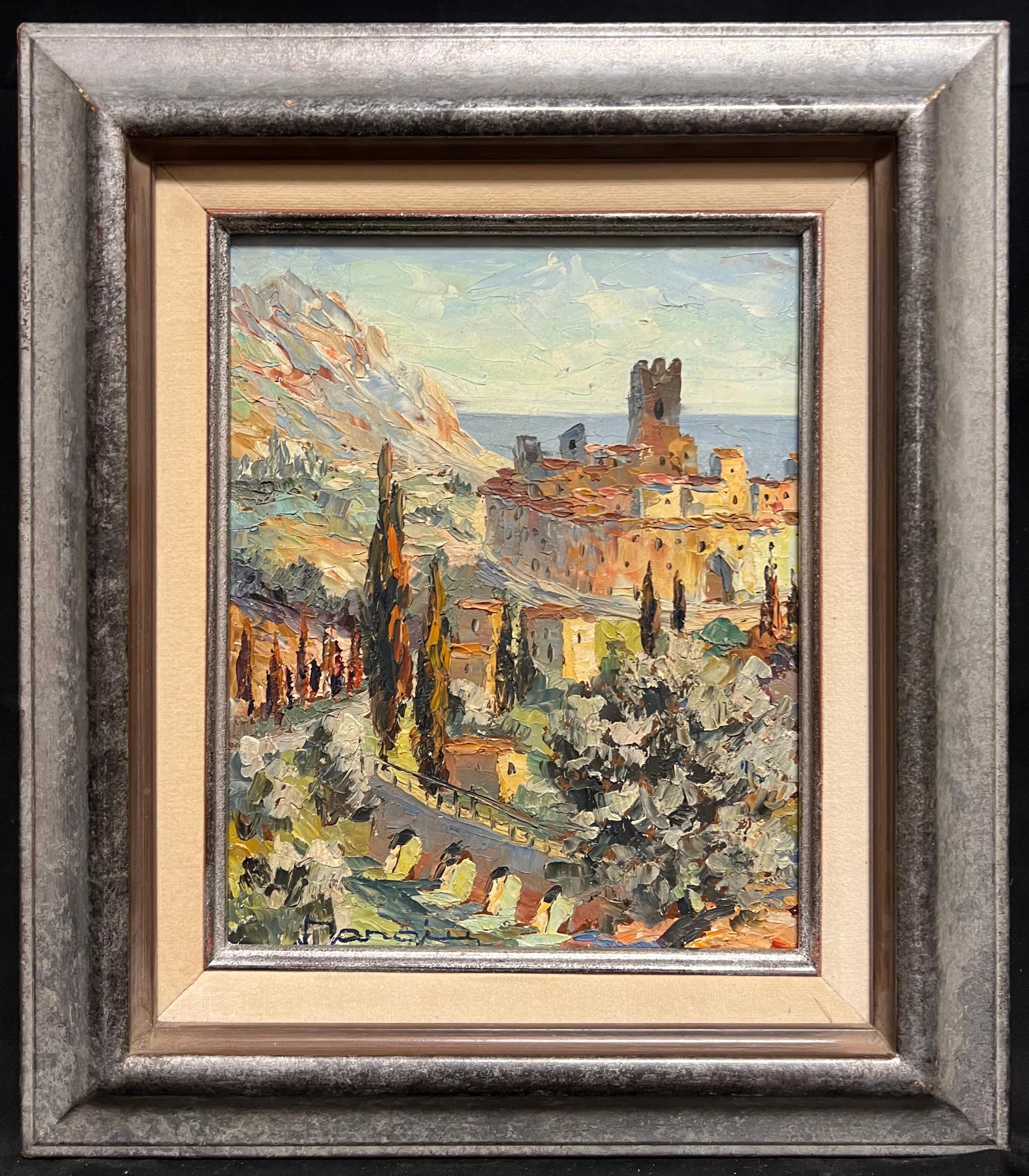
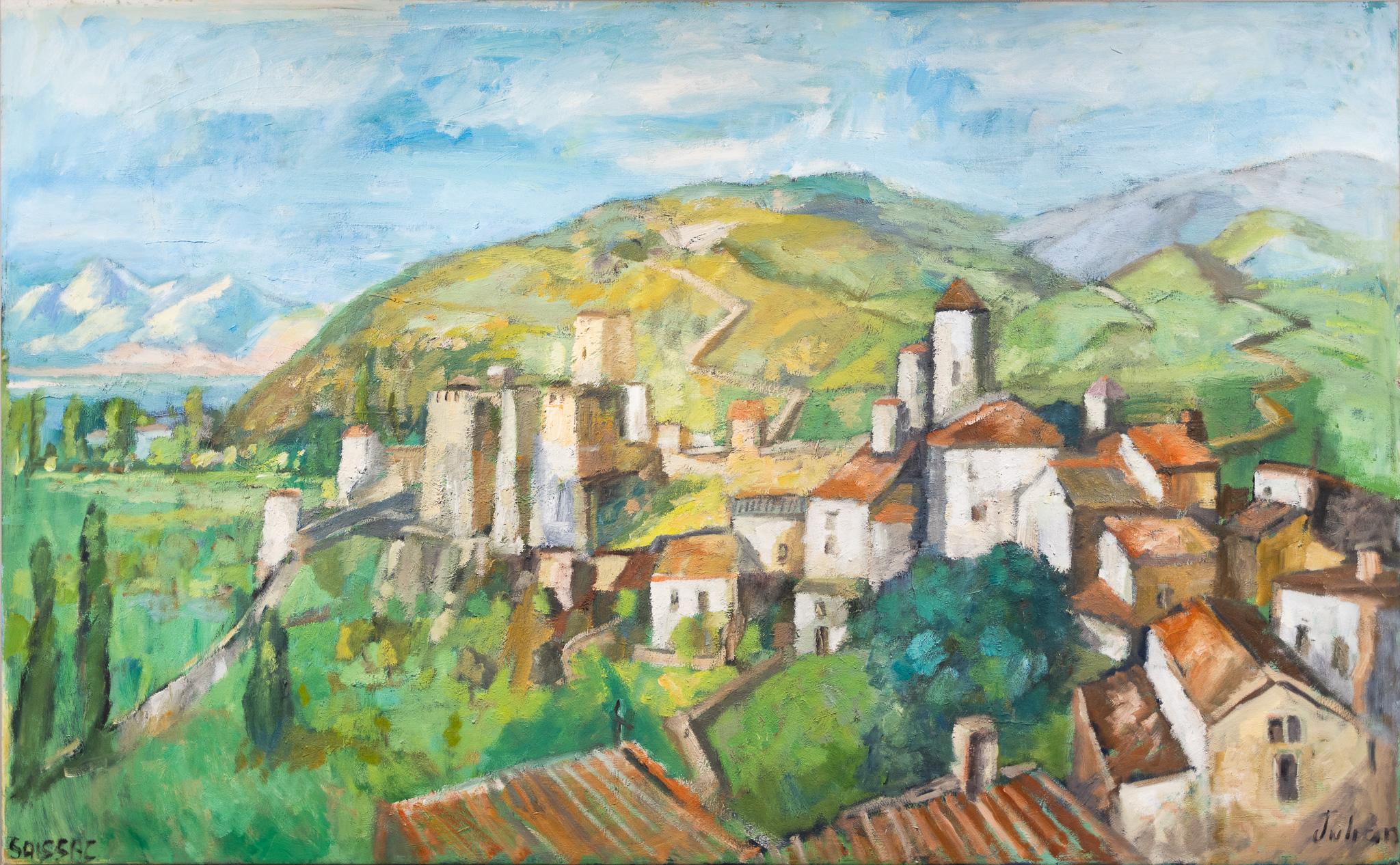
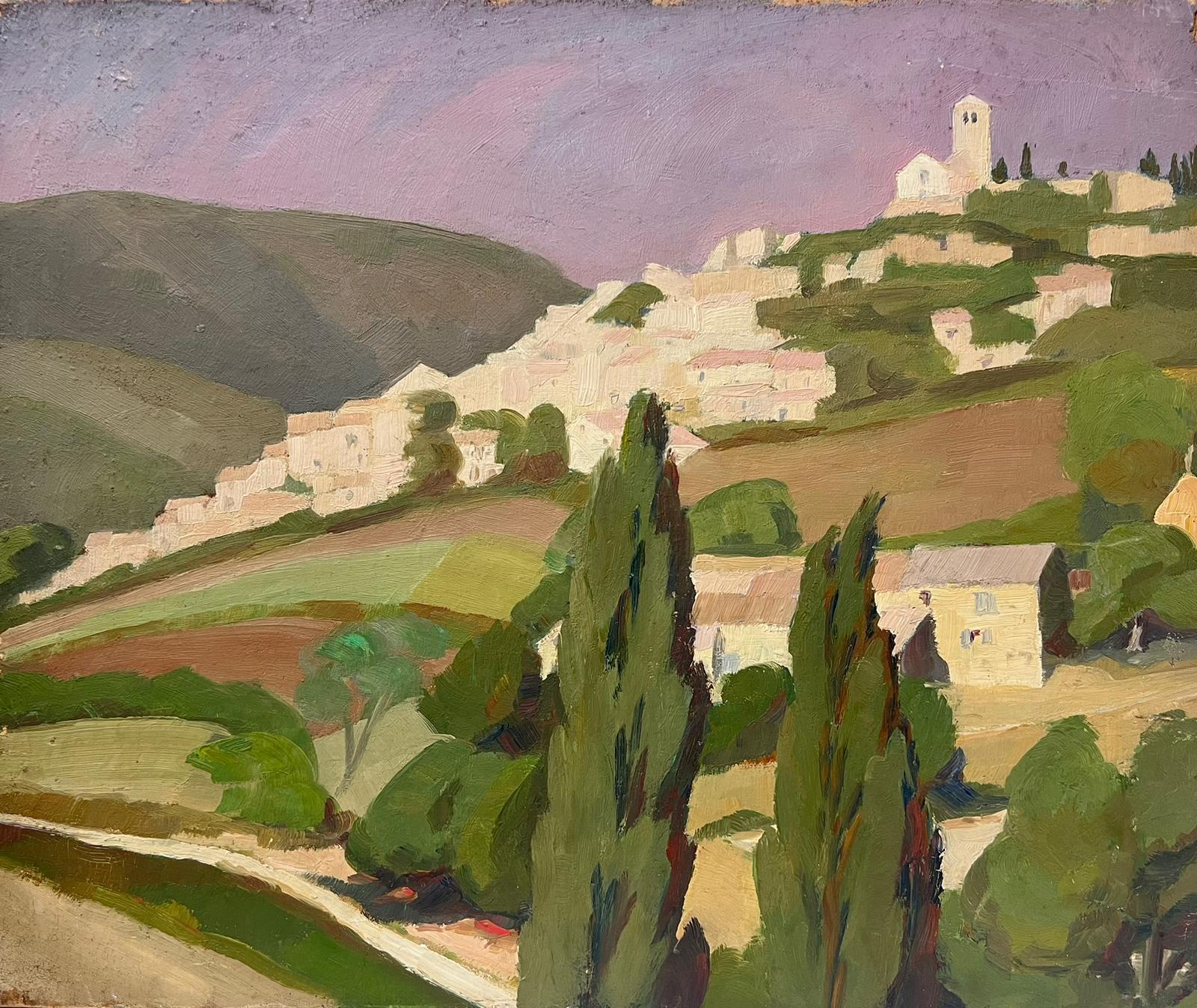
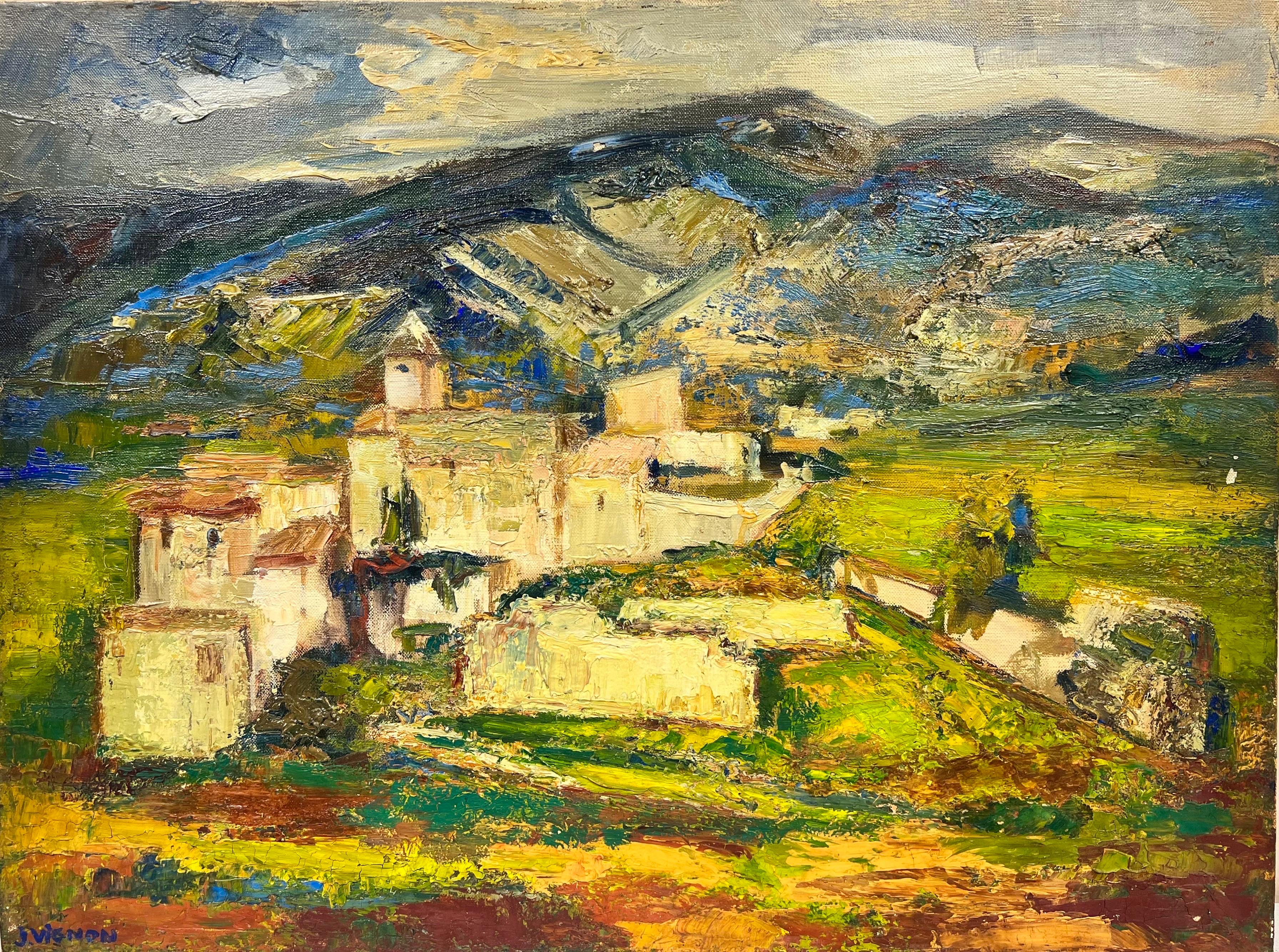
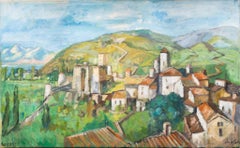
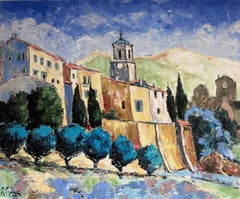
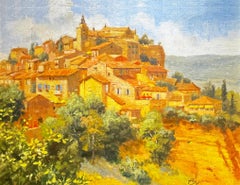
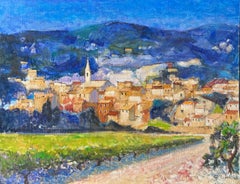
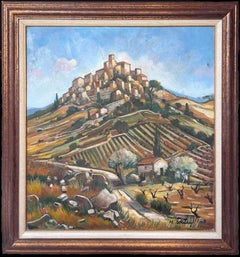
An exceptional tapestry-like mid-century French Post-Impressionist landscape painting by celebrated artist André Wilder (1871–1965), signed in the bottom left and dated 1933, beautifully capturing a sun-drenched hilltop village crowned by an ancient stone fortress. The artwork showcases Wilder’s signature en plein air mastery, relying on a vibrant, heavy impasto and a rich, texturally driven palette to capture the warm European light reflecting off traditional terracotta roofs and historic stone ramparts.
This is Villeneuve lez Avignon, the city of cardinals, where the legacy of the popes and centuries of history permeate every stone and alleyway, evoking the glorious past of a city deeply connected to its large neighbour, Avignon. Nestled between the banks of the Rhône and the Provençal hills, this royal city founded by Philip the Fair, was the scene of huge construction sites giving life to sumptuous cardinal's palaces, where you can find significant architectural treasures.
True to his Impressionist roots, Wilder foregoes rigid academic styling in favor of delivering raw, atmospheric emotion directly onto the canvas. The foreground is alive with structured, deep green agricultural rows and lush foliage that sweep the viewer’s eye upward through the geometric forms of the hillside village, culminating at the brilliant, sun-bleached walls of the chateau above.
This piece stands as a definitive example of early-to-mid 20th-century French landscape painting—bringing an air of timeless, authentic European elegance and curated provenance to any collection.
MORE ABOUT THIS PAINTING:
Title: Vue de Villeneuve-lez-Avignon
Medium: Oil on canvas
Overall size: 35ins x 26ins or 89cms x 66cms (Approx)
Date: 1933
Condition: The painting is in good stable vintage condition. The frame is also vintage, has imperfections throughout, particulalry at the corners.
Signed: André Wilder (born Eugène Lucien André van Wilder) (1871-1965) was a prominent French Post-Impressionist painter of landscapes, townscapes, and marines. Born in Paris in 1871 to parents of Belgian descent, he was officially naturalized as a French citizen in 1890. Raised in a highly cultured home,his father was a prominent music critic and translator of Richard Wagner, Wilder initially pursued the graphic arts, providing illustrations for popular Parisian periodicals like Le Monde Illustré during the 1890s.
Wilder received a stellar academic foundation at the École des Arts Décoratifs under the celebrated French master Jean-Léon Gérôme, as well as studying under Marius Michel in the South of France. Despite this traditional academic training, Wilder quickly broke away from the confines of the studio to paint en plein air (directly from nature).
He fell heavily under the spell of Impressionism, developing a profound admiration for Claude Monet and Alfred Sisley. A pivotal turning point came in 1895 when he met the landscape painter Maxime Maufra in Trébeurden, Brittany. Maufra’s bold approach heavily guided Wilder's personal style, which evolved into a distinct form of Post-Impressionism characterized by a spontaneous, energetic handling of paint and a brilliant mastery of light. Notably, Wilder often utilized a vermilion ground preparation on his canvases, allowing the reddish hues to deliberately peek through the contours of his landscapes, lending them an unusual, vibrant warmth.
Wilder enjoyed immense critical and commercial success during his lifetime. His talent caught the attention of the legendary Bernheim-Jeune gallery in Paris, which hosted major solo exhibitions of his work in 1904 and 1909. His landmark 1904 exhibition featured a five-page catalog preface written by the famous anarchist writer and influential art critic Octave Mirbeau, a close friend and champion of the original Impressionists.
Wilder traveled extensively to capture the varying qualities of European light, painting highly sought-after series across the Netherlands, Belgium, the banks of the Seine, and the rugged coasts of Brittany (Morbihan, Carnac, Saint-Malo). He regularly exhibited at France's most prestigious salons, including:
The Salon de la Société Nationale des Beaux-Arts
The Salon d’Automne
The Salon des Tuileries
His reputation expanded far beyond France, with exhibitions hosted in major global art hubs including London, New York, San Francisco, Zurich, Brussels, and Tokyo. In recognition of his "46 years of artistic career and military service," the French Ministry of National Education awarded him the prestigious rank of Chevalier de la Légion d’honneur in 1933.
In 1939, Wilder sought the luminous light of the French Riviera, relocating to Cagnes-sur-Mer. He spent his final decades working in the Lot region and later in Antibes, where he passed away in 1965 at the age of 93.
Today, his paintings are highly collectible examples of French Post-Impressionist landscape art. Numerous works by André Wilder were purchased directly by the French State and reside in the permanent collections of various French ministries, prefectures, town halls, and national museums.