Want more images or videos?
Request additional images or videos from the seller
1 of 5

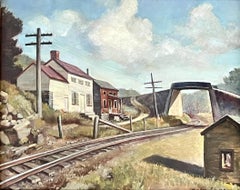
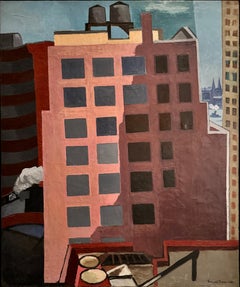
Edward Biberman
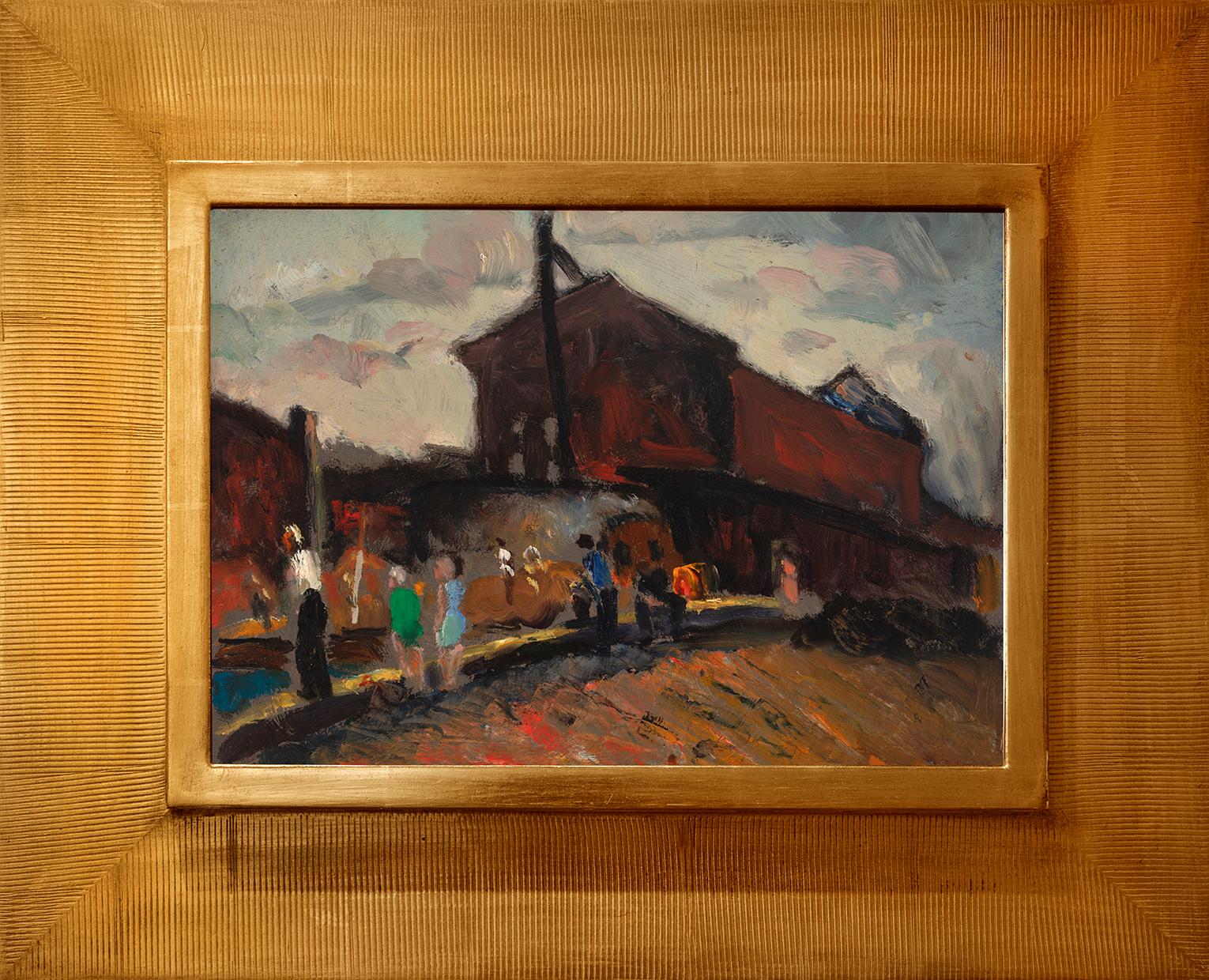
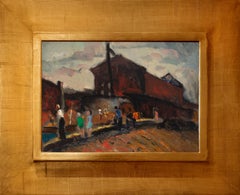
The Railway Station

c. 1934

$50,000
£37,984.85
€44,307.37
CA$71,623.13
A$72,659.34
CHF 41,328
MX$882,736.10
NOK 486,048.26
SEK 487,733.04
DKK 331,278.46

About the Item

The Railway Station, c. 1934, oil on canvas, signed lower right, titled verso and noted "34"; illustrated Kaufman, Jeffrey, Brush with Life: The Art of Being Edward Biberman (2007), 85 minutes (film) This work is part of our exhibition The Architectural World of Edward Biberman (1904 - 1986). About the Painting The Railway Station is an important early work by Edward Biberman. It is a prime example of Biberman's precisionist and magic realism oriented paintings from the 1930s. Painted in New York, The Railway Station shows the artist's keen interest in urban architecture. About the Artist Edward Biberman was one of California’s most important modernist painters. He was born in Philadelphia, the son of Russian Jewish immigrants. Biberman’s artistic career started at the Pennsylvania Academy of Fine Arts followed by three years of study in Paris, where he associated closely with Calder and Noguchi and exhibited at the Salon d'Automne, Grand Palais, in 1927 and the Salon des Independents in 1929. Upon his return to the United States, Biberman spent time in New York City, where he showed at many of the city’s premier galleries and museums. His works were selected for several of the Museum of Modern Art’s early exhibitions of American artists, including 46 Painters and Sculptors Under the Age of 35 (1930) and Murals by American Painters and Photographers (1932). Hoping to escape the pressures of the New York art world, Biberman moved to Los Angeles in 1936 where he could be close to his family, including his film director brother, Herbert Biberman, and his sister-in-law, the Academy Award winning actress, Gale Sondergaard. During the course of his long career, Biberman showed at the Salon d’Automne (Paris); the Whitney Museum of American Art; Metropolitan Museum of Art (New York), Corcoran Gallery, Los Angeles County Museum of Art (LACMA) and dozens of other museums and galleries across the US and in Europe. He enjoyed over forty-five solo exhibitions and his works were included in over one hundred group shows. Biberman completed three murals for public works projects, including his work Abbot Kinney and the Story of Venice for the Venice Post Office, which was installed for six months at LACMA in 2014. His works are in the permanent collections of more than a dozen museums, including the Museum of Fine Arts, Houston, National Portrait Gallery (of the Smithsonian Institution), Butler Institute of American Art, Pennsylvania Academy of Fine Arts and LACMA. Several books are dedicated to Biberman’s art, as is a feature length documentary, Brush with Life: The Art of Being Edward Biberman (2007). Biberman’s art has undergone a resurgence of popularity during the past fifteen years with four solo or focused exhibitions, Edward Biberman Revisited (2009), Edward Biberman (2011-12), Lost Horizons: Mural Dreams of Edward Biberman (2014) and Edward Biberman, Abbot Kinney and the Story of Venice (2014), and representation in a number of other exhibitions, such as George Ault and 1940s America at the Smithsonian Institution (2011), Pacific Standard Time (2012) and Contraption: Rediscovering California Jewish Artists (2018). He is listed in Who was Who in American Art and all other standard references. Biberman’s portrait of Martin Luther King, I Have a Dream, is currently on view at LACMA at part of Black American Portraits, a companion exhibition to the Obama presidential and first lady portraits. Biberman’s brand of modernism can fairly be divided into four categories 1) precisionist urban scenes of New York and Southern California which celebrate the creations of humanity; 2) portraits which expose not only the historical context, but also the souls, of his subjects; 3) rural landscapes and still life paintings which portray the beauty of America and its flora; and 4) social realist works which explore the struggles, hopes and shortcomings of our society. Regardless of genre, Biberman had a unique sense of structure and color. His figures are at the same time specific and universal. Taken as a whole, Biberman’s body of work presents the viewer with a compelling and often daring vision of 20th century America and its art.
  • Creator:
    Edward Biberman (1904 - 1986)
  • Creation Year:
    c. 1934
  • Dimensions:
    Height: 20 in (50.8 cm)Width: 30 in (76.2 cm)Depth: 1 in (2.54 cm)
  • Medium:
  • Movement & Style:
  • Period:
  • Condition:
  • Gallery Location:
    Los Angeles, CA
  • Reference Number:
    1stDibs: LU1859212202992

More From This Seller

View All
View from Main Reading Room, New York

View from Main Reading Room, New York

By Robert Herrmann

Located in Los Angeles, CA

View from Main Reading Room, New York, 1959-60, oil on canvas, signed and dated in pencil verso, 20 x 20 inches, exhibited: Cincinnati Art Galleries, Cincinnati, OH, March 4 to 28, 2...

Category

Mid-20th Century American Modern Landscape Paintings

Materials

Canvas, Oil

Pleasant Ridge

Pleasant Ridge

By Robert Herrmann

Located in Los Angeles, CA

Pleasant Ridge, 1966-7, oil on board, signed, dated and titled verso, 16 x 24 inches, exhibited: Robert Herrmann, Cincinnati Art Galleries, Cincinnati, OH, March 4 to 28, 2000, no. 1...

Category

Mid-20th Century American Modern Landscape Paintings

Materials

Masonite, Oil

Silverman's Barns

Silverman's Barns

By Marina Stern

Located in Los Angeles, CA

This work is part of our exhibition Marina Stern Luminary, the first retrospective of the artist since 2007. Previously exhibited: Marina Stern Nocturnes, Forum Gallery, New York, N...

Category

1990s American Modern Landscape Paintings

Materials

Canvas, Oil

Across the Street

Across the Street

By Charles Louis Goeller

Located in Los Angeles, CA

This painting is part of our exhibition Charles Goeller: A Wistful Loneliness. Oil on canvas, 16 x 12 inches, Signed lower right Exhibited: 1) [Solo E...

Category

1940s American Modern Landscape Paintings

Materials

Oil, Canvas

Park View

Park View

By Marina Stern

Located in Los Angeles, CA

This work is part of our exhibition Marina Stern Luminary, the first retrospective of the artist since 2007. Marina Stern was a multifaceted New York-based artist whose works ranged...

Category

1980s American Modern Landscape Paintings

Materials

Canvas, Oil

Untitled (Houses and Railroad Tracks)

Untitled (Houses and Railroad Tracks)

By Harry Lane

Located in Los Angeles, CA

Untitled (Houses and Railroad Tracks), c. 1940s, oil on canvas board, signed lower right, 16 x 20 inches, presented in a newer frame This work is part of our exhibition America Coas...

Category

1940s American Modern Paintings

Materials

Oil, Board

You May Also Like

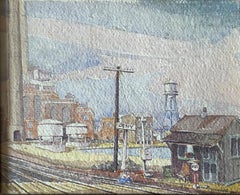
"Train Station, " Max Kuehne, Industrial City Scene, American Impressionism

"Train Station, " Max Kuehne, Industrial City Scene, American Impressionism

By Max Kuehne

Located in New York, NY

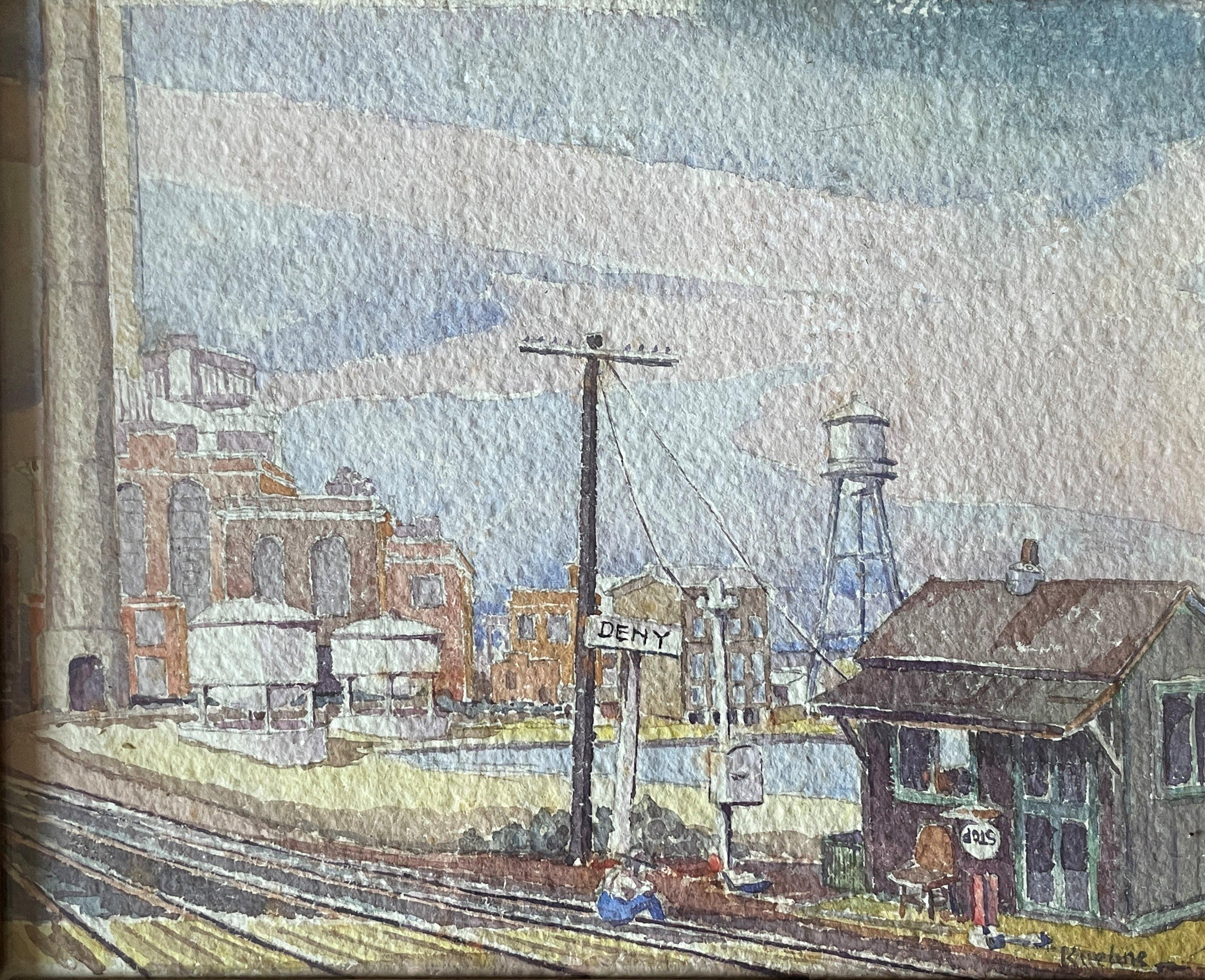
Max Kuehne (1880 - 1968) Train Station, circa 1910 Watercolor on paper 8 1/4 x 10 1/4 inches Signed lower right Provenance: Private Collection, Illinois Max Kuehne was born in Halle, Germany on November 7, 1880. During his adolescence the family immigrated to America and settled in Flushing, New York. As a young man, Max was active in rowing events, bicycle racing, swimming and sailing. After experimenting with various occupations, Kuehne decided to study art, which led him to William Merritt Chase's famous school in New York; he was trained by Chase himself, then by Kenneth Hayes Miller. Chase was at the peak of his career, and his portraits were especially in demand. Kuehne would have profited from Chase's invaluable lessons in technique, as well as his inspirational personality. Miller, only four years older than Kuehne, was another of the many artists to benefit from Chase's teachings. Even though Miller still would have been under the spell of Chase upon Kuehne's arrival, he was already experimenting with an aestheticism that went beyond Chase's realism and virtuosity of the brush. Later Miller developed a style dependent upon volumetric figures that recall Italian Renaissance prototypes. Kuehne moved from Miller to Robert Henri in 1909. Rockwell Kent, who also studied under Chase, Miller, and Henri, expressed what he felt were their respective contributions: "As Chase had taught us to use our eyes, and Henri to enlist our hearts, Miller called on us to use our heads." (Rockwell Kent, It's Me O Lord: The Autobiography of Rockwell Kent. New York: Dodd, Mead and Co., 1955, p. 83). Henri prompted Kuehne to search out the unvarnished realities of urban living; a notable portion of Henri's stylistic formula was incorporated into his work. Having received such a thorough foundation in art, Kuehne spent a year in Europe's major art museums to study techniques of the old masters. His son Richard named Ernest Lawson as one of Max Kuehne's European traveling companions. In 1911 Kuehne moved to New York where he maintained a studio and painted everyday scenes around him, using the rather Manet-like, dark palette of Henri. A trip to Gloucester during the following summer engendered a brighter palette. In the words of Gallatin (1924, p. 60), during that summer Kuehne "executed some of his most successful pictures, paintings full of sunlight . . . revealing the fact that he was becoming a colorist of considerable distinction." Kuehne was away in England the year of the Armory Show (1913), where he worked on powerful, painterly seascapes on the rocky shores of Cornwall. Possibly inspired by Henri - who had discovered Madrid in 1900 then took classes there in 1906, 1908 and 1912 - Kuehne visited Spain in 1914; in all, he would spend three years there, maintaining a studio in Granada. He developed his own impressionism and a greater simplicity while in Spain, under the influence of the brilliant Mediterranean light. George Bellows convinced Kuehne to spend the summer of 1919 in Rockport, Maine (near Camden). The influence of Bellows was more than casual; he would have intensified Kuehne's commitment to paint life "in the raw" around him. After another brief trip to Spain in 1920, Kuehne went to the other Rockport (Cape Ann, Massachusetts) where he was accepted as a member of the vigorous art colony, spearheaded by Aldro T. Hibbard. Rockport's picturesque ambiance fulfilled the needs of an artist-sailor: as a writer in the Gloucester Daily Times explained, "Max Kuehne came to Rockport to paint, but he stayed to sail." The 1920s was a boom decade for Cape Ann, as it was for the rest of the nation. Kuehne's studio in Rockport was formerly occupied by Jonas Lie. Kuehne spent the summer of 1923 in Paris, where in July, André Breton started a brawl as the curtain went up on a play by his rival Tristan Tzara; the event signified the demise of the Dada movement. Kuehne could not relate to this avant-garde art but was apparently influenced by more traditional painters — the Fauves, Nabis, and painters such as Bonnard. Gallatin perceived a looser handling and more brilliant color in the pictures Kuehne brought back to the States in the fall. In 1926, Kuehne won the First Honorable Mention at the Carnegie Institute, and he re-exhibited there, for example, in 1937 (Before the Wind). Besides painting, Kuehne did sculpture, decorative screens, and furniture work with carved and gilded molding. In addition, he designed and carved his own frames, and John Taylor Adams encouraged Kuehne to execute etchings. Through his talents in all these media he was able to survive the Depression, and during the 1940s and 1950s these activities almost eclipsed his easel painting. In later years, Kuehne's landscapes and still-lifes show the influence of Cézanne and Bonnard, and his style changed radically. Max Kuehne died in 1968. He exhibited his work at the National Academy of Design, the Art Institute of Chicago, the Carnegie Institute in Pittsburgh, the Memorial Art Gallery of the University of Rochester, and in various New York City galleries. Kuehne's works are in the following public collections: the Detroit Institute of Arts (Marine Headland), the Whitney Museum (Diamond Hill...

Category

1910s American Impressionist Landscape Drawings and Watercolors

Materials

Paper, Watercolor

"The Train Depot"

"The Train Depot"

By Gershon Benjamin

Located in Lambertville, NJ

Jim’s of Lambertville is proud to offer this artwork by: Gershon Benjamin (1899-1985) An American Modernist of portraits, landscapes, still lives, and the urban scene, Gershon Benj...

Category

1930s Modern Landscape Paintings

Materials

Oil, Board

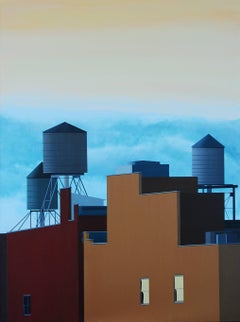
Houston and Broadway

Houston and Broadway

By Jeff Goldenberg

Located in New Orleans, LA

Jeff Goldenberg is a New York based artist and writer, whose current body of acrylic paintings depicts views of the lower Manhattan skyline from vantage points seen from his studio. ...

Category

2010s Contemporary Landscape Paintings

Materials

Canvas, Acrylic

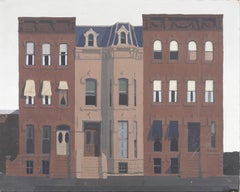
American Modernist Architectural Cityscape Surreal Rare Original Oil Painting

American Modernist Architectural Cityscape Surreal Rare Original Oil Painting

Located in Buffalo, NY

Vintage American modernist street scene oil painting. Oil on canvas. Unsigned. Measuring: 24 by 30 inches overall. Excellent condition, ready to hang and enjoy.

Category

1960s Modern Landscape Paintings

Materials

Canvas, Oil

NYC Cityscape American Scene WPA Modern Realism Mid 20th Century Architectural

NYC Cityscape American Scene WPA Modern Realism Mid 20th Century Architectural

By Ernest Fiene

Located in New York, NY

NYC Cityscape American Scene WPA Modern Realism Mid 20th Century Architectural Ernest Fiene (1894-1965) Cityscape 36 x 30 inches Oil on canvas Signed and dated 1930. lower right Provenance Estate of the artist. ACA Galleries, New York Exhibited New York, Frank Rehn Gallery, Changing Old New York, 1931. New York, ACA Galleries, Ernest Fiene: Art of the City, 1925-1955, May 2-23, 1981, n.p., no. 5. BIO Ernest Fiene was born in Elberfeld, Germany in 1894. As a teenager, Fiene immigrated to the United States in 1912. He studied art at the National Academy of Design in New York City from 1914 to 1918, taking day classes with Thomas Maynard and evening classes with Leon Kroll. Fiene continued his studies at the Beaux-Arts Institute of Design in New York from 1916 to 1918, adding classes in printmaking at the Art Students League in 1923. Fiene began his career as an artist in 1919 with his first exhibition of watercolors at the MacDowell Club arranged by his mentor Robert Henri. In 1923 the Whitney Studio Club mounted a large exhibition of his works. The following year he had an exhibition at the New Gallery in New York, which completely sold out all fifty-two works, including paintings, watercolors, drawings, and etchings. With the proceeds of sales from the New Gallery exhibition, Ernest Fiene and his younger brother Paul, a sculptor, built studios in Woodstock, New York in 1925. In the early Twenties Ernest Fiene painted mostly landscapes of Woodstock and both the Ramapo and Hudson River Valleys. The first monograph from the Younger Artists Series was published on Fiene in 1922. Published in Woodstock, the series went on to include Alexander Brook, Peggy Bacon, and Yasuo Kuniyoshi. The book reproduced 1 illustration in color and another 27 reproductions in black and white. Around 1925 Fiene became fascinated with the intensity, excitement, and opportunities for color harmonies New York City offered as a subject. His paintings shifted to urban and industrial themes with architecture, industry, and transportation becoming his subjects. By 1926 Fiene had attracted the dealer Frank K.M. Rehn, who gave him a one-man exhibition that year, which travelled to the Boston Arts Club. C.W. Kraushaar Galleries gave Fiene a one-man exhibition of urban, landscape, portrait, and still life paintings in 1927. Julianna Force, the director of the Whitney Studio Club and first director of the Whitney Museum of American Art, included two of Fiene’s paintings in a fall exhibition in 1928. The Whitney Studio Club showed Fiene’s paintings in a two-man exhibition with Glenn O. Coleman that year and acquired three of Fiene’s paintings. Also in 1928 Fiene became affiliated with Edith Halpert’s Downtown Gallery where he had an exhibition of 20 lithographs in the spring. Fiene sold his house in Woodstock in 1928 to spend more of his time in New York City. With so many successful exhibitions, Fiene returned to Paris in 1928-29 where he rented Jules Pascin's studio and studied at the Académie de la Grande Chaumière. In France, Fiene painted both landscape and urban subjects developed from ideas influenced by Cubist geometry and the use of flat areas of broad color. Upon returning to New York in 1930, Fiene used this new approach to continue to paint New York skyscraper and waterfront subjects, as well as to begin a series of paintings on changing old New York based on the excavations for Radio City Music Hall and the construction of the Empire State Building. Frank K.M. Rehn Galleries exhibited this series, titled “Changing Old New York,” in 1931. Fiene also has solo exhibitions at Rehn Galleries in 1930 and 1932. Fiene’s oil paintings are exhibited at the Chicago Arts Club in 1930 as well. Fiene was included in the Museum of Modern Art’s exhibition Painting and Sculpture by Living Americans in December of 1931. Visiting New York, Henri Matisse saw the exhibition and called Fiene’s Razing Buildings, West 49th Street the finest painting he had seen in New York. Fiene had two mural studies from his Mechanical Progress series exhibited at the Museum of Modern Art’s exhibition Murals by American Painters and Photographers in 1932. Fiene sent View from my Window which depicts Fiene working on a lithograph stone while looking out his window to the newly completed Empire State Building to the Carnegie International in 1931. In 1932 Fiene participated in the first Biennial of American Painting at the Whitney Museum and his prints were included in exhibitions at the Downtown Gallery and the Wehye Gallery. In the same year, Fiene was awarded a Guggenheim fellowship to further study mural painting in Florence, Italy. On his return from Italy in 1933 Fiene re-engaged himself in New York City life and won several public and private mural projects. Fiene resumed his active exhibition schedule, participating in two group exhibitions at the Whitney Museum and a one-man exhibition of recent paintings at the Downtown Gallery in January 1934. In 1933 he purchased a farm in Southbury, Connecticut, which added Connecticut scenes to his landscape subjects. This was also the year Fiene began to spend summers on Monhegan Island, Maine, where he painted seascapes, harbor scenes, and still lifes. Fiene’s landscape paintings attracted numerous commissions as part of the American Scene movement. Through the fall and winter of 1935-36, Fiene took an extended sketching trip through the urban, industrial, and farming areas of Pennsylvania and West Virginia. Most of the twenty-four Pennsylvania urban and rural paintings...

Category

1930s American Modern Landscape Paintings

Materials

Canvas, Oil

The Edge

The Edge

By Nicholas Evans-Cato

Located in Fairfield, CT

Represented by George Billis Gallery, NYC & LA --Every painting begins with a place to stand. Sometimes I find one in seconds; sometimes the hunt goes on for many seasons. A canvas c...

Category

21st Century and Contemporary American Realist Landscape Paintings

Materials

Linen, Oil