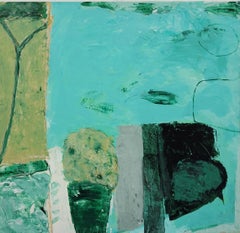
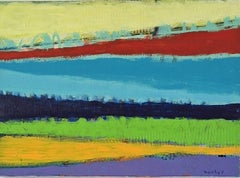
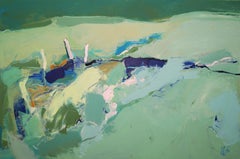
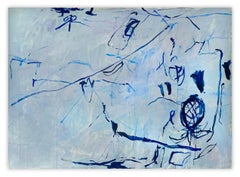
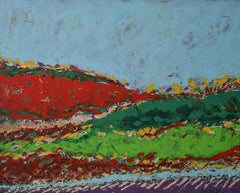
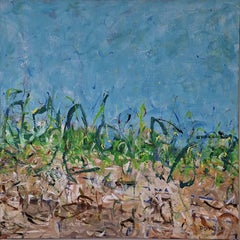
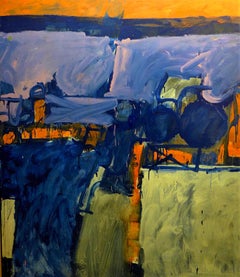
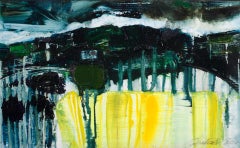
Chuta KIMURA (also "Tchuta" or "Tshuta") is an allusive landscape painter and pastellist. His name - composed of the words Ki (tree) and Mura (village) - literally means "village tree". The artist was born into a middle-class family with an ancestral Samurai background. From the age of 13, he took drawing lessons at the Takamatsu School of Decorative Arts. In 1936, he went on to study at Tokyo's Nika Art Academy, where the academic teaching did not suit him. In 1937, he exhibited for the first time at the Dokuritsu Salon, but was immediately drafted by the army to serve in China - where, despite the war, he developed a passion for ancient calligraphy. Shortly afterwards, in 1941, he discovered a painting by Pierre Bonnard at the Ohara Art Museum in Kurashiki, the light of which overwhelmed him. In 1947, he married Satchiko Yunoki, with whom he decided to move to Paris. Thanks to a patron, the young couple settled in Montparnasse in March 1953 (taking over the former studio of his illustrious compatriot, Foujita). In 1954, he exhibited at the Salon des Artistes Français and met Jacques Zeitoun, artistic director of the "Art Vivant" gallery (Paris and Lyon), who immediately signed him up. From 1955 onwards, Kimura enjoyed a steady stream of solo exhibitions - in Paris (e.g. Galerie St Placide, Kriegel, or Art Yomiuri - the latter exhibiting his work 4 times at FIAC in the 1980s); Lyon (e.g. Galerie St Georges); Antibes (e.g. Galerie St Georges); and Paris. galerie St Georges); Antibes (ex. galerie René Raporte); Brussels (ex. galerie de France et du Benelux); Geneva (ex. galerie Krugier); Tokyo (ex. galleries Nichido, or Takarashi); and New York (ex. galleries David Findlay, or Ruth Sigel). The artist also participated in fairs and group exhibitions (e.g. Biennale de Paris in 1957, Centre Pompidou in 1979, The Phillips Collection in 1985). In 1962, he moved to Châtenay-Malabry and met Jean Grenier - professor of philosophy and holder of the chair of aesthetics and art science at the Sorbonne - who became his principal biographer: "When Kimura rightly prides himself on uniting East and West, which, he writes, are as different from each other as day and night are from each other, he might add that it is by remaining himself and drawing on the dual traditions of his country that he has succeeded in creating a work that is at once so violent and so gentle." In 1963, the French State bought a painting from him - "Jardin à Châtenay". In 1965, Galerie Kriegel took him on under contract until 1977. In 1987, the artist attended his last exhibition in New York. Kimura's works can be found in the permanent collections of numerous institutions and corporations: MAM Paris; Fonds National d'Art Contemporain; The Phillips Collection, Washington D.C.; MOMAT; National MoA, Osaka; MoA - Hiroshima, Kamiya, and Takasaki; Setayaga Art Museum; MoMA - Saitama, Ibaraki, and Gunma; Takamatsu City MoA; Toyota Motor Corporation; Abu Dhabi Oil Co. and Nippon Television Network Corporation.