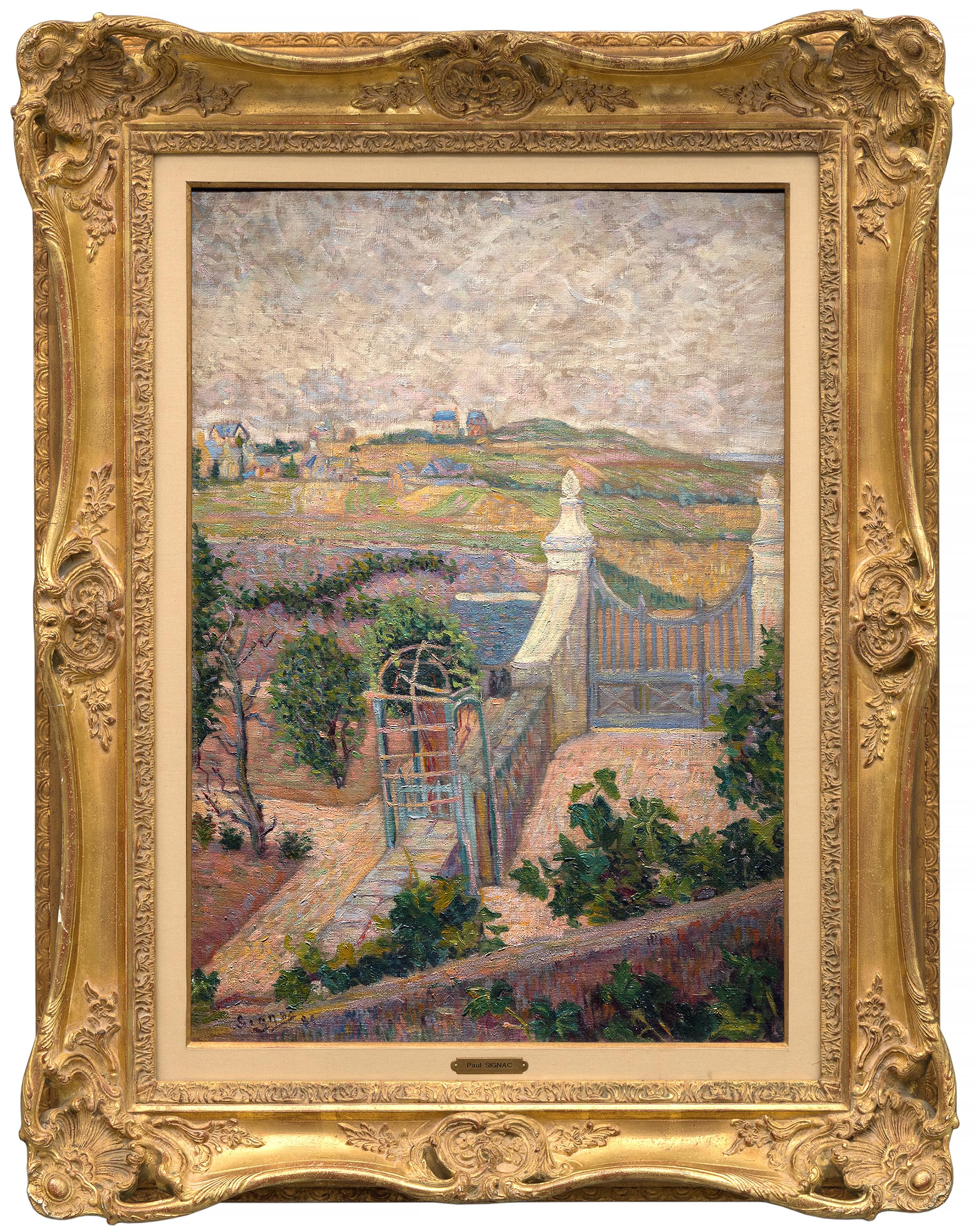
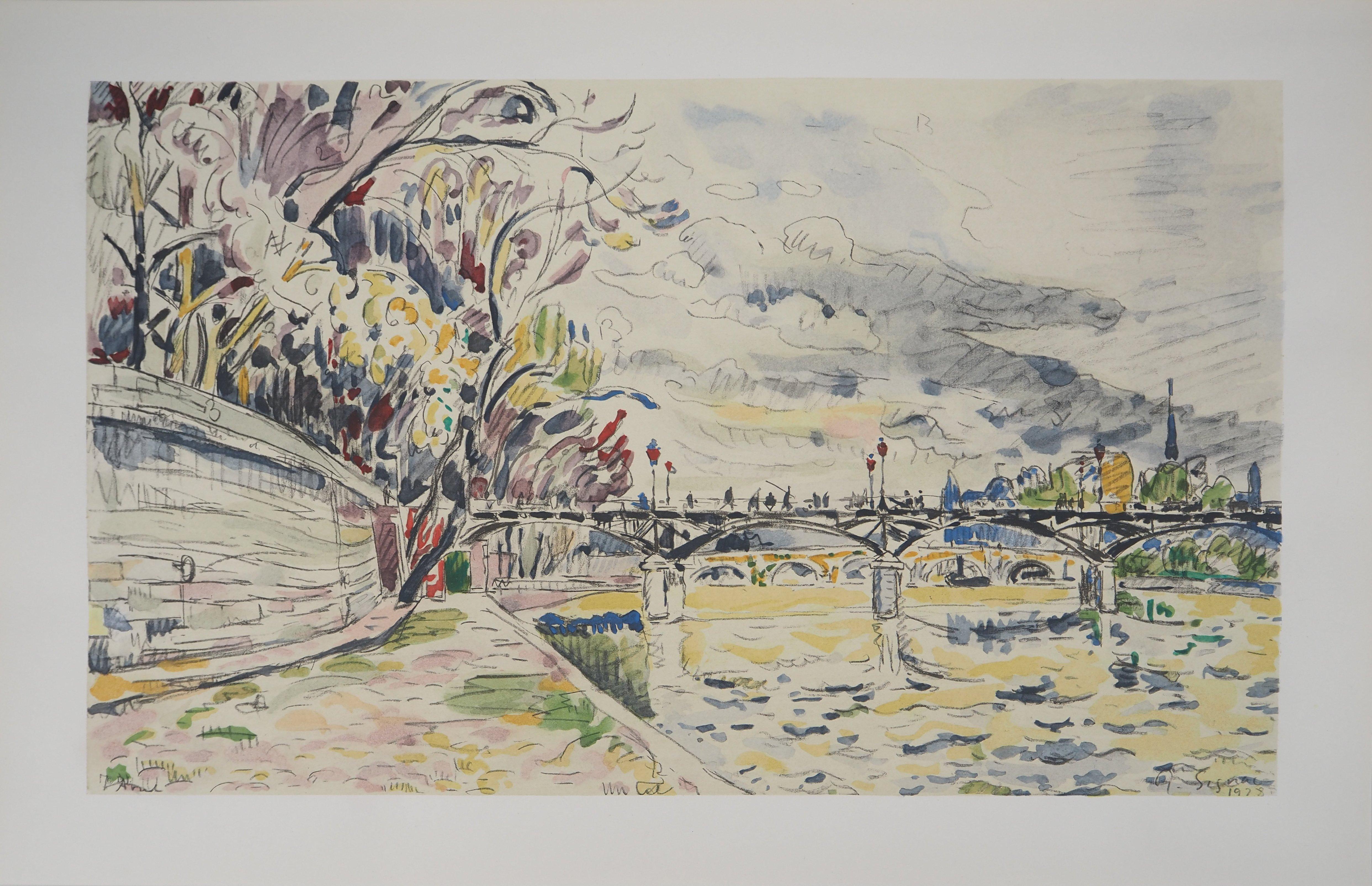
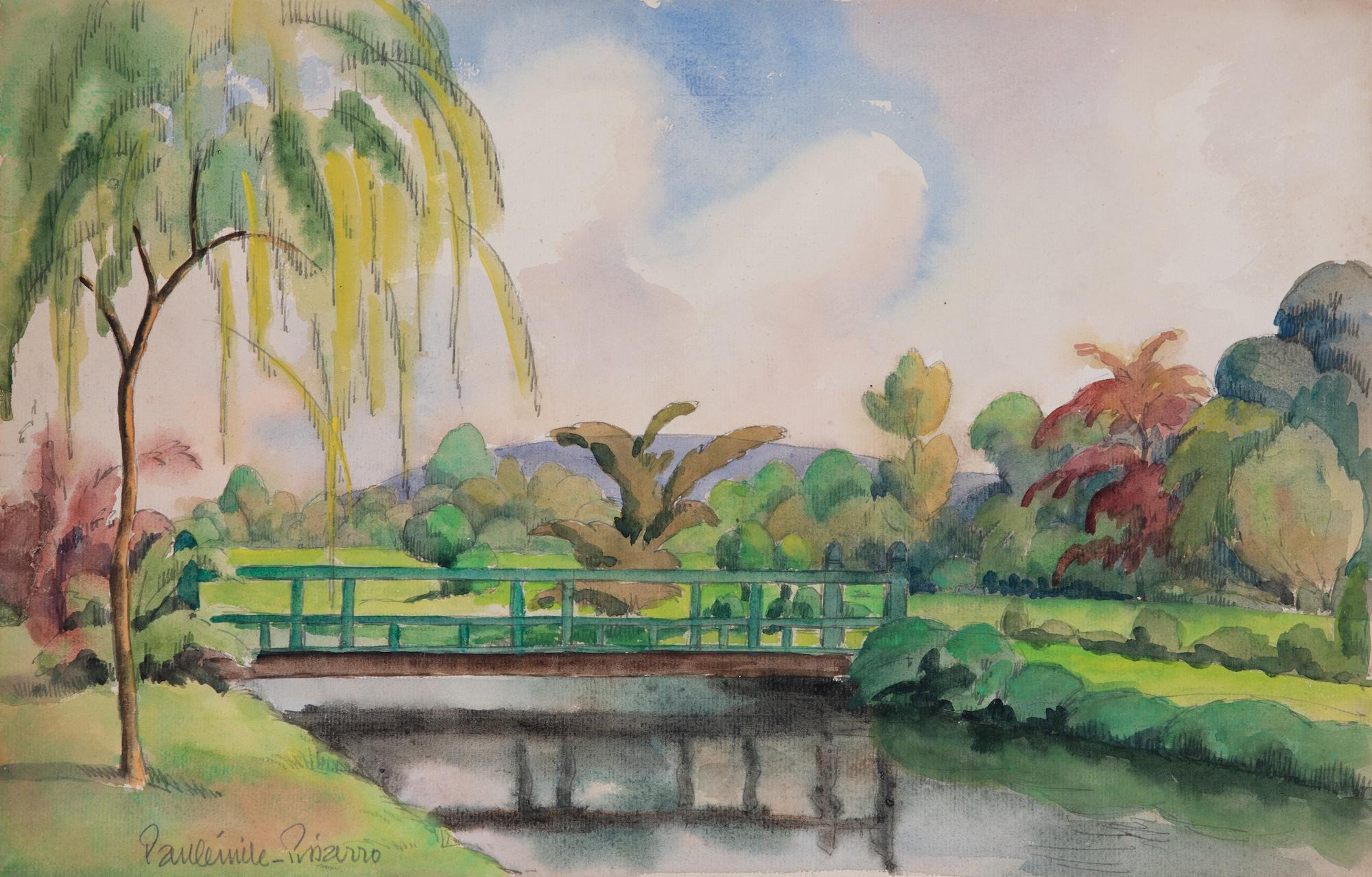
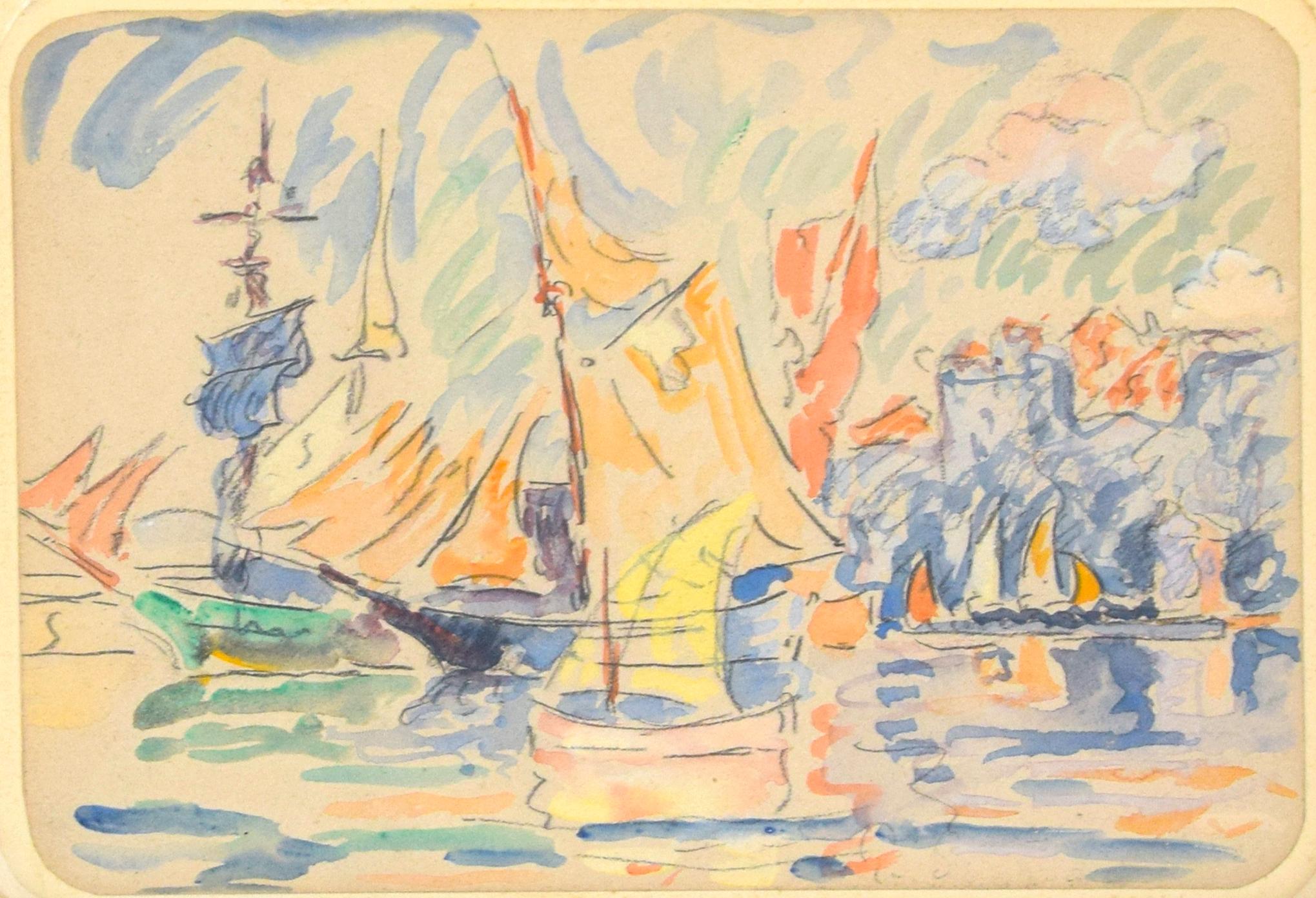
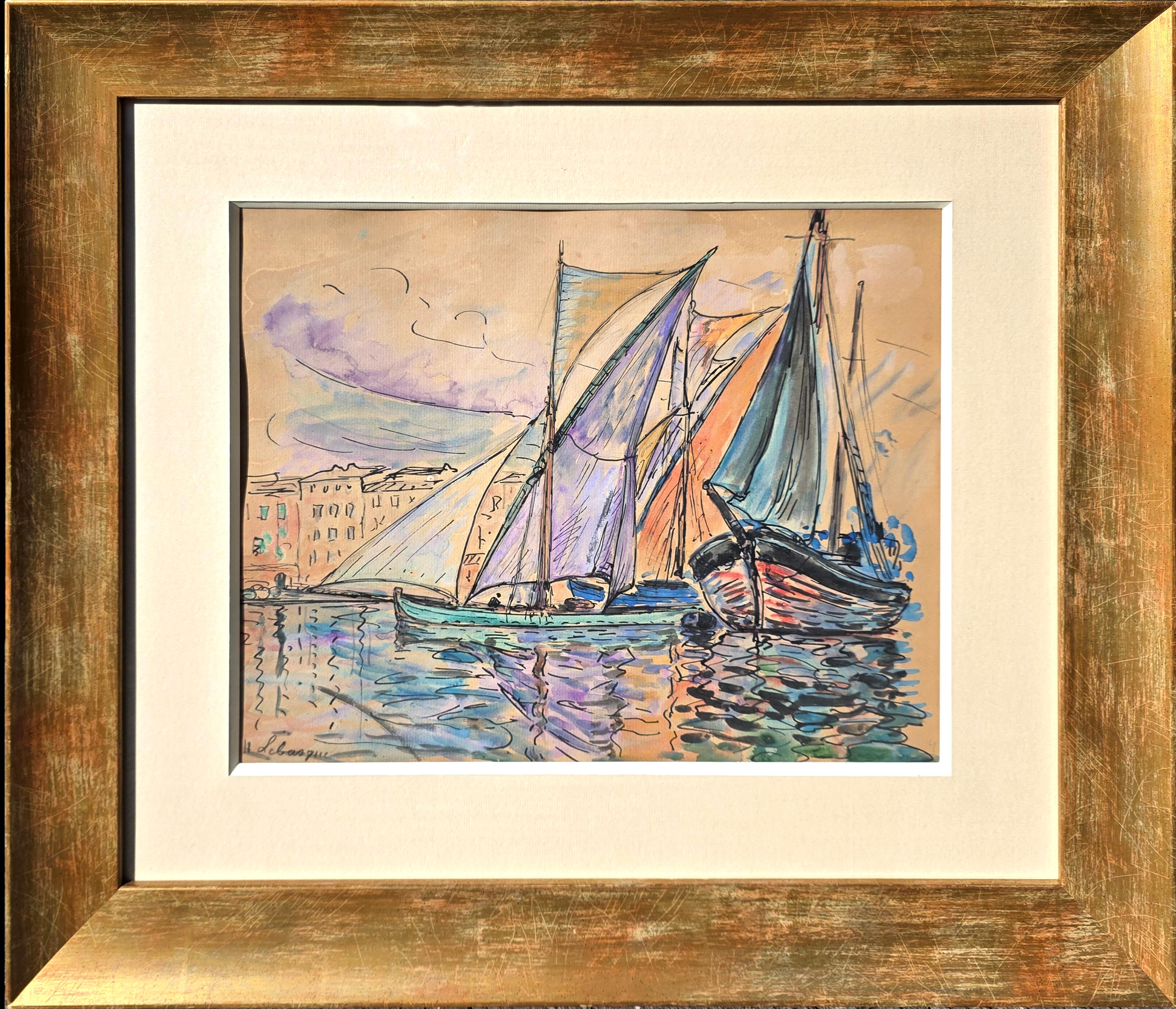
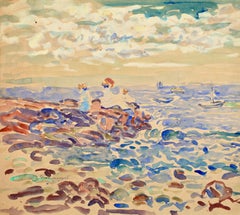
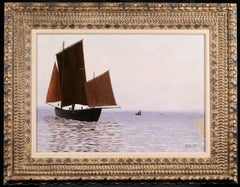
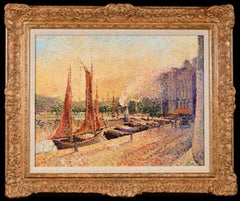
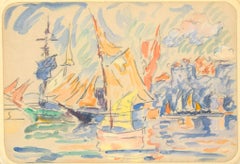
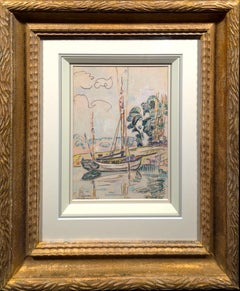
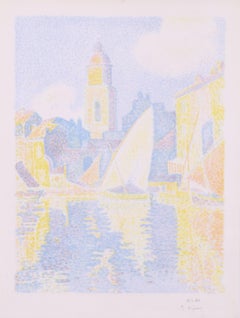
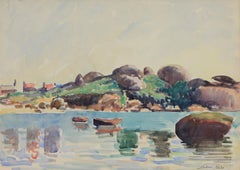
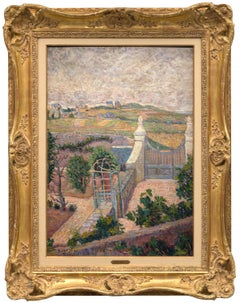
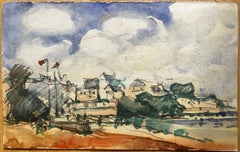
Signed watercolour on paper circa 1930 by French post impressionist painter Paul Signac. The piece depicts a view of sail boats in the harbour at Paimpol, a commune in the Côtes-d'Armor department in Brittany in northwest France.
Signature:
Signed lower right and titled "Glycine et Islandan et La Mouette Cabotine - Paimpol" lower left
Dimensions:
Framed: 22"x28"
Unframed: 12"x18"
Provenance:
This watercolour is part of the "Ports of France" series, kept by Paul Signac and not given to Gaston Lévy.
This work was formerly in the private collection of the painter Paul Signac and Françoise Cachin.
A certificate from Marina Ferretti accompanies the work Ref 2025.24.11/89
In 1880, having left school, Paul Signac contemplated becoming a scholar, his financial independence being assured by his prosperous family. In February 1882, he published a pastiche of Émile Zola’s work in the Parisian magazine Le Chat Noir, entitled Serendipity ( Une trouvaille), but on seeing reproductions of Claude Monet’s work in La Vie Moderne, he decided to turn his ambitions to painting. He took lessons with painter Émile Bin in Montmartre, and settled in successive studios in the area. He wrote to Monet, asking his advice, in 1883. In 1884 he met Armand Guillaumin and exhibited work at the Salon des Artistes Indépendants where he was introduced to Georges Seurat, whose Bathing at Asnières was a revelation to him. The two artists moved in the same avant-garde literary circles and became close friends. Both were part of the founding committee of the Société des Artistes Indépendants (Signac was its President from 1909 to 1934 and unceasingly encouraged younger avant-garde artists such as the Fauves and the Cubists). In 1885 Signac met Camille Pissarro at Durand-Ruel’s. He met Vincent Van Gogh in 1887 at Père Tanguy’s paint shop and the pair remained close friends. He spent summers in various parts of France (Les Andelys and Fécamp in 1886, Comblat-le-Château in Auvergne in 1887, Collioure on the Mediterranean coast, Portrieux in North Brittany in 1888, Cassis in 1889, Italy and Brittany in 1990, and Concarneau in 1891). In 1892 he discovered the little port of St-Tropez where he bought a villa – La Hune – in 1897. He returned there each summer, bringing with him several friends, artists, and writers, including Henri Matisse, who worked with Signac and Henri Edmond Cross for several months. Signac was constantly searching for new subjects to paint, often travelling to ports such as La Rochelle, Marseilles, Genoa, Rotterdam (1896), Switzerland (1903)), Venice (1904 and 1908), and Istanbul (1907). He received the Croix de la Légion d’Honneur in 1911. In 1913, after the birth of his daughter, Ginette, with his mistress Jeanne Selmershein-Desgranges, he separated from his wife and settled in Antibes.
In 1884, Signac discovered the writings of the chemist Michel-Eugène Chevreul, whose pioneering study of colour, The Law of Simultaneous Contrast (1839) had been developed by Hermann von Helmholtz (1878). Signac also read the work of David Sutter, whose articles on the Phenomena of Sight were published in 1880 in the review Art, and that of Edouard Rood (1881). Signac’s views on colour were also influenced by Eugène Delacroix, whose Journal was published between 1893 and 1895. Signac had a taste for mathematics, and in 1889 worked closely with his friend Charles Henry, a mathematician and physician. Henry was researching mathematical and geometric proportion and their potential application to the industrial arts. Signac was associated with the Symbolists of La Revue Indépendante. He was also an admirer of Jules Vallès and Joris-Karl Huysmans. He collaborated on the anarchist journal Le Cri du Peuple and throughout his life unceasingly expressed his social and political opinions. A competent writer, from 1890 he published various articles on art, provided texts for exhibition catalogues and wrote other publications including a volume on Stendhal (Antibes, December 1913-January 1914) and a monograph on Jongkind (Paris, Crès, 1927) which included a Watercolour Treatise ( Traité de l’aquarelle). In 1899 he published From Delacroix to Neo-Impressionism (Editions de la Revue blanche, Paris, 1899; H. Floury, Paris, 1911; Hermann, Paris, 1964), in which he analysed the principles of Neo-Impressionism which he had developed with Seurat. He methodically studied the composition and decomposition of light in coloured rays, and quickly established his role as the theoretician of the group, which included Cross, Théo Van Rysselberghe, Maximilien Luce, Henry van de Velde, Hippolyte Petitjean, Lucie Cousturier, Charles Angrand, and Albert Dubois-Pillet. Signac illustrated the book, Chromatic Circle by M. Charles Henry presenting all colours and colour harmonies with an introduction to the general theory of dynamogeny, otherwise known as contrast, rhythm and measure ( Cercle Chromatique de M. Charles Henry présentant tous les compléments et toutes les harmonies des couleurs avec une introduciton sur la théorie générale de la dynamogénie, autrement dit du contraste, du rythme et de la mesure) (1888).
Signac painted plein-air paintings with a fiery touch before adopting the pointillist style, based on observation and the direct study of nature as exemplified in Seurat’s Un dimanche à la Grande Jatte (1886). This so-called Divisionist method, inspired by Michel-Eugène Chevreul’s book and developed by Charles Henry, was based on division, colour contrasts, and mathematical rhythms. Signac reconciled a naturalist concern for the social reality of the time ( Les Modistes, 1886) with his own ideological convictions and a new aesthetic inspired by Japanese prints ( Felix Fénéon’s Portrait, 1890). A confirmed yachtsman, he applied his new technique to landscapes and seascapes from 1887 to 1895, painting series devoted to the quays of Paris, the port of La Rochelle, and views of St-Raphaël and Antibes. His urge to travel explains the abundance of watercolour in his work, particularly after 1910, and his rapid and exact style. He noted his observations, always searching for the best means of capturing the multiple effects of light and the presence of the sun. Associating his work with musical compositions, until 1893 he designated an opus number to each of his works, sometimes adding musical titles as with the series La Mer (1891), allowing visual harmony to coincide with musical and social harmony.
From 1895 to 1897 the pointillist stroke seems to disintegrate and change form in his work, the optical mixing of colours resulting in grey tones; Signac’s response is to enlarge the dots with the end of his brush, flattening the brush into a square or rectangle, thus placing brighter colour on the white canvas. In both watercolour and oil, which he used in a very diluted, fluid form, he spread lively and translucent tones on the white of the paper or prepared canvas, leaving the white to appear transparently or at intervals between the strokes of colour. The white has the role of giving light and air, and serves as a common link between the many-coloured strokes, thus obtaining an effect of freshness and clarity. The critic Félix Fénéon talked of the ‘wild chromatic climbing’ of his paintings, and wrote of his art as ‘a great decorative development, which sacrifices anecdote to arabesque, nomenclature to synthesis, the fleeting to the permanent...’. Research and experimentation into the recomposition of light and the need to create a particular type of architectural drawing justified working in the studio. Signac applied and adapted a strictly pointillist Divisionism to his own ends. Very small touches of colour, pure and sometimes acid, produced a spectacular brightness. In his second period, he enlarged his colour strokes, making rectangular marks with the brush which structured the form more solidly to the detriment of the optical mix. This Neo-Impressionist technique was highly influential within the many strands of Post-Impressionism and beyond. In 1888, he made his first lithographs for the programme of the Théâtre Libre d’Antoine in Paris. He was also a collector, accumulating around 250 works.
He took part in public exhibitions: in 1884–1895, at the Salon des Artistes Indépendants, Paris; the Salon des Artistes Français, where he exhibited the greater part of his work; in 1885, New York; in 1886 at the 8th and last Impressionist exhibition with Edgar Degas, Jean-Louis Forain, Paul Gauguin, Pissarro, and Seurat; from 1888 at the Salon des Vingt de Bruxelles, a group founded by Octave Maus, of which Signac became a member in 1891; in 1894–1896, Salon de la Libre Esthétique, Brussels; 1901, Galerie Keller et Reiner, Berlin; 1907, Galerie Bernheim-Jeune, Paris; in 1908 at the exhibition of the Zolotoe Runo (Golden Fleece) in Moscow; in 1909–1910 at the Salon Izdebsky at Odessa, Kiev, St Petersburg, and Riga; in 1912 at St Petersburg at the Institut Français for the Centennial Exhibition 1812–1912; in 1933 in Paris at the exhibition Seurat and His Friends, for which he wrote the catalogue preface. Since his death he has been represented in thematic exhibitions relating to the Post-Impressionist period, including: 1953, Seurat and His Friends ( Seurat et ses Amis), Wildenstein Gallery, New York; 1962, Van Gogh’s Life in His Drawings: Van Gogh’s Relationship with Signac, Marlborough Fine Art, London; 1968, Paul Signac et les Maîtres Suisses du XIXe et XXe siècle, Galerie Paul Vallotton, Lausanne; 1972, Seurat and the Neo-Impressionist, Chuokoron-Sha, Tokyo; 1975, Paul Signac et ses Amis à Saint-Tropez de 1982 à 1914, Musée de l’Annonciade, Saint-Tropez ; 1994, Monet to Matisse, Landscape Painting in France, 1874–1914, National Gallery of Scotland, Edinburgh; 1997, Signac and the Liberation of Colour, from Matisse to Mondrian, Musée de Grenoble, Westfälisches Landesmuseum für Kunst und Kulturgeschichte in Münster, Kunstsammlungen in Weimar; 2001, Signac 1863–1935: Master Neo-Impressionist, Grand Palais, Paris, Van Gogh Museum, Amsterdam, Metropolitan Museum of Art, New York. His works were shown in many individual exhibitions including: 1904, Paul Signac: Venice, Hollande, Galerie Druet, Paris; 1923, Paul Signac: Peintures, Cartons de Tableaux, Dessins, Aquarelles, Galerie Bernheim-Jeune, Paris; 1950, Paul Signac : Peintures, aquarelles, Musée des Beaux-Arts, Mulhouse; 1951, P. Signac, Musée d’Art moderne, Paris; 1953, Watercolors by Paul Signac, Los Angeles County Museum, Los Angeles; 1954, Paul Signac, Retrospective Exhibition, Marlborough Fine Art, London ; 1958, La Création de l’Oeuvre chez Paul Signac, Marlborough Fine Art, London; 1963, Musée du Louvre, Paris; 1977, Paul Signac, 1863–1935, Paintings, Watercolors, Drawings and Prints, Metropolitan Museum of Art, New York ; 1986, Paul Signac: 1863–1935, Watercolours and Drawings, Marlborough Gallery, London; 1989, Paul Signac: Aquarelles, Musée de Melun; 1992, Signac et Saint-Tropez, Musée de l’Annonciade, Saint-Tropez, Musée des Beaux-Arts, Rheims; 2000, Paul Signac, A Collection of Watercolors and Drawings, 1863–1935, Arkansas Art Center, Little Rock, and Musée Marmottan, Paris; Fondation Pierre Gianadda, Martigny (Switzerland).
Museum and Gallery Holdings
Amsterdam (Van Gogh Mus.): Railway Junction near Bois-Colombes (1885, oil on canvas); Harbour of Saint-Tropez (1895, lithograph)
Bergamo (Accademia Carrara): The Sea. Saint-Briac. The Guérin Guard. Saint-Lunaire. Opus 211 (1890, oil on canvas)
Berlin (Nationalgal.)
Besançon (MBA et d’Archéologie): The Chevet of Notre-Dame (1925, pencil and watercolour)
Boston (MFA): Port of Saint-Cast (1890, oil on canvas); Boats (1897–1898, colour lithograph on cream wove paper); In the Nederlands (etching); Sails in Saint-Tropez (etching); Bell in St. Tropez with Figures (etching); Clocher de St. Tropez (etching); Flood in Paris (1922, lithograph)
Brussels (Mus. royaux des Beaux-Arts de Belgique): Saint-Tropez. The Inlet (1906, oil on canvas)
Bucharest (Muz. National de Arta al României): Saint-Tropez. The Portrait (1896, oil on canvas)
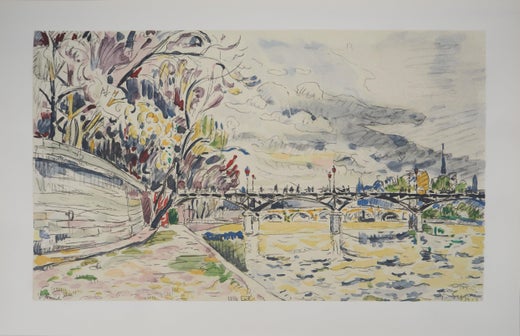
Cleveland (MA): Harmonious Times (1895–1896); Saint-Tropez: The Port (1897–1898); Evening, the Jetty at Vlissingen (1898); Paris, the Pont des Arts with Tug-boats (1927); Ships near the Trieux River (1925)
Denain (Mus. municipal): The Demolishers (1897–1899)
Essen (Folkwang Mus.): Paris, la Cité (1912); The Seine et St-Cloud (oil on canvas); Pink Tower (Entry to the Port of Marseilles) (1913)
Grenoble (Mus. de Grenoble): The Customs Path (1905); Saint-Tropez. Sunset on the City. Study (c. 1896, oil on canvas)
Hanover (Niedersächsisches): Venice, Mist (1908, oil on canvas)
Houston (MFA): The Bonaventure Pine (1893, oil on canvas)
London (Courtauld Institute of Art): St Tropez (c. 1893, oil and graphite/panel); Still-life with a Watermelon (1918, graphite, watercolour on paper)
Los Angeles (County MA): Saint-Tropez: Evening Sun (1894, watercolour over traces of graphite); Lézardrieux: The Coast (1924, watercolour and pencil)
Lyons (MBA)
Madrid (Mus. Thyssen Bornemisza): Paimpol (watercolour and pencil); Port-en-Bessin, the Beach (oil on canvas)
Marseilles (Mus. Cantini): Entry to the Port of Marseilles (1918)
Melbourne (NG of Victoria): Gasometers at Clichy (1886)
Minneapolis (IA): Blessing of the Tuna Fleet at Groix (1923, oil on canvas); Snow, Boulevard de Clichy, Paris (1886, oil on canvas); On the Bank of the River (watercolour and black chalk on white wove paper); Le Pont Neuf (charcoal); Fishing Boats in La Rochelle (c. 1919–1921, graphite, watercolour, and opaque white); Port-en-Bessin (1888, oil on canvas)
Montreuil (Town Hall): Time of Harmony: The Golden Age Is not in the Past It Is in the Future (oil on canvas)
Munich (Staatsgemäldesammlungen of Bavaria): The Seine River in Samois. Etude I, II, III, IV (1899, oil on canvas, four studies); River Seine Landscape in Samois (1899, oil on canvas)
Nancy (MBA): The Demolisher (1897–1899, oil on canvas)
Nantes (MBA)
New York (Metropolitan MA): Concarneau. Evening Stillness. Opus 220 (allegro maestoso) (1891, oil on canvas); The Jetty at Cassis (1889, oil on canvas); View of the Port of Marseilles (1905, oil on canvas); Lighthouse at Groix (oil on canvas)
New York (MoMA): Concarneau, Evening Calm, Opus 220 (1891, oil on canvas); Setting Sun. Sardine Fishing, Adagio, Opus 221 (1891, oil on canvas); Port of Saint-Tropez
Otterlo (Kröller-Müller Mus.): Mantes (1900, oil on canvas); Port of Collioure (1887); Rotterdam. The Mill. The Canal in the Morning (Rotterdam. Le moulin. Le canal le matin) (1906, oil on canvas); Portrieux (1888); The Two Cypresses. Opus 241 (mistral) (1893, oil on canvas)
Paris (Louvre): Sketch for Au Temps d’Harmonie (c. 1893, pink and black wash drawing); Red Sail on the Sea (1906, watercolour); The Storm (1895); Sunset on the Maures (c. 1905, watercolour)
Paris (Louvre, Drawings Collection): Bridge at Asnières (watercolour); Biarritz, the Lighthouse (1906, pencil and watercolour); Boats on the Corne d’Or (1907, pencil and watercolour); La Salute, Venice (1914, pencil and watercolour)
Paris (MNAM-CCI): Entry to the Port of Marseilles (1911)
Paris (Mus. d’Orsay): Les Andelys, the Bank (1886, oil on canvas); River Banks, the River Seine at Herblay (1889, oil on canvas); Red Lifebelt (1895); The Palace of Popes (1909, oil on canvas); Bayonne (drawing); Landscapes and Studies (five); Portrait of Eric Satie; Woman near a Lamp (1890, oil on wood); Woman with a Sunshade (1893, oil on canvas); Women near a Well (Young Provençales near a Well) (1892, oil on wood, decoration for a panel in half-light); The Yellow Sail, Venice (1904, oil on canvas)
Paris (Musée Marmottan Monet): Venice (1908, watercolour)
Pittsburgh (MFA Carnegie Institute): Plane Trees. Opus 242 (place des Lices, Saint-Tropez) (1893, oil on canvas)
Rotterdam (Mus. Boijmans Van Beuningen): The Meuse at Rotterdam (1907)
San Francisco (FAM): seven works
St Petersburg (Hermitage): The Harbour at Marseilles (c. 1906–1907, oil on canvas); Square of the Hotel de Ville in Aix-en-Provence (pencil, watercolour, gouache, and white); Sailboat at a Pier (c. 1920, pencil, watercolour, and gouache on laid paper); Sailing Ships (1895, colour lithograph); Banks of the Seine (c. 1900, lithographic crayon, watercolour, and gouache); The Large Pine, Saint-Tropez (c. 1892–1893, oil on panel)
St-Tropez (Mus. de l’Annonciade): Port at St-Tropez (1894); Le Pouliguen (1928, watercolour); Ornemental Pond of Cézanne’s House in Jas de Bouffan (1920, pencil and watercolour); Sisteron (1930, pencil and aquarelle); Bourg-Saint-Andéol (1930, pencil and watercolour); View of St-Tropez, Sunset over the Pine Wood (1896); St-Tropez, Parasol Pines and Carob Trees (1897); Saint-Tropez. Sunset with Pinewood (1896, oil on canvas); St-Tropez, the Quay (1899); The Coastal Path (c. 1901, watercolour); Saint-Tropez. The Storm (1895, oil on canvas)
Stuttgart (Staatsgal.): The Seine River in Samois. Morning (1900, oil on canvas on card)
The Hague (Gemeentemus.): Lunch (1887); Cassis (1889); Cape Lombardy (1889)
Toledo (MA): Canal Grande (Venice) (1905, oil on canvas)
Washington, DC (NGA): La Rochelle (c. 1930, watercolour over black chalk on laid paper); Pont Neuf, Paris (watercolour over black chalk on laid paper); Sailboats near a Lighthouse (pen and brown ink with brown wash over graphite on laid paper); 12 prints
Washington, DC (Smithsonian American AM): Landscape (1915, watercolour)
Worcester (AM): Golfe Juan (1896, oil on canvas)
Wuppertal (Von der Heydt Mus.): Port of St-Tropez (1893); Tartans with Flags. Opus 240 (1893, oil on canvas)