Want more images or videos?
Request additional images or videos from the seller
1 of 11

Philip Castle
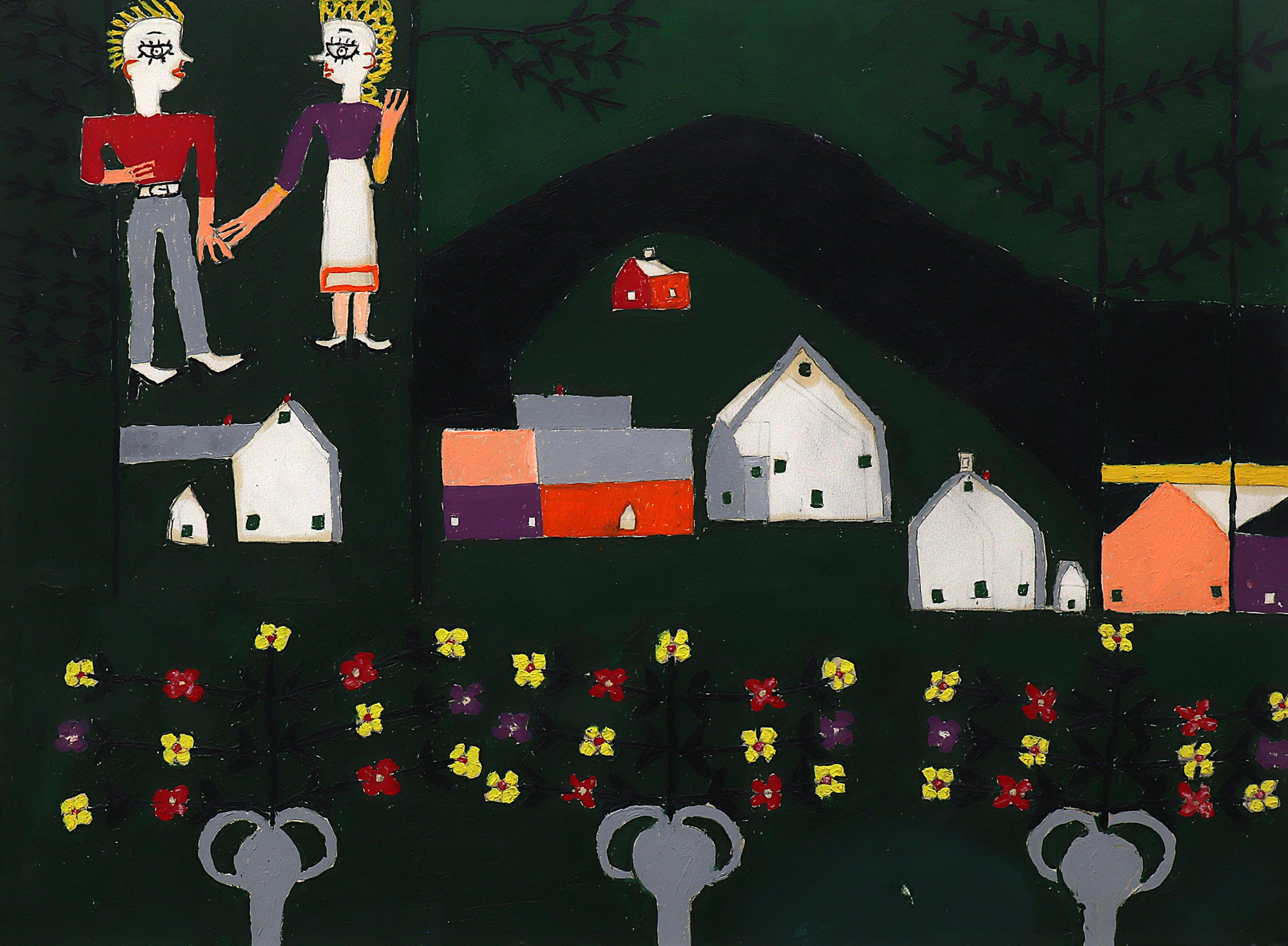
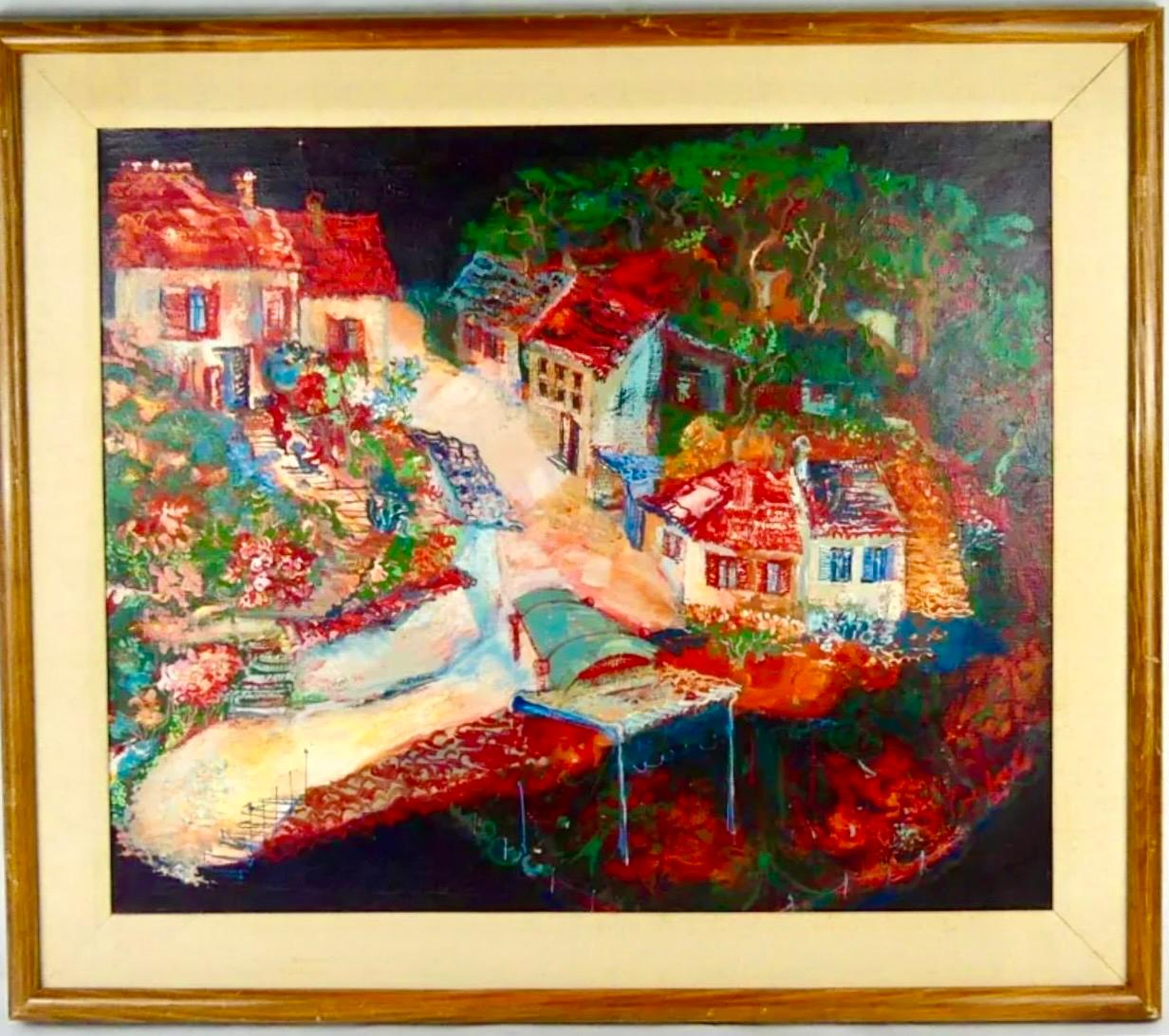
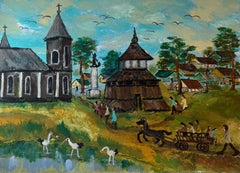
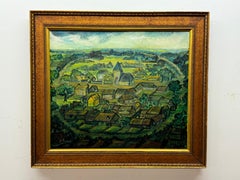
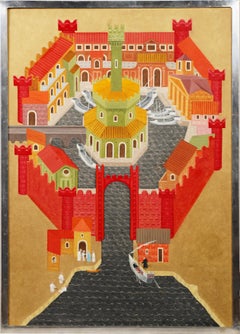
Fantastic Village Scene Modern Irish Magic Realism Oil Painting

$3,000
£2,267.58
€2,638.70
CA$4,232.02
A$4,268.03
CHF 2,484.68
MX$51,944.05
NOK 28,475.98
SEK 29,425.66
DKK 19,724.89

About the Item

Philip Castle was an Irish Painter and husband to artist Barry Castle He is rarely exhibited. His detailed, meticulous work took a long time to complete and his output was quite limited. He was the husband of Barry Castle, known for her vivid allegorical fantasies, featuring animal and human characters in stylised, often bucolic settings. Her intricately detailed work was distinguished by a note of mischievous humour but it was also thoughtful and introspective in tone. It sometimes featured self-portraits, disguised to a greater or lesser extent. The graphic clarity and translucent colouring of her technique were ideally suited to illustration and she illustrated several books, including one, Cooking for Cats (1985), for which she herself provided the verse text. Her writing displays a mordant wit and an instinct for the macabre reminiscent of Roald Dahl. While at the NCAD she met Philip Castle, who was studying physics at Trinity with Nobel Laureate Ernest Walton. Philip forsook his studies to become a self-taught painter of hugely detailed, architectonic compositions, and they married in 1963. In the mid-1960s they settled in Villefranche-sur-Mer in the south of France. They subsequently acquired a ruined farmhouse in a remote part of Tuscany. Eventually managing to make a scorpion-infested section of the house habitable (formerly the pigsty, Castle maintained), they spent two months there each summer. Finding herself alone in their French home when Philip was away for a month in 1968, Castle started to paint with his brushes. From that point on she painted consistently, though it took her some time to find her own style. Philip exhibited his work with the Portal Gallery in London and, from 1974, she showed her paintings there too. While the Portal specialised in Outsider art, she was not an Outsider artist as such. Although she described herself as a naive artist, her technique was sophisticated and displayed know-ledge of medieval and renaissance art. She also exhibited in the Solomon Gallery, Dublin. When in Dublin she and Philip resided in a tiny building in Proud's Lane, managing to fit surprisingly large numbers of people into a minimal space for lavish dinner parties. Like her mother, she was a brilliant cook. Reading through her mother's papers, she was inspired to illustrate some of her writings and two books ensued: The Cottage in the Bog, (1992) and The Queen of Aran's Daughter (1995), the first a story of Irish rural life, the second a collection of fairy tales set on Aran.
  • Creator:
    Philip Castle (1942, British)
  • Dimensions:
    Height: 21.5 in (54.61 cm)Width: 25.75 in (65.41 cm)Depth: 0.66 in (1.68 cm)
  • Medium:
  • Movement & Style:
  • Period:
  • Condition:
  • Gallery Location:
    Surfside, FL
  • Reference Number:
    1stDibs: LU38216450012

More From This Seller

View All
Large Israeli Naive Art Screen Enamel Oil Painting Jerusalem Old City Folk Art

Large Israeli Naive Art Screen Enamel Oil Painting Jerusalem Old City Folk Art

By Gabriel Cohen

Located in Surfside, FL

JERUSALEM, Vielle du David, (City of David) Superlac (enamel) painting on paper, hand signed, titled and dated. Provenance: Michael Hittleman Gallery Los Angeles. Gabriel Cohen, (...

Category

20th Century Folk Art Landscape Paintings

Materials

Paper, Oil, Alkyd

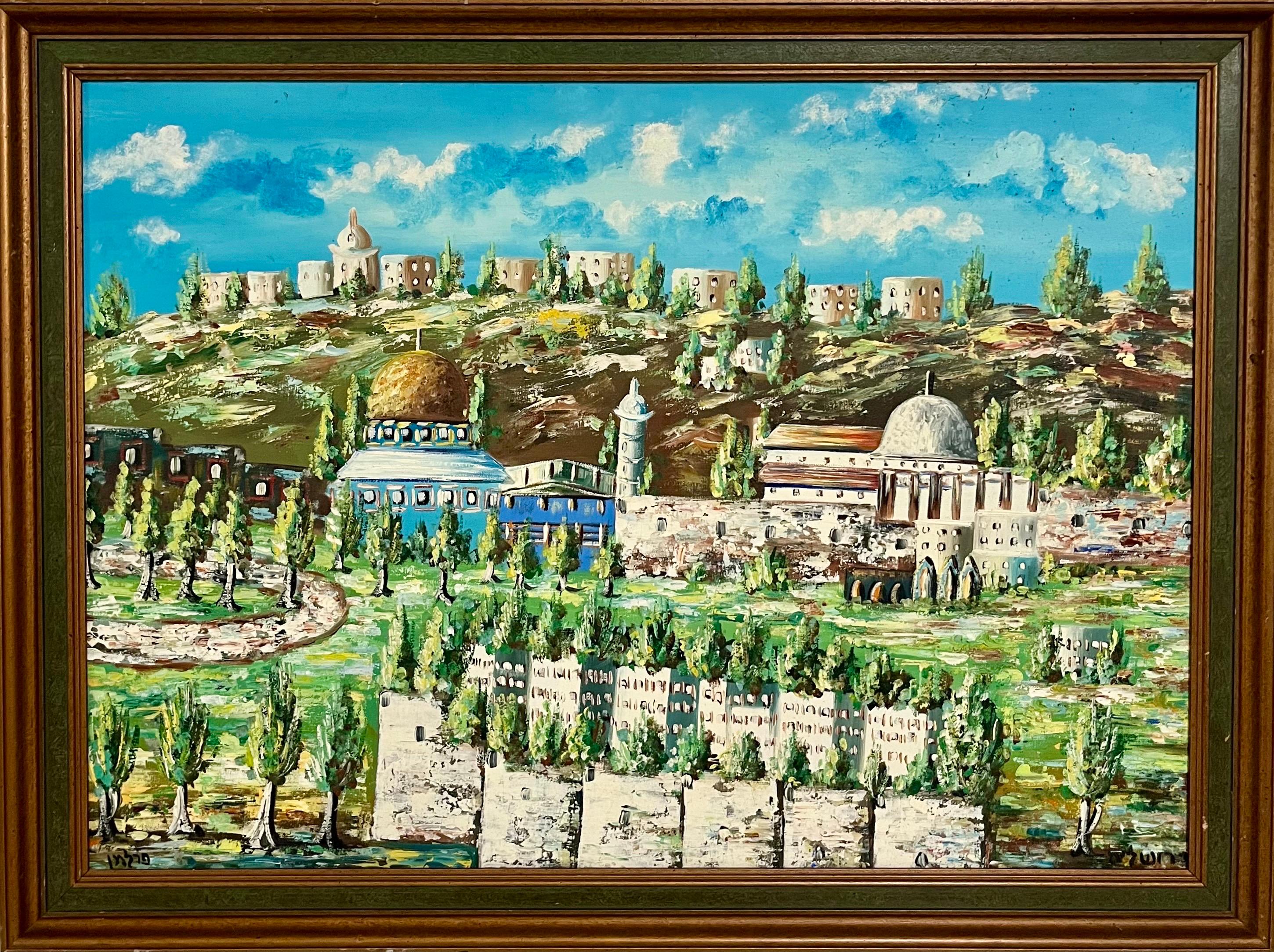
Rare Israeli Naive Art Oil Painting Jerusalem Israel Old City Landscape Folk Art

Rare Israeli Naive Art Oil Painting Jerusalem Israel Old City Landscape Folk Art

Located in Surfside, FL

JERUSALEM, Vielle du David, (City of David) Oil painting on canvas Hand signed in Hebrew (Perlman, Pearlman or Perelman. There are numerous artists with this name. we are unsure wh...

Category

20th Century Folk Art Landscape Paintings

Materials

Canvas, Oil

Mod 1970's Israeli Judaica Folk Art Jerusalem View Enamel on Copper Painting

Mod 1970's Israeli Judaica Folk Art Jerusalem View Enamel on Copper Painting

Located in Surfside, FL

This is a masterfully executed wall hanging enamel on copper painting of Jerusalem. it is signed in Hebrew. Israel has had a Vibrant Folk Art, Naive art scene for a long time now art...

Category

20th Century Folk Art Landscape Paintings

Materials

Copper, Enamel

Whimsical French Folk Art, Naive, Oil Painting  Madeline Marie Christine Clavier

Whimsical French Folk Art, Naive, Oil Painting Madeline Marie Christine Clavier

By Madeline Christine Clavier

Located in Surfside, FL

MADELINE CHRISTINE CLAVIER (1913-2015) Signature: Signed lower right & titled verso Medium: Oil on canvas Provenance: The collection of the artist's family Marie Christine Clavier was born in Saigon, Vietnam in 1913 to French parents and lived there for her formative years. She returned to France as a teenager and began to study painting. Her work quickly developed into whimsical paintings of poetry and songs – harmonized in a unique and distinct painting technique. Her work has an impasto feel and a folk art, outsider artist sensibility to it. Similar in style to Maik and other fantasy realists who use animals, flowers and foliage in their artworks. Marie Clavier painted ro herself rather than for profit as she was quite independently wealthy. She exhibited extensively in the United States in the 1970s especially across Connecticut and New York, showing at various galleries and cultural centres. She had numerous solo exhibitions in the 1970’s- notably at the Maison Francaise in New York and New York University. She showed at Galerie Bernheim Jeune in Paris. She won many awards for her work including Gold Medals and Palme D’Or medals. In 1988 the prestigious art publisher Leopard D’Or produced catalogue book on her life and work – by this point she had virtually given up painting. She died in 2015 aged 102. Bernheim-Jeune gallery is one of the oldest art galleries in Paris. Opened on Rue Laffitte in 1863 by Alexandre Bernheim (1839-1915), friend of Delacroix, Corot and Courbet, it changed location a few times before settling on Avenue Matignon. The gallery promoted realists, Barbizon school paintings and, in 1874, the first impressionist and later post-impressionist painters. It closed in 2019. In 1901, Alexandre Bernheim, with his sons, Josse (1870-1941), and Gaston (1870-1953), organized the first important exhibition of Vincent van Gogh paintings in Paris with the help of art critic Julien Leclercq. In 1906, Bernheim-Jeune frères started presenting works by Pierre Bonnard, Edouard Vuillard, Paul Cezanne, Henri-Edmond Cross, Kees van Dongen, Henri Matisse, Le Douanier Rousseau, Raoul Dufy, Maurice de Vlaminck, Amedeo Modigliani, Maurice Utrillo and Georges Dufrenoy. From 1906 to 1925, art critic Félix Fénéon was the director of the gallery and was instrumental in bringing in the art of Georges Seurat and Umberto Boccioni. In 1922, an exhibition brought together works by Alice Halicka, Auguste Herbin, Pierre Hodé, Moise Kisling, Marie Laurencin, Henri Lebasque, Fernand Leger and Henri Matisse. The gallery now exhibits painters and sculptors in the tradition of the École de Paris and artists such as Jean Carzou, Shelomo Selinger or Pollès. Her style is a recognizable, cheerful, whimsical and a happy creation. Naïve art is any form of visual art that is created by a person who lacks the formal education and training that a professional artist undergoes (in anatomy, art history, technique, perspective, ways of seeing). Unlike folk art, naïve art does not necessarily evince a distinct cultural context or tradition. Naïve art is recognized, and often imitated, for its childlike simplicity and frankness. Paintings of this kind typically have a flat rendering style with a rudimentary expression of perspective. One particularly influential painter of "naïve art" was Henri Rousseau (1844–1910), a French Post-Impressionist who was discovered by Pablo Picasso. Naïve art is often seen as outsider art that is by someone without formal (or little) training or degree. While this was true before the twentieth century, there are now academies for naïve art. Naïve art is now a fully recognized art genre, represented in art galleries worldwide. Museums devoted to naïve art now exist in Kecskemét, Hungary; Riga, Latvia; Jaen, Spain; Rio de Janeiro, Brasil; Vicq France and Paris. Another term related to (but not completely synonymous with) naïve art is folk art. There also exist the terms "naïvism" and "primitivism" which are usually applied to professional painters working in the style of naïve art (like Paul Gauguin, Mikhail Larionov, Paul Klee). At all events, naive art can be regarded as having occupied an "official" position in the annals of twentieth-century art since - at the very latest - the publication of the Der Blaue Reiter, an almanac in 1912. Wassily Kandinsky and Franz Marc, who brought out the almanac, presented 6 reproductions of paintings by le Douanier' Rousseau (Henri Rousseau), comparing them with other pictorial examples. However, most experts agree that the year that naive art was "discovered" was 1885, when the painter Paul Signac became aware of the talents of Henri Rousseau and set about organizing exhibitions of his work in a number of prestigious galleries. The Earth Group (Grupa Zemlja) were Croatian artists, architects and intellectuals active in Zagreb from 1929 to 1935. The group included the painters Krsto Hegedušić, Edo Kovačević, Omer Mujadžić, Kamilo Ružička, Ivan Tabaković, and Oton Postružnik, the sculptors Antun Augustinčić, Frano Kršinić, and the architect Drago Ibler. A term applied to Yugoslav (Croatian) naive painters working in or around the village of Hlebine, near the Hungarian border, from about 1930. Some of the best known naive artists are Dragan Gaži, Ivan Generalić, Josip Generalić, Krsto Hegedušić, Mijo Kovačić, Ivan Lacković-Croata, Franjo Mraz, Ivan Večenaj and Mirko Virius. Camille Bombois (1883–1970) Ferdinand Cheval, known as 'le facteur Cheval' (1836–1924) Henry Darger (1892–1973) L. S. Lowry (1887–1976) Grandma Moses, Anna Mary Robertson...

Category

20th Century Folk Art Animal Paintings
Materials

Canvas, Oil

You May Also Like

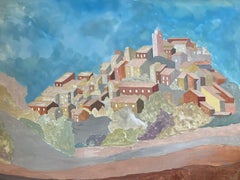
Bernard Labbe French Modernist Cubist Village Landscape Gouache Painting

Bernard Labbe French Modernist Cubist Village Landscape Gouache Painting

By Bernard Labbe

Located in Cirencester, Gloucestershire

Title Bernard Labbe French Modernist Cubist Village Landscape Gouache Painting Key Details Artist: Bernard Labbe, French, mid 20th century Title: French Landscape Medium: Original wa...

Category

Mid-20th Century Modern Landscape Paintings

Materials

Watercolor, Gouache

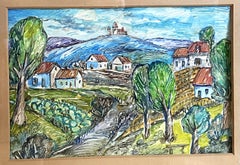
"Vibrant Landscape with Village"

"Vibrant Landscape with Village"

Located in Edinburgh, GB

Franz von Zülow (1883–1963) – Vibrant Landscape with Village Medium: Mixed media on paper (likely gouache or watercolor with ink) Dimensions: Framed: 41 x 53 cm Flat: 30 x 45 cm Si...

Category

19th Century Realist Landscape Paintings

Materials

Oil, Board

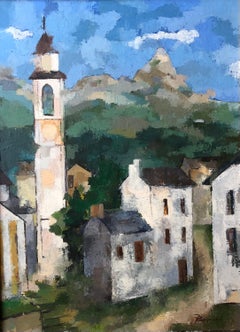
Charming village scene painting in a style reminiscing to Cezanne

Charming village scene painting in a style reminiscing to Cezanne

Located in San Francisco, CA

Charming village scene painting in a style reminiscing to Cezanne Signed "MADO" lower right Oil on canvas 18 x 21 unframed, 23 x 26 framed

Category

19th Century Landscape Paintings

Materials

Canvas, Oil