Want more images or videos?
Request additional images or videos from the seller
1 of 10

Tosa Mitsuyoshi
Japanese Artisans - Silk Dying -Japanese Woodblock Print

Circa 1920s

$1,085
$1,55030% Off
£817.12
£1,167.3230% Off
€954.74
€1,363.9230% Off
CA$1,537.26
CA$2,196.0930% Off
A$1,544.09
A$2,205.8430% Off
CHF 895.31
CHF 1,279.0130% Off
MX$18,839.49
MX$26,913.5630% Off
NOK 10,361.25
NOK 14,801.7930% Off
SEK 10,631.19
SEK 15,187.4130% Off
DKK 7,137.10
DKK 10,195.8630% Off

About the Item

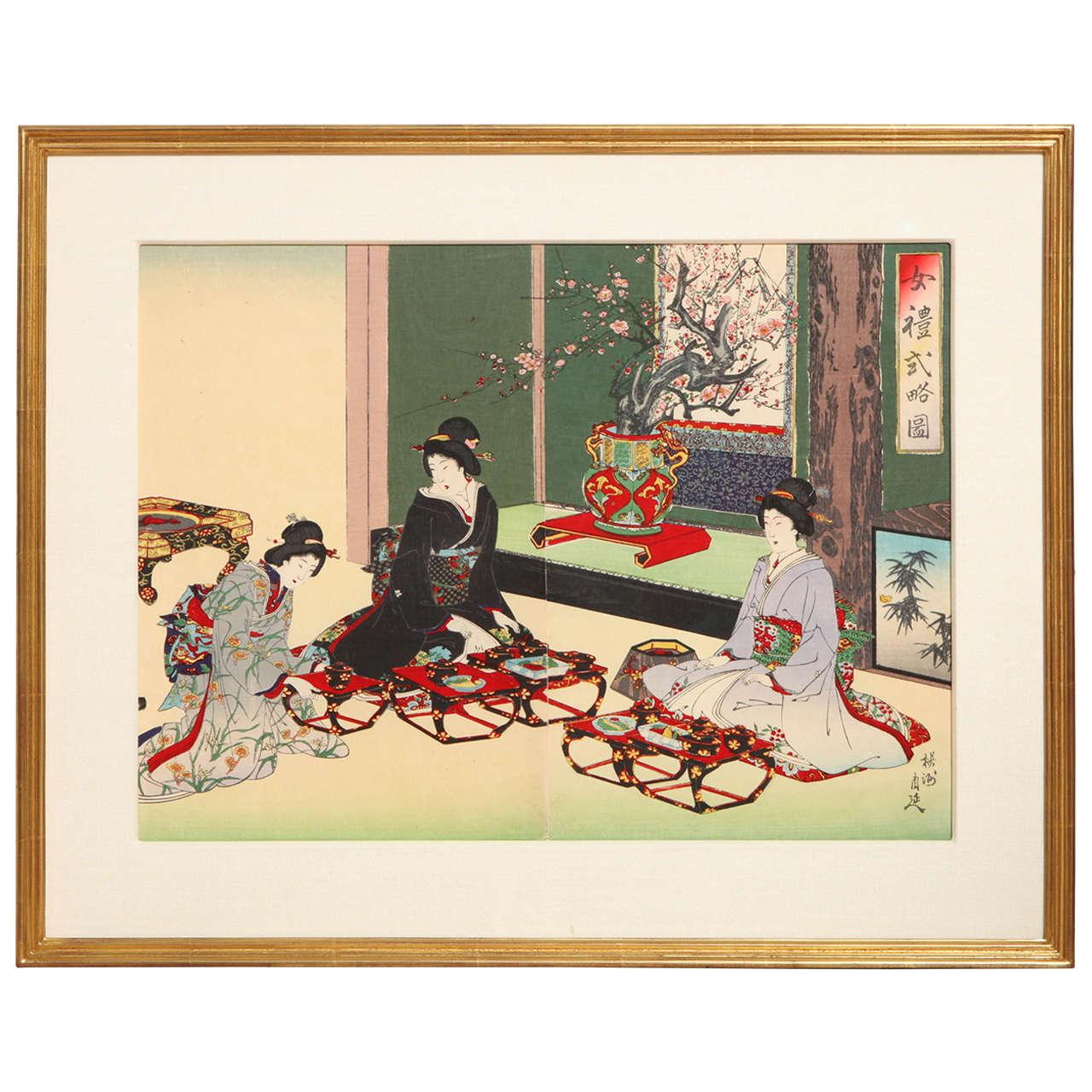
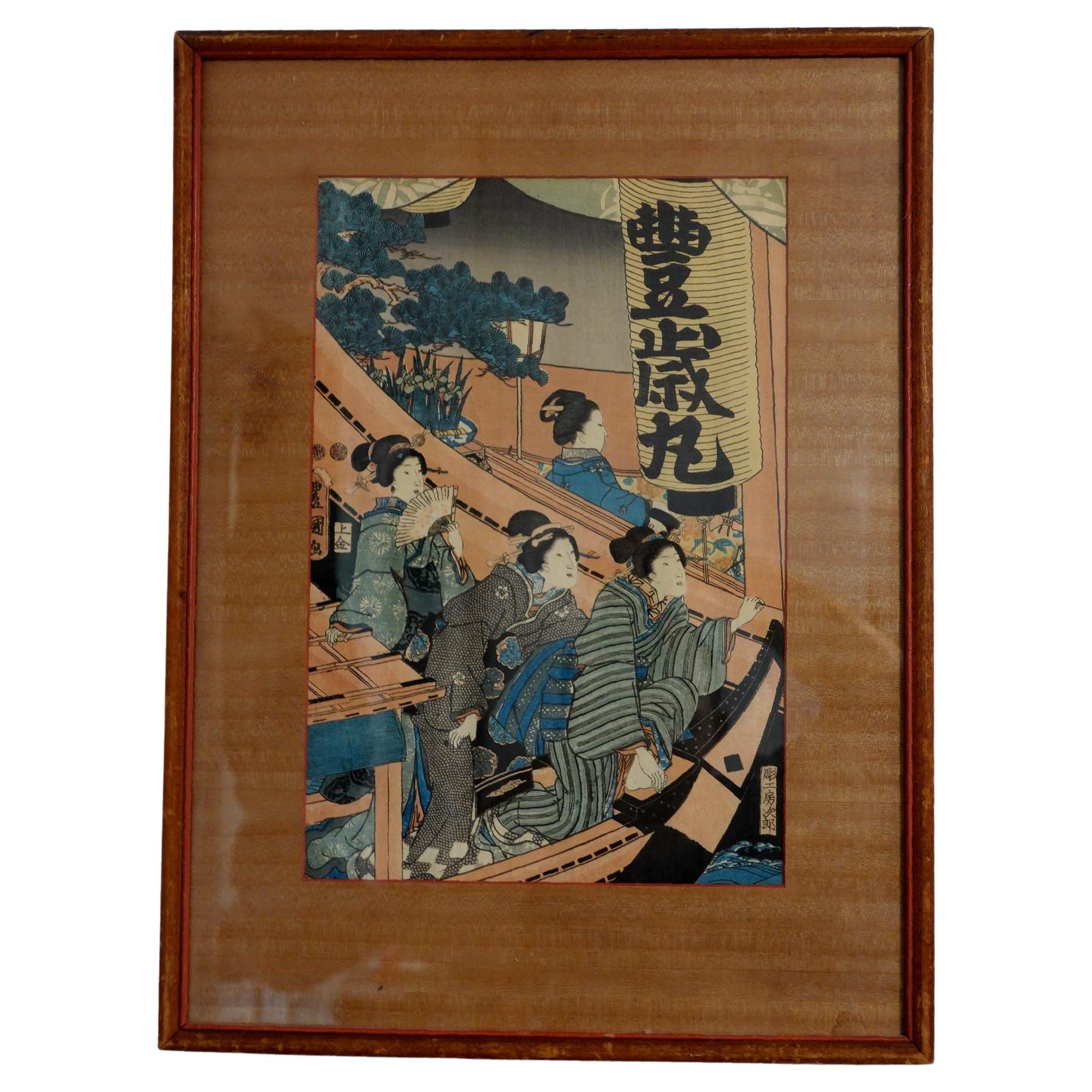
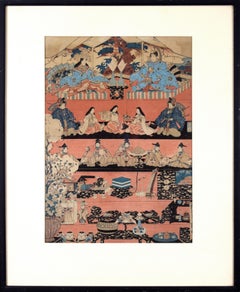
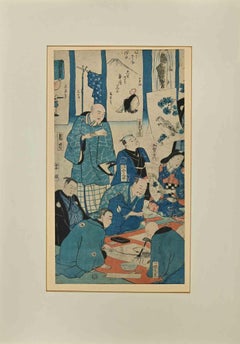
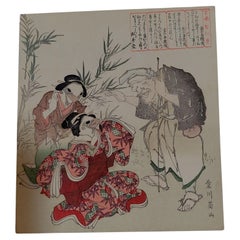
Japanese Artisans - Japanese Woodblock Print J Japanese woodblock depicting six women, all wearing vibrant kimonos, working on crafts by Tosa Mitsuoki (Japanese, 1617-1691). Japanese,c. 1600. Handcraft depiction (dye works).Section from a painted screen with presentations of handcraft.Kita-in, Saitama. Stamped lower left. Presented in a white mat and giltwood frame. Frame: 19"H x 14"W Mat: 18.25"H x 13.25"W Image: 14.5"H x 9.5"W Tosa Mitsuoki was a Japanese painter, reinvigorating the Yamato style of classical Japanese painting. Yamato-e originated from interest in reproducing early Tang dynasty paintings, and was later reinvented and further refined to fit Japanese cultural perceptions in the late Heian period. Yamato, sometimes referred to as wa or kazu had become synonymous with the Tosa-ha by the Muromachi period as a way for Japanese artist to distinguish their works from those of mainland Chinese paintings, kara-e. Yamato-e incorporated various visual and literary techniques for establishing narrative. Works were not always accompanied with text and may rely on heavily on period specific visual motifs, icons, and symbols to relay a story or theme. Tosa style by the time of Mitsuoki focused heavily on depicting themes of plants and nature, famous places, meisho, the four seasons, shik, bird-and-flower, kacho. Many of these popular symbols and icons from mimicking Chinese practices, treating the original Chinese masterwork as a sort of prototype to improve upon. Popular formats for Mitsuoki's pictures were wall scrolls kakemono, or handscrolls that would be read from right to left with the accompanied story, sliding doors fusuma and folding screen panels byobu that featured up to six panels. Mitsuoki's style incorporated the depth and calligraphy techniques of ink wash brushwork similar to Song dynasty and Yuan dynasty Chinese court paintings, used cartoon-like sketch linework, innovation of historical designs, and excellent execution of decorative elements.
  • Creator:
    Tosa Mitsuyoshi
  • Creation Year:
    Circa 1920s
  • Dimensions:
    Height: 19 in (48.26 cm)Width: 14 in (35.56 cm)Depth: 0.5 in (1.27 cm)
  • Medium:
  • Movement & Style:
  • Period:
  • Condition:
    Good condition. Some normal age toning to paper.
  • Gallery Location:
    Soquel, CA
  • Reference Number:
    Seller: N76081stDibs: LU54213870612

More From This Seller

View All
"Various Himochi" Wagashi Festival Japanese Woodblock Print by Utagawa Toyokuni

"Various Himochi" Wagashi Festival Japanese Woodblock Print by Utagawa Toyokuni

By Utagawa Toyokuni

Located in Soquel, CA

"Various Himochi" Wagashi Festival Japanese Woodblock Print by Utagawa Toyokuni Rare oversized early 19th century 5-tiered woodblock by Utagawa Ichiyosai Toyokuni, (Japan, 1769-1825), a Japanese lord and wife oversee a sekku festival of food, music, and dolls or toys. '"oshi" is the first day of “Mi (Snake)” in the third month of the lunar calendar. This day, known in modern Japan as the Girls' Festival, originated in China as a form of purification ceremony in which water and drinking peach blossom wine were used to drive away evil. Many kinds of hishi-mochi appear in this picture of hina ningyo (dolls associated with Hinamatsuri, or the Girl’s Day) from Omochae. The custom of eating special dishes at events throughout the year and at milestones in people's lives has existed since ancient times. This paragraph specifically focuses on the annual event called sekku, and life events that involve eating sweets. Joshi is the first day of “Mi (Snake)” in the third month of the lunar calendar. This day, known in modern Japan as the Girls' Festival, originated in China as a form of purification ceremony in which water and drinking peach blossom wine were used to drive away evil. According to the Keiso saijiki, in ancient China, on the third day of the third lunar month, people ate “ryuzetsuhan,” which is the juice of gogyo (Jersey cudweed) mixed with rice flour and nectar. In Japan, there is a record in the Heian period history book Nihon Montoku tenno jitsuroku [839-5] that it was an annual event to make kusamochi using gogyo on the third day of the third month of the lunar calendar, which may have been influenced by Chinese customs. The tradition of eating kusamochi on the third day of the third month of the lunar calendar continued after that. By the Edo period, however, hishimochi had come to be used as a sweet to serve on the third day of the third month. A picture of a hishimochi is included in the Morisada manko , which we mentioned in Part 1. According to it, hishimochi in the Edo period were often three layers of green-white-green instead of the now common red-white-green. However, it is possible to see from our collection that not all hishimochi were made in this way. Omochae published in 1857, is a good example. Omochae is a type of ukiyoe print...

Category

1820s Edo Figurative Prints

Materials

Ink, Rice Paper, Woodcut
"Enshoku Sanju-roku Kasen" (Thirty-six Enchanting Flowers) Woodblock on paper

"Enshoku Sanju-roku Kasen" (Thirty-six Enchanting Flowers) Woodblock on paper

By Toyohara Kunichika

Located in Soquel, CA

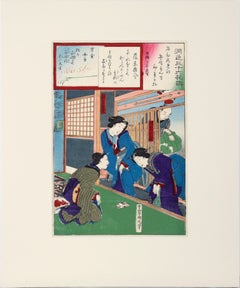
"Enshoku Sanju-roku Kasen" (Thirty-six Enchanting Flowers) Woodblock on paper Elegant woodblock print by Toyohara Kunuchika (Japanese, 1835-1900). Three women are in talking with each other inside, while a man waits outside holding a bag of some kind. The colors in this piece are rich and saturated, primarily blues, greens, and purple. Mat size: 16"H x 20"W Paper size: 14.75"H x 9.88"W Born in 1835, Toyohara Kunichika grew up in the Kyobashi district of Edo in the midst of merchants and artisans. In 1848, at age 13, he was accepted as an apprentice into the studio of Utagawa Kunisada I...

Category

1880s Edo Figurative Prints

Materials

Ink, Rice Paper, Woodcut
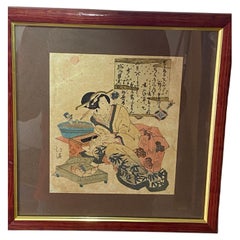
Japanese Original Woodblock Print

Japanese Original Woodblock Print

By Suzuki Harunobu

Located in Soquel, CA

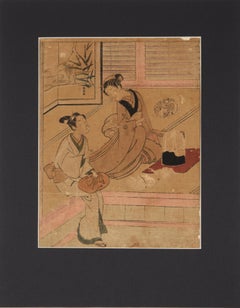
Japanese Original Woodblock Print Harunobu Suzuki (né Hozumi) (Japanese, 1724 - 1770) Presented in a black mat. Mat: 16"H x 12"W Paper: 12"H x 9"W I...

Category

18th Century Edo Figurative Prints

Materials

Ink, Rice Paper, Woodcut
You May Also Like

Mid-19th Century Japanese Style Woodcut Print Drawing Lesson, Unframed

Mid-19th Century Japanese Style Woodcut Print Drawing Lesson, Unframed

Located in Roma, IT

Drawing Lesson is a Woodcut print on paper realized by an unknown japanese master in the mid-19th century. Included a Passepartout: 51 x 36 cm Good conditions. The artwork represe...

Category

Mid-19th Century Modern Figurative Prints

Materials

Woodcut

Japanese Woodblock Print by Eizan Kikugawa, 菊川英山

Japanese Woodblock Print by Eizan Kikugawa, 菊川英山

Located in Norton, MA

Japanese Woodblock Print by Eizan Kikugawa,???? (1787~1867) ABOUT THE ARTIST A native of Edo, Eizan Kikugawa was born as Toshinobu Omiya in 1787. He began his artistic career s...

Category

Antique Early 19th Century Japanese Prints

Materials

Paper

Japanese Woodblock Print by Utagawa Yoshiika 落合芳幾  '1833-1904'

Japanese Woodblock Print by Utagawa Yoshiika 落合芳幾 '1833-1904'

Located in Norton, MA

Japanese woodblock print by Utagawa Yoshiika 落合芳幾 (1833-1904), unframed. About the artist Yoshiiku was a popular ukiyo-e printmaker during the Meiji period. It is thought that he was the son of a tea house proprietor, hence his particular skill success in the portrayal of various beauties from teahouses and restaurants. Yet, he was an artist comfortable across subject matter and is recognized for his fierce portrayal of famous historical warriors. Yoshiiku was a student of Kuniyoshi and a contemporary rival of the famed Yoshitoshi. He signed his name Utagawa Yoshiiku...

Category

Antique Mid-19th Century Japanese Prints

Materials

Paper

Japanese Painting, 17th Century, Tale of Genji, Tosa School

Japanese Painting, 17th Century, Tale of Genji, Tosa School

Located in Kyoto, JP

Illustration to an unidentified chapter of the Tale of Genji (Genji Monogatari) Tosa School (second half of the 17th Century) Ink, pigment, gofun and...

Category

Antique Late 17th Century Japanese Edo Paintings and Screens

Materials

Gold Leaf

Original Japanese Woodblock Print by Totoya Hokkei 19th Century

Original Japanese Woodblock Print by Totoya Hokkei 19th Century

By Totoya Hokkei

Located in Auribeau sur Siagne, FR

Rare, original Utagawa Hiroshige 19th century woodblock print. Beautiful Edo period print from the original publisher. Museum quality framed with con...

Category

Antique 19th Century Japanese Chinese Export Prints

Materials

Paper