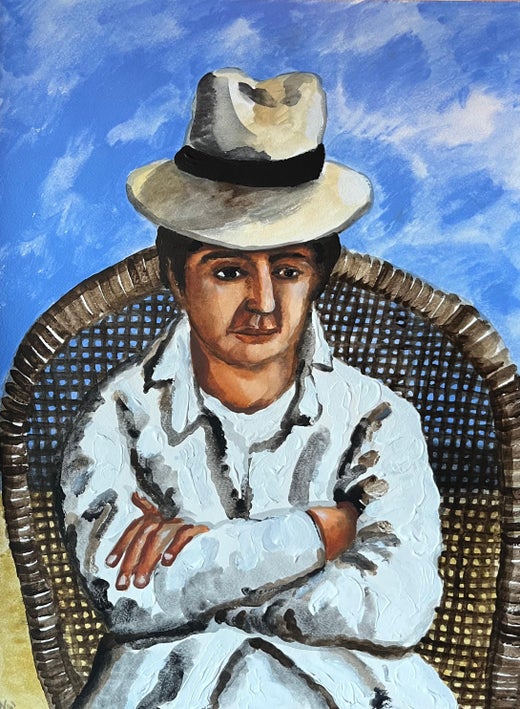
Born in Moscow in 1944 in a family of architects. In 1962-1968, she studied at the Moscow State Art Institute named after V.I. Surikov with the famous painter, professor Dmitry Zhilinsky. Natalia Nesterova remained one of the most recognized seventies masters. The Fatherland did not deprive her of her awards and titles: State Prize, Triumph Prize, the title of Honored Artist of the Russian Federation, the title of academician and the Honorary Gold Medal of the Academy of Arts. Since 1991 she is a professor of painting at the Russian Academy of Arts. Since 1988, the artist has mostly lived in the United States. She has participated in over sixty individual and group exhibitions at home and abroad. Her paintings are stored in major collections: in the State Tretyakov Gallery, the State Russian Museum, the Museum of Oriental Art, the Cosmonautics Museum, the Pleiades Museum, in the collection of Art Modern galleries, the Moscow Palette, MARS (Moscow), in 39 museums of the CIS countries, as well as the Solomon R. Guggenheim Museum (New York), Art Museum (Warsaw), collection of Peter Ludwig (Cologne, Aachen), Art Museum (Seoul), Museum of Fine Arts in Montreal, Art Museum (Poznan), Oklahoma Museum, Hal Brom Gallery, Art Museum (Tallinn ), Maya Paul Gallery Lsky (Chicago), private collections in the USA, Europe, America, Asia, Estonia. Her paintings can be described as genre, filled with satirical pathos. Favorite subjects - festive and idle celebrations, pesky rest on the seashore, aimless walks around the city, endless playing cards, many hours of sitting in a cafe. The faces on her canvases often look like masks, the figures froze in artificial mannequin poses, and things in ridiculous positions. Recognizable and topographically authentic city landscapes turn into a fake space, where mise-en-scenes from the theater of the absurdity are played out with false ambiguity. The anti-heroes of Nesterov’s canvases languish with boredom, loneliness and the meaninglessness of their existence, they are empty and hectic. These are the inhabitants of the last Soviet period.