Want more images or videos?
Request additional images or videos from the seller
1 of 14

Carle van Loo
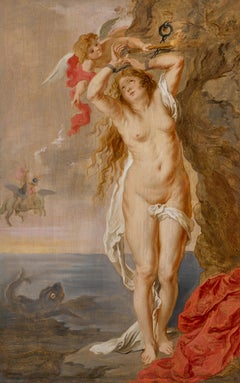
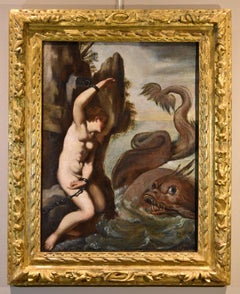
Perseus and Andromeda Oil Painting on Canvas, Old Masters, Circa 1726

circa 1725

$64,058.36
$80,00023% Off
£47,348.93
£60,301.5023% Off
€57,270.68VAT Included
€70,530.3123% Off
CA$88,890.58
CA$113,232.2423% Off
A$90,490.70
A$115,286.8523% Off
CHF 52,112.24
CHF 66,394.8223% Off
MX$1,090,497.47
MX$1,389,117.6023% Off
NOK 604,877.46
NOK 770,516.1623% Off
SEK 610,283.98
SEK 777,403.2023% Off
DKK 413,855.43
DKK 527,184.9623% Off

About the Item

Carle Vanloo (Nice 1705 – Paris 1765) Perseus and Andromeda Oil on canvas. H. 081; W. 065. Alongside François Boucher (1703-1770) and Charles-Joseph Natoire (1700-1777), Carle Vanloo (Nice 1705 – Paris 1765) is today recognized as one of the three principal French history painters of the so-called "1700 generation." Carle Vanloo's production is well-documented from the time of his reception at the Royal Academy of Painting and Sculpture in 1734 (Apollo Flaying Marsyas, Paris, École Nationale Supérieure des Beaux-arts) until his appointment as director of the institution in 1765. Consequently, his works have always been easily attributed to him. The early years, during which the artist began to paint, are more complex to identify, and this is precisely the period to which our painting belongs (fig. 2). Since Carle Vanloo was a student in Turin and then in Rome under his brother Jean-Baptiste (1684-1745), who was about twenty years his senior, it was predictable that multiple connections would be perceptible between their respective productions. This is most apparent between Carle Vanloo's return to Paris in 1723 and his new departure for Italy in 1727 (after winning the "Grand Prize" of the Royal Academy). The history of the commission for the large Presentation in the Temple intended for the Saint-Martin-des-Champs church in Paris in 1725 perfectly illustrates this. Signed and dated Carle Vanloo, the canvas is now kept in the Primatial Saint-Jean of Lyon, but the preparatory sketch preserved at the Museum of Fine Arts of Lyon is actually attributed to Jean-Baptiste Vanloo (and not to Carle Vanloo as long suspected by Daniel Ternois). Beyond these collaborative relationships, the styles of the two brothers during this period show strong affinities. A good example is Diana and Endymion, announced under the name of Jean-Baptiste Vanloo (fig. 1) in the Paris art market several years ago (sale Paris, Hôtel Drouot, Me Couturier Nicolay, December 10, 1999. Oil on canvas. H. 081; W. 073). The reception piece of the latter with the same subject, showing Endymion in a similar pose, was misleading. It was actually an early work of Carle Vanloo, probably painted around 1726: the formal simplification and certain techniques, such as the phenomenon of illumination of Diana's forehead, are typical of Carle Vanloo at this period of his life. Carle Vanloo is known for illustrating the subject of Perseus and Andromeda around 1737; it is the famous painting kept at the Hermitage Museum in Saint Petersburg (oil on canvas. H. 072; W. 091; ГЭ 1230). Our painting, however, appears to be his first vision of the subject, more precisely around 1726, exactly at the time of the just mentioned Diana and Endymion. The same sobriety of composition is noted: in the foreground, Andromeda appears tied to the rocks, with the aerial silhouette of Perseus emerging to kill the sea monster. In the distance, King Cepheus, father of Andromeda, and the Ethiopians witness the miracle. The detail noted about Diana is observed again: Andromeda's forehead and the upper part of her head are so illuminated that they become almost optically blurred. Typical of Carle Vanloo's writing at this time are the faces that evade the viewer's gaze. Dating from 1727, Aeneas Fleeing Troy (Louvre) illustrates this perfectly, with the face of the Trojan hero barely visible. The same can be said here, with Perseus' face almost disappearing behind his helmet. The manner of treating the drapery is another distinctive element of Carle Vanloo's style in the mid-1720s. The drapery covering Andromeda forms a simplified design, almost in a diamond shape. This strange way of depicting drapery can be seen in other paintings of the same period, starting with those mentioned below. Indeed, it is worth questioning whether our painting is part of a cycle by the same author on the subject of The Loves of the Gods. Is it merely a coincidence that Carle Vanloo's Diana and Endymion, which again illustrates Ovid's Metamorphoses, dates from the same period and has almost the same dimensions as Perseus and Andromeda? The same question affects Mars and Venus, a painting by Carle Vanloo kept at the Fine Arts Museum of Houston (TX, U.S.A.; oil on canvas. H. 081; W. 066; BF. 1978.24; fig. 3). The museum dates this painting to around 1726 and the dimensions are again similar. A fourth painting is very likely part of the same series: Eros and Psyche by Carle Vanloo (oil on canvas. H. 081; W. 065; fig. 4), currently visible at the Galerie Marty de Cambiaire (Paris). Carle Vanloo was aware of the famous mythological series that his rival François Lemoyne (1688-1737) was painting for his patron François Berger (the canvases are shared between the Museum of Fine Arts of Tours, the Wallace Collection in London, and other museums). Lemoyne had just depicted Perseus and Andromeda (the Wallace Collection canvas in London is dated 1723). Undoubtedly painted for a private collector, Carle Vanloo's mythological cycle on his first return from Italy deserves our attention all the more as it would have been a "response" to François Lemoyne's work. It appears especially as Carle Vanloo's first attempt to establish himself on the Parisian art scene in the field of mythology. Fr. Marandet London, July 8, 2024.
  • Creator:
    Carle van Loo (1705 - 1765, French)
  • Creation Year:
    circa 1725
  • Dimensions:
    Height: 31.89 in (81 cm)Width: 25.6 in (65 cm)
  • Medium:
  • Movement & Style:
  • Period:
    1720-1729
  • Condition:
  • Gallery Location:
    Paris, FR
  • Reference Number:
    1stDibs: LU2258215475662

More From This Seller

View All
Perseus and Andromeda Oil on Panel, Old Masters Style, 17th Century

Perseus and Andromeda Oil on Panel, Old Masters Style, 17th Century

By David Teniers the Younger

Located in Paris, Île-de-France

DAVID TENIERS THE YOUNGER (1610–1690) Perseus and Andromeda Oil on panel 42.5 × 26.7 cm (16³⁄₄ × 10¹⁄₂ in.) Unsigned Provenance • Possibly Archduke Leopold Wilhelm of Habsburg (16...

Category

1650s Old Masters Nude Paintings

Materials

Oil, Panel, Wood Panel

French School, Late 18th Century (circa 1775-1795) - Allegory Of Mourning

French School, Late 18th Century (circa 1775-1795) - Allegory Of Mourning

Located in Paris, Île-de-France

French School, late 18th century (circa 1775–1795) Allegory of Mourning (or Fallen Fortune) Pen and brown ink, grey ink, wash, watercolor, and white gouache highlights on laid paper...

Category

Late 18th Century Rococo Portrait Drawings and Watercolors

Materials

Ink, Watercolor, Gouache, Laid Paper

Penitent Saint Mary Magdalene, Oil on Canvas, Circa 1665-1675

Penitent Saint Mary Magdalene, Oil on Canvas, Circa 1665-1675

Located in Paris, Île-de-France

Nicolas LOIR (Paris, 1624 – 1679) Penitent Saint Mary Magdalene Oil on canvas, 58 x 71 cm Unsigned Circa 1665–1675 Trained under Simon Vouet and later Sébastien Bourdon, Nicolas ...

Category

17th Century Old Masters Figurative Paintings

Materials

Canvas, Oil

Hercules vanquishing a drakaina (half‑woman, half‑serpent)

Hercules vanquishing a drakaina (half‑woman, half‑serpent)

By Giovanni Domenico Tiepolo

Located in Paris, Île-de-France

Circle of Giovanni Domenico Tiepolo (Venice 1727 – Madrid 1804) Hercules vanquishing a drakaina (half‑woman, half‑serpent) – interpreted either as Echidna or a personified Hydra c. ...

Category

18th Century Old Masters Figurative Drawings and Watercolors

Materials

Ink

Reclining female nude with her legs out and looking up to the right

Reclining female nude with her legs out and looking up to the right

Located in Paris, Île-de-France

Pierre-Charles Le Mettay (1726-1759) Reclining female nude with her legs out and looking up to the right Black chalk with stumping, heightened with white, on blue paper 25.5 x 36.5 ...

Category

Early 18th Century Old Masters Nude Drawings and Watercolors

Materials

Chalk

You May Also Like

Perseus Andromeda Van Thulden Paint 17th Century Oil on canvas on table Flemish

Perseus Andromeda Van Thulden Paint 17th Century Oil on canvas on table Flemish

Located in Riva del Garda, IT

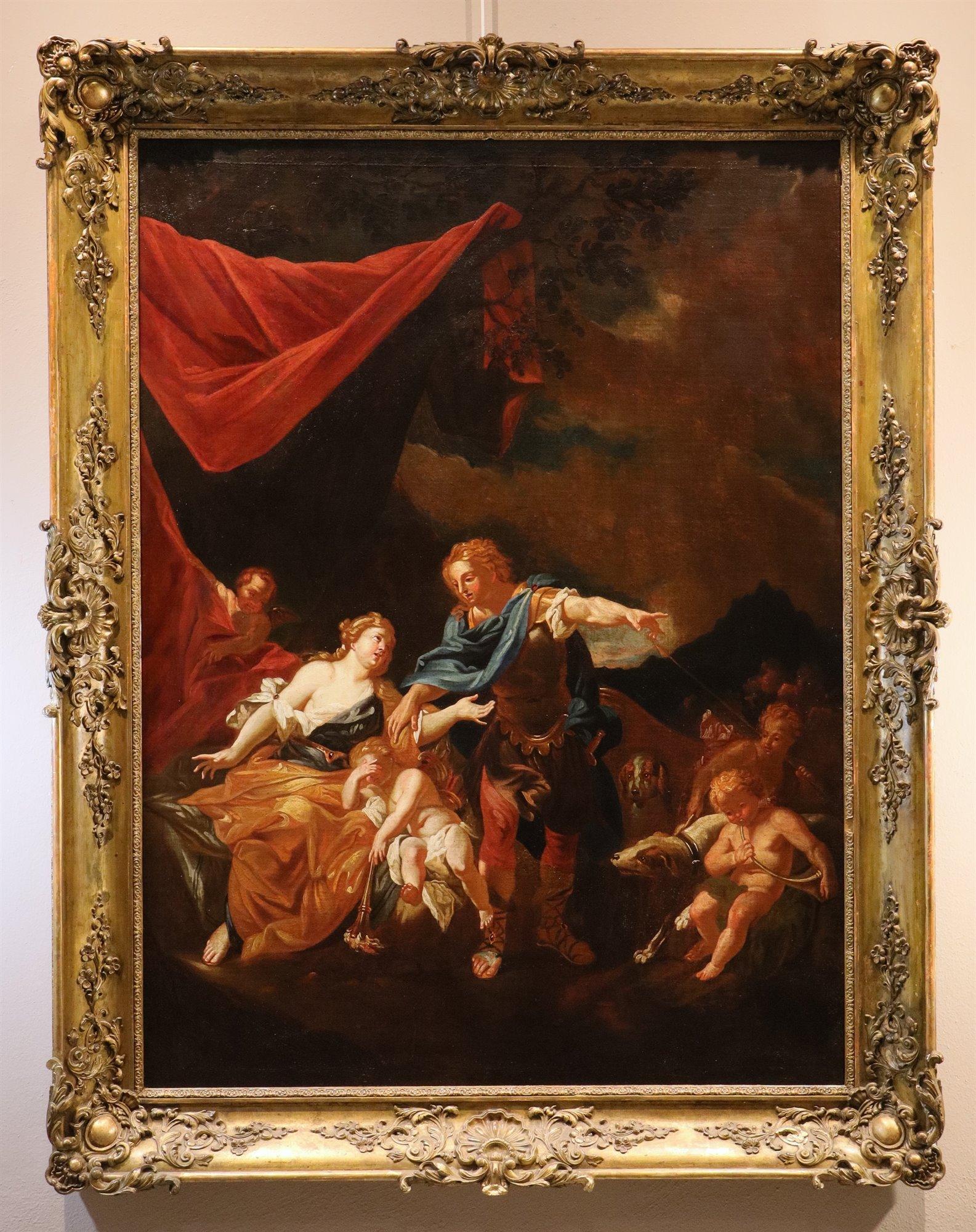
A follower of Peter Paul Rubens (Siegen 1577 – Antwerp 1640) Attributed to Theodoor van Thulden (Bois-Le-Duc, 1606 – 1669) Perseus Frees Andromeda oil on canvas, mounted on panel? 82 x 67 cm. - with frame 98 x 83 cm. The subject of the painting, derived from Ovid’s Metamorphoses (Book IV, lines 663–752), is inspired by the myth of Princess Andromeda, daughter of King Cepheus of Ethiopia and Queen Cassiopeia, depicted here as she is freed by the Greek hero Perseus after he has defeated the sea monster that held her captive. This cruel punishment had been imposed on her by Poseidon, god of the seas, to atone for the arrogance of her mother Cassiopeia, who had dared to compare herself and her daughter to the Nereids in beauty. When Perseus returned home on his winged horse Pegasus after his victory over the fearsome Medusa, he saw the princess chained to a rock on the coast and, overwhelmed by her beauty, decided to save her. The hero, clad in gleaming armour and wearing the red cloak of the victor and a crested helmet, is flanked by two small cherubs, one of whom helps him to break the chains binding Andromeda to the rock, emphasising the theme of love triumphing over danger. This is a smaller version derived from the famous ‘Perseus Frees Andromeda’ painted by Peter Paul Rubens around 1620, now housed in the Gemäldegalerie in Berlin, from which the main scene on the right has been taken. Rubens, who often employed sophisticated references to antiquity to emphasise the message of his paintings, modelled the figure of Andromeda and the cherub at her side, intent on loosening her chains, on the statue of the Happy Venus (Rome, Vatican Collections, which he saw during his stay in Rome. The success of Rubens’s work led to its widespread circulation and a substantial number of copies produced by his workshop (in Vienna at the Liechtenstein Gallery, in Potsdam at the Sanssouci Gallery, the Museum of Arles, and the Museum of Lisbon). It is our opinion that the authorship of the finely executed painting presented here is to be attributed to a Flemish artist active around the second half of the 17th century amongst Rubens’s followers...

Category

17th Century Old Masters Figurative Paintings
Materials

Oil

Hercules and Omphale - Oil Painting on Canvas - 18th Century

Hercules and Omphale - Oil Painting on Canvas - 18th Century

Located in Roma, IT

Hercules and Omphale is an original painting realized in France between the end of the 18th and the beginning of the 19th Century. Original oil painting on canvas. Dimensions: 73 x...

Category

Late 18th Century Modern Figurative Paintings

Materials

Canvas, Oil

Hercules and Omphale, Old Master Painting, Mannerism, Baroque, Mythology, Prague

Hercules and Omphale, Old Master Painting, Mannerism, Baroque, Mythology, Prague

Located in Greven, DE

Hercules and Omphale Oil on panel, 52 x 41 cm According to legend, Hercules had to make atonement and became a slave to the Lydian queen Omphale. When she found out who her slave was, she married him. Falling for his mistress and made effeminate by the luxury of court life, the former hero allowed himself to become the laughing stock of the court. He dressed in women's clothes, spun wool and did other women's work, whereas Omphale wore his lion's skin and carried a wooden club. When the time of punishment was over, the hero realised his delusion and left Omphale. So far, the painting could not be clearly assigned to an artist. Nevertheless, it impresses with its fluid and convincing painting, whose colourfulness and conception are reminiscent of the Prague School around Bartholomäus Spranger. This work follows an engraving and an etching made by Michel Dorigny in 1643 after a design by Simon Vouet. It shows the same scene but the print differs in minor details from the present painting (see e.g. the head of the lion) and the treatment of the faces seems to be painted more detailed and refined. So far there is no painting...

Category

17th Century Baroque Figurative Paintings

Materials

Oil, Panel